The clinical benefits of hormone replacement therapy in women have to be carefully balanced against the possible risks, and a particular theoretical concern relates to risks associated with various forms of female oncology. Because of conflicting reports, gynecologists and oncologists especially need a single, authoritative resource of up-to-date information. Hormone Replacement Therapy and Cancer, published in association with the International Menopause Society, provides the very consensus statement that clinicians need in this difficult and complex area.
Many of the world's leading specialists have contributed important chapters that provide state-of-the-art knowledge about the effects of hormones on women and possible cancer risks. The introductory section deals with carcinogenesis, and the other main sections cover HRT and breast cancer, endometrial cancer, colon cancer, melanoma and epithelial ovarian cancer. The concluding chapters discuss the benefits and risks of sp ecific therapies. An authoritative clinical reference with extensive bibliographic references and index, Hormone Replacement Therapy and Cancer covers all aspects of HRT and cancer based on the research available up to June 2001.
eBook - ePub
Hormone Replacement Therapy and Cancer
The Current Status of Research and Practice
- 296 pages
- English
- ePUB (mobile friendly)
- Available on iOS & Android
eBook - ePub
Hormone Replacement Therapy and Cancer
The Current Status of Research and Practice
About this book
Information
Oncogenes and tumor suppressor genes
1
Tumor cells are different from their normal counterparts in many aspects such as growth control, morphology, cell-cell interactions, membrane properties, cytoskeletal structures and gene expression. In normal cells, growth is strictly controlled. A cell will not proliferate if it does not receive signals from the extracellular environment. These signals are mediated by growth factors, most of which are peptides acting in a paracrine manner. Growth factors interact with specific receptors, located on the plasma membrane, which are transmembrane molecules, endowed with tyrosine kinase activity. Upon ligand binding, receptors undergo dimerization, thus moving into close proximity their intracellular portions. This results in a conformational change of the kinase domain, leading to enzyme activation (Figure 1). The receptor thus autophosphorylates on tyrosine residues that become docking sites for intracellular transducers. Many cytoplasmic proteins contain domains (such as SH2 or PTB) able to recognize the phosphorylated tyrosines (Figure 2). These proteins can be either enzymes (such as phospholipase Oγ, tyrosine phosphatases, cytoplasmic tyrosine kinases, etc.) or adaptors (SHC, Gab1, Gab2, GRB2) or transcription factors (STAT family). Upon interaction with the receptor, these proteins become activated and start to transduce cytoplasmic signals. Eventually, the signal is brought to the nucleus where gene transcription is induced. Each of these steps are negatively regulated by growth inhibitory factors, tyrosine phosphatases, inhibitors of cytoplasmic transducers and nuclear proteins that block progression of the cell cycle (Figures 3 and 4).

In normal cells, growth is strictly controlled by a fine balance between promoting and inhibitory factors. In neoplastic cells, this control is lost as a consequence of either an increase of promoting factors or a decrease of inhibitory factors.
Genes encoding proteins that positively regulate growth are called proto-oncogenes, while genes encoding proteins that negatively regulate growth are called tumor suppressor genes. Mutations in these genes, leading to a constitutive activation (in the case of proto-oncogenes) or inactivation (for tumor suppressor genes) are responsible for the acquisition of neoplastic properties.


What mechanisms are responsible for such activation? Conversion, or activation, of a protooncogene into an oncogene generally involves a gain-of-function mutation (Figure 5). At least three mechanisms can produce oncogenes from the corresponding proto-oncogenes:
(1) Point mutations or small deletions in the coding sequence, resulting in a constitutively activated protein;(2) Gene amplification, resulting in overexpression of the normal protein;(3) Chromosomal translocations, bringing the proto-oncogene under the control of an active promoter, causing inappropriate expression of the gene.
In the first case, the encoded oncoprotein differs slightly from the normal product. In the other two cases, the expressed protein is normal but is present in much higher amounts than in normal cells. In all the cases, the gain-of-function mutations converting proto-oncogenes to oncogenes act dominantly. This means that mutation in only one of the alleles is sufficient to induce cancer development.
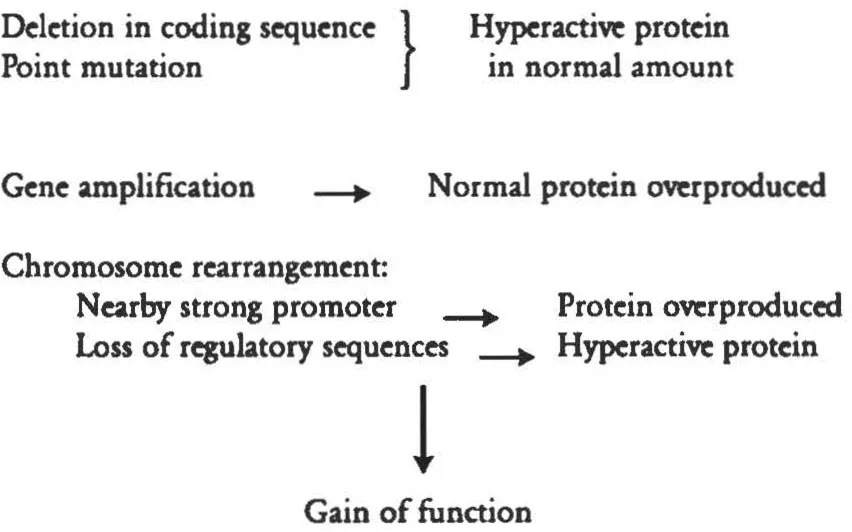
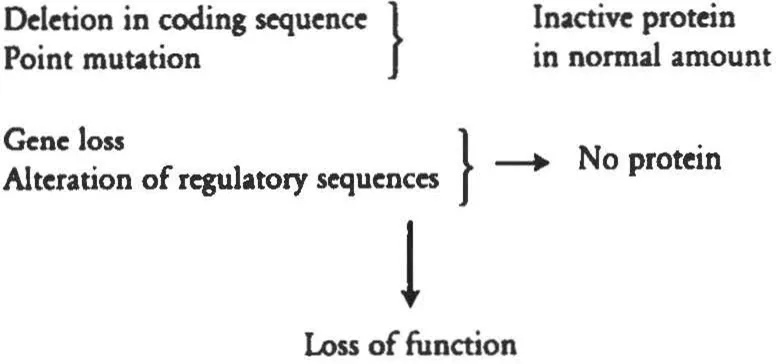
In order to promote neoplastic growth, tumor suppressor genes must be inactivated (Figure 6). This can be caused by:
(1) Point mutations or small deletions in the coding sequence, resulting in a constitutively inactive protein;(2) Gene deletion, resulting in no expression of the protein;(3) Chromosomal translocations, leading to the formation of fusion proteins lacking their normal activity.
In all cases, loss-of-function mutations act recessively, this means that mutations in both the alleles are required to induce cancer development.
CLASSIFICATION OF ONCOGENES AND TUMOR SUPPRESSOR GENES
On the basis of the physiologic function of the corresponding proto-oncogene, oncogenes have been grouped into the families shown in Table 1. On the same basis, tumor suppressor genes have also been grouped into different families, as shown in Table 2. A more recent classification divides tumor suppressor genes into two broad categories. Gatekeeper genes directly regulate the growth of tumors by inhibiting their growth or by promoting their death. The functions of these genes are rate-limiting for tumor growth. As a result, both the maternal and paternal copies of these genes must be inactivated for a tumor to develop. Caretaker genes are involved in the control of genetic instability. Their inactivation leads to genetic instability that indirectly promotes growth by causing an increased mutation rate. Targets of caretakers are gatekeepers and oncogenes.
ONCOGENIC MUTATIONS AFFECTING CELL PROLIFERATION
As previously mentioned, genes encoding each class of cell regulatory protein have been identified as proto-oncogenes or tumor suppressor genes. We provide now some examples of how these proteins can be involved in induction of human cancers.
Autocrine production of growth factors
Growth factors usually act in a ‘paracrine’ manner, that is they are produced by a cell and act on a different cell, located in close proximity, which expresses the receptor (Figure 7). If the ligand is n...
Table of contents
- Cover
- Half Title Page
- Title Page
- Copyright Page
- Table of Contents
- List of principal contributors
- 1 Oncogenes and tumor suppressor genes
- 2 Telomerase and cancer
- 3 Matrix metalloproteinases
- 4 Biological basis of angiogenesis and role of vascular endothelial growth factor-D
- 5 Breast cancer: epidemiology, pathology and natural history
- 6 Genes and heredity in breast cancer
- 7 Endocrine, paracrine and intracrine mechanisms of growth regulation in normal and malignant breast epithelium
- 8 Chemoprevention of breast cancer with tamoxifen: recent experience and future perspectives
- 9 Hormonal therapy of breast cancer
- 10 Hormone replacement therapy and mammographic breast density
- 11 Hormone replacement therapy, insulin-like growth factor I and breast cancer
- 12 Postmenopausal hormone use and breast cancer risk: reassessment of the evidence
- 13 The use of hormonal therapy for management of severe postmenopausal symptoms following breast cancer
- 14 Endometrial cancer: epidemiology, pathology and natural history
- 15 Endocrine, paracrine and intracrine mechanisms of growth regulation in normal and malignant endometrial epithelium
- 16 Chemoprevention and endocrine therapy of endometrial carcinoma
- 17 Hormone replacement therapy and endometrial cancer
- 18 Endometrial stromal tumors — are they hormonally sensitive?
- 19 Epidemiology of colorectal cancer
- 20 Colon cancer: pathology and natural history
- 21 Estrogen receptors, estrogens and colon cancer
- 22 Cyclo-oxygenase-2: an endogenous tumor promoter and target for the chemoprevention of colorectal cancer and other neoplastic diseases
- 23 Hormone replacement therapy and colon cancer
- 24 Cutaneous malignant melanoma: epidemiology, endocrine features and hormone replacement therapy
- 25 BRCA1-BRCA2 and ovarian cancer
- 26 Estrogen replacement therapy use and risk of ovarian cancer: results from two Italian studies and review of the literature
- 27 Understanding HRT risks and benefits and the new science of HRT
- 28 Pulsed estrogen therapy may lead to lower breast stimulation than with daily continuous estrogen exposure
- 29 Transdermal estrogen therapy and the risk of breast cancer: a clinical appraisal
- 30 The effects of selective estrogen receptor modulators on the endometrium
- 31 Safety and tolerability profile of Livial
- 32 Preclinical and clinical development of new progesterone receptor antagonists with high receptor specificity for breast cancer treatment
- 33 More than bones: hormone replacement therapy for mind and body
- Index
Trusted by 375,005 students
Access to over 1.5 million titles for a fair monthly price.
Study more efficiently using our study tools.
Frequently asked questions
Yes, you can cancel anytime from the Subscription tab in your account settings on the Perlego website. Your subscription will stay active until the end of your current billing period. Learn how to cancel your subscription
No, books cannot be downloaded as external files, such as PDFs, for use outside of Perlego. However, you can download books within the Perlego app for offline reading on mobile or tablet. Learn how to download books offline
Perlego offers two plans: Essential and Complete
- Essential is ideal for learners and professionals who enjoy exploring a wide range of subjects. Access the Essential Library with 800,000+ trusted titles and best-sellers across business, personal growth, and the humanities. Includes unlimited reading time and Standard Read Aloud voice.
- Complete: Perfect for advanced learners and researchers needing full, unrestricted access. Unlock 1.5M+ books across hundreds of subjects, including academic and specialized titles. The Complete Plan also includes advanced features like Premium Read Aloud and Research Assistant.
We are an online textbook subscription service, where you can get access to an entire online library for less than the price of a single book per month. With over 1.5 million books across 990+ topics, we’ve got you covered! Learn about our mission
Look out for the read-aloud symbol on your next book to see if you can listen to it. The read-aloud tool reads text aloud for you, highlighting the text as it is being read. You can pause it, speed it up and slow it down. Learn more about Read Aloud
Yes! You can use the Perlego app on both iOS and Android devices to read anytime, anywhere — even offline. Perfect for commutes or when you’re on the go.
Please note we cannot support devices running on iOS 13 and Android 7 or earlier. Learn more about using the app
Please note we cannot support devices running on iOS 13 and Android 7 or earlier. Learn more about using the app
Yes, you can access Hormone Replacement Therapy and Cancer by Andrea R. Genazzani in PDF and/or ePUB format, as well as other popular books in Medicine & Gynecology, Obstetrics & Midwifery. We have over 1.5 million books available in our catalogue for you to explore.