Every journalist must be able to conduct an interview and write snappy copy. No matter what field they are working in journalists also need to be able to wield a digital recorder, take photographs, talk to camera convincingly and create content for online delivery.
Reporting in a Multimedia World offers a thorough overview of the core skills journalists need for the 21st century. The authors show how to generate story ideas, handle interviews, write for different audiences, and edit your own copy. They explain the basics of news photography and broadcast media, the requirements of different digital platforms and the challenges of user generated content. They also look at professional issues: the use of social media by journalists, legal and ethical issues, and career strategies.
Thoroughly revised to reflect the rapid changes in media as a result of digital technologies, and written in a lively style with case studies and tips from experienced journalists, Reporting in a Multimedia World is an ideal introduction to an exciting and demanding profession.
'Theoretical and practical aspects of journalism are perfectly matched, making it an invaluable resource for students and teachers alike.' - Padma Iyer in AsiaPacific MediaEducator
eBook - ePub
Reporting in a Multimedia World
An introduction to core journalism skills
- 336 pages
- English
- ePUB (mobile friendly)
- Available on iOS & Android
eBook - ePub
Reporting in a Multimedia World
An introduction to core journalism skills
About this book
Information
Part 1
NEWS–PEOPLE and INSTITUTIONS
1 The Newsroom
- The changing newsroom
- New technologies, new approaches
- Who's who in news?
- Australian media: A snapshot
- Different audiences, different styles
- Journalism's stakeholders
How many jobs are there where you get to be the conscience of the community and actually hold politicians and other decision-makers accountable? It's a great privilege and I don't think a lot of people realise what a privilege it is really. You can actually influence things. That's the best part about being a journalist. You can make things happen. (Interview with Ingrid Svendsen, Walkley Award-winning former journalist)
The changing newsroom
In late 2007, Australia's largest selling broadsheet, The Sydney Morning Herald,splashed an unusual choice of images across the top of page 2: a picture of its new multimedia newsroom. Television news has long made a feature of showing its news-gathering operations. Pictures of camera crews regularly appear in stories, and shots of TV newsrooms are commonly used as the background for bulletins. The print media, on the other hand, traditionally have been less interested in showing readers their journalists' working environment. Or perhaps they had less to show. But the Herald's new digital newsroom was more than just a striking picture; it signalled a new approach to news production and editorial structure, one replicated across metropolitan and regional newsrooms. Where old-style newsrooms were marked by divisions, both in the physical space and in editorial decision-making, newsrooms were now increasingly organised according to a 'hub and spokes' concept that transformed their operations. Gone were the days when editorial executives sat behind glass windows and reporters were divided into sectional areas.
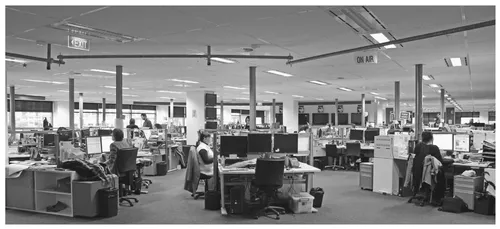
The newsroom at The Sydney Morning Heraldcombines masthead and digital, organised into a 'hub' and 'spokes'.
All of the key decision-makers in the newsroom—including editors, news editors, chiefs of staff, tablet and online editors and section editors, as well as chief subs—were now located in the general news area known as the 'hub'. Reporters and other editorial staff were then arranged around the hub, in 'spokes' radiating outwards. The result was constant communication between the news-gathering and the news-processing staff. Some newsrooms even developed software that allowed for each news product or contribution, be it a piece of written copy, video or audio, to be tracked as it made its way from source to hub and from hub to output. As the Heraldwrote: 'The key decision-makers for the newspaper and website are all within a few metres of each other' and can 'decide the best way to deliver the news to readers and viewers using video, slide shows, the website, print and mobile options' (Smith, 2007: 12). Within a couple of years, the integration of masthead and online staff had become even more significant.
New technologies, new approaches
When historians look back at the media of the early twenty-first century, 2010 will likely be seen as a watershed year. It saw the launch of Apple's iPad and, as news organisations lined up to release apps on which to sell their product, more than one proprietor suggested that it was a game changer which would answer the biggest question to dog news delivery since it had first gone online in the mid-1990s: how to raise significant revenues from digital delivery. By the end of that year, some television programs had joined Australia's main newspapers and magazines in developing apps for tablet delivery. The introduction of tablet editions had special significance for printed publications because they allowed them to retain the lookof a newspaper or magazine while also allowing the benefits of electronic delivery, such as embedded video, galleries of images, links, and so on,
At the same time, more publications began moving their online content behind pay walls, employing a variety of measures to force browsers to pay for access to stories.
In the Australian broadcast media, the ABC launched its 24-hour news channel, joining the pay TV Sky News in around-the-clock television news delivery. Perhaps most significant for journalists, the service was launched with 'no additional funding' (Kalina, 2010: 3).
By 2010, most of the main Australian news publications and programs had added Facebook sites and Twitter feeds to their output. Many individual reporters also had their own professional social media presence, promoted by their news organisations and creating the possibility that reporters would build their own brand loyalty alongside viewer loyalty to the news service itself. Filing for multiple platforms had become the norm rather than the exception, as had multiskilling, with more and more journalists expected to be able to shoot (stills and/or video) as well as write. There were, of course, repercussions for journalists. In late 2010, the Media Entertainment and Arts Alliance (MEAA) released the second edition of its report on the profession, Life in the Clickstream II,in which it noted that staffing at most of Australia's large news organisations had contracted over the previous two years and a majority of journalists surveyed for the report felt that their workloads had increased. In the face of the digital revolution in the media, the MEAA wrote, journalists had been 'struggling to maintain the quality of their work in increasingly difficult conditions':
Broadly speaking, their employers are asking them to do more with less and, in many cases, to learn a whole new set of tools and techniques, while maintaining (or in most cases, increasing) their output. (MEAA, 2010: 18)
The changes hardly slowed the following year. Early in 2011, News Corporation launched The Dailyin the United States, the first tablet-only newspaper staffed by a newsroom of 100 (Hutcheon, 2011: 11). Company chairman Rupert Murdoch expressed the hopes of the news industry across the globe when he observed that there was a 'growing segment of the population that is educated and sophisticated and does not read national print newspapers or watch television news', but that did 'consume media' (Chessell, 2011: 8).
All of these developments in such a short space of time, to say nothing of the ownership changes in the Australian media that also occurred, pointed to a news media that was changing not just by the year, but by the month— even the week.
Who's who in news?
While the structure and layout of newsrooms has changed, the key positions remain familiar, even if their roles are more fluid than in the oast.
The editor(in papers and magazines) or news director (in broadcast outlets) looks after the 'big picture', including hiring and firing, and is ultimately responsible for the publication or program. Chiefs of stafflook after the day-to-day management of news-gathering, such as assigning reporters (and crews in television). The news editoror program producerplays a leading role in deciding the shape of the publication or broadcast, including what story goes where and the length at which stories can run. Sub-editorscheck reporters' copy, write headlines and photo captions, and design and lay out pages. The role of photographersand camera operatorsrequires little explanation, but note that, in television, 'editors' are the people who assemble the images and sound of each story, not the people in charge. The role of the reportersin the news production process is covered in detail in the sections on news-gathering.
Australian media: A snapshot
While the job descriptions remain fairly consistent from one newsroom to another, the ways in which news staff go about their jobs can vary considerably according to the location of the news organisation. The popular image of journalists is generally constructed around those who work in large, metropolitan newsrooms. Metro reporters tend to enjoy the highest status and salaries, as well as the highest public profiles. Metro media canvass state, national and international agendas as well as the news of their own city. It is largely the metro media that determine the national news cycle by their decisions about which stories to run and which to drop.
Metro news media may be the most visible of the media, but they are far from the whole story. Every large Australian city is served by a series of news publications, which can be ranked by the size of their audience, whether they have to be purchased by audience members or are free, and by the scope of their news agenda. These include:
- national press (The Australian Financial Revtew, The Australian),radio and television outlets (ABC national networks and SBS)
- metropolitan press, radio (public sector and commercial) and television (public sector and commercial, free-to-air and pay) outlets
- free metro and suburban press, which are usually weekly or bi-weekly
- community radio and television stations, some of which have news services.
Each of these news organisations also has an online news arm.
Residents of smaller cities or towns will have access to many of the national and metropolitan media as well as regional newspapers, radio and television. In smaller centres, the local papers may be published weekly, or two or three times a week.
Australia also has a sizeable magazine market. The compendium of Australian media, Margaret Gee's Media Guide,listed 153 categories of magazine in 2010, ranging across such diverse topics as animals, shipping, dentistry, home and garden, sport (from aerobics to triathalon), travel and women. Some categories contained just a single title, while others had dozens. The biggest selling of these was the monthly Australian Women's Weekly,which circulated around 494 000 copies per edition in 2010.
That edition of the Media Guidealso listed 655 Trade and Speciality publications on subjects as diverse as accounting, law and medicine. Some of these publications employed journalists. In addition, there were 111 titles listed under Multicultural Press.
A number of news agencies feed the Australian media, along with subscribers in government, business, education, and so on. In Australia, the largest of these is Australian Associated Press, which has offices in all the state and territory capitals as well as a few overseas centres.
While Australia has a diverse range of news outlets, the ownership structure behind them is highly concentrated and in 2011 was dominated by News Ltd (the Australian arm of the Murdoch family-controlled international News Corporation), Nine Entertainment Company (majority owned by CVC Asia Pacific Ltd), Fairfax Media Ltd, Ten Network Holdings Ltd, AAP, APN News & Media, Seven West Media Ltd and the federally funded ABC and SBS.
In 2011, the Australian journalists' union, the MEAA, estimated the number of people regularly employed and deriving most of their income from mainstream journalism to be some 8000, down from 9500 a decade earlier. Of the 8000, more than half—some 5000—a smaller percentage than a decade earlier, worked in the print media and their online arms. Some 1000 were thought to be working in public broadcasting (at the ABC and SBS). Slightly fewer—800—were working in commercial radio and television. The number working in magazines was thought to be 1000, and 200 worked in purely online operations. Other sources, such as the Australian Census, tend to show a higher figure because they include people working at the periphery of the media, and it is important for those hoping to work in the field to understand the elasticity of the media and be prepared to look beyond the mainstream.
Different audiences, different styles
Australian journalism has a few over-arching statements of intent—principally the preambles to the Journalists' Code of Ethics and the Australian Press Council's Statement of Principles (which are reproduced in full in Chapter 3).
The Statement of Principles of the American Society of Newspaper Editors has a more succinct definition of the journalist's role:
Article 1 . .. The primary purpose of gathering and distributing news and opinion is to serve the general welfare by informing the people and enabling them to make judgments on the issues of the time. (ASNE, 2009: n,p.)
Many individual news organisations have their own in-house guides, which may include mission statements about the role of a journalist.
Definitions of journalism and journalists inevitably focus on a single ideal, but there are many different types of journalism and of journalists—from those who do painstaking and influential investigative work to those who work on magazines intended solely as entertainment. Within the main news media, there are also different news agendas and news styles.
Reporters working for the metropolitan daily media enjoy exposure to a large audience. In early 2011, the nation's highest-selling tabloid (Melbourne's Herald Sun)sold some 489000 copies each weekday. The largest-selling broadsheet (The Sydney Morning Herald)sold about 209500 copies. For reporters, those circulation figures bring with them the pressures of developing and writing stories that will appeal to a mass audience.
In the regional daily media, the size of the market and the types of pressures on reporters are different. Regional and suburban media tend to have a closer relationship with their audience than that experienced by the metro media, and their reporters are generally part of the community on which they report. The...
Table of contents
- Cover
- Half Title
- Title
- Copyright
- Contents
- FOREWORD
- 1. News–people and institutions
- 2. The raw material
- 3. News-gathering
- 4. News writing
- 5. Putting it all together
- 6. Professional options
- REFERENCES
- INDEX
Trusted by 375,005 students
Access to over 1.5 million titles for a fair monthly price.
Study more efficiently using our study tools.
Frequently asked questions
Yes, you can cancel anytime from the Subscription tab in your account settings on the Perlego website. Your subscription will stay active until the end of your current billing period. Learn how to cancel your subscription
No, books cannot be downloaded as external files, such as PDFs, for use outside of Perlego. However, you can download books within the Perlego app for offline reading on mobile or tablet. Learn how to download books offline
Perlego offers two plans: Essential and Complete
- Essential is ideal for learners and professionals who enjoy exploring a wide range of subjects. Access the Essential Library with 800,000+ trusted titles and best-sellers across business, personal growth, and the humanities. Includes unlimited reading time and Standard Read Aloud voice.
- Complete: Perfect for advanced learners and researchers needing full, unrestricted access. Unlock 1.5M+ books across hundreds of subjects, including academic and specialized titles. The Complete Plan also includes advanced features like Premium Read Aloud and Research Assistant.
We are an online textbook subscription service, where you can get access to an entire online library for less than the price of a single book per month. With over 1.5 million books across 990+ topics, we’ve got you covered! Learn about our mission
Look out for the read-aloud symbol on your next book to see if you can listen to it. The read-aloud tool reads text aloud for you, highlighting the text as it is being read. You can pause it, speed it up and slow it down. Learn more about Read Aloud
Yes! You can use the Perlego app on both iOS and Android devices to read anytime, anywhere — even offline. Perfect for commutes or when you’re on the go.
Please note we cannot support devices running on iOS 13 and Android 7 or earlier. Learn more about using the app
Please note we cannot support devices running on iOS 13 and Android 7 or earlier. Learn more about using the app
Yes, you can access Reporting in a Multimedia World by Gail Sedorkin,Mandy Oakham,Roger Patching,Barbara Alysen in PDF and/or ePUB format, as well as other popular books in Languages & Linguistics & Digital Marketing. We have over 1.5 million books available in our catalogue for you to explore.