Working with families in which parents have problems with alcohol or other drugs can be complex, stressful and intense. This ground-breaking guide helps human service workers to better support parents struggling to overcome substance use problems. It draws together the perspectives of professionals from alcohol and other drug treatment centres, child and family welfare groups as well as leading researchers in the fields of addiction and child protection, and also provides practical strategies for understanding and overcoming common practice challenges.
In this book you will find guidelines for: developing positive relationships with parents and children; identifying what you need to know when undertaking an assessment; ensuring the safety of families; improving family life; assisting parents when children are in care; and focusing on your own self-care and professional development.
This is an essential resource for both students and professionals working in this challenging field.
'The optimism, wisdom and insight collated in this work... makes this required reading for all of those whose working lives coincide with substance-using parents or their children.' - Professor David Best, Chair, Sheffield Addiction Recovery Research Group; founder and co-chair of Recovery Academy Australia
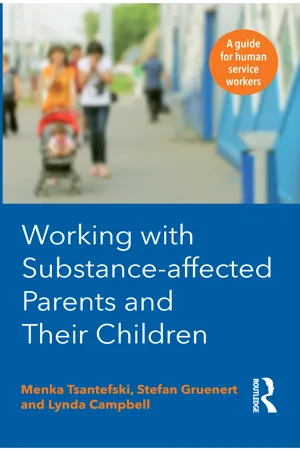
eBook - ePub
Working with Substance-Affected Parents and their Children
A guide for human service workers
- 288 pages
- English
- ePUB (mobile friendly)
- Available on iOS & Android
eBook - ePub
Working with Substance-Affected Parents and their Children
A guide for human service workers
About this book
Information
ABOUT THE AUTHORS
Dr Menka Tsantefski is a Senior Lecturer, School of Human Services and Social Work, Griffith University, Queensland. She previously taught Social Work at the University of Melbourne for seven years, specialising in child- and family-related subjects. For many years, Menka worked at Odyssey House Victoria, researching the experiences of children of substance-affected parents and designing, delivering and managing programs for children and families.
Dr Stefan Gruenert is the father of two boys, a registered psychologist and CEO of Odyssey House Victoria. He is Board Director of the Victorian Alcohol and Other Drug Association, and the Alcohol and Drug Council of Australia. He has worked with parents and children, been a strong advocate for family-inclusive practice, and conducted research and taught courses on alcohol and other drug use, men's issues, intimacy, family work and fathers.
Dr Lynda Campbell has over forty years' experience in the child and family welfare sector, including twenty years of teaching and research in Social Work at the University of Melbourne, where she became an Honorary Research Fellow on her retirement. She has written extensively on child and family services, maintaining a long-term interest in the interface between those services and the alcohol and other drug sector.
INTRODUCTION
Working with families where one or more parents has an alcohol or other drug problem can be very complex, stressful and intense. It is particularly challenging because the problematic use of any substance is accompanied typically by a wide range of issues, such as poor mental health, a history of trauma, child abuse and neglect, including in the parent's own childhood, domestic violence and relationship problems, as well as financial difficulties, legal problems, unemployment and housing instability. However, those who choose to do this work will also experience many rewards as they watch families achieve their personal goals, as they see children thrive, and as they journey alongside parents who courageously tackle their problems, grow in confidence and gain greater enjoyment from family life.
This resource has been designed to assist new workers across many different settings to better support parents struggling to overcome substance use problems, their children and their extended family members or other carers. There are many simple things workers can do that will make a big difference. There are also many traps and challenges experienced by those starting out. Based on extensive consultation with professionals from both the alcohol and other drug treatment and the child and family welfare sectors, alongside leading academics in the fields of addiction and child protection, this book has been organised around commonly experienced practice dilemmas. It includes strategies for overcoming these difficulties from workers' experiences, supplemented with content from up-to-date peer-reviewed literature about what works. While this book does not replace a structured program or an academic qualification, it will help workers, whether newly qualified or struggling with this client group, to apply their existing skills and knowledge to working with vulnerable families where problematic alcohol and other drug use is a key feature.
This book is particularly relevant for those working with substance-affected parents who have one or more children under the age of twelve years. These families pose a particular challenge for workers and are frequently brought to the attention of child protection authorities. While much of the book may be relevant to families with older children, the parenting issues and developmental needs of adolescents, who may be beginning their own substance use, would deserve a whole book on its own.
Throughout this book, we will refer to alcohol and other drugs (AOD) as a reminder that alcohol is a drug, too. Sometimes we refer to substances and mean the same thing. We will generally refer to parents whose use of alcohol or other drugs would meet the criteria for a substance use disorder as defined by the Diagnostic and Statistical Manual of Mental Disorders Fifth Edition (DSM-5), although we don't assume that all people will have a diagnosis. Consequently, we may also refer to addiction or to problematic, dependent or harmful substance use or misuse to describe alcohol or other drug use that is clearly having an impact on the user or their families, whether intoxication is irregular or frequent. Lastly, we will also use the term Indigenous peoples to refer to Aboriginal or First Nation peoples, and the acronym CALD to refer to people with cultural and linguistically diverse backgrounds. It is assumed that readers will have a basic understanding of many of the concepts and terms referred to in this resource. However, definitions and further explanations for all words in bold print can be found in the Glossary towards the end of the book.
In Part 1, we introduce readers to the common issues facing parents and their children (Chapter 1). We then provide several frameworks to help readers understand these problems and highlight common approaches for workers seeking to assist (Chapter 2). In Part 2, we move to more practical assistance and provide readers with foundational skills and knowledge to begin effective practice with families, including how to enhance engagement with parents (Chapter 3) and with children (Chapter 4), and what to look for when conducting an assessment (Chapter 5). In Part 3, we provide more detail about working together with families to facilitate change, with a focus on uncovering the dreams, hopes and goals of the whole family. After outlining the tasks involved in keeping children safe (Chapter 6), we introduce readers to strategies that will help families change the way they function, so that parenting is more effective and family life more rewarding for both adults and children (Chapter 7). Recognising that these changes do not and cannot occur in isolation, we discuss how to activate or build sustainable supports around children and parents, focusing separately on strengthening the informal social network and improving the functioning of formal services surrounding the family (Chapter 8). This is followed by an exploration of how workers can support children and parents during the difficult time when children are placed in care away from home (Chapter 9). In Part 4, we conclude by examining the needs of the worker, and highlight the importance of professional development and supervision to effective practice and a sustainable career (Chapter 10).
HOW CAN THIS BOOK HELP YOU?
If you are a new worker in an adult- or child-focused service, this book is designed to provide you with some helpful information and knowledge. If you have case management responsibilities within either the alcohol and other drug sector, or the child and family services sector, you are likely to benefit most from its content, although many other professionals in contact with vulnerable families may also find it relevant and helpful. We have designed this book to provide general information relevant to a wide range of settings and geographic locations, but we understand that some sections will have more relevance for some readers than for others. While funding and organisational policy may determine your primary role and whom you may support, the content of this book challenges you to consider working in a way that is mindful of all family members, that integrates your work with that of others and that is inclusive of entire families and significant others, wherever possible.
During the consultations that informed this book, workers often asked us to give direct and concrete examples of the sort of actions workers should take when working with families. We have responded to these requests wherever possible. It must be noted, though, that despite our advisory tone, the suggestions contained within this book are not intended to be prescriptive, and may not be suitable for all settings, local areas or with all cultural groups. We aim to develop your awareness of the connection between the problematic use of alcohol or other drugs by parents and child wellbeing, and to promote sensitive responses to the needs of children, parents and other family members, regardless of what type of community service you work in. At a minimum, we hope this book will help you to understand the importance of identifying alcohol and other drug use, parenting or child wellbeing issues, and following up any concerns through more comprehensive assessments and, where appropriate, making referrals to specialist service providers. More optimistically, we hope this book will lead you to engage in more effective and direct work with families and to provide greater integrated care with other community supports or service providers.
Most importantly, this resource should help you to, with confidence:
- create a welcoming and safe environment for your clients;
- identify and enhance family strengths;
- instil a sense of hope and optimism that positive change, the achievement of goals and recovery are all possible; and
- work in partnership with parents, children, other carers and professionals from within and beyond your own discipline to name and address any risks and concerns.
It should be noted that this book was developed in Victoria, Australia. However, as it does not focus on any specific legislation, it is applicable to supporting families elsewhere. As always, strategies must be implemented in accordance with local legislation, protocols and procedures relating to both children and substance misuse.
BEFORE YOU BEGIN
Supporting families affected by problematic alcohol and other drug use requires a multidimensional understanding and approach. You should consider the needs of children, the needs of their parents as individuals, and sometimes as couples, and the life circumstances and functioning of the family as a whole. Equally, the quality of the family's support and its sense of belonging within its wider social network and community are important. This book cannot cover all contingencies across this spectrum of risk and protective factors, but it can draw attention to key issues at each of these levels. It is particularly focused on what workers in a variety of service types can do to keep children safe and help them thrive, to support parents in their parenting role, to help strengthen the attachment between parents and children, and to ensure responsive, appropriate and effective service provision that leads to recovery for all family members. We have made the assumption that, in most cases, children and their parents will be best served by our efforts to keep families together. This is our starting point. Naturally, clinical and legal judgements may determine otherwise in some circumstances.
This resource is based on the wisdom of those who have been immersed in work with families affected by problematic parental substance use for many years. Nevertheless, all sound practice wisdom is a blending of theory and practice, of ways of thinking and ways of doing, and on the evidence of what works. Before we address the practice dilemmas commonly reported by those working with these families, we will introduce what we understand about parental substance misuse and its implications for children. We will also present some useful theoretical frameworks for thinking about both the development and wellbeing of children and their families, and the process of helping people to achieve change in their lives.
PART 1
FOUNDATIONAL KNOWLEDGE
1
Understanding families with alcohol and other drug problems
Many children throughout the world have parents who use alcohol or other drugs. Use can vary in frequency and intensity from occasional light social use to heavy dependent use. It is important to remember that there is a significant difference between use and impairment. As a consequence, the impact on family functioning and the harm to children can vary considerably. In some cases, light and occasional use of alcohol may add to family celebrations and cohesion and place children at no risk. In other families, where regular and heavy drinking occurs, children may be severely impacted by compromised parenting to the detriment of their overall development and wellbeing.
Clearly, not all parents who use alcohol or other drugs are bad parents or incapable of looking after children and meeting their needs. However, parents whose use of alcohol or other drugs is frequent or dependent will often also experience a wide range of other problems, including family or domestic violence, poverty, ill-health (e.g. hepatitis C and dental issues), mental health issues (e.g. depression, anxiety or psychosis), and difficulties with housing and employment (Dawe et al., 2007). While difficult to untangle, each of these issues may impair parenting and children's health and wellbeing, even if parents stop using alcohol or other drugs. Yet parental substance misuse presents distinctive challenges and is worthy of attention in its own right; many workers find the issue daunting. To begin, this chapter will present a summary of current knowledge about parental substance misuse as a social concern, the effects of substance use on users and on their parenting, the consequences for children at different developmental stages and some implications for service providers.
PARENTAL SUBSTANCE MISUSE AS A SOCIAL CONCERN
Even though alcohol and other drugs have long been used by adults across societies, public concern about parental substance misuse has accelerated over recent decades. Initially, concern regarding substance use among women drew attention to the impact on their children and, in particular, newborn infants (Deren, 1986). Over time, both the child protection and family services sector and the alcohol and other drug treatment sector have begun to pay more attention to the needs and rights of children of all ages in substance-using families, and boundary issues have emerged between these two separate arenas of discourse and practice. Defining this as a social issue has involved counting, locating and differentiating the populations of concern.
It is difficult to establish clearly how many children are adversely affected by their parents' substance use, but estimates are that over eight million children in the United States are living in households where at least one parent is dependent upon or is abusing substances (Hedges, 2012). In Australia, at least one in eight children live in a household where there is problematic parental substance use or dependence on alcohol or other drugs (Dawe & Harnett, 2007). This currently translates to more than 500,000 children under the age of fifteen years. United Kingdom figures suggest al...
Table of contents
- Cover
- Title Page
- Copyright Page
- Foreword
- Acknowledgements
- Contents
- About the authors
- Index
Trusted by 375,005 students
Access to over 1.5 million titles for a fair monthly price.
Study more efficiently using our study tools.
Frequently asked questions
Yes, you can cancel anytime from the Subscription tab in your account settings on the Perlego website. Your subscription will stay active until the end of your current billing period. Learn how to cancel your subscription
No, books cannot be downloaded as external files, such as PDFs, for use outside of Perlego. However, you can download books within the Perlego app for offline reading on mobile or tablet. Learn how to download books offline
Perlego offers two plans: Essential and Complete
- Essential is ideal for learners and professionals who enjoy exploring a wide range of subjects. Access the Essential Library with 800,000+ trusted titles and best-sellers across business, personal growth, and the humanities. Includes unlimited reading time and Standard Read Aloud voice.
- Complete: Perfect for advanced learners and researchers needing full, unrestricted access. Unlock 1.5M+ books across hundreds of subjects, including academic and specialized titles. The Complete Plan also includes advanced features like Premium Read Aloud and Research Assistant.
We are an online textbook subscription service, where you can get access to an entire online library for less than the price of a single book per month. With over 1.5 million books across 990+ topics, we’ve got you covered! Learn about our mission
Look out for the read-aloud symbol on your next book to see if you can listen to it. The read-aloud tool reads text aloud for you, highlighting the text as it is being read. You can pause it, speed it up and slow it down. Learn more about Read Aloud
Yes! You can use the Perlego app on both iOS and Android devices to read anytime, anywhere — even offline. Perfect for commutes or when you’re on the go.
Please note we cannot support devices running on iOS 13 and Android 7 or earlier. Learn more about using the app
Please note we cannot support devices running on iOS 13 and Android 7 or earlier. Learn more about using the app
Yes, you can access Working with Substance-Affected Parents and their Children by Lynda Campbell,Menka Tsantefski,Stefan Gruenert in PDF and/or ePUB format, as well as other popular books in Medicine & Health Care Delivery. We have over 1.5 million books available in our catalogue for you to explore.