The middle years of learning are increasingly recognised as one of the most challenging yet opportune periods for growth and development. Based on the Positive Behaviour Support (PBS) framework, this book will equip educators with the appropriate knowledge, skills and strategies to support learners in maximising their educational success, managing emotional issues and making a successful transition to adulthood.
Part A outlines the principles of the PBS framework, defines key characteristics of middle-years learners and provides insight from neuroscience into the nature of the adolescent brain. This section also looks at the importance of listening to the student voice, highlights issues that can arise during the transition into the middle years of schooling, and discusses the use of evidence-based PBS practices to encourage engagement and establish clear behavioural expectations with learners. Part B focuses on the practical aspects of implementing universal PBS strategies in the classroom, including developing strong and effective relationships with students, promoting school connectedness and supporting self-regulation. Part C examines more focused and intensive interventions, and provides strategies for working with students experiencing stress, anxiety and bullying. Finally, Part D discusses ways to support a range of perspectives and experiences in the middle-years, including trauma-affected students, ethnic and cultural diversity and students on the autism spectrum, as well as ways to use ICT to re-engage vulnerable students.
This is an essential reference for both primary and secondary educators, revealing how PBS strategies can play a profound role in positively transforming classroom behaviour.
eBook - ePub
Developing Positive Classroom Environments
Strategies for nurturing adolescent learning
- 346 pages
- English
- ePUB (mobile friendly)
- Available on iOS & Android
eBook - ePub
About this book
Information
Part B
Tier 1—Universal interventions
Key elements of PBS and classroom practice
Chapter 7
Tier 1
Universal interventions that support PBS and classroom practice
LEARNING INTENTIONS
In this chapter, we will explore Positive Behaviour Support (PBS) Tier 1 universal interventions and:
- the influences on teachers’ discipline practices
- the impact of fluctuating energy levels on classroom learning and behaviour
- strategies to identify and manage the energy fluctuations of students
- strategies to address low and mid-level behavioural disruption.
Children manifest their individuality in a variety of ways. Some are more resilient than others; some have a tendency towards a short fuse while others are more robust. What one child takes in his or her stride may upset another. Regardless, every child needs at least one adult in their formative years who will steadfastly believe in their capacity to learn and who can provide guidance over a sustained period. For many children, this is their teacher. The significance of the influence teachers can have in shaping a child’s confidence in their educational and social potential, over and above formal learning priorities, should never be underestimated.
This chapter focuses on the key role of effective teachers in fostering social development, positive decision-making and connectedness in middle-years learners by incorporating Positive Behaviour Support (PBS) Tier 1 universal interventions into their teaching practice. The importance of appropriate acknowledgement and correction strategies is explored and the impact of energy levels on class cohesion examined.
Throughout the years of formal education, teachers can help each child develop:
- a sense of personal worth—an awareness of their own level of skill and potential that contributes to their personal development and social connection
- an internal locus of control—the ability to consider the effects of their behaviour on others and moderate that behaviour according to the situation
- a sense of being valued, safe and secure—understanding the conditions and knowing the people to whom they can turn when faced with unsettling or frightening situations
- appropriate social behaviour and conflict-resolution skills—identifying and displaying behaviours that peacefully resolve conflict and maintain connections with peers and other community members.
While these skills ideally develop in the early years, it is never too late to support individuals in acquiring these attributes. This support is particularly relevant in the middle years, when significant changes occur in a child’s physiological, emotional and social domains. Timely intervention that supports children in engaging with the positive aspects of schooling is likely to be effective at any age.
What influences our discipline practices?
All theories of discipline claim that they work—that is, lead to the end of a disruption. An important goal in a teacher’s professional development is acquiring the knowledge and understanding needed to critically review the large range of behaviour management theories and practices. Our individual discipline practices are influenced by a range of factors, including:
- our beliefs about children and childhood at different ages and our views on children’s capacity to self-manage their behaviour
- our views of disruption as either an error of skill or a deliberate act of defiance
- our own formal education experiences
- our understanding of the key theories of discipline and teaching
- our values, which govern which behaviours we see as problematic.
It is important to recognise our own standpoint in relation to each of these influences, so that when we apply a particular technique it is ethical and aligns with our own values (Sargeant, 2014).
There are no simple, quick-fix or easy answers to effective discipline. All models aimed at supporting positive behaviour take time and effort to implement and are influenced by varying views or definitions of behaviour (Loukus, 2015). At its most obvious, ‘behaviour refers to everything people do, good and bad, right or wrong, helpful or useless, productive or wasteful’ (Charles, 2002, p. 8), but a more helpful view from Apter (1982) allows teachers to focus on the context in which their influence is most visible, the classroom. Richmond (2002, p.32) offers an educative definition of behaviour management, which she views as ‘a specialised communication genre undertaken by teachers for the central purpose of helping all students maximise their successful connection with the curriculum’.
When applying any specific strategy, we must feel that we are abiding by our own discipline principles so that the success of the strategy is more likely. Effective teachers are able to develop and justify their personal approach to the management of student behaviour and ethically apply the most appropriate method that suits their professional style (Porter, 2007).
Our responses to children’s disruptions must be ethical and, importantly, the adult–child relationship must suffer no harm as a result of how a disruption is handled. The methods we use must convey our own values, such as respect and fair treatment; otherwise, they are unlikely to be successful in the long term.
Ultimately, the strategies we choose to support appropriate behaviour must also have a protective focus, so that future disruptions are mostly prevented. If disruptions do occur, however, our practices, if effective, will achieve the following outcomes.
- The disruption will be brought under control, quickly and safely.
- The disruption should be less likely to recur.
- Positive learning intentions are communicated.
- There are no unintended side effects on the child.
- Other children will feel safe about how they would be treated if in the same situation.
7.1 Pause and reflect
You have asked your class to provide an evaluation of your teaching so that you can further develop your teaching skills. How would your students describe or perceive you and the classroom environment? Consider the following.
- Your overall classroom environment (e.g., organised, chaotic, boring, messy, safe, fun)
- You, their teacher (e.g., warm, tough, encouraging, nasty, someone who presents great lessons)
- The learning experiences (e.g., inspiring, interesting, challenging)
Perceptions of behaviour
There is no single approach to supporting positive behaviour that works with every child, and teacher views on supporting positive behaviour vary according to their views on child development, how children learn, the nature of adult–child relationships and their prior experiences. Our individual perspectives also influence our view of what motivates individuals to behave disruptively.
As prominent adults in the lives of children in their middle years, teachers should be mindful of the role they play and their possible influences on the lives and futures of the children they teach. Every word and action by a teacher may be witnessed by one or more children and can have a lasting effect (Doyle, 1986). This will, in turn, influence the universal interventions that you as the teacher put in place in your classroom environment.
Children come to school from diverse social, cultural and family contexts and they bring with them the values expressed and the behaviours modelled at home. They also bring with them a multitude of experiences, both positive and negative, that they must set aside in order to attend to the business of being a student. These attributes may not necessarily be aligned with those endorsed by you or your school. Just as professional teachers leave their personal concerns at the door while teaching, so, too, must many students (Sargeant, 2010).
The impact of these varying experiences outside the school can be substantial. Behaviours that present as a problem in the school may not be viewed the same way elsewhere. Such clashes in standards can occur in relation to appropriate language, sharing behaviours, teamwork, homework, competition, personal hygiene, food choices and personal safety. When these contrasts in standards between the influential adults in a child’s life become apparent, the contradictions can impact on a child’s behavioural decision-making and rationalisations for his or her behaviour. The example below highlights how conflicts can occur when an adult’s (in this case, a teacher’s) perception of a behaviour differs from a student’s perception of the same event.
Contrasting value systems between students and teachers, if not recognised and—where possible—resolved, may affect the important and essential student–teacher relationship. As detailed in Chapter 5, the implementation and expression of clear (and translated) expectations is critical. Clearly communicated expectations establish a foundation upon which positive behaviour can be acknowledged. Equally, clear expectations provide a supportive context when challenging behaviour must be corrected. As Richmond (2002) asserts, balancing correction and acknowledgement with direct reference to expectations promotes clarity in communication and consistency in application, and supports positive learning (Figure 7.1). Acknowledging feedback involves
Case study
At the end of the school day, Patrick left school to catch the bus home. As he arrived at the pedestrian crossing the lights were red, but the bus was arriving at the stop across the road. Patrick quickly checked for traffic, then ran across the road to make the bus. His teacher, Mr Jackson, was nearby and his account of the event was that Patrick ran into oncoming traffic and ignored the safety aspects of the crossing. He called out to Patrick to stop but Patrick, oblivious to the danger, just smiled, waved and got on the bus.
The next day, Patrick was given a detention. It took Mr Jackson some time to convince Patrick that his behaviour, regardless of the outcome, was actually unsafe. Quite simply, Patrick thought he had acted safely, even if he had disobeyed the rules. The conflict in perspective relates to the balance between maintaining safe behaviour by following the correct crossing procedure (wait for the lights) or risk taking (running across the road).
planning and implementing encouraging communications that convey to the student that he or she is on the right track. Corrective feedback involves planning and implementing strategies that interrupt, and positively refocus, socially inappropriate and/or disruptive classroom behaviour.
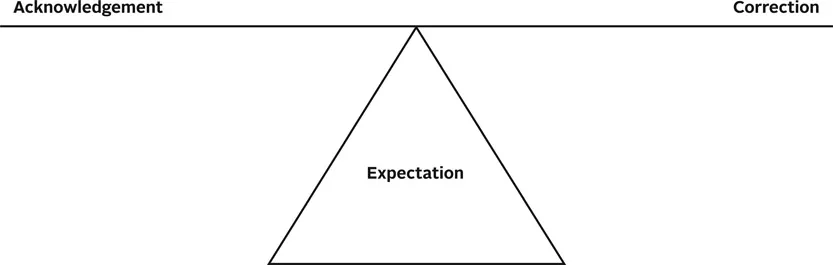
Figure 7.1 The balance model
Source: Adapted from Richmond (2002).
Sometimes a child will bring to class a set of values and behavioural norms that may be inconsistent with those of other children and/or those expected by the teacher. The teacher, as a person of authority in this context, will often assert several expectations that are formulated from the teacher’s perspective, based on his or her own knowledge, experience and education. Such assertions may lead the children to respond either by complying or challenging the teacher’s authority. At these times, in communicating expectations crucial to the universal interventions of Tier 1 of PBS, it is critical that the teacher is clear that, at a minimum, certain behaviours are expected within the class and school context. Learned behaviours and the effects of continued negative experiences can provide a significant barrier to lasting change. Considering the perspective of the child will assist teachers in persisting with long-term strategies.
Conflicting behaviours may still occur at home but, as discussed previously, the direct influence of the teacher outside of school is limited (see Chapter 5). As expressed in Apter’s definition, the behavioural process of teaching children th...
Table of contents
- Cover
- Half Title
- Title Page
- Copyright Page
- Dedication Page
- Contents
- List of tables and figures
- Contributors
- Preface
- Part A: The Positive Behaviour Support framework and middle-years learners
- Part B: Tier 1—Universal interventions: Key elements of PBS and classroom practice
- Part C: Tiers 2 and 3—Targeted group interventions and intensive individual interventions
- Part D: Catering for diversity as part of a PBS approach
- Acknowledgements
- Index
Trusted by 375,005 students
Access to over 1.5 million titles for a fair monthly price.
Study more efficiently using our study tools.
Frequently asked questions
Yes, you can cancel anytime from the Subscription tab in your account settings on the Perlego website. Your subscription will stay active until the end of your current billing period. Learn how to cancel your subscription
No, books cannot be downloaded as external files, such as PDFs, for use outside of Perlego. However, you can download books within the Perlego app for offline reading on mobile or tablet. Learn how to download books offline
Perlego offers two plans: Essential and Complete
- Essential is ideal for learners and professionals who enjoy exploring a wide range of subjects. Access the Essential Library with 800,000+ trusted titles and best-sellers across business, personal growth, and the humanities. Includes unlimited reading time and Standard Read Aloud voice.
- Complete: Perfect for advanced learners and researchers needing full, unrestricted access. Unlock 1.5M+ books across hundreds of subjects, including academic and specialized titles. The Complete Plan also includes advanced features like Premium Read Aloud and Research Assistant.
We are an online textbook subscription service, where you can get access to an entire online library for less than the price of a single book per month. With over 1.5 million books across 990+ topics, we’ve got you covered! Learn about our mission
Look out for the read-aloud symbol on your next book to see if you can listen to it. The read-aloud tool reads text aloud for you, highlighting the text as it is being read. You can pause it, speed it up and slow it down. Learn more about Read Aloud
Yes! You can use the Perlego app on both iOS and Android devices to read anytime, anywhere — even offline. Perfect for commutes or when you’re on the go.
Please note we cannot support devices running on iOS 13 and Android 7 or earlier. Learn more about using the app
Please note we cannot support devices running on iOS 13 and Android 7 or earlier. Learn more about using the app
Yes, you can access Developing Positive Classroom Environments by Beth Saggers in PDF and/or ePUB format, as well as other popular books in Education & Behavioural Management. We have over 1.5 million books available in our catalogue for you to explore.