- 288 pages
- English
- ePUB (mobile friendly)
- Available on iOS & Android
eBook - ePub
About this book
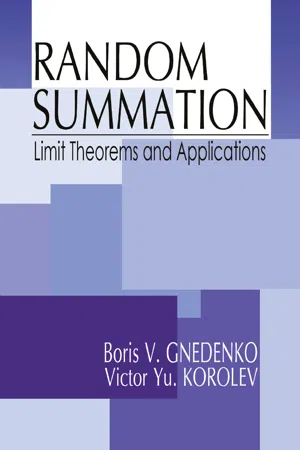
This book provides an introduction to the asymptotic theory of random summation, combining a strict exposition of the foundations of this theory and recent results. It also includes a description of its applications to solving practical problems in hardware and software reliability, insurance, finance, and more. The authors show how practice interacts with theory, and how new mathematical formulations of problems appear and develop.
Attention is mainly focused on transfer theorems, description of the classes of limit laws, and criteria for convergence of distributions of sums for a random number of random variables. Theoretical background is given for the choice of approximations for the distribution of stock prices or surplus processes. General mathematical theory of reliability growth of modified systems, including software, is presented. Special sections deal with doubling with repair, rarefaction of renewal processes, limit theorems for supercritical Galton-Watson processes, information properties of probability distributions, and asymptotic behavior of doubly stochastic Poisson processes.
Random Summation: Limit Theorems and Applications will be of use to specialists and students in probability theory, mathematical statistics, and stochastic processes, as well as to financial mathematicians, actuaries, and to engineers desiring to improve probability models for solving practical problems and for finding new approaches to the construction of mathematical models.
Information
Chapter 1
Examples
1.1 Examples related to generalized Poisson laws
EXAMPLE 1.1.1. Consider the energy received by some region of the surface of Earth from cosmic particles during time T. Let Ek be the energy of the k-th particle and N be the total number of particles arrived during time T. It is obvious that the energy received by the region is equal to
(1.1) |
We will consider Ek, k ≥ 1, here, as independent random variables with the same distribution function F(x), and N as a random variable which is independent of the variables {Ek}k≥1, and takes nonnegative integer values with the corresponding probabilities
When studying these physical phenomena it is usually assumed that the random variable N has the Poisson distribution with some parameter λ, i.e.,
(1.2) |
Experimental data are in good accordance with this assumption. Some more details of the mathematical premises of (12) are presented in the Appendix, where the properties of the Poisson flows of events are described.
Let us find the distribution function G(x) of the random variable E. Since the sum (11) has no summands with probability p0, then we can conclude that the function G(x) has a jump at zero, which is equal to p0. The sum (11) will have n summands with probability pn and the distribution function of the variable E will be F*n(x), where
and F*1(x) = F(x). If we denote by F*(0)(x) the degenerate distribution function which has the only unit jump at zero, then according to the law of total probability we can write the following relation
(1.3) |
In terms of the characteristic functions
relation (13) can be written as
(1.4) |
If pk are given by (12), then (14) takes a simple form
(1.5) |
Formula (15) implies, in particular, that the distribution function G(x) is always infinitely divisible (including the case when the distribution function F(x) is not).
It is well known that under the conditions of our example the expectation and variance of the random variable E are determined as
Under assumption (12) these formulas take a very simple form
This example seemed to be an interesting and useful object of the mathematical investigation. Due to these reasons the formula for the expectation of a random sum (when the number of summands is independent of the summands) was included into the textbook (Gnedenko, 1949). We should note that other authors paid their at...
Table of contents
- Cover
- Half Title
- Title Page
- Copyright Page
- Preface
- Table of Contents
- 1 Examples
- 2 Doubling with Repair
- 3 Limit Theorems for “Growing” Random Sums
- 4 Limit Theorems for Random Sums in the Double Array Scheme
- 5 Mathematical Theory of Reliability Growth. A Bayesian Approach
- Appendix 1. Information Properties of Probability Distributions
- Appendix 2. Asymptotic Behavior of Generalized Doubly Stochastic Poisson Processes
- Bibliographical Commentary
- References
- Index
Trusted by 375,005 students
Access to over 1.5 million titles for a fair monthly price.
Study more efficiently using our study tools.
Frequently asked questions
Yes, you can cancel anytime from the Subscription tab in your account settings on the Perlego website. Your subscription will stay active until the end of your current billing period. Learn how to cancel your subscription
No, books cannot be downloaded as external files, such as PDFs, for use outside of Perlego. However, you can download books within the Perlego app for offline reading on mobile or tablet. Learn how to download books offline
Perlego offers two plans: Essential and Complete
- Essential is ideal for learners and professionals who enjoy exploring a wide range of subjects. Access the Essential Library with 800,000+ trusted titles and best-sellers across business, personal growth, and the humanities. Includes unlimited reading time and Standard Read Aloud voice.
- Complete: Perfect for advanced learners and researchers needing full, unrestricted access. Unlock 1.5M+ books across hundreds of subjects, including academic and specialized titles. The Complete Plan also includes advanced features like Premium Read Aloud and Research Assistant.
We are an online textbook subscription service, where you can get access to an entire online library for less than the price of a single book per month. With over 1.5 million books across 990+ topics, we’ve got you covered! Learn about our mission
Look out for the read-aloud symbol on your next book to see if you can listen to it. The read-aloud tool reads text aloud for you, highlighting the text as it is being read. You can pause it, speed it up and slow it down. Learn more about Read Aloud
Yes! You can use the Perlego app on both iOS and Android devices to read anytime, anywhere — even offline. Perfect for commutes or when you’re on the go.
Please note we cannot support devices running on iOS 13 and Android 7 or earlier. Learn more about using the app
Please note we cannot support devices running on iOS 13 and Android 7 or earlier. Learn more about using the app
Yes, you can access Random Summation by Boris V. Gnedenko,Victor Yu. Korolev in PDF and/or ePUB format, as well as other popular books in Mathematics & Calculus. We have over 1.5 million books available in our catalogue for you to explore.