- 305 pages
- English
- ePUB (mobile friendly)
- Available on iOS & Android
eBook - ePub
About this book
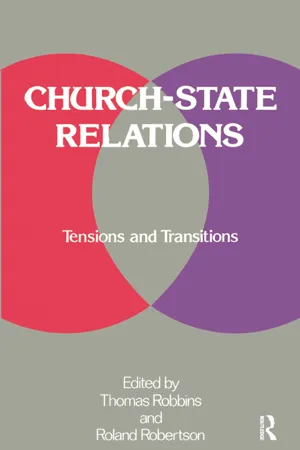
Encounters between agents of the state and religious organizations have been increasing throughout the world, thus the need to understand the relationships between religion and other major domains of life is increasingly important. In this comprehensive reader on church-state relations, scholars examine the connections between religion and political life from a comparative perspective.
Information
Part I
GENERAL CONSIDERATIONS
1
General Considerations in the Study of Contemporary Church-State Relationships
Roland Robertson
It can hardly be said that the putatively relevant academic disciplines were ready for the encounters involving agencies of the state or of secular political actors, on the one side, and religious organizations or movements, on the other, that we have witnessed in many parts of the world in recent years. Those specializing in the empirically focused study of religion had concerned themselves with religion in its more peripheral manifestations—with quite a few sociologists maintaining that what is most characteristic of religion in the modern world is, indeed, its peripheral status—while those studying the “harsh” realities of modern life, particularly those of politics and economics, were seemingly disdainful of the idea that religion had much to do, except in a few isolated cases, with the comprehension of the central issues of modern life.
Widespread acceptance of one or another version of the secularization thesis formed the immediate backdrop to this state of unreadiness. The social sciences had for long promoted the idea that religion is more or less irrelevant—and increasingly so—to the governmental, political, economic and other major domains of modern life. In no small measure such a perception has been a desideratum of scientific study of human societies, and when religion has reared its head it has thus often been regarded as an ephemeral, atavistic annoyance on the analytical terrain. Not unironically the prevalence of the secularization thesis has, on the other hand, constituted a major target of some modern religious or politicoreligious movements. Be that as it may, the study of religion has, for the most part, been regarded for the past fifty years or so as “wallpaper in the halls of academe” (a characterization which is adopted from Beckford’s more detailed discussion of the preoccupations of some influential sociologists of religion in the following chapter). Specialists in the study of religion have themselves often reflected that attitude, sometimes by maintaining that the “wallpaper” is in fact the most interesting thing about social systems, by which I specifically mean that the claim that religion has primarily to do with meaning, identity and the like has frequently been made on the basis of the idea that these aspects of human life are ultimately the most important—that they are transcendent and do not need to be systematically related to the supposedly more mundane themes of politics, government, violence, revolution, economic crisis, and so on.
The academic disciplines have, in effect, followed the course broadly indicated by those classical sociologists in their characterization, to use Max Weber’s phrase, of the “parcelling-out” of modern life. The perception that modern life in general is characterized by its being functionally differentiated into increasingly autonomous and distinct spheres has been consolidated by a parallel differentiation of academic life itself. This had led, inter alia, to sociologists of religion being greatly preoccupied—as if that were the point of the subdiscipline—with producing general theories of religion per se (including its decline or demise). What thus has been greatly neglected until quite recently is the interpenetration of religious and other spheres.
Few, if any, of the great intellectuals whose work has been resoundingly influential in the study of religion, were concerned with religion per se. That was not Kant’s pivotal concern, nor was it Rousseau’s. Hegel did not study only religion nor did de Tocqueville, Troeltsch, Freud, Max Weber, Durkheim or Parsons. Each of these, in their different ways, had an agenda for the analysis of general or specific aspects of the modern world per se and attended to religion as a crucial part—but, nonetheless, only a part—of their respective foci of concern. The circumstances which have produced a professional sociology of religion concerned so much with religion per se cannot, indeed should not, receive attention here. Nor can, nor should there be analysis of the crystallization of political science and political sociology—neither of which have displayed much interest in religion until very recently. In other words, examining the courses of professionalization and the modes of self-identification of academic disciplines is not directly relevant to the concerns of this book. Nonetheless, insofar as academic disciplines refract significant aspects of the societies in which they emerge, congeal and become subject to mutation or demise, it is relevant to consider more generally how we have overlooked—or at least been taken by surprise by the sudden reemergence of—apparently consequential connections between church and state, religion and politics, religion and government, religion and international relations, and so on.
For the most part, those who have advocated the secularization thesis have not seriously explored the question as to the terms in which modern societies function. Many have at one and the same time strongly insisted on the historical significance of religion as providing the symbolic foundations of societies or in legitimating the political realm and the operation of the state, on the one hand, and denied such significance in the modern world, on the other—without paying much, if any, attention to the bases of modern regimes. More broadly, there has been a tendency to insist on the centrality of religion to the operation of human societies in broad anthropological perspective but a lack of interest in how societies which used to “need” religion now persist. The latter problem has largely been left by students of religion to other specialists.
Meanwhile, after a long period of neglect of what Bagehot, in his influential work on the British constitution, called the dignified parts of government (symbolism, ritual, and so on) and, more generally, the theme of legitimacy (in other than highly restricted form), political scientists and political sociologists have, in recent years, become increasingly preoccupied with such matters—but particularly the themes of legitimacy and legitimation. However, blossoming of interest in the modern state and the question of its legitimacy and forms of legitimation has not resulted as such in a revitalization of concern with religion; although the situation has significantly changed since 1979, the year of the Iranian and Nicaraguan revolutions and the Polish protorevolution.
That church-state relations have become more visible and often problematic in recent years does not, of course, constitute in itself evidence against the thesis that the modern state largely stands without need of religious legitimation. One certainly has, for example, to entertain the possibility that the recent proliferation of religion-based challenges to the authority of the modern state are merely ephemeral reactions to the onward march of secularization. Moreover, even if—as some significant figures in social science have claimed—the modern state is particularly vulnerable to legitimation crises or even if many states lack legitimacy that does not in itself mean that religion (or the church) becomes again automatically relevant to the functioning of state apparati. Moreover (as Thomas Robbins makes clear in his introduction to part two), quite a few of the more publicized of church-state encounters in recent years have arisen from the attempt on the part of state agencies to expand their regulative control, rather than from attempts by religious organizations to assert a monitoring role vis a vis the state (or the domain of secular-political activity) or from a diffuse upsurge in religiosity.
Nevertheless, with such caveats firmly in mind, it would seem that in the modern world religious factors are coming to play more rather than less significant roles in affairs of state. Since church-state and/or religious-political issues have emerged in nearly every corner of the modern world in recent years—in societies which have relatively little in common in terms of histories and sociocultural attributes—the question immediately arises as to whether there is something about the world as a whole, the modern world system, which gives rise to them. I deal with the central aspects of that theme in the third essay in this section, in particular reference to the idea that the “tightening” of the entire world into a single sociocultural system places strong constraints upon individual societies to identify and legitimate themselves in relation to the global circumstance and, more diffusely, humanity. Emphasis is also given to the ways in which heightened consciousness about the raison d’etre and fate of the world and the human species is a pivotal factor in the rise of religious and religiopolitical (as well as secular-political) movements oriented to the global-human circumstance per se. At this point, however, an even more general introductory theme should be mentioned.
Particular sensitivity to church-state problems, tensions, conflicts, and the like is, virtually by definition, likely to occur most from within societies which erect—in varying degrees—walls of separation (to invoke Jefferson’s famous phrase) between church and state and that stress the necessity for constitutional and legal safeguards against the impingement of religion on the societal political system and vice versa. It is also likely to be found in societies—such as those of Eastern Europe—in which the state has been greatly secularized, regardless of the degree to which there is a tradition in such societies of safeguarding the religious realm from state encroachment or protecting the religious rights of individuals. Additionally, in societies of both of those types the idea that societies—including the ostensibly secularized state systems thereof—are not beholden to or reliant upon transcendent forms of religious or quasi-religious symbolism is likely to be evident.
Sahlins (1976:220) has pinpointed a crucial aspect of this theme. What Marx said about primitive societies not being able to exist unless they disguised to themselves “the real basis of that existence, as in the form of religious illusions” may be more true of modern societies in that the latter conspire “to conceal the symbolic ordering of the system,” not least in the form of “those academic theories of praxis by which we conceive ourselves and the rest of the world.”1 Geertz (1980:121–22), in speaking of the etymological history of “that master noun of modern political discourse, state” notes that
Each of the leading notions of what the state ‘is’ that has developed in the West since the sixteenth century—monopolist of violence within a territory, executive committee of the ruling class, delegated agent of the popular will, pragmatic device for conciliating interests—has [led to] those dimensions of authority not easily reducible to a command-and-obedience conception of political life [being] left in an indefinite world of excrescences, mysteries, fictions, and decorations.
To be sure, neither Sahlins nor Geertz are speaking directly to the theme of church-and-state. Nonetheless their striking formulations point to matters which have a considerable bearing on that theme. Sahlins indicates that modern life is actually founded much, much more on symbolism, including religious symbolism, than is normally recognized in either quotidian or academic contexts. Geertz (1980:123) cogently maintains, to again use his own words, that in the mainstreams of Western life “the semiotic aspects of the state … remain so much mummery.” And while his main concern is with Bageot’s dignified parts of government—myth, political symbology, ceremony, and so on—his comments surely indicate that the segregation of the exercise of power and authority from general, cultural symbolism is a form of modern false consciousness (to reverse, in tandem with Sahlins, the usual Marxist perspective). Put simply, affairs of state cannot be regarded simply as a sphere for the autonomous operation of what Weber called material interests, any more than the church can be appropriately conceived of as being almost exclusively the domain of ideal interests (the latter idea being effectively destroyed by Beckford in the following chapter). Even more important there is the question of how the two are connected.
For, to adopt Sahlins (1985) again, we have to be interested in the structure of the conjuncture. In the present context that means paying attention to the ways in which church and state are coordinated. We cannot take the American term separation literally, for if church and state were to be truly—as opposed to constitutionally—separated, there would be no society at all. This theme has been evident in writing, particularly on the part of Americans, on the theme of civil religion. Indeed, in some formulations civil religion is conceptualized precisely to refer to the ways in which a rationale is provided for their being held apart and the ways in which they should interact.2 (The more typical formulation, which does not necessarily exclude the latter, is centered upon the idea of civil religion as a set of symbols concerning sacred themes, ceremonials, places and events in a nation’s history.) The formulation of civil religion as rationale for the autonomy-within-interdependence of religion and state-centered politics has usually been applied to Western societies, most notably the United States, in which Christianity has been the dominant religious tradition. For Christianity is, of course, distinctive in the degree to which it raises ongoing dilemmas about the relationship between active involvement in worldly affairs and the salvation of souls.3 As will be seen more fully in the introduction to part three, other religious traditions have displayed much less ambivalence in this regard, although in societies in which there is a problematic plurality of religious cultures, civil-religious themes are very likely to emerge, regardless of the particular faiths involved—centered on the problem of coexistence of such faiths relative to national loyalty and societal identity (Markoff and Regan 1981).4
A pressure to connect religious and state domains in the modern world, regardless of the degree to which there is formal, constitutional separation, arises from the fact that increasingly we face the problem of the plurality of cultures and faiths at the global level. And that circumstance is almost certainly also a source for our now becoming more conscious of the “deeper” aspects of modern life. By the same token, consciousness of roots, tradition, heritage, and so on, increases the likelihood that societies will draw upon religiocultural resources in defining their identities and that movements within and across societies will invoke religious symbols. Thus we have become increasingly conscious in recent years of the religious aspects of revolutionary situations, revolutionary and revitalization movements and of revolutions themselves (Lewy 1974).
The modern idea of revolution, as it developed during and in the aftermath of the French Revolution at the end of the eighteenth century, acquired a strongly secular cast (in spite of the quasi-religious activities of the French Revolutionaries themselves). In fact it is not too much to say that until very recently the revolutionary myth has to a considerable extent been predicated upon and has heralded a more-or-less totally secularized world (Robertson 1985). Thus we are now only beginning to realize the extent to which nineteenth century revolutionary activity in fact involved a distinctly religious dimension (Billington 1980). On the other hand, recent events in Asia, the Middle East, Eastern Europe and Latin America compel us to reexamine the relationship between religion and revolution—and, in turn, the connection between that conjunction and the modern state.
The circumstances under which revolutionary movements are likely to invoke and deploy religious ideas and symbols is directly addressed by Leland Robinson in his contribution to this section. Thus in the papers which follow we have, first, an analysis of the ways in which sociologists ...
Table of contents
- Cover
- Half Title
- Title Page
- Copyright Page
- Table of Contents
- Dedication
- Acknowledgments
- Introduction
- Part I General Considerations
- Part II Church-State Tension in the United States
- Part III Comparative Perspectives
- About the Contributors
- Index
Trusted by 375,005 students
Access to over 1.5 million titles for a fair monthly price.
Study more efficiently using our study tools.
Frequently asked questions
Yes, you can cancel anytime from the Subscription tab in your account settings on the Perlego website. Your subscription will stay active until the end of your current billing period. Learn how to cancel your subscription
No, books cannot be downloaded as external files, such as PDFs, for use outside of Perlego. However, you can download books within the Perlego app for offline reading on mobile or tablet. Learn how to download books offline
Perlego offers two plans: Essential and Complete
- Essential is ideal for learners and professionals who enjoy exploring a wide range of subjects. Access the Essential Library with 800,000+ trusted titles and best-sellers across business, personal growth, and the humanities. Includes unlimited reading time and Standard Read Aloud voice.
- Complete: Perfect for advanced learners and researchers needing full, unrestricted access. Unlock 1.5M+ books across hundreds of subjects, including academic and specialized titles. The Complete Plan also includes advanced features like Premium Read Aloud and Research Assistant.
We are an online textbook subscription service, where you can get access to an entire online library for less than the price of a single book per month. With over 1.5 million books across 990+ topics, we’ve got you covered! Learn about our mission
Look out for the read-aloud symbol on your next book to see if you can listen to it. The read-aloud tool reads text aloud for you, highlighting the text as it is being read. You can pause it, speed it up and slow it down. Learn more about Read Aloud
Yes! You can use the Perlego app on both iOS and Android devices to read anytime, anywhere — even offline. Perfect for commutes or when you’re on the go.
Please note we cannot support devices running on iOS 13 and Android 7 or earlier. Learn more about using the app
Please note we cannot support devices running on iOS 13 and Android 7 or earlier. Learn more about using the app
Yes, you can access Church-state Relations by Thomas Robbins in PDF and/or ePUB format, as well as other popular books in Theology & Religion & International Relations. We have over 1.5 million books available in our catalogue for you to explore.