Lectures remain a staple form of teaching in higher and professional education, yet presenting doesn't come naturally to most of us. 53 Interesting Things to do in your Lectures provides practical suggestions, each tried and tested, for developing really effective lectures and presentations across all disciplines.
The authors cover the full presentation process, from structuring the lecture, to use of illustrations and technology, techniques to attract and sustain student attention, active learning strategies, and dealing with questions.
Whether you're new to lecturing and training and keen to develop good presentation technique, or more experienced and looking to expand your repertoire, 53 Interesting Things to do in your Lectures is a handy guide to keep on your desk.
eBook - ePub
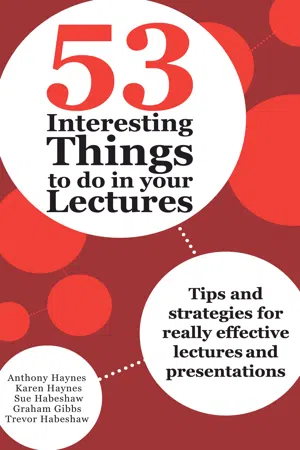
53 Interesting Things to do in your Lectures
Tips and strategies for really effective lectures and presentations
- 148 pages
- English
- ePUB (mobile friendly)
- Available on iOS & Android
eBook - ePub
53 Interesting Things to do in your Lectures
Tips and strategies for really effective lectures and presentations
About this book
Information
Chapter 1 Structuring the process
| 1 Briefing |
| 2 Flagging |
| 3 Ground rules |
| 4 Students’ questions |
| 5 Orientation |
1 Briefing
Lectures are used by teachers for an extraordinary variety of purposes. Their relationship to other course elements such as reading, tutorials, assignments and practicals differs markedly from one course to another. What it is sensible for students to do during such different lectures also varies enormously. However, students may respond as if a lecture is a lecture is a lecture, and behave identically in entirely different situations which demand quite different learning activities. To brief students at the start of a lecture is to tell them what sort of a lecture it is to be, and what sort of learning activity it might be sensible to undertake. Briefing students not only influences their behaviour so that they make more appropriate and effective use of your lecture in their learning, but also has an impact on their perceptiveness and discrimination as learners. They will begin to recognise that different learning tasks make different demands and start extending their repertoire of learning responses accordingly.
We offer a variety of different briefings here to illustrate what we mean:
- ‘The reason I am lecturing in the way I am is that I want you to see some live examples of the applications of legal principles to specific cases. I’m expecting you to learn the principles from your text books, and to learn to apply legal principles by tackling the legal problems I’ve prepared for you which we will discuss in tutorials. In this lecture what I want you to pay attention to is the way I go about tackling such problems. I want you to be able to do it like me. There is only any point in noting down the details of the cases if this helps you to understand and remember the legal arguments involved. OK?’
- ‘Your text book deals with these calculations of forces in rigid structures perfectly adequately, but you may find it difficult to follow on your own. I’m going to use each of these lectures to go over one chapter: to explain the methods and notations the text book uses, and to highlight particular problems or interesting bits. You could probably manage without these lectures. You certainly can’t manage without going through your text book very thoroughly. I’m lecturing to make your work through your text book that much quicker and easier. You should make notes in your textbook as I go along, rather than take full notes.’
- ‘You are only going to get a grip on the social psychology of groups by reading, and reading quite widely. I’ve given you
- substantial reading list; read as much as you can but you will find the reading hard going. The authors I’ve chosen all use different language and make different assumptions even when considering the same phenomenon. The theoretical perspectives from which writers approach topics are very varied and greatly colour the way they write. So the purpose of my lectures is to try to stop you from getting lost when you start reading. I’ll familiarise you with the terminology and highlight some landmarks along the way. I want you to consider my lectures as maps to a strange land. Take the sort of notes you’ll find helpful to have next to you when you’re reading.’
- ‘This lecture introduces you to dialectical materialism. It’s a difficult concept and one that underpins much of what the remainder of the course is concerned with. Now I could just give you a neat definition to write down or some quotes from Engels for you to copy. But that wouldn’t help you much. Instead I’d like to talk around this concept and just try to explain it as best I can; I want you just to try and understand it. Don’t bother taking any notes; just listen and think. I’ll be asking you to discuss some aspects of dialectical materialism later in the lecture.’
Briefing is concerned with the overall function of the lecture and is therefore distinct from Flagging (see 2) which is used to draw attention to the nature of specific actions you might take within a lecture.
2 Flagging
Flagging is explaining what you are doing, and why. Teachers often introduce an activity or the next stage of a session without flagging it, assuming either that students already know what it is they are supposed to do and what they are supposed to get out of it, or that students don’t need to know: all they have to do is follow instructions. But people’s ability to undertake tasks depends crucially on their understanding of the task – and not just their understanding of what the task is, but of why it is a sensible or useful thing to do. Many of the suggestions in this book may need thorough flagging the first few times they are used or students may feel hesitant and reluctant to engage in the suggested activity.
For example, you might want to introduce a break into your lecture – something you haven’t tried before – and say, ‘OK, stand up, stretch your arms and give a big yawn’. This is likely to be met with embarrassed giggles and not much movement. To flag this would be to explain, ‘You’ve been sitting still in this gloomy, stuffy room for 40 minutes now. It may help you to be comfortable and to stay alert for the next 20 minutes if you use the next minute to move around a bit. Stand up, stretch your arms, have a good yawn, try anything you like to release the physical tension and relax your muscles. I’m going to do the same’.
If you wanted to introduce a buzz group exercise (see 38 Buzz groups) you might say, ‘Now, in pairs, I want you to look at the map on the next slide and decide what Christaller’s theory would have to say about the location of the towns’. For students unused to such activity during a lecture, and unused to working with one other student, and certainly unsure whether this was some sort of trick test, this might be a difficult task to get going on. To flag it might involve explaining, ‘It’s important that you are able to apply Christaller’s theory to specific places and I need to know whether you are able to do this before I continue. So I’m going to set you a very brief task to do. It might be difficult to get going on your own so work together with your neighbour’.
It is probably better to be over-explicit in your flagging than to assume your audience already knows why you are doing what you are doing.
3 Ground rules
All lectures have ground rules though these are not normally explicit. Unless you have informed your students of the specific ground rules you want to operate they will probably assume that conventional ground rules are operating. These conventional ground rules may include:
- The responsibility for the success of the lecture is entirely the teacher’s, who will do all the preparation, all the real work during the lecture, and make all the decisions during the lecture about its content and process.
- The lecture topic will relate directly to the syllabus and to likely exam questions on it.
- The student’s role is to sit quietly and listen: interrupting is undesirable and talking with a neighbour is absolutely banned.
- The teacher will lecture uninterrupted for 55 minutes.
- No work, other than listening and taking notes, is required of the student.
- Attending lectures is a solitary, unco-operative, even competitive, activity: students work for themselves.
- If the teacher wants to know if students are attending, bored, interested, comprehending, or whatever, she will have to ask a specific student: such information is not to be offered spontaneously (which would offend the teacher) or in response to general questions addressed to the whole class (which would offend students suspecting creeping).
- Only geeks sit at the front.
You may feel that these ground rules are not those you would like to operate. In this case you may need to take some time at the start of the course, or of specific lectures, to make your own preferred ground rules explicit.
You could say, ‘On this course the lecture periods will be rather different from what you are used to. In them I expect students to tell me if they think I’m going too fast, if they need a break, and so on. So if you feel you just can’t listen any more and your writing hand is aching, it is perfectly OK to ask me to stop for two minutes to catch up and rest. I’ll expect such suggestions from you’.
Students’ assumptions about ground rules may be soundly based in their experience of many conventional lectures. You will need to be very explicit about your own ground rules, refer to them repeatedly, and behave appropriately (e.g. by accepting a student’s request for a break, in the example above) for students to start operating according to your ground rules. More radical changes in ground rules (e.g. concerning sharing of responsibility for preparation, or concerning the acceptability of direct comments about the quality of your lecturing) may need to be introduced gradually. Some other suggestions in this book (see 4 Students’ questions and 35 Now look at me when I’m talking) concern the operation of specific ground rules.
4 Students' questions
Students are often confused because some teachers allow them to ask questions during the lecture, some allot time for questions at the end and some only accept individual questions when the rest of the students are packing up and leaving. They are particularly confused because teachers don’t usually explain what their practice is when they first meet the students. Students who are not given any indication to the contrary will tend to assume that they can never ask questions in lectures.
It is very helpful to students if you not only make it clear what your attitude to questions is but if you also support this statement with appropriate behaviour. That is, if you say that it’s all right for them to interrupt the lecture, don’t look annoyed when they do; if you say you’ll take questions at the end, allow time for them; if you say you’ll answer individual questions, give those individuals your full attention when they approach you.
This is a specific form of Ground rules (see 3).
See also ‘Are there any questions?’ (53).
5 Orientation
Some teachers rush into lecture rooms and start speaking immediately, only to find that they feel disorientated, the students aren’t ready and they need time to set up presentation media. It is worth pausing before you start your lecture and giving yourself time to orientate yourself by looking round the room, rehearsing silently the names of some of the students, chatting briefly with those at the front, cleaning the whiteboard, checking your audiovisuals, or arranging your notes.
It’s also helpful if the introduction to your lecture is such that students don’t need to start writing straight away but have their own orientation period at the start whose function is to remind them what it’s like to be in one of your lectures as well as to introduce the lecture and link it with the previous week’s work.
You can even begin to orientate your students before the lecture starts by displaying a slide of the total lecture programme or the structure of that day’s lecture or by playing a CD or DVD which will provide a context for your lecture: baroque music for a lecture on baroque, for example, or a scene from the appropriate play for a drama lecture.
If you explain the principle of orientation to students and they see the point of it, they will learn to orientate themselves without your help. They can do this before the lecture by looking through their notes or reviewing the previous week’s work with a friend.
If you decide to introduce quiet time into your lectures, you can make the connection and point out to your students that one of the purposes of quiet time is that of reorientation (see 43 Quiet time).
Table of contents
- Cover
- Title Page
- Copyright Page
- Contents
- Series Page
- Foreword
- Preface to the first edition
- Chapter 1 Structuring the process
- Chapter 2 Improving students' notes
- Chapter 3 Using handouts
- Chapter 4 Structuring and summarising content
- Chapter 5 Linking lectures
- Chapter 6 Holding attention
- Chapter 7 Active learning during lectures
- Chapter 8 Checking on learning
Trusted by 375,005 students
Access to over 1.5 million titles for a fair monthly price.
Study more efficiently using our study tools.
Frequently asked questions
Yes, you can cancel anytime from the Subscription tab in your account settings on the Perlego website. Your subscription will stay active until the end of your current billing period. Learn how to cancel your subscription
No, books cannot be downloaded as external files, such as PDFs, for use outside of Perlego. However, you can download books within the Perlego app for offline reading on mobile or tablet. Learn how to download books offline
Perlego offers two plans: Essential and Complete
- Essential is ideal for learners and professionals who enjoy exploring a wide range of subjects. Access the Essential Library with 800,000+ trusted titles and best-sellers across business, personal growth, and the humanities. Includes unlimited reading time and Standard Read Aloud voice.
- Complete: Perfect for advanced learners and researchers needing full, unrestricted access. Unlock 1.5M+ books across hundreds of subjects, including academic and specialized titles. The Complete Plan also includes advanced features like Premium Read Aloud and Research Assistant.
We are an online textbook subscription service, where you can get access to an entire online library for less than the price of a single book per month. With over 1.5 million books across 990+ topics, we’ve got you covered! Learn about our mission
Look out for the read-aloud symbol on your next book to see if you can listen to it. The read-aloud tool reads text aloud for you, highlighting the text as it is being read. You can pause it, speed it up and slow it down. Learn more about Read Aloud
Yes! You can use the Perlego app on both iOS and Android devices to read anytime, anywhere — even offline. Perfect for commutes or when you’re on the go.
Please note we cannot support devices running on iOS 13 and Android 7 or earlier. Learn more about using the app
Please note we cannot support devices running on iOS 13 and Android 7 or earlier. Learn more about using the app
Yes, you can access 53 Interesting Things to do in your Lectures by Anthony Haynes,Karen Haynes,Sue Habeshaw,Graham Gibbs,Trevor Habeshaw in PDF and/or ePUB format, as well as other popular books in Education & Education General. We have over 1.5 million books available in our catalogue for you to explore.