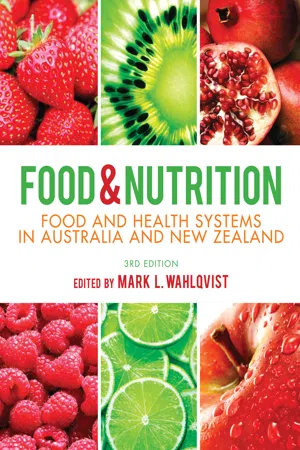
Mark Wahlqvist's Food and Nutrition is widely regarded as the most authoritative introduction to nutrition and dietetics in the region. It provides a comprehensive overview of nutrition needs at different life stages, the biochemistry of foods, dietary disorders, and the social, political and environmental contexts of food production and consumption.This third edition has been completely revised and significantly expanded to encompass recent developments in nutritional science, technology and policy. It includes new material on genetics, regulation, food production, birth weight, lifestyle and cancer, and the implications of climate change for food production, safety and availability. Chapters are extensively illustrated with data and diagrams.The book is divided into the following sections: * Human nutrition* Food systems, security and policy* The biology of food components* Lifespan nutrition* Food and disease* Food and nutrition for individuals and societyWith chapters from leading nutritionists, Food andNutrition is an indispensable student text and a valuable professional reference.
- 808 pages
- English
- ePUB (mobile friendly)
- Available on iOS & Android
eBook - ePub
About this book
Information
Part I
HUMAN NUTRITION: THE CONCEPT AND CONTEXT

1 Introduction to human nutrition
2 Evaluating the reliability of nutrition information
3 Social approaches to understanding food, eating and nutrition
4 Food and nutrition for Aboriginal and Torres Strait Islander peoples
1
Introduction to human nutrition

OBJECTIVES
- To provide an understanding of the dimensions of human nutrition.
- To explore the origins of human food culture.
- To provide an historical basis for deductions about preferred ways of eating in the contemporary world.
- To consider the long-term and unintended consequences of changes in the human diet.
THE DIMENSIONS OF HUMAN NUTRITION
The study of human nutrition encompasses a remarkable breadth of topics. These include the genetic inheritance that determines each individual’s susceptibility to disease, and the influence of the physical and social environment, which determines whether disease occurs. New knowledge of the human genome is revolutionising our understanding of disease, and the interplay of nutrition and disease. It may be that in the future a ‘reading’ of a child’s genome will provide the basis for the dietary requirements necessary to prevent the occurrence of particular diseases, although this will depend on a number of ethical and socio-economic issues. Chapter 28 provides a discussion of the genetic basis of disease and how the genome interacts with nutrition.
Whereas the genotype is the underlying gene-plan of the body, the phenotype is the actual body as constructed, allowing for the dominance of certain genes and environmental influences on development. The influence of environment needs to be considered in two ways. The first is in terms of the environment in which each individual was conceived and developed in utero, followed by early nurturing and breastfeeding as an infant. It is now known that the health and nutrition of the mother (and probably the father) can influence the health of the child many years later as an older adult, particularly with regard to diseases such as heart disease and diabetes (see Chapters 30, 31 and 32). The second consideration concerns the many aspects of the environment that currently act on the individual. These include the physical environment, which encompasses climate, shelter, water, food supply and conditions of hygiene, and the social environment, which includes family influence, social supports and obligations, work, money and government regulations.
Food is part of the human environment and, in an ideal world, just the right amount of safe and nutritious food would be consumed so that each person would have the best chance of achieving optimum health and long life. However, it is not as simple as that. Not all available foods are equally nutritious. The quality of the foods consumed can be the result of several factors:
- government regulations regarding a safe food supply (see Chapter 12)
- what foods are supplied by farmers, food manufacturers and supermarkets (see Chapter 5)
- what foods we choose to buy and eat, and
- whether the food system is sustainable (Chapters 5 and 13).
Nutrition can be divided into ‘pre-swallowing’ and ‘post-swallowing’ aspects (see Chapter 3). The ‘pre-swallowing’ considerations can be divided into those that deal with the food supply and those relating to our human individuality, as well as the anthropological and sociological influences that determine what we choose to eat. The ‘post-swallowing’ aspects concern the physiology of nutrition, including nutritional requirements for energy, protein and vitamins, along with the consequences of too little or too much of these nutrients. Just what nutrients are required and how much of each is complicated. It is not possible to do experiments on humans as might be done with laboratory rats or other animals. Certainly, the nutritional requirements of rats—which, like us, are mammals—are similar to human requirements, but they are not exactly the same. Information on nutrition is drawn from two major sources. The first is laboratory science, where experimental animals are used, and to a lesser extent human subjects are used as well. The other main source of information is epidemiology—the study of nutrition and disease in populations. Epidemiology shows up relationships such as an association or prediction of heart disease with high intakes of saturated fats, or a higher incidence of the congenital disease spina bifida with low intakes of the B-vitamin folacin. Where such associations or predictions are found, laboratory science takes over to determine the nature of cause and effect.
Very often, information is not clear-cut. Statistical analysis must be used to determine whether a certain finding might have arisen by chance or not. Even so, knowledge that seemed firmly established may change as continuing research uncovers new information. Assessing the significance of new information can be complicated. Scientists do not necessarily agree and arguments may go on for years before finally being settled one way or another. Some people in the nutrition field may be selective about what they believe. Sometimes their reasons are religious or they may have a financial interest in proclaiming certain ‘facts’. With the introduction of computers and the internet, information is no longer hard to find—the more difficult problem is sorting out factual information from that which is biased (see Chapter 2).
EVOLUTION AND THE HUMAN DIET
It might reasonably be assumed that human beings evolved in association with particular diets and that the physiology of the human body is adapted to maintain health on those diets. Thus the more we understand about what early humans ate, and their state of health, the more we are likely to be able to optimise present food consumption for physical and mental well-being and longevity. Research into the lives and nutrition of early humans is continuing in many parts of the world, particularly in Africa, the Middle East and amongst Indigenous Australians (see Chapter 4). There are three main ways through which we can rediscover these early patterns:
- the anthropological study of early human ancestors (Eaton and Konner 1985; Bryant 1994)
- the study of contemporary communities that have retained earlier dietary patterns, notably hunter-gatherer societies such as Aboriginal Australians or Malaysians (Orang Asli) (Chong and Khoo 1975) or Kung Bushmen in Southern Africa (Truswell and Hansen 1968; Truswell 1977)
- the study of the human genome and how genetic expression may be affected by food intake. Studies of Aboriginal Australians have shown, for example, that Aboriginal physiology is adapted to maintain better health on bush diets than on ‘Western’ diets rich in saturated fats and sugar. The studies of Kerin O’Dea on the metabolism and health of Aboriginal Australians typify this approach (Temple and Burkitt 1994).
ANTHROPOLOGICAL STUDY OF THE HUMAN DIET
Anthropologists reconstruct earlier ways of eating by various methods, including:
- the examination of middens (cooking mounds) and burial sites for evidence of the types of food eaten (Meehan 1982)
- the study of coprolites (fossilised or hardened preserved faecal specimens) for indicators of foods eaten, such as fish scales or grains (Eaton and Konner 1985)
- deductions about the ecosystems of the period and their potential for producing various kinds of foods (Hetzel and Firth 1978; Woodward et al. 1987)
- detailed examination of teeth and jaw development as indicative of types of foods eaten (Katzenberg et al. 1993).
Evidence of the health of early humans comes principally from human remains, which are usually skeletal, but there have also been a few spectacular finds of mummified and frozen corpses, which can then be examined (Polosmak 1994; Spindler 1994). These remains have indicated that hunter-gatherers were able to live apparently healthy lives, at least into their seventh decade. They were sometimes taller than subsequent generations, suggesting that the overall food supply was better and susceptibility to recurrent disease less. Recent increases in human height, which have been documented in Scandinavia through studies at the Stockholm Museum, followed a low-point in height after an earlier taller hunter-gatherer population.
CONTEMPORARY AND ANCESTRAL HUNTER-GATHERERS
From the work of Eaton and Konner (1985), it is possible to make the following deductions about the Paleolithic (Pleistocene, 400 000–45 000 BC) diet:
- There were appreciable quantities of low fat animal-derived foods (see Table 1.1).
- Plant-derived foods were unrefined.
We could add to this that the food patterns were relatively sustainable, if seasonal, and related to the ecosystems along itinerant or migratory routes. These would, if revisited, increasingly reflect local change through the growth of favoured food plants from transported seed. In later times, locality was more drastically changed by subsistence agriculture and new, sometimes fragile, ecosystems were established.
| Macronutrient | Intake (g) |
|---|---|
| Protein | 251.1 |
| animal | 190.7 |
| vegetable | 60.4 |
| Fat | 71.3 |
| animal | 29.7 |
| vegetable | 41.6 |
| Carbohydrate | 333.6 |
| Fibre | 45.7 |
Source: Eaton and Konner (1985).
With regard to nutrient intakes (see Table 1.2):
- For macronutrients, protein was a relatively high, and fat a relatively low, contributor to energy intake.
- Relatively high cholesterol intakes were tolerated, but against a dietary background high in fibre and low in fat (with a high P:S ratio).
- Salt (or sodium) intake was relatively low and the potassium:sodium ratio high.
- Calcium intakes exceeded those in industrialised societies today.
- The diet achieved upwards of 400 mg of vitamin C (ascorbic acid).
These deductions depend on ancestral and contemporary anthropological studies of hunter-gatherers. There are some important conclusions to be drawn about this work, along with related studies:
- Foods derived from the sea, rivers, lakes or streams consistently played a role in human nutrition.
- The intake of animal-derived fat was low because the creatures caught were undomesticated—the fatty part of a hunted animal, like the breast of a gazelle, was highly prized. The fats from wild animals are much less saturated than from current domestic herbivores. Plant-derived fat was relatively unrefined, mainly from seeds or nuts.
- Cholesterol intake could be relatively high (500–600 mg/day), from land and sea creatures combined, but it was not accompanied by significant amounts of animal-derived fat.
| Late Paleolithic diet | Current American diet | Australian recommendations | |
|---|---|---|---|
| Total dietary energy (%) | |||
| Protein | 34 | 12 | 15–25 |
| Carbohydrate | 45 | 46 | 45–50 |
| Fat | 21 | 42 | 20–25 |
| P:S ratio* | 1.41 | 0.44 | |
| Cholesterol (mg) | 591 | 600 | |
| Fibre (g) | 45.7 | 19.7 | [20–30] |
| Sodium (mg) | 690 | 2300–6900 | 460–920 |
| Calcium (mg) | 1580 | 740 | 1100 |
| Ascorbic acid (mg) | 392.3 | 87.7 | 45 |
Note: * P:S denotes polyunsaturated:saturated fats.
Source: Modified from Eaton and Konner (1985) and further adapted for Australia from the NRVs (Nutrient Reference Values), for men and women above 19 years, of the NH&MRC (2006); for dietary fibre a consensus recommendation is shown in square brackets.
THE HUMAN GENOME AND ITS EXPRESSION
The first ‘humans’ appeared about four million years ago and the earlier form of Homo sapiens about 400 000 years ago. The human species as we know it has existed for about 200 000 years, or some six thousand generations, as judged by studies of genes in mitochondria, which are independent of genes in cell nuclei and derived unchanged from the mother rather than from the fusion of sperm and egg. The mutation rate of mitochondrial DNA is well characterised and allows an estimate of the age of the species. Anatomically modern humans (Homo sapiens sapiens) appeared about 45 000 years ago. It is likely that, in the three hundred or so generations since the emergence of subsistence agri...
Table of contents
- Cover
- Half Title
- Title Page
- Copyright Page
- Contents
- Dedication Page
- List of contributors
- Part I HUMAN NUTRITION: THE CONCEPT AND CONTEXT
- Part II FOOD SYSTEMS, SECURITY AND POLICY
- Part III THE BIOLOGY OF FOOD COMPONENTS
- Part IV LIFESPAN NUTRITION
- Part V FOOD AND DISEASE
- Part VI FOOD AND NUTRITION FOR INDIVIDUALS AND SOCIETY
- Abbreviations
- Index
Trusted by 375,005 students
Access to over 1.5 million titles for a fair monthly price.
Study more efficiently using our study tools.
Frequently asked questions
Yes, you can cancel anytime from the Subscription tab in your account settings on the Perlego website. Your subscription will stay active until the end of your current billing period. Learn how to cancel your subscription
No, books cannot be downloaded as external files, such as PDFs, for use outside of Perlego. However, you can download books within the Perlego app for offline reading on mobile or tablet. Learn how to download books offline
Perlego offers two plans: Essential and Complete
- Essential is ideal for learners and professionals who enjoy exploring a wide range of subjects. Access the Essential Library with 800,000+ trusted titles and best-sellers across business, personal growth, and the humanities. Includes unlimited reading time and Standard Read Aloud voice.
- Complete: Perfect for advanced learners and researchers needing full, unrestricted access. Unlock 1.5M+ books across hundreds of subjects, including academic and specialized titles. The Complete Plan also includes advanced features like Premium Read Aloud and Research Assistant.
We are an online textbook subscription service, where you can get access to an entire online library for less than the price of a single book per month. With over 1.5 million books across 990+ topics, we’ve got you covered! Learn about our mission
Look out for the read-aloud symbol on your next book to see if you can listen to it. The read-aloud tool reads text aloud for you, highlighting the text as it is being read. You can pause it, speed it up and slow it down. Learn more about Read Aloud
Yes! You can use the Perlego app on both iOS and Android devices to read anytime, anywhere — even offline. Perfect for commutes or when you’re on the go.
Please note we cannot support devices running on iOS 13 and Android 7 or earlier. Learn more about using the app
Please note we cannot support devices running on iOS 13 and Android 7 or earlier. Learn more about using the app
Yes, you can access Food and Nutrition by Mark L Wahlqvist in PDF and/or ePUB format, as well as other popular books in Medicine & Health Care Delivery. We have over 1.5 million books available in our catalogue for you to explore.