Effective Australian history education has never been more important for the development of critically aware and thoughtful young people. History fosters important skills in reasoning, historical consciousness and empathy; and an appreciation of history is crucial to the development of students' understanding of the very nature of our society. This edited collection comprises contributions from leading historians, educators and practising teachers, and surveys Australian history teaching today, from the development of the national curriculum to fostering historical thinking and promoting effective engagement in the history classroom.
The book begins with an analysis of the principles underlying the drafting of the national curriculum and features insights from the writers of the curriculum themselves. It focuses on the curriculum from primary- and secondary-school teaching perspectives. Part 2 examines the teaching of historical expertise including historical thinking and value formation, as well as productive assessment and the important role social history can play in the classroom. Part 3 concentrates on specific approaches to history teaching including teacher talk; the use of historical fiction and film; digital technology and the internet; as well as museums as a teaching medium. Part 4 analyses key aspects of Australian history teaching including Indigenous perspectives, teaching citizenship and assisting the pre-service teacher in their transition to becoming a professional.
Rich with insights into historical skills, historical concepts and critical thinking, as well as practical guidance on translating principles into engaging classroom approaches, this is an essential reference for both pre-service and in-service history teachers and educators.
eBook - ePub
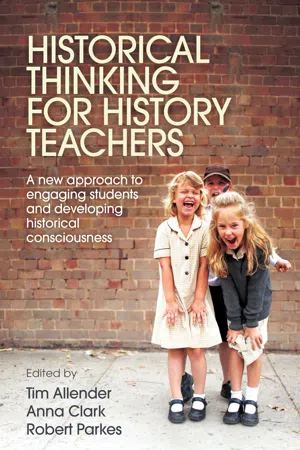
Historical Thinking for History Teachers
A new approach to engaging students and developing historical consciousness
- 384 pages
- English
- ePUB (mobile friendly)
- Available on iOS & Android
eBook - ePub
Historical Thinking for History Teachers
A new approach to engaging students and developing historical consciousness
About this book
Information
PART 1UNDERSTANDING THE AUSTRALIAN HISTORY CURRICULUM
CHAPTER 1 Historical consciousness and the Australian Curriculum
Tony Taylor
INTRODUCTION
As has been the case in many other nations, the teaching and learning of history in modern Australian schools have endured a controversial past— indeed, arguably more controversial than any other Australian school subject. This is principally because historical interpretation—even at the school level—is frequently tied to politicised versions of national narratives (Taylor & Guyver 2012). Consequently, understanding the contentious nature of the events that preceded the establishment of an Australian national curriculum in history is an important part of a classroom teacher’s sense of both historical consciousness and curriculum knowledge. By historical consciousness, I mean more than just knowing and understanding the past: it entails understanding the process by which individual and group understandings of the past are formed, how they affect the present and how they may affect the future. By curriculum knowledge, I mean comprehending the past, present and future contexts of a curriculum. In other words, when teachers of history inspect their latest curriculum publication, they need to ask and be able to answer several questions: what lies behind this document? How and why did the education system get to this place? And where is this history curriculum heading?
This chapter attempts to deal with these questions during the period prior to the 2008–10 drafting of the Australian Curriculum: History (dealt with in Chapter 2). The chapter discusses the importance of the UK Schools Council History Project (SCHP) as an inspiration for history education reformers in Australia, the fall and subsequent rise of historical consciousness in schools during the twenty-year period that preceded the 2010 introduction of the Australian Curriculum, the significance of the 2000–01 National History Inquiry, the Commonwealth History Project 2001–06 and the 2006 National History Summit.
THE BACKGROUND TO TEACHING AND LEARNING HISTORY IN MODERN AUSTRALIA
Prior to the 1980s, much of the history teaching in Australian secondary schools had a traditional look about it. Classes in secondary schools were largely based on chalk and talk, combined with the intermittent colourful anecdote, the reading of textbooks or topic books, the occasional 16-milli-metre film shown on a cumbersome Black and Howell projector and, for the more able students, the taking of notes and the writing of essays. Primary school students, often taught by teachers with little or no background in history, tended to work on integrated projects that included historical elements. During the 1970s, though, progressive educators in Australia had become increasingly critical of a subject-by-subject disciplinary approach to the humanities in secondary schools. They wanted a broader, more socially and economically relevant approach to curriculum to help deal with the increased numbers of students staying on to the senior years in secondary schools, and they looked to the other side of the Pacific for inspiration. There, a US-based New Social Studies movement, originally based on the work of American educator Edwin Fenton (1966), offered an alternative vision for Australia in the 1980s. This over-a rching social studies approach, based on the use of a facts, concepts and generalisations template for all humanities subjects, came at a time when state- or territory-based curriculum design in Australia was haphazard, localised and built on previous syllabus incarnations.
Australian supporters of the New Social Studies saw value in integrating subjects within themes or topics so that the knowledge and skills used in each discipline could cross over and join with the knowledge and skills acquired in other subjects. For example, if students were finding out about the sixteenth- and seventeenth-century European voyages of discovery, they could use facts, concepts and generalisations gained in studying history, geography and economics, leading to what was expected to be a socially productive curriculum based on knowledge and skills that would, according to one contemporary observer, ‘teach the art of cooperative living’ (Taylor et al. 2012: 29).
Consequently, at a 1989 annual meeting of Australian education ministers in Tasmania, it was decided that the states and territories would teach humanities by following a fully integrated social studies model, a Studies of Society and Environment (SOSE) K–10 curriculum framework. This decision—part of a federal Labor government push to increase retention rates—was announced in the 1989 Hobart Declaration on Schooling. The integrated SOSE approach would now become the standard way of teaching humanities to students in the K–10 years in most Australian government schools as well as all Catholic diocesan schools. There were to be two additional features added to SOSE. In Australia, Fenton’s (1966) knowledge and skills elements were joined by ‘values’ and, as the framework’s title suggests, the new program featured study of the environment. Within SOSE, history’s knowledge and skills features were limited to Time, Continuity and Change.
New South Wales was the only state that declined to give up its history and geography lessons at the secondary school level. Major non-government schools also declined to join the SOSE framework, sticking to history and geography as their main humanities subject areas. One consequence was that while a majority of Australian schools in the 1990s followed the SOSE path, a substantial minority did not. Another consequence was that, at the school level, history as a subject and historical consciousness as an educational outcome went into a steep decline.
THE NEW HISTORY MOVEMENT
Meanwhile, a different kind of curriculum movement called New History had begun in the United Kingdom during the 1960s, and it began to flourish there in the early 1970s, dominating secondary school history education during the 1980s. New History was to reach Australia in the late 1980s, eventually playing a part in the formation of the Australian Curriculum: History in 2010.
The British idea of New History was to move the subject along from its early twentieth-century origins as a memorised learning of Ancient Egypt, Greece and Rome (in Year 7), and Medieval England and the Tudor and Stuart eras (in Years 8 and 9) followed by a study of the achievements of Great Britain as the originator of the Industrial Revolution (in Year 10). In terms of student interest, this topic sequence went from the fascinating through to the vivid but concluded with the dull, just as students were about to choose their two-year examination courses in Years 10 and 11. This approach was not a formal national history curriculum but the basis of a patchwork curriculum of common practice and common agreement in the hundreds of local education authorities of the different jurisdictions of England, Wales, Scotland and Northern Ireland.
New History had its theoretical origins in UK education philosopher Paul Hirst’s (1966) argument that there were seven ‘forms of knowledge’, all of which were distinctly different from one another, and one of those forms was history. In 1970, UK educator Martin Ballard (1970) published an edited collection of chapters, New Movements in the Study and Teaching of History, which gave UK history educators a theoretical starting point for curriculum design in history. UK history educator Jeanette Coltham (1971) then authored a pamphlet published by the Historical Association in 1971, The Development of Thinking and the Learning of History. In the same year, Coltham and John Fines (1971) co-authored a brief but very influential Historical Association pamphlet, Educational Objectives for the Study of History. This pamphlet introduced UK teachers of history and UK syllabus designers to the structured curriculum approach of US educator Benjamin Bloom (1956). By this stage, those UK history educators who wanted to develop an informed and systematic pedagogical approach to the subject as a replacement for what was effectively an old-fashioned teacher-centric curriculum now had a great deal of scholarly and professional literature to provide them with support. Accordingly, Roy Wake, a senior government inspector in Whitehall’s Department of Education (covering England and Wales), who was concerned that history was being left out of a late 1970s broad curriculum reform movement, pressed for the government to take action, according to inaugural SCHP director David Sylvester (2009).
THE SCHOOLS COUNCIL HISTORY PROJECT
Under pressure from Roy Wake, in 1972 the UK government’s Schools Council established a grant of £126,000 (approximately A$250,000) to set up a Schools Council [ages] 13–16 History Project (later the Schools Council History Project, or SCHP, and later again the Schools History Project), to be trialled in 32 schools in England, Scotland, Wales and Northern Ireland. The principal aim of the project was to develop historical thinking by examining mainly primary sources across a sequence of topics in Years 9–11 that focused in turn on detective skills, a study in development over time, a modern world history topic, a depth study and a local history investigation. This was a revolutionary approach to secondary school history. The effect of the SCHP on the teaching and learning of history in the United Kingdom was astonishing. For example, in one large comprehensive school (1700 students), where the author was a new head of history in the 1970s, the number of students taking history as an option in Years 10 and 11 rose from 50 to 420 in a two-year period (Taylor 1980). By the mid-1980s, s tudents and teachers in the United Kingdom were voting with their feet. One-third of all Year 10 and 11 students studying history were taking the SCHP syllabuses, two of a proliferation of regional examination board (age 16+) examination syllabuses. The SCHP is currently in its 45th year. For its current status, see Schools History Project (2018).
A clear indicator of the success of the SCHP was the assessment report written by Denis Shemilt (1980) in his History 13–16 Evaluation Study. A social scientist by background, Shemilt had been recruited to carry out an external appraisal of the SCHP. His conclusions were that students and teachers now worked far harder in history lessons than they did in other subjects; they recognised that history was a complex discipline; the inquiry-based and problem-solving approach of the SCHP was pedagogically beneficial; and the clear disciplinary framework provided by the SCHP provided school history with a solid rationale for a subject that more students could relate to and understand.
There were problems with the SCHP, though, many of which were dealt with at school level and through syllabus adjustment. These included too much emphasis on primary sources at the expense of secondary sources, and incoherence issues in a syllabus that seemed fragmented, with no overarching chronology linking the depth studies. Nevertheless, by 1989 when the UK government introduced its first version of a national curriculum, the SCHP was the dominant approach used in teaching history at secondary school level in the United Kingdom, and its influence extended into national curriculum history in three respects. First, the SCHP advocated a new and systematic way of inquiry-based thinking about history founded on the use of evidence, causal relationships and empathy. The latter was a product of the SCHP team’s slightly inaccurate version of UK philosopher and historian R.G. Collingwood’s work on empathetic re-enactment as a historical understanding (Marnie Hughes-Warrington 2003 deals at length with historical empathy; see also Taylor et al. (2012: 196–9). Second, the idea that history was about running a race through a chronicle of events no longer held true: depth studies were now the norm. Third the view that school history should lead to a single inevitable conclusion was also no longer valid. The SCHP had introduced students and teachers to open-ended explanation based on sound disciplinary methodology.
THE SCHOOLS COUNCIL HISTORY PROJECT AND AUSTRALIA
In Australia during the late 1970s, a small number of mostly NSW history educators who were looking for a progressive approach to syllabus reform absorbed what was happening in the United Kingdom and began to take a serious interest in using the SCHP as a foundation for their state’s history curriculum. Their interest lay in three aspects of the SCHP: first, the project provided an exemplary model of teacher-involved curriculum development process; second, the SCHP offered a sound philosophical basis for the disciplinary nature of history education (the views of Hirst and Collingwood); third, the SCHP syllabus was varied in format (depth studies/local history/contemporary history/studies over time).
In 1977, NSW history inspector John Lambert visited the SCHP team’s headquarters in Leeds and negotiated a June/July 1978 visit to New South Wales by the project’s then director, Tony Boddington, who conducted twenty successful workshops across the state. Boddington’s tour was followed by working visits from other prominent UK history educators. At the same time, NSW history educators Norm Little and Judy Mackinolty (1977) published an edited subject association manual, A New Look at History Teaching. Such New History concepts were too late to be included in the NSW overhaul of its 1980 syllabus, but they were included in the radically different and controversial 1992 Junior Secondary Syllabus.
Carmel Young (later Fahey), who witnessed and participated in these events as president of the NSW History Teachers’ Association (HTA) and as chair of the 1992 NSW Junior Secondary Syllabus Committee, commented in an email to the author (Fahey 2017):
The process core of the 1992 syllabus owes a great deal to the SCHP and the National Curriculum UK. However, the 1992 syllabus was also a response to changing local curriculum demands and constraints, as well as an expression of emerging views about content and approaches to the teaching and learning of Australian history. It was the first syllabus in Australia to mandate Aboriginal history, women’s history and environmental history. So, in terms of content—a great departure from the SCHP, but not in its commitment to the inquiry process and all that entails.
In 1999, educationally conservative NSW Premier Bob Carr oversaw the introduction of a Year 9 and 10 history syllabus that rejected the thinking behind the politically contentious 1992 version. The new syllabus insisted on at least 100 hours of Australian history (and geography) in the final two years of compulsory schooling. The history content was a long list of key events, which unfortunately reintroduced the idea of history as a rapid race through a chronicle of events. Meanwhile, in the other states and territories, SOSE prevailed. On the face of it, both authentic historical pedagogy and historical consciousness in Australian schools were now at a very low ebb.
THE LIFE AND DEATH OF SOSE
During the 1990s, the prevalence of SOSE in Australian schools— particularly its dominance of the secondary school curriculum—began to cause increasing anxiety among members of both the academic history and history-teaching communities, the latter represented by state-based HTAs. Their concern was that, beyond New South Wales, history as a distinctly different subject had all but disappeared from the timet able, and the number of students taking history in Years 11 and 12 was in decline. Conservative politicians and media outlets deplored the seeming absence of history in SOSE classes—in their case, because of the apparent absence of a celebratory study of Australian history. However, the traditionalist side of politics could do little at Commonwealth level during a continuing Australian Labor Party (ALP) period of government in the first half of the 1990s. When the Liberal-Natio...
Table of contents
- Cover
- Half Title
- Title Page
- Copyright Page
- Contents
- Acronyms and abbreviations
- Contributors
- Preface: Understanding history and the history classroom
- Introduction
- PART 1: UNDERSTANDING THE AUSTRALIAN HISTORY CURRICULUM
- PART 2: TEACHING HISTORICAL SKILLS AND EFFECTIVE ASSESSMENT
- PART 3: TEACHING APPROACHES
- PART 4: KEY ISSUES IN AUSTRALIAN HISTORY TEACHING
- Index
Trusted by 375,005 students
Access to over 1.5 million titles for a fair monthly price.
Study more efficiently using our study tools.
Frequently asked questions
Yes, you can cancel anytime from the Subscription tab in your account settings on the Perlego website. Your subscription will stay active until the end of your current billing period. Learn how to cancel your subscription
No, books cannot be downloaded as external files, such as PDFs, for use outside of Perlego. However, you can download books within the Perlego app for offline reading on mobile or tablet. Learn how to download books offline
Perlego offers two plans: Essential and Complete
- Essential is ideal for learners and professionals who enjoy exploring a wide range of subjects. Access the Essential Library with 800,000+ trusted titles and best-sellers across business, personal growth, and the humanities. Includes unlimited reading time and Standard Read Aloud voice.
- Complete: Perfect for advanced learners and researchers needing full, unrestricted access. Unlock 1.5M+ books across hundreds of subjects, including academic and specialized titles. The Complete Plan also includes advanced features like Premium Read Aloud and Research Assistant.
We are an online textbook subscription service, where you can get access to an entire online library for less than the price of a single book per month. With over 1.5 million books across 990+ topics, we’ve got you covered! Learn about our mission
Look out for the read-aloud symbol on your next book to see if you can listen to it. The read-aloud tool reads text aloud for you, highlighting the text as it is being read. You can pause it, speed it up and slow it down. Learn more about Read Aloud
Yes! You can use the Perlego app on both iOS and Android devices to read anytime, anywhere — even offline. Perfect for commutes or when you’re on the go.
Please note we cannot support devices running on iOS 13 and Android 7 or earlier. Learn more about using the app
Please note we cannot support devices running on iOS 13 and Android 7 or earlier. Learn more about using the app
Yes, you can access Historical Thinking for History Teachers by Robert Parkes,Tim Allender,Anna Clark in PDF and/or ePUB format, as well as other popular books in Education & Education General. We have over 1.5 million books available in our catalogue for you to explore.