* What is complementary medicine?
* What evidence is there to support its use?
* What can orthodox medicine learn from holistic practices?
Providing a sound introduction to the range of treatments and philosophies usually termed 'complementary and alternative medicine', this book offers a systematic explanation of the philosophies and practices that underpin contemporary complementary medicine.
Introduction to Complementary Medicine examines the rise in popularity of complementary medicine and discusses the challenges of developing a more integrated system of health care.
Drawing on recent research, this book explores the development, application, evidence, contraindications and appropriateness of a wide range of traditional systems of medicine and healing modalities, including Herbal Medicine, Massage, Osteopathy, Traditional Chinese Medicine, Aromatherapy, Chiropractic, Ayurveda, Yoga and Meditation.
Written by leading academics, researchers and experienced practitioners, Introduction to Complementary Medicine is designed to be used as a reference for students and practitioners in a range of health professions.
With a foreword by Dr Joseph Pizzorno ND
- 384 pages
- English
- ePUB (mobile friendly)
- Available on iOS & Android
eBook - ePub
Introduction to Complementary Medicine
About this book
Information
PART 1 Philosophies of healing
1 Ayurveda
Shaun Matthews
Ayurveda, the traditional system of medicine that arose out of the Indian subcontinent, has been practised for well over 6000 years. The word Ayurveda is derived from two words in Sanskrit, the language of ancient India: Ayus, meaning life, and veda, meaning knowledge or science. Ayurveda is thus the science of life, or, more aptly, the art of living. It looks to understand all of life, from birth to death, including the physical, emotional, mental and spiritual aspects of human existence.
As such Ayurveda is a truly holistic paradigm of healing, helping people to live their lives in harmony with nature, nature here being both without, and within, one’s relationship with the outside world as well as with one’s own body. It examines the individual’s relationship with food and herbs, the weather and the seasons, their relationship with fellow human beings and, ultimately, their relationship with themselves.
In India it is known as ‘the mother of all healing’ as it is said to care for all creatures as a mother does for her children. Ayurveda also describes approaches to improving the health of animals and even plants. As well as drawing from a long history of clinical experience, Ayurveda honours the role of intuition in the healing process. Intuition is seen as a god-given gift that can be utilised by physician and patient alike. Thus, unlike western medicine, it has a place for knowledge that comes from subjective as well as objective experience.
Ayurveda presents a model of health and disease that understands living systems in essentially energetic terms, and in this way it neatly brings together interactions between the mind, body and spirit. The term ‘bodymind’ better reflects the orientation of Ayurveda, which tends to view the human organism as a whole.
The term Asthanga Ayurveda refers to the fact that Ayurveda is traditionally described as having eight limbs, which are:
- Kaya Chikitsa—medical therapeutics
- Shalakya Tantra—treatment of diseases of the head and neck
- Shalya Tantra—surgery
- Kaumarabhritya—paediatrics
- Agada Tantra—toxicology
- Bhutavidya—psychology and psychiatry
- Rasayana—the science of rejuvenation
- Vajikarana—the science of aphrodisiacs
Ayurveda as a healing science does not exist in isolation; indeed it is part of a tradition of Vedic sciences. Its sister sciences include Jyotish (Vedic astrology), Yoga and Vaastu (Vedic architecture and space harmonisation). Yoga therapy is becoming increasingly well known in western countries, in which various yogic practices are used to treat a range of diseases. In this tradition patients are given instruction in yoga postures (asanas), breathing exercises (pranayama) and meditation to help restore the flow of vital energy (prana) around the body. Various saltwater cleansing practices are also utilised in yoga therapy to purify the ‘bodymind’.
The history of Ayurveda
Ayurveda is held to have been originally propounded by Brahma, the creative intelligence behind the universe. Its teachings were written down during the Vedic period in India from 4000 to 2000 BCE. The four Vedas, or books of sacred knowledge, are some of humanity’s oldest literature and contain many references to the essential principles of Ayurveda.
Since the Vedic period, Ayurveda has had a chequered history and, as Table 1.1 shows, a lot of Ayurvedic knowledge has been lost over the years, particularly during the Muslim and European invasions of India. In Kerala state in the south of India, generally acknowledged as the home of Ayurveda, the oral tradition of Ayurvedic learning has been spared. Thus it is not uncommon to find families in Kerala that have been practising Ayurveda in a father to son tradition for over 400 years. In India
| 4000-2000 BCE—the Vedic period in India |
| 1500 BCE—appearance of Charaka Samhita, Ayurveda's foremost medical text |
| 600 BCE—Ayurvedic teaching institution at Takshashila established |
| 300 BCE—Emperor Ashoka converts to Buddhism, Ayurveda enjoying state patronage |
| 300 CE—Nalanda Buddhist University, housing 10 000 students, teaching Ayurveda |
| 800 CE—spread of Indian culture, including Ayurveda, to Tibet, Sri Lanka and Southeast Asia |
| 1000-1200 CE—Muslim invasions of India and destruction of centres of learning and Ayurvedic texts |
| 1600-1700 CE—the opening of European trade routes to the East |
| 1750-1950 CE—British occupation of India |
| 1835 CE—active suppression of indigenous systems of healing by the British |
| 1947 CE—Indian independence and renaissance of Ayurveda |
| 1990s—emerging interest in western countries in Ayurveda as a holistic healing science |
today there are over 50 universities with faculties of Ayurveda and many new private colleges of Ayurveda are being founded. However, only a small percentage of the national health budget goes to Ayurveda, so facilities in public hospitals are often limited. In the south of India many new Ayurvedic spas and health resorts have opened in recent years and are becoming popular with foreign tourists and students.
The aims of Ayurveda
Ayurveda, as well as being a medical system that seeks to relieve the suffering of humanity through different treatment strategies, is also focused on preserving the health of healthy people and helping people in general to attain the four principal aims of life in Ayurveda: dharma, artha, kama and moksha.
Dharma is a complex concept which has been interpreted in different ways through the ages. When used at the level of the individual, it refers to that path through life that allows for a person to achieve their full potential and to fulfil their own unique destiny. A person’s dharma is a calling to honour and actualise their uniqueness as a human being. It is not a selfish endeavour but rather something that will ‘carry’ them through their life. Honouring their dharma may involve doing things that are boring, inconvenient and even painful; however, living in accordance with their dharma is innately satisfying at a deep level. Their dharma not only contributes to their own personal wellbeing but it is also beneficial for their families and communities. Dharma has a protective function in a person’s journey through life, and enables them to find out where their own individual thread fits into the overall tapestry of life.
The second Vedic aim, artha, relates to the pursuit of security, which may be through gathering wealth, power and/or fame. It is also the means by which a person is able to support themselves in their journey through life. Kama, the third Vedic aim, relates to the pursuit of pleasure, in the form of simple mundane desires such as the desire to enjoy one’s children, a beautiful piece of music or the warmth of the sun’s rays on one’s back. The fourth aim of life is moksha, which means ‘liberation’. It relates to the spiritual domain of our lives and is concerned with such questions as ‘Who am I?’ and ‘What will happen to me when I die?’. It involves coming to terms in a meaningful way with the transitory nature of our lives on this planet.
The philosophical basis of Ayurveda
Ayurveda draws from a rich mix of philosophical systems that have their origins in ancient India. Those systems that accept the authority of the Vedas are referred to
| Astika philosophical systems | Nastika philosophical systems |
|---|---|
| Samkhya | Buddhism |
| Yoga | Jainism |
| Nyaya | Charvaka |
| Vaisheshika | |
| Purva Mimamsa | |
| Vedanta |
as astika and those that do not accept the authority of the Vedas are called nastika (see Table 1.2). Ayurveda’s approach is essentially synthetic, maintaining that truth can be seen from many different points of view, all equally valid.
Of these systems, Samkhya provides Ayurveda with its theory of creation and outlines the workings of the mind. It is the oldest school of Indian philosophy and is generally seen as the first attempt to harmonise the philosophy of the Vedas through reason. It is a systematic account of the process of evolution and attempts to comprehend the universe as the sum total of 25 categories.
According to Samkhya the misery of the soul comes about because of its intimate association with the physical body. Bondage is said to be an illusion caused by incorrect knowledge of the true nature of reality. It is held that discriminative knowledge will release the soul from misery. Samkhya is concerned with the empirical world and is governed by the rules of reason and what can be known. It postulates two ultimate realities, Purusa and Prakruti. Purusa is cosmic spirit, the animating principle of nature; by virtue of Purusa we become aware of the existence of the physical world. Prakruti is cosmic substance, the primary source of all things. All objects of the world, including the body, the mind, the senses and the intellect are derived from Prakruti.
Mahat is the first product of the evolution of Prakruti and is often translated as cosmic intelligence. Ahamkara, the second product of Prakruti, is the ‘I’-forming principle, which gives us the feeling of ‘I’ and mine. It causes the disparate parts of a being to relate to each other as part of a separate but unified organism. On account of the ahamkara, or ego, we wrongly consider ourselves to be the agent or cause of our actions. Ahamkara manifests into the five sense faculties, the five motor organs and the mind, or manas. The five motor organs, or organs of actions, are the mouth, the hands, the feet, the reproductive organs and the excretory organs. It also further manifests into the five senses with their corresponding elements or bhutas (see Figure 1.1).
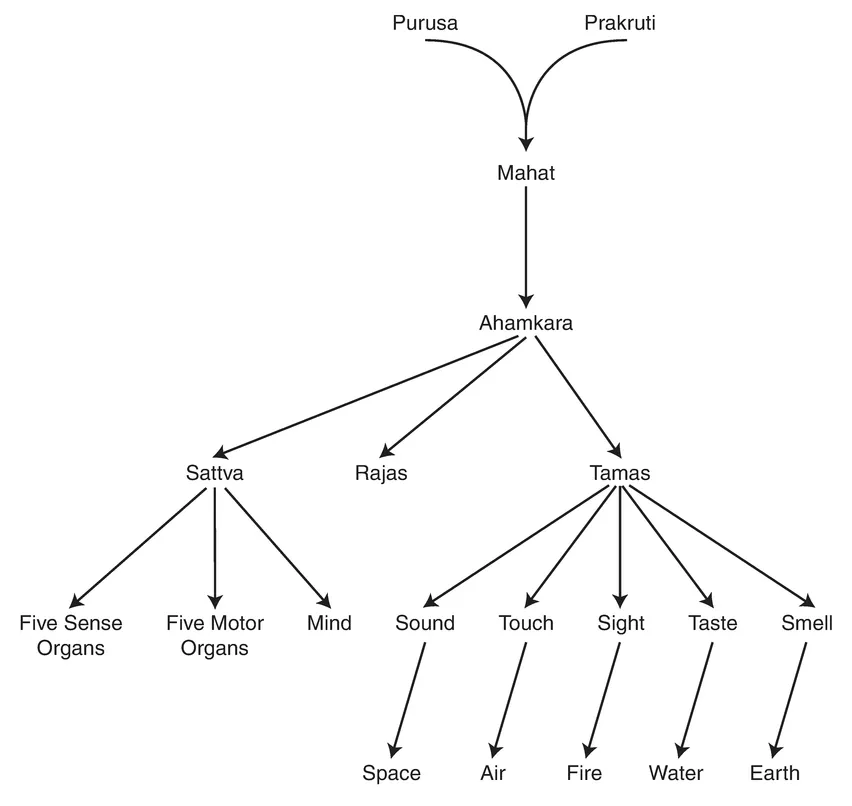
Figure 1.1The cosmology of Samkhya
The Triguna
Samkhya teaches that Prakruti has three gunas, or primary attributes, Sattva, Rajas and Tamas. These principles are said to exist behind all substances in the universe and account for the diverse range of objects in experience. Sattva is the principle of harmony and brings lasting happiness. Rajas is the principle of dynamism and brings pain in the long run. Ta...
Table of contents
- Cover
- Half Title
- Title Page
- Copyright Page
- Contents
- Preface
- Acknowledgements
- Contributors
- Foreword
- Introduction The evolving medical paradigm
- Part 1 Philosophies of healing
- Part 2 Healing modalities
- Conclusion Challenges facing integrated medicine
- References
- Index
Trusted by 375,005 students
Access to over 1.5 million titles for a fair monthly price.
Study more efficiently using our study tools.
Frequently asked questions
Yes, you can cancel anytime from the Subscription tab in your account settings on the Perlego website. Your subscription will stay active until the end of your current billing period. Learn how to cancel your subscription
No, books cannot be downloaded as external files, such as PDFs, for use outside of Perlego. However, you can download books within the Perlego app for offline reading on mobile or tablet. Learn how to download books offline
Perlego offers two plans: Essential and Complete
- Essential is ideal for learners and professionals who enjoy exploring a wide range of subjects. Access the Essential Library with 800,000+ trusted titles and best-sellers across business, personal growth, and the humanities. Includes unlimited reading time and Standard Read Aloud voice.
- Complete: Perfect for advanced learners and researchers needing full, unrestricted access. Unlock 1.5M+ books across hundreds of subjects, including academic and specialized titles. The Complete Plan also includes advanced features like Premium Read Aloud and Research Assistant.
We are an online textbook subscription service, where you can get access to an entire online library for less than the price of a single book per month. With over 1.5 million books across 990+ topics, we’ve got you covered! Learn about our mission
Look out for the read-aloud symbol on your next book to see if you can listen to it. The read-aloud tool reads text aloud for you, highlighting the text as it is being read. You can pause it, speed it up and slow it down. Learn more about Read Aloud
Yes! You can use the Perlego app on both iOS and Android devices to read anytime, anywhere — even offline. Perfect for commutes or when you’re on the go.
Please note we cannot support devices running on iOS 13 and Android 7 or earlier. Learn more about using the app
Please note we cannot support devices running on iOS 13 and Android 7 or earlier. Learn more about using the app
Yes, you can access Introduction to Complementary Medicine by Terry Robson in PDF and/or ePUB format, as well as other popular books in Medicina & Medicina alternativa e complementare. We have over 1.5 million books available in our catalogue for you to explore.