The opportunities and comfortable lifestyle available to most Australians have been denied to generations of Indigenous people. As a result some of Australia's original inhabitants suffer from what has been described as 'Fourth World' standards of health. This is out of place in a country that prides itself on egalitarianism and a fair go for all.
Shifting the focus from individual behaviour, to the social and political circumstances that influence people's lives and ultimately their health, helps us to understand the origins of poor health. It can also guide action to bring about change. Social Determinants of Indigenous Health offers a systematic overview of the relationship between the social and political environment and health.
Highly respected contributors from around Australia examine the long-term health impacts of the Indigenous experience of dispossession, colonial rule and racism. They also explore the role of factors such as poverty, class, community and social capital, education, employment and housing. They scrutinise the social dynamics of making policy for Indigenous Australians, and the interrelation between human rights and health. Finally, they outline a framework for effective health interventions, which take social factors into consideration.
This is a groundbreaking work, developed in consultation with Indigenous health professionals and researchers. It is essential reading for anyone working in Indigenous health.
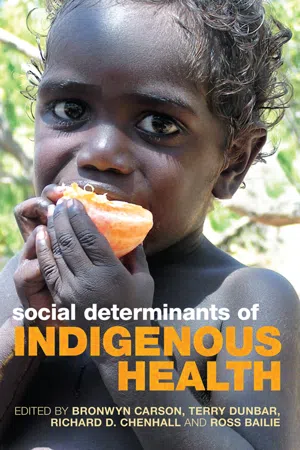
eBook - ePub
Social Determinants of Indigenous Health
- 336 pages
- English
- ePUB (mobile friendly)
- Available on iOS & Android
eBook - ePub
Social Determinants of Indigenous Health
About this book
Information
Chapter 1
Defining what we mean

The standard of health of Aboriginals [sic] is far lower than that of the majority of Australians and would not be tolerated if it existed in the Australian community as a whole.
When innumerable reports on the poor state of health are released, there are expressions of shock or surprise and outraged cries for immediate action. However, the reports appear to have no real impact and the appalling state of Aboriginal health is soon forgotten until another report is released.
The Committee found that this low standard of health in the majority of Aboriginal communities can be largely attributed to the unsatisfactory environmental conditions in which Aboriginals live, to their low socioeconomic status in the Australian community, and to the failure of health
authorities to give sufficient attention to the special health needs of Aboriginals and to take proper account of their social and cultural beliefs and practices. (House of Representatives Standing Committee on Aboriginal Affairs 1979, p. iii)
The idea that social conditions have an impact on health is sometimes difficult to assert in an era when individuals are increasingly seen as the primary agents of their own lives. In Australia at the beginning of the twenty-first century, as in all similar developed nations, citizens are regularly reminded that if they eat wisely, drink moderately and exercise more, their health will improve and the whole country will benefit economically. However, it is worth reminding ourselves that the poor health of Indigenous people in this country has long been attributed—at least in part—to the circumstances in which they live, by people occupying the opposite ends of the political spectrum. The tension between theories of health which focus their attention on individuals and their relationships, and those which seek explanations in the material conditions of people’s lives, forms the framework for this chapter.
It is true that the way in which we live—our ‘lifestyles’—influences our health to a significant extent, particularly in the case of illnesses such as cardiovascular disease and diabetes which are responsible for much morbidity and premature mortality. However, in spite of this, factors outside the control of individuals continue to have a powerful impact on health status: ‘Major socioeconomic inequalities in mortality are observed in every country that collects relevant data. These inequalities are noted for most major causes of death, across almost all age groups, and persist over time’ (Najman 2001, p. 73).
The notion that social inequalities are implicated in health inequalities is an unpalatable message for some—especially when accompanied by calls to reduce those inequalities. In the United States in the 1950s, it was argued by many that social stratification (and hence social inequality) was necessary for the development of progressive societies where social mobility was based upon merit. This type of society, it was argued, allowed the most qualified to occupy positions of power and status, and provided an incentive for those in less powerful positions to strive for upward mobility. This line of argument is currently promulgated (with little supporting evidence) in the United States, Australia and elsewhere by business interests and their neo-liberal supporters. As in the 1950s, those currently suggesting redistribution of resources are often portrayed as Marxist-inspired radicals hell-bent on the destruction of civilised ways of life (Lynch 2000).
The notion that social inequalities are implicated in health inequalities is not new. It has a history dating back at least to medieval times in Europe, where observations were made of unusually high rates of disease among miners. As John Lynch (2000, p. 7) has noted, ‘social medicine’—concerned with the association between social conditions and poor health—was undertaken from the seventeenth century in Europe. By the nineteenth century, rapid industrialisation and urbanisation, and the abysmal working and living conditions (at least among the poor), had been linked to premature mortality and diseases such as typhus. The pioneering work of people such as John Snow, who mapped cases of cholera in London and sourced infections to a public water pump, led to a recognition of the need to provide safe water and sanitation (Germov 2005; Lynch 2000).
More controversially—because of its overtly political nature—at the same time in England, Engels (1973 [1892]) was observing the link between the growth of capitalism and the declining health of the working class. He noted, for example, how diseases such as ‘black lung’ among miners appeared to be linked to the poor ventilation of mines; however, mine owners did nothing about this because of their desire to secure profits. As we will see, this approach has been taken up more vigorously at some times than at others, but it forms the basis for contemporary research and debate on the social determinants of health, which has to be examined in this political context. The debate has little to do with health as such, but rather is concerned with the way in which the specific conditions in any country produce unequal health outcomes.
THE BIOMEDICAL MODEL OF HEALTH: ITS SUCCESSES AND LIMITS
In addition to the identification of the connection between social conditions and disease, influential work was carried out which would lead to what became known as the ‘biomedical model’ of health—fundamental to which is the concept of ‘germs’. Louis Pasteur’s research in the late nineteenth century showed how variously transmitted micro-organisms caused particular diseases. The context is important here: a rapidly industrialising Europe saw frightening outbreaks and epidemics leading to mass deaths, made far worse by total ignorance of the means by which disease was transmitted. While it was starting to be recognised that social conditions were implicated in disease, isolating the way micro-organisms or ‘germs’ were spread by vectors such as rats, or through water, and then from one person to another was crucial to the development of ‘specific aetiology’—the idea that particular diseases could be traced to particular causes. It was this, for example, which led to the revolutionary idea that hygiene and sterilisation were essential in practices such as surgery to prevent the spread of disease (Germov 2005).
This work formed the foundation for the biomedical model, which conceptualised the body as similar to a machine, comprised of interrelated parts which work most of the time. When illness strikes, it is necessary to isolate the source and treat that part, in order to get the machine operating efficiently once more. Linked to this is the Cartesian belief that the physical body and the mind are two quite separate entities, and that what goes on inside the head is essentially irrelevant to what goes on inside the body. Under the influence of this model, medical interest increasingly focused on smaller units of analysis, as the instruments of medical science allowed for the observation of biological, cellular and genetic units. Experimentation then focused on the way in which interventions at each level might assist in reducing and eliminating disease—a process that, conceptually, led to the reduction of illness to a series of biological processes (Germov 2005).
The biomedical model of health has achieved some undoubted successes which, combined with the power of professional groups which controlled and promoted it, led to its dominance in medical and health theory and practice in the twentieth century. Nevertheless, it has been subject to several criticisms. First, its ‘reductionism’ has been criticised for objectifying the body at the expense of the whole person, including the ways in which individuals experience illness. Contemporary thoughts about what constitutes a person include such influences as personal history, and emotional and psychological makeup, as well as a physical body. So our own subjectivities affect who gets sick and how illness is experienced. That is, we are not simply the sum total of our biological and genetic makeup—a point taken up by holistic health practitioners throughout the world (Germov 2005).
Second, in its most elemental form, the biomedical model could not explain why, among those exposed to a particular pathogen, some became ill and others did not (for example, in the case of exposure to the tuberculosis bacillus). Throughout human history, such apparent randomness has been ascribed to supernatural forces, such as ‘God’s will’. However, for those seeking to find naturalistic explanations, interest turned to factors such as differential exposure and nutritional status, which are socially determined. Third, while the biomedical approach has made important contributions, in practice it has not been successful in reducing the heavy burden of avoidable disease, particularly in developing countries, but also among large segments of the population in many developed countries (Navarro 1974).
The biomedical model has been modified in response to such criticisms. Nevertheless, it remains focused primarily on the causal role of biological factors, with psychological and social factors seen as playing a secondary role. It is these explanatory and practical limitations that, in recent years, have led to a resurgence of interest in social models of health.
THE ORIGINS OF CONTEMPORARY SOCIAL MODELS OF HEALTH
Contemporary social models of health have many disciplinary roots, and here we draw upon those from both sociology and social epidemiology. From sociology comes the theory that health and illness are socially produced and distributed. The two great nineteenth-century influences on sociology, Durkheim (1933) and Marx (1904, 1957, 1976), each demonstrated the way in which the distribution of illness and disease was related to social conditions, although they drew very different conclusions from their work. Marx saw the exploitation of workers by the owners of productive resources (raw materials and capital, which he termed the ‘means of production’) as fundamental to the poorer health of working people. Durkheim, however, focused on the changing nature of social relationships that was occurring as a result of industrialisation. This involved the shift from intimate face-to-face contact typical in pre-industrial villages (gemeinschaft, or mechanical solidarity) to the more atomistic relationships (geselleschaft, or organic solidarity) which came about with occupational specialisation and factory-based rather than home-based work.
Their cures for the social and health ills of society reflected this distinction. For Marx, change would only occur when members of the exploited class—the ‘proletariat’—became conscious of their class position and their economic and social exploitation, then organised and overthrew the owners of capital. This would lead to the creation of an egalitarian society in which resources were more evenly distributed. Thus an awareness of the structural inequality in society was necessary. For Durkheim, it was systems of belief, such as organised religion, which provided protection against the alienation of industrialisation. Modern societies, he claimed, were relinquishing traditional religions without finding satisfying substitutes which provided social solidarity, social control, psychological support and systems of meaning. Within sociology, these two positions have come to represent, respectively, conflict and functionalist perspectives on society and social change. The work of Marx and Durkheim has directly, or indirectly, influenced those working on the ‘structural determinants’ of health on the one hand and those working on the ‘psychosocial determinants’ of health on the other.
European research
For those working in the area of health rather than sociological disciplines, the contemporary social model of health has many roots, but its British links can be traced to the rebirth of social epidemiology in Britain from the 1940s and characterised by country-wide, or ecological, empirical studies of the relationship between social factors such as unemployment and diseases such as rheumatic heart disease. The establishment of the British Journal of Social Medicine in 1947 reflected the growing importance of this type of work. Even earlier, however, Scandinavian researchers had been investigating the links between poverty and ill-health and laying the foundations for the development of progressive social policies designed to reduce economic and hence health inequalities (Lynch 2000).
In the 1970s, there was a resurgence of interest in the social origins of disease—the very same associations noted a hundred years before in Europe. Research demonstrated that it was rising living standards, not medical interventions, which accounted for the greatest ...
Table of contents
- Cover
- Half Title
- Title Page
- Copyright Page
- Contents
- Figures, tables and boxes
- Contributors
- Acknowledgments
- Note on photographs
- Introduction
- 1 Defining what we mean
- 2 Understanding the processes
- 3 History
- 4 Racism
- 5 Poverty and social class
- 6 Social capital
- 7 Education
- 8 Employment and welfare
- 9 Country
- 10 Housing
- 11 Policy processes
- 12 Human rights
- 13 Interventions and sustainable programs
- Index
Trusted by 375,005 students
Access to over 1.5 million titles for a fair monthly price.
Study more efficiently using our study tools.
Frequently asked questions
Yes, you can cancel anytime from the Subscription tab in your account settings on the Perlego website. Your subscription will stay active until the end of your current billing period. Learn how to cancel your subscription
No, books cannot be downloaded as external files, such as PDFs, for use outside of Perlego. However, you can download books within the Perlego app for offline reading on mobile or tablet. Learn how to download books offline
Perlego offers two plans: Essential and Complete
- Essential is ideal for learners and professionals who enjoy exploring a wide range of subjects. Access the Essential Library with 800,000+ trusted titles and best-sellers across business, personal growth, and the humanities. Includes unlimited reading time and Standard Read Aloud voice.
- Complete: Perfect for advanced learners and researchers needing full, unrestricted access. Unlock 1.5M+ books across hundreds of subjects, including academic and specialized titles. The Complete Plan also includes advanced features like Premium Read Aloud and Research Assistant.
We are an online textbook subscription service, where you can get access to an entire online library for less than the price of a single book per month. With over 1.5 million books across 990+ topics, we’ve got you covered! Learn about our mission
Look out for the read-aloud symbol on your next book to see if you can listen to it. The read-aloud tool reads text aloud for you, highlighting the text as it is being read. You can pause it, speed it up and slow it down. Learn more about Read Aloud
Yes! You can use the Perlego app on both iOS and Android devices to read anytime, anywhere — even offline. Perfect for commutes or when you’re on the go.
Please note we cannot support devices running on iOS 13 and Android 7 or earlier. Learn more about using the app
Please note we cannot support devices running on iOS 13 and Android 7 or earlier. Learn more about using the app
Yes, you can access Social Determinants of Indigenous Health by Bronwyn Carson,Terry Dunbar,Richard D Chenhall,Ross Bailie in PDF and/or ePUB format, as well as other popular books in Social Sciences & Social Science Biographies. We have over 1.5 million books available in our catalogue for you to explore.