Health services practice or working with clients facing health issues requires diverse approaches and wide-ranging knowledge. In this ground-breaking book Melissa Petrakis draws on the experience and expertise of leading researchers and practitioners to provide a guide to the disparate settings in which social workers are engaged and the conceptual frameworks and skills needed for effective practice.The book begins by examining the nature of health social work and considers its core values and principles. This section also provides an overview of the social determinants of health. Part 2 explores key areas of practice including working with children, mothers and families, hospital-based social work, domestic and family violence, mental health, dual diagnosis, forensic social work, Indigenous approaches to health, oncology and aged care. Part 3 looks at politicised issues in the field including working with people living with disability, refugee health and concludes by considering how a focus on well-being informed by Maori approaches could provide new insights into better practice. Underpinning the book throughout is a clear guide to assessment procedures, case management, strengths-based practices and developing effective partnerships and collaboration. Social Work Practice in Health is destined to become a key reference tool for social work students and practitioners, providing practical, evidence-based and insightful approaches.
eBook - ePub
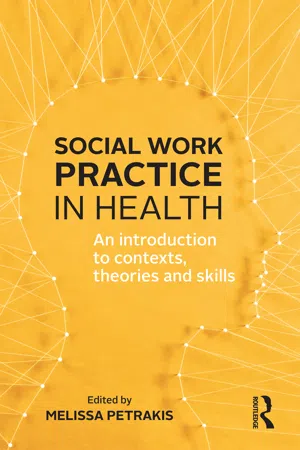
Social Work Practice in Health
An introduction to contexts, theories and skills
- 336 pages
- English
- ePUB (mobile friendly)
- Available on iOS & Android
eBook - ePub
About this book
Information
Part I:
What is health social work? Role, values and principles for practice
1
An introduction to health and health services practice, and the social determinants of health
Melissa Petrakis and Carrie Lethborg
Introduciton
This chapter will provide definitions of health and describe prevailing assumptions about health and illness. It will examine patterns of health and illness in society and the role and skills of social work to contribute in this area of practice. Challenges in and to our work will also be examined. The chapter will then move to a description of the social determinants of health. Social exclusion and its impacts will be explored, as will social disadvantage. Discrepancies in health outcomes for Aboriginal and Torres Strait Islander peoples will be particularly highlighted.
Definitions of health
In 1955 the World Health Organization (WHO) convened a study group to review experience and knowledge on indices and measures for assessment of health, discuss the concept of health and factors affecting health, and basic elements, possible indicators of health, and needs. In their deliberation, published in 1957, importantly they defined health (p. 8) as: 'a condition or quality of the human organism expressing the adequate functioning of the organism in given conditions, genetic and environmental.
This definition represented a significant shift away from a focus on health as a physical or biological condition alone, predominant since the mid-nineteenth century in Western nations (Sheridan & Radmacher 1992). Health so defined is no longer solely equated with die absence of illness, and health care with die fight against disease. Health, according to the 1957 WHO definition, was instead defined in terms of functioning, so even though individuals may not be in a state of complete physical, mental or social wellbeing, if they were functioning adequately then they may be said to be healthy. An example of this might be an individual with diabetes who maintains their required medications and consequently feels healthy, and functions adequately in daily life, and participates in the community.
A medicalised view of health leads to a narrower focus for understanding the complex dimensions that shape health and illness. Grbich (2004) argues that as long as health is seen as entirely biologically determined, and health care conceptualised as the provision of medical services that provide clinical and technological solutions, then important connections between health and the social and economic environments in which it occurs are not made.
Understandings of health and illness are constantly evolving concepts shaped by prevailing attitudes, beliefs, socio-cultural and historical events, social standards and changes to technical and medical knowledge. For example, Indigenous health is not split into the mind/body dichotomy but is holistic and the outcome of a complex interplay between individual, place of birth (and the place of birth of one's ancestors) and spiritual integrity (Grbich 2004). Health practices also vary according to religious practices; for example, the acceptance or non-acceptance of male and female circumcision. Practices that were acceptable in the 1950s (for example, the common practice of removing tonsils in children experiencing recurrent throat infections [Hultcrantz & Ericsson 2013]), are no longer acceptable today.
Definitions of health and illness, disease and disability are important to enable a common understanding. They are also used in law, in order to decide who is eligible for particular benefits and services. It is important, though, to consider any definition or diagnostic classification within the context of the assumptions and ideology that underpins it (Frone et al. 1995). Any definition or diagnosis should not be considered in isolation from the social, political, economic or biological circumstances from which it is created, and this includes considerations of the influence of age, gender, culture and ethnicity and individual developmental stage including cognitive, moral, psychosocial and physical factors.
Prevailing assumptions about health and illness
It is important to consider what assumptions a society makes about health and illness. Who has been influential in developing these assumptions or standards and how have they become commonly accepted?
Two prevailing assumptions include:
- People choose to be sick or well. This belief is located in deviancy models (Kleinman 1978), whereby people are said to be motivated to be sick in order to be able to be dependant. The belief here is that disease arises because there is something intrinsically wrong with the individual, as the body is an extension and expression of the inner self. Aspects of this belief system are seen in positions taken, for example, on chronic fatigue syndrome, where some health professionals believed it was a psychosomatic condition (Ware 1992) because they could find no physical evidence of its existence using standard medical testing.
- It is best to express dis-ease through physical conditions. This illustrates the mind-body split where physical disease is treated as more acceptable than emotional disease (Mehta 2011). Society can confer a degree of acceptability on illness—the sick role—that may encourage people to express life problems physiologically and seek medical solutions for them; for example, 'Mediterranean back'(Rubinstein 1982) or Munchausen by proxy. Some alternative health groups have utilised this belief positively, focusing on the benefits of relaxation, meditation and diet as ways of healing the inner self and therefore the expressed illness.
Each society determines what it regards as normal or healthy and these decisions change over time. For example, childbirth in the 1940s through to the 1960s took on the characteristics of illness as hospitals and medical services took over responsibility for childbirth. This could be said to be a response to high levels of mortality and the availability of services to safely deliver children. But it could also be understood in terms of the dominance and emergence of particular professions, such as obstetricians having power over midwives, and the cultural dominance of taking childbirth out of the realm of women and the family. Associated with this there was also an increased use of pain relief and caesarean. Attitudes to childbirth today are significantly different, and pregnancy and childbirth are seen as health states not illness. This change may have been influenced by healthier women, the feminist and consumer rights movements, escalating hospital costs and the emergence of economic rationalism.
Patterns of health and illness
The social organisation of society is closely connected with health and illness. An individual's health status is not just a result of physical health, or the presence or absence of disease; it is the consequence of the interaction between lifestyle, biological, environmental and socio-cultural factors.
The Ottawa Charter for Health Promotion (WHO 1986) addressed health in terms of social capital:
To reach a state of complete physical mental and social wellbeing, an individual or group must be able to identify and to realize aspirations, to satisfy needs, and to change or cope with the environment. Health is, therefore, seen as a resource for everyday life, not the objective of living. Health is a positive concept emphasizing social and personal resources, as well as physical capacities. Therefore, health promotion is not just the responsibility of the health sector, but goes beyond healthy lifestyles to wellbeing.
The fundamental conditions and resources for health are peace, shelter, education, food, income, a stable ecosystem, sustainable resources, social justice and equity.
Improvement in health requires a secure foundation in these basic prerequisites.
The enjoyment of the highest attainable standard of health is one of the fundamental rights of every human being without distinction of race, religion, political belief, economic or social condition.
(Article 57 charter of the UN)
This charter clearly outlines the resources required to achieve good health, but unfortunately in many countries these resources do not exist.
In Australia we have a relatively good health status, with the exception of the Indigenous population (discussed in Chapter 11), refugees in detention (discussed in Chapter 15) and some older people (discussed in Chapter 13). Improvements in public health measures, socio-economic conditions and education, particularly through health promotion campaigns, have produced an overall increased lifespan in our society (Australian Institute of Health and Welfare 2017). Public health initiatives have eradicated many epidemic diseases and now many diseases of concern are those related to lifestyle changes over the most recent two generations; for example, respiratory illness, heart disease, accidents and obesity (Zammit et al. 2010). Public health promotion campaigns that have been influential on our thinking about health and illness in Australia have included the Quit campaign; the Safe Sex campaigns, including the Grim Reaper AIDS campaign of the 1980s; Beyondblue, the national depression initiative; and the Slip Slop Slap campaign, concerned with skin cancer prevention.
Many chronic illnesses are also illnesses of ageing, and with increased lifespan yet falling fertility rates there is a proportional increase in the aged in societies in Western industrialised nations. In Australia 35 per cent of the population (7 million people) sufFers from one or more chronic illnesses: asthma, type 2 diabetes, coronary heart disease, cerebrovascular disease (largely stroke), arthritis, osteoporosis, chronic obstructive pulmonary disease (COPD), depression or high blood pressure (Australian Institute of Health and Welfare 2014). These are large numbers of people and are conditions largely managed in the community; social work potentially has an important role to play here.
Epidemiology provides information about patterns of illness. It deals with the incidence, aetiology (cause), distribution, effects and control of disease in populations. It has been pivotal in providing information about the relationship between risk factors, such as smoking and lung cancer, drinking infected water and disease and unsafe sexual practices and sexually transmitted diseases. More recently it has extended its boundaries from the purely physical diseases to social contributors to disease and illness, such as the effect of gender, poverty, culture and class.
Resources are not the only factor at play regarding social inequalities in health; rather, it is a more complex issue involving factors such as geography, gender, ethnicity and health experiences. Wilkinson and Marmot (2003) in the Social Determinants of Health suggest poverty, social inequality and social exclusion are the most important determinants of vulnerability regardless of delivery of medical care or culture. There is thus a relationship between health and unemployment, ethnicity, occupation, income, gender, geography, poverty and Aboriginality (Australian Institute of Health and Welfare 2014).
If health and illness are not just issues of physiology and provision of resources but are influenced by significant non-biological factors (such as lifestyle, environment, socio-economic conditions and socio-cultural context), then social workers need to concern themselves with those whose life experiences are detrimental to good health. They need to assist those who lack the resources to deal with the structures that positively affect their health. Social workers also need to ensure that health interventions developed for the community address inequalities, and that health policies acknowledge the structural basis of health problems and are not confined to medical and technological solutions.
The role of social work
Social workers have a role in the wider decision-making about community health issues, and this may involve taking a political stand. For example, the Australian Association of Social Workers (AASW) has taken a stand on the health problems of refugees in detention (AASW 2016), Aboriginal health and poverty (to name a few issues). As part of National Close the Gap Day on 20 March 2014, Anita Phillips (AASW board director) and Glenys Wilkinson (AASW CEO) signed on behalf of the AASW a Statement of Int...
Table of contents
- Cover
- Title
- Copyright
- Contents
- Author biographies
- List of figures and tables
- Preface
- Part I: What is health social work? Role, values and principles for practice
- Part II: Health practice and practice contexts
- Part III: Politicised issues in health practice
- Index
Trusted by 375,005 students
Access to over 1.5 million titles for a fair monthly price.
Study more efficiently using our study tools.
Frequently asked questions
Yes, you can cancel anytime from the Subscription tab in your account settings on the Perlego website. Your subscription will stay active until the end of your current billing period. Learn how to cancel your subscription
No, books cannot be downloaded as external files, such as PDFs, for use outside of Perlego. However, you can download books within the Perlego app for offline reading on mobile or tablet. Learn how to download books offline
Perlego offers two plans: Essential and Complete
- Essential is ideal for learners and professionals who enjoy exploring a wide range of subjects. Access the Essential Library with 800,000+ trusted titles and best-sellers across business, personal growth, and the humanities. Includes unlimited reading time and Standard Read Aloud voice.
- Complete: Perfect for advanced learners and researchers needing full, unrestricted access. Unlock 1.5M+ books across hundreds of subjects, including academic and specialized titles. The Complete Plan also includes advanced features like Premium Read Aloud and Research Assistant.
We are an online textbook subscription service, where you can get access to an entire online library for less than the price of a single book per month. With over 1.5 million books across 990+ topics, we’ve got you covered! Learn about our mission
Look out for the read-aloud symbol on your next book to see if you can listen to it. The read-aloud tool reads text aloud for you, highlighting the text as it is being read. You can pause it, speed it up and slow it down. Learn more about Read Aloud
Yes! You can use the Perlego app on both iOS and Android devices to read anytime, anywhere — even offline. Perfect for commutes or when you’re on the go.
Please note we cannot support devices running on iOS 13 and Android 7 or earlier. Learn more about using the app
Please note we cannot support devices running on iOS 13 and Android 7 or earlier. Learn more about using the app
Yes, you can access Social Work Practice in Health by Melissa Petrakis in PDF and/or ePUB format, as well as other popular books in Scienze sociali & Lavoro in ambito sociale. We have over 1.5 million books available in our catalogue for you to explore.