Stammering Resources for Adults and Teenagers
eBook - ePub

Stammering Resources for Adults and Teenagers

Integrating New Evidence into Clinical Practice

  1. 244 pages
  2. English
  3. ePUB (mobile friendly)
  4. Available on iOS & Android
eBook - ePub

Stammering Resources for Adults and Teenagers

Integrating New Evidence into Clinical Practice

About this book

This comprehensive and practical resource is a second volume to the highly influential Dysfluency Resource Book (2010). It brings together the very latest developments in the field of stammering and dysfluency in adults and teenagers and builds upon some of the approaches explored in the Dysfluency Resource Book. The book draws on the expert knowledge of contributors from a wide range of fields, such as specialist speech and language therapy, education, psychology and youth work, with a focus on presenting practical guidance for those working in this complex area.

This valuable resource:

• Has chapters exploring the latest clinical developments, such as acceptance and commitment therapy (ACT) and narrative therapy.

• Provides in-depth discussion of some established therapeutic practices, including avoidance-reduction therapy and group work.

• Offers concrete application to theory, both the social and medical models, guiding the reader on how to integrate new evidence into clinical practice.

• Provides a wealth of activities and photocopiable handouts that can be used in practice.

Designed for clinicians and students working with teenagers and adults who stammer, this flexible and practical book embeds an ethos of reflection and adaptation. The detailed overview of therapeutic approaches allows the reader to explore a wide range of techniques, building a strong foundation of knowledge from which to tailor and develop their own practice.

Frequently asked questions

Yes, you can cancel anytime from the Subscription tab in your account settings on the Perlego website. Your subscription will stay active until the end of your current billing period. Learn how to cancel your subscription.
At the moment all of our mobile-responsive ePub books are available to download via the app. Most of our PDFs are also available to download and we're working on making the final remaining ones downloadable now. Learn more here.
Perlego offers two plans: Essential and Complete
  • Essential is ideal for learners and professionals who enjoy exploring a wide range of subjects. Access the Essential Library with 800,000+ trusted titles and best-sellers across business, personal growth, and the humanities. Includes unlimited reading time and Standard Read Aloud voice.
  • Complete: Perfect for advanced learners and researchers needing full, unrestricted access. Unlock 1.4M+ books across hundreds of subjects, including academic and specialized titles. The Complete Plan also includes advanced features like Premium Read Aloud and Research Assistant.
Both plans are available with monthly, semester, or annual billing cycles.
We are an online textbook subscription service, where you can get access to an entire online library for less than the price of a single book per month. With over 1 million books across 1000+ topics, we’ve got you covered! Learn more here.
Look out for the read-aloud symbol on your next book to see if you can listen to it. The read-aloud tool reads text aloud for you, highlighting the text as it is being read. You can pause it, speed it up and slow it down. Learn more here.
Yes! You can use the Perlego app on both iOS or Android devices to read anytime, anywhere — even offline. Perfect for commutes or when you’re on the go.
Please note we cannot support devices running on iOS 13 and Android 7 or earlier. Learn more about using the app.
Yes, you can access Stammering Resources for Adults and Teenagers by Trudy Stewart in PDF and/or ePUB format, as well as other popular books in Education & Education General. We have over one million books available in our catalogue for you to explore.

Information

Publisher
Routledge
Year
2020
eBook ISBN
9780429558863
Edition
1

1
The art and practice of being a clinician working with individuals who stammer

Trudy Stewart and Margaret Leahy

Introduction: consideration of the clinician choosing to work in dysfluency

We have met and collaborated with many clinicians across several decades. This experience has led to questions regarding the nature of the therapist who finds herself or chooses to work with dysfluent clients. Is there a particular “type” of clinician or an adopted style that works better within the fluency specialism and with individual PWS?
In this chapter the development of clinical skills will be explored, with particular emphasis on interpersonal behaviours. Various professional guidelines will be examined for indicative characteristics considered to be important. The remainder of the chapter is concerned with defining and describing specific attributes and ways of interacting, the nature of the therapeutic relationship and intrapersonal behaviour.

Developing skills

Moving towards graduation: There are many stages along the way to becoming a therapist: some have signposts, written in a language one can read, while others arise in a person’s thinking, generated by a sense of altruism, of wanting to make a contribution, and there are those that appear more opportunistically, like a door that opens, inviting entry.
The phases with signposts include undergraduate and post-graduate experiences. The journey towards graduation as a therapist encompasses a growing awareness of an individual’s personal attributes, therapeutic interests and qualities.
The development of a clinician-scientist’s knowledge, skills and attitudes generally follow a hierarchy, with overlap across the stages:
a Student clinician as a listener–observer
At this stage, learning to listen is of central importance, with its accompanying responsibility of interpretation, an investigative, questioning approach which is attuned to a client’s information.
b Student clinician as assessor and diagnostician
Here the listener–observer becomes adept in assessment, evaluation and the processes involved in diagnostics: data collection via interviewing, testing, analysis, leading to differential diagnosis and naming of the problem. In dysfluency studies, a student acquires knowledge regarding causative factors and clear descriptions and definitions of non-fluency/developmental dysfluency, stammering/stuttering, cluttering, acquired stammering (idiopathic and neurogenic).
c Student clinician engaging in the application of science in clinic, with supervision
At this point, experienced, trained supervisors assume the role of supervising a student in applying theory to practice and developing clinical skills to work effectively with clients.
A student interacts with clients, learns to introduce specific topics to build upon client strengths and facilitates the acquisition of skills and strategies for her communication needs.
d Student as clinician–scientist, becoming an autonomous professional SLT
A therapist who is a clinical scientist has the scientific knowledge and skills that can be applied to evidence-based clinical decision making. The clinical element refers to the art of practice with good communication skills and with informed ethical action and social responsibility. The scientific element presupposes a therapist who critically interprets, reflects upon and contributes toward the evolving theoretical knowledge base in her area of work, often through original research.
Developing a specialism: In developing skills as a clinical scientist working with PWS, Shapiro (1999) suggests a model with a series of phases:
  • Early developmental level: in which the clinician has her own view of the client’s issues and sees herself as in control of the client’s change process. She tends to focus on a limited number of issues and has few problem-solving strategies and limited flexibility to modify the therapeutic direction.
  • More advanced clinical development: here the clinician is able to incorporate the client’s understanding of his problem into intervention and the change process. She considers stammering as a multidimensional problem, including thoughts, feelings and behaviours, and has several intervention strategies at her disposal. She is also able to reflect upon and modify the process as it proceeds.
Expanding Shapiro’s model, we suggest the most advanced clinician is able to hand over control of the change process to the client, enabling him to identify the issues to be changed, the means by which change will occur, reflecting with him on the process and jointly determining what and how modifications should be made. There is a significant shift in attitude, with the client seen as the expert in his problem and in finding his own solution, ultimately being his own therapist.

On “being” a clinician: exploring some characteristics

There are several ways of understanding what is necessary to be the best, most effective clinician working with PWS: using professional guidelines, looking at the research evidence, critically appraising best practice. This section will explore all of these areas in an attempt to understand the nature of the clinician working with PWS.

What professional guidelines suggest

There are documents which specify the competencies, knowledge and understanding required for working clinically with a PWS (e.g. RCSLT Clinical Guidelines 2005). However, often such documents fail to address issues concerning personal characteristics and attributes a clinician brings to the therapeutic process and which can be crucial in achieving desired outcomes. For example, for a clinician in the USA, can refer to the ASHA Special Interest division on Fluency and Fluency Disorders “Guidelines for Practice in Stuttering Treatment” for details of clinician attributes (which is based on the Texas Speech & Hearing Association Fluency Task Force’s list of “Personal Clinician Competencies”). This document lists:

Personal Attributes

  • Has good problem-solving skills and uses them when things do not go according to plan in evaluation and treatment.
  • Is flexible in thinking and planning.

Learned Attributes

  • Has an understanding and appreciation of the basic processes of dynamic clinical interaction, such as transference, denial, grief, victimization.
  • Can communicate relevant ideas about stuttering to clients and their families.
  • Has a general working knowledge of psychopathology.
  • Has a general working knowledge of cognitive and behavioral learning theory.
(ASHA 1999)

How should a clinician “be” when working with a PWS?

As valid as these attributes and undergraduate/Shapiro’s model of development may be, neither address fundamental questions which a clinician who is starting to work in the field of dysfluency might ask:
  • How should I be while working with a client who has a stammer? When should I challenge, probe, reflect on what has been said?
  • What sort of relationship is effective with this client?
  • Is this any different from how I am when I work with any other client?
  • Does it make any difference how I am with a client to the therapy process?
One might consider such questions as unnecessary and possibly the result of clinical inexperience. However, they are important, as research clearly shows that how a clinician is with a client does make a difference. In fact, it is considered to be one of, if not the most important factor in determining good therapeutic outcomes, and this is regardless of the management approach being used (Van Riper 1975, Cooper and Cooper 1985, Shapiro 1999).
Emerick (1974) puts this very clearly:
After laboring with stutterers for over a decade I am convinced that it is not only what I do that helps the person get better but also how I do it and who I am.
(pp. 92–93)
In the context of psychological change, other researchers have talked recently about the characteristics of an effective clinician. Wampold (2015) discussed the factors that differentiated effective from a less effective therapist. He stated:
Studies have shown that effective therapists (vis-Ă -vis less effective therapists) are able to form stronger alliances across a range of patients, have a greater level of facilitative interpersonal skills, express more professional self-doubt, and engage in more time outside of the actual therapy practicing various therapy skills.
(p. 273)
It seems pertinent, therefore, to delineate the factors that contribute to interpersonal skills for a clinician working with a PWS. In this chapter we will also provide a means of practising these skills outside a therapeutic context.
While we underline the importance of these issues, we would also urge a clinician not to regard them as part of “the recipe” for successful intervention. There is not one single set of techniques or strategies that should be applied to each and every therapeutic encounter. A therapist should engage with each client individually, adopting a flexible and responsive approach. Owen and Hilsenroth (2014) found evidence that a rigid adherence to a particular protocol caused issues with the therapeutic alliance and increased resistance to the treatment. They concluded that a more flexible approach related to better outcomes for the client.
Returning to our questions of how a clinician might be when working with dysfluent clients: In order to consider the multitude of significant factors in a therapeutic exchange we propose subdividing this s...
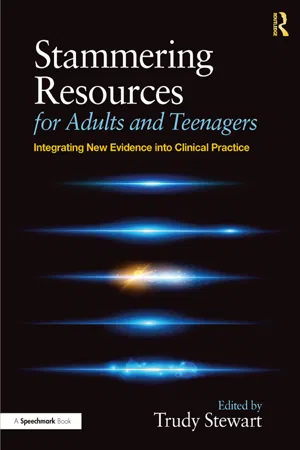
Table of contents

  1. Cover
  2. Half Title
  3. Title Page
  4. Copyright Page
  5. Dedication Page
  6. Contents
  7. List of figures, tables and resources
  8. Acknowledgements
  9. Foreword
  10. Introduction
  11. 1 The art and practice of being a clinician working with individuals who stammer
  12. 2 Service delivery
  13. 3 Stammering and voice
  14. 4 Narrative practice: identifying and changing problem stories about stammering
  15. 5 Principles of avoidance-reduction therapy
  16. 6 Integrating mindfulness into therapy with people who stammer
  17. 7 Integrating acceptance and commitment therapy into stammering therapy
  18. 8 Working together: the power of the therapeutic group
  19. 9 Working with self-help groups
  20. Index