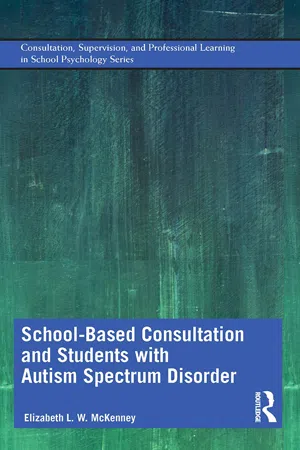
School-Based Consultation and Students with Autism Spectrum Disorder examines the preventive and remedial powers of consultation for indirectly supporting the needs of youth with Autism Spectrum Disorder (ASD), through collaborating with their parents and educators. Given the unprecedented numbers of students with ASD in schools, and the variety of evidence-based interventions currently available, consultation helps ensure appropriate service delivery across the range of student functioning. Focusing on foundational knowledge and skills that school consultants need to incorporate ASD service delivery into their research and practice, this text addresses consistent and effective service delivery for students with ASD to optimize their positive academic, behavioral, adaptive, and social communicative outcomes. Highlighting relevant cross-cultural research throughout its chapters, the book concludes with a section on future directions in the field that includes areas for improvement in meeting the needs of diverse students, families, and schools.
eBook - ePub
School-Based Consultation and Students with Autism Spectrum Disorder
- 256 pages
- English
- ePUB (mobile friendly)
- Available on iOS & Android
eBook - ePub
School-Based Consultation and Students with Autism Spectrum Disorder
About this book
Information
PART I
The Intersection of Consultation and Autism Spectrum Disorder
1
Issues and Trends in School-Based Consultation
At its most basic, consultation is occurring when a specialist works with a caregiver to affect change for a third party. Thus, consultation is an indirect service, in which the specialist rarely or never works directly with the third-party client (Caplan, 1970; Erchul & Sheridan, 2014). In school-based consultation, the specialist is usually a school psychologist, special education teacher, someone with behavioral intervention expertise, or another mental health provider. Those with whom school-based consultants (SBCs) work – teachers, parents, administrators, other educators, and/or family members – are referred to as consultees. In this text, several other features are considered essential to the definition and practice of school-based consultation:
- The specialist in the role of SBC has unique and valuable insight and/or expertise into the challenge faced by the consultee (the reason that the consultee and SBC are collaborating; Erchul & Martens, 2010).
- The SBC also has training and experience acting in a consultant role, for which they have received/are receiving professional supervision (Newman & Rosenfield, 2019).
- As such, the SBC has a set of procedures, based on a problem-solving model, through which they guide the consultee/s (Erchul & Martens, 2010; Newman & Rosenfield, 2019).
- Simultaneously, the SBC is skilled and comfortable with making modifications to the consultation procedures, as needed, to ensure that the team achieves its consultation aims (Schulte, Murr, Tunstall, & Mudholkar, 2014).
Of course, there are as many slightly varying definitions of school-based consultation as there are articles, chapters, and books written on the topic. Readers using this text who are not already familiar with the breadth of school-based consultation literature are encouraged to seek sources from the following bibliography of key works.
- Behavioral Consultation in Applied Settings: An Individual Guide (Kratochwill & Bergan, 1990),
- Building Competence in School Consultation (Newman & Rosenfield, 2019),
- Conjoint Behavioral Consultation: Promoting Family-School Connections and Interventions (Sheridan & Kratochwill, 2007),
- Handbook of Research in School Consultation, Second Edition (Erchul & Sheridan, 2014),
- School Consultation: Conceptual and Empirical Bases of Practice, Third Edition (Erchul & Martens, 2010),
- Theory and Practice of Mental Health Consultation (Caplan, 1970).
Text Organization
Several skillsets are needed to effectively support the needs of students with ASD in schools. The organization of this text is intended to systematically increase readers’ knowledge in those domains. First, one must possess knowledge of what ASD is and what interventions are effective to address its core features and related areas of concern. The core symptoms of ASD, other symptoms commonly experienced by people with ASD, and the way that they all affect the development, learning, behavior, and social-emotional functioning of students with ASD are examined in Chapter 2. In Chapter 3, readers will become familiar with our current understanding of effective interventions to treat those symptoms. Thus, readers are encouraged to proceed through the early chapters (Chapter 2 and Chapter 3) before reading later chapters, which discuss specific consultation models and types of collaboration common to working in schools to support students with ASD. The remaining portions of the book are designed to increase professionals’ knowledge of how to help students with ASD by helping their teams (i.e., families and educators) to meet their needs. Chapters 4 through 6 cover specific models of consultation and discuss how they may be used when supporting students with ASD. Chapter 4 reviews problem-solving consultation (also called behavioral consultation), which is at the basis of most other contemporary forms of consultation. Chapter 5 extends into Conjoint Behavioral Consultation (CBC), which has a particular focus on involving students’ families in consultation and improving home-school connections. Then, Chapter 6 considers Consultee-Centered Consultation (CCC), which emphasizes a strong collaborative relationship between the consultant and consultee, thereby increasing consultees’ ability to respond effectively to the current challenge and similar future challenges. In each of these chapters, specific issues and needs that arise in consulting for students with ASD are highlighted and explored. In Chapter 7, readers become familiar with the broader network of community-based supports available to students with ASD, and effective methods through which to partner with such providers are considered. Finally, Chapter 8 examines how systemic efforts to support students at school (i.e., multi-tiered systems of support) can be used to identify and treat the full range of needs that students with ASD may have. Chapter 9 ends the book with a consideration of several future challenges and opportunities for consultation and students with ASD.
Beginning in Chapter 4 and continuing through Chapter 8, readers will note that most chapters contain one or more tables entitled “Tools for Collaboration,” which highlight strategies, data collection tools, and other methods that SBCs can use to support their work with students with ASD. Each of these chapters also contains a section called “Focus on Culture,” which delves into specific considerations about working with individuals possessing one or more non-dominant identities, specific to topics germane to that chapter. Much work remains to be done to increase our knowledge of how the assessment, intervention, and consultation activities that we undertake with children and adolescents with ASD are broadly applicable to students and families across socioeconomic status levels, racial/ethnic identity, sexual orientation, native language, nationality, acculturation status, gender/gender identity, and other ways in which individuals identify culturally (e.g., religion). The “Focus on Culture” sections in this text are designed as starting points, from which readers can begin their own continuous development in examining how aspects of identity affect our work with individuals with ASD. See also the “Preface” of this text for a discussion of how ASD itself is an important identity feature for many.
Remember that the most ethical way to engage in new professional activities is to receive careful supervision or consultation from a more experienced colleague prior to and while engaging in the work (APA, 2017; NASP, 2010). Thus, readers are encouraged to seek out opportunities to work with children and adolescents with ASD, so that they can become familiar with what ASD is and the myriad ways that students may demonstrate symptoms. It is also helpful to observe systematic, evidence-based work with students with ASD. Then, those wishing to engage in consultation to support students with ASD can attempt the strategies described in this text to ensure that services are delivered effectively. There are many helpful experiences for novice professionals interested in building ASD expertise. These include working under the supervision of a Board Certified Behavior Analyst (BCBA) as a frontline therapist delivering Evidence-Based Intervention (EBI) for children and adolescents with ASD, working in summer camps and treatment programs that serve children with ASD and closely related childhood conditions, such as the Summer Treatment Program (Fabiano, Schatz, & Pelham, 2014), participating in applied research projects involving youth with ASD, babysitting or nannying, working as a job coach/assistant for adults with ASD, or working as a special education classroom assistant/paraprofessional. Those already working as school-based specialists may wish to consider volunteering time in classes and programs for students with ASD, and/or increasing their work with children and adolescents with ASD in other professional domains (e.g., assessment) before taking on the role of SBC for students with ASD, if possible.
Finally, remember that like all fields, school consultation is continuously developing. New practices, findings, student needs, and community issues are emerging all the time. Wise SBCs maintain their engagement with research, professional development offerings, and professional support from peers and mentors throughout their career. With a broad understanding of the current state of school consultation and the needs of students with ASD, SBCs are ready to begin using school consultation to enhance outcomes for students with ASD and their teams. With continuous professional engagement, SBCs will be able to do so for many years to come.
The State of School Consultation Research
School consultation research is often characterized by slow and steady progress (Erchul & Sheridan, 2014). The slow pace of research in school consultation is largely attributed to consultation being a time intensive professional activity, the study of which is somewhat bedeviled by methodological challenges. Schulte et al. (2014) provide an excellent and detailed review of the way in which many of those challenges have affected school consultation research. They include inconsistencies in the degree to which school consultation researchers collect information on and describe all the relevant participant characteristics, including client, consultee, and consultant features that might moderate the effectiveness of consultation. Further, researchers have not consistently documented the degree to which various consultation investigations contain features known to strengthen internal validity across studies. Some consultation approaches occur via prescribed, manualized procedures, while others are less structured. Some school consultation researchers take care to document the extent to which consultants achieved all required steps, and others do not. School consultation researchers disagree about the extent to which aspects are largely influenced by the consultant, such as warmth and being perceived as caring, influence consultation success and, therefore, should be considered integral to consultation delivery. Even what it means to deliver a treatment with integrity is a matter of discussion, both in terms of consultants delivering consultation and consultees implementing interventions. While researchers largely agree that it means little to have implemented 100 percent of the steps in a plan if 30 percent of those steps were irrelevant to the current concern, we have little in the way of standard procedures for adapting consultation steps based on presenting needs. Some recent research in implementation support has taken on this challenge (see Chapters 4 and 6 for discussions of adapting the intensity of implementation support according to consultee need). However, much more work is needed in this area, especially in regard to adaptations to consultation procedures. Finally, operationalizing what it means for consultation to “work,” is complex, as multiple outcomes are facilitated by every consultation effort. In addition to the ultimate client outcome, other factors, such as consultees’ self-efficacy, relationship with other consultees, satisfaction with the intervention outcomes, and satisfaction with the consultation process, can all be considered target outcomes of consultation (Schulte et al., 2014). At the very least, both in research and in practice, we need to clarify when we are measuring the impact of consultation processes and procedures (e.g., consultees’ conceptualization of the student need, the potential for change, and the acceptability of participating in consultation) and when we are studying the impact of interventions supported by consultation (e.g., client changes and the perceived impact of those changes on clients’ and consultees’ daily lives).
Despite these challenges, school consultation research is also characterized by its refreshing diversity of research paradigms. While many areas of psychology, education, and related social sciences are dominated by between-groups designs that require inferential statistics to interpret their findings, several other research methodologies are common, if not more common, in school consultation research (Elliott, 2014). Readers of this text will benefit from having a working understanding of each of the three research approaches common to school consultation research: qualitative research, single case experimental research, and between-groups quantitative research.
If research is the process of building knowledge, then it is helpful to examine what it means to build knowledge. There are two ways in which humans undertake knowledge construction: inductively and deductively. The latter form of knowledge construction, deductive reasoning, is common in between-groups research containing a large number of participants. Researchers using between-groups methods examine relevant literature, create a theory (their hypothesis), and then collect evidence that they assume will either confirm or deny their hypothesis. When the collected data suggests that there is overwhelming evidence in support of their hypothesis (determined via inferential statistical analysis of the mathematical properties of that data), the researchers conclude that there is support for their theory.
In contrast, inductive reasoning is typically atheoretical. That is, using inductive techniques, such as single-case experimental or qualitative research, researchers attempt to enter into the evidence gathering and analysis process without a priori hypotheses about what that data will reveal. There are mathematical reasons for approaching research this way – there is no null hypothesis to be disproven in inductive reasoning methods. There are also conceptual reasons for being atheoretical. Especially in qualitative research, researchers are interested in what the data reveals about a particular topic or question, and take active steps to limit the extent to which their pre-existing beliefs and knowledge impact the collection and analysis process. Thus, the goal in research based on inductive reasoning is to ask general questions, collect data relevant to those questions, and then (maybe) interpret the findings. The development of a theory or a law to describe findings is optional in inductive paradigms, a phenomenon perhaps best illustrated by the relative paucity of theory in fields dominated by single case experimental research (e.g., Applied Behavior Analysis). Note that this distinction is not absolute – there are inferential statistical analyses that are conducted atheoretically (e.g., factor analysis) and single-case experimental research studies that begin with a hypothesis (e.g., “Differential reinforcement is likely to be effective in increasing on-topic speech for adolescents with ASD, given its previously established functional relationship with on-topic speech of individuals with schizophrenia.”)
In addition to being able to differentiate research methods that are inductive and those that are deductive, we can also differentiate research in terms of control over the phenomenon of interest, or the independent variable (IV). Any investigation can be characterized as one in which the researchers have some, complete, or no control over the IV. For example, in qualitative research in which researchers are observing or asking questions about an experience that participants have had or are having, researchers typically do not randomly assign participants to certain conditions. Rather, their aim is to collect and analyze information about the impact of experiencing certain conditions as naturally as possible, and to generate as much information about their selected topic as is supported by the findings. In contrast, in single case experimental research, researchers go to great lengths to ensure that they have complete control over the introduction (and, if applicable, removal) of the IV, and to limit the extent to which other variables influence the dependent variable (DV). In this sense, single case design studies are typically true experiments. Finally, in between-groups studies analyzed via inferential statistics, there is a range of control over the independent variable, from none to complete. When researchers have complete control over the introduction and removal of the IV, and are able to randomly determine who is assigned to receive it and who is not, they are typically conducting a randomized control trial (RCT), which is often considered to be the gold standard in measuring the relationship between two or more variables of interest, for its high internal and external validity (Gresham, 2014). Finally, consultation research has also benefitted from comprehensive inve...
Table of contents
- Endorsements
- Half Title
- Series Page
- Title Page
- Copyright Page
- Dedication
- Table of Contents
- List of Illustrations
- Preface
- A Note on Language
- Acknowledgments
- List of Acronyms
- PART I: The Intersection of Consultation and Autism Spectrum Disorder
- PART II: Consultation Models
- PART III: Community and Systems Collaboration
- PART IV: Future Directions
- Index
Trusted by 375,005 students
Access to over 1.5 million titles for a fair monthly price.
Study more efficiently using our study tools.
Frequently asked questions
Yes, you can cancel anytime from the Subscription tab in your account settings on the Perlego website. Your subscription will stay active until the end of your current billing period. Learn how to cancel your subscription
No, books cannot be downloaded as external files, such as PDFs, for use outside of Perlego. However, you can download books within the Perlego app for offline reading on mobile or tablet. Learn how to download books offline
Perlego offers two plans: Essential and Complete
- Essential is ideal for learners and professionals who enjoy exploring a wide range of subjects. Access the Essential Library with 800,000+ trusted titles and best-sellers across business, personal growth, and the humanities. Includes unlimited reading time and Standard Read Aloud voice.
- Complete: Perfect for advanced learners and researchers needing full, unrestricted access. Unlock 1.5M+ books across hundreds of subjects, including academic and specialized titles. The Complete Plan also includes advanced features like Premium Read Aloud and Research Assistant.
We are an online textbook subscription service, where you can get access to an entire online library for less than the price of a single book per month. With over 1.5 million books across 990+ topics, we’ve got you covered! Learn about our mission
Look out for the read-aloud symbol on your next book to see if you can listen to it. The read-aloud tool reads text aloud for you, highlighting the text as it is being read. You can pause it, speed it up and slow it down. Learn more about Read Aloud
Yes! You can use the Perlego app on both iOS and Android devices to read anytime, anywhere — even offline. Perfect for commutes or when you’re on the go.
Please note we cannot support devices running on iOS 13 and Android 7 or earlier. Learn more about using the app
Please note we cannot support devices running on iOS 13 and Android 7 or earlier. Learn more about using the app
Yes, you can access School-Based Consultation and Students with Autism Spectrum Disorder by Elizabeth McKenney,Elizabeth L. W. McKenney in PDF and/or ePUB format, as well as other popular books in Education & Education General. We have over 1.5 million books available in our catalogue for you to explore.