- English
- ePUB (mobile friendly)
- Available on iOS & Android
eBook - ePub
About this book
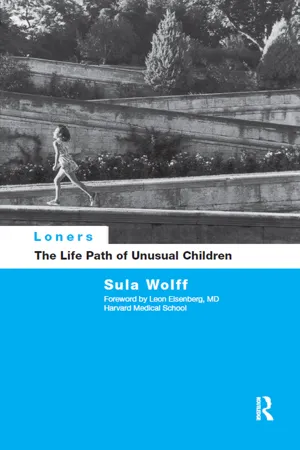
Some children seem different, detached, disinterested in the games of other children. They prefer their hobbies to friends of their own age and if forced into community activities, as they often are at school, can become aggressive and difficult. In Loners, Sula Wolff describes a childhood personality syndrome that has frequently been neglected. Often using children's own words, their lives and problems become real as she unwraps their stories from first referral to adulthood. Some have become talented and successful adults, whilst others are less fortunate in later years. Carefully documented and meticulously researched, this study makes compelling reading.
Information
1 Early observations
THE FIRST ELEVEN CASES
Some thirty years ago, as a child psychiatrist working in a children’s hospital, I noticed that out of my first just over two hundred consecutively referred children, eleven had a particularly puzzling clinical picture. Many of their behavioural difficulties were exactly the same as those of other children attending the child psychiatry department, but the child’s life history and family circumstances did not, as they usually do, reveal the explanations for the disorders. Most psychiatrically disturbed children have suffered from traumatic life events or chronic social, family or educational adversity, often from both, and their parents are only too aware of what the causes of the trouble might be. In a very few children disturbed behaviour is clearly due to some organic brain impairment; but these eleven children were physically healthy and only a few of them had been exposed to adverse circumstances.
All these children were boys; they ranged in age from 7 to 14 years; they were of normal, some of superior, intelligence; and nine had fathers in professional or higher managerial occupations. Ten of the eleven were referred because of marked difficulty in social adjustment at school, and eight of these were also failing educationally. The one child referred because of difficulties at home – stealing from his mother – had been solitary at school.
All the parents described their children as finding it hard to make friends and join in with group activities. School entrance precipitated the difficulties of one child; return to school after an illness those of another; a change of school those of a third; and going to boarding school was the trigger for those of two others. All these children found school life stressful, but coped with it in different ways. Two of the younger children refused to talk in class – in one case, if the teacher wanted a response, she would get the boy to write it down. A third boy, now older, had not talked in school throughout his first year there. These children had suffered from what is called ‘elective mutism’ : they talked at home but not at school. Three children attempted to avoid going to school altogether and, if pressed, developed aches and pains: they presented with the syndrome of ‘school refusal’. Another would stand by the school gate, refusing to enter until the janitor rang the bell. One boy, then 13, avoided gym and all school games, becoming panicky to the point of tears if urged to take part, so that finally the school made other arrangements for him during periods of gym and sports. Altogether seven of the eleven boys said they hated school games.
The mothers of all these children described difficulties as having existed since the pre-school years, but as not severe enough for them to have sought help. When 2 years old, one boy refused to wear a blazer, ‘because if you wear a blazer, you grow up and if you grow up your parents leave you’. His mother then put his teddy bear in a blazer, and gradually her son too accepted this garment. Ten of the mothers were puzzled by their sons, concerned because they found they did not really understand them. One said: ‘I don’t know him as I should.’ Other parents described their children as ‘remote’, ‘lacking in feeling’, ‘solitary’. One mother said: ‘He never lets his feelings go although he looks as if he’d like to’; another: ‘He finds it difficult to show affection. Questions only result in a closing up’; and a third: ‘There’s a strangeness about him’.
A second characteristic reported by seven mothers was their children’s difficulty in adapting to new circumstances and negativism or obstinacy over particular issues for reasons the child never made clear; if pressed to conform, temper outbursts occurred. Among other difficulties mentioned were: extreme modesty, despite the absence of parental prudishness, in three of the children; compulsive motor habits in three; and difficulty in falling asleep at night, also in three of the eleven.
One of the children, DAVID, had had two brief paranoid illnesses in which he thought a hidden tape recorder was recording him and that people were after him. To avoid this, he had to ‘pay penalties’ in the form of whistling and singing to the imagined tape recorder. At school he felt other people looked at him, ‘because I invented this hymn’. He said: ‘The main idea of the tape-recording thing was the year was not 1960 but two centuries later, and the experiment was to find out what a man was like now, and I was chosen and this was mixed up with the idea … I hummed songs to myself and I imagined little tape recorders all over the place. I didn’t see them. I got a few theories of a whole model town…’
In the families of the children the most striking feature was that in five cases one of the parents, and in two other cases a more distant relative, was withdrawn and unsociable and made poor emotional contact with other people; and that in three other families one of the parents was found to talk all too freely, to have an impaired sense of what was socially appropriate, to show a mood state not apparently congruous with what was being discussed, and to have some unusual, metaphorical ways of expressing him- or herself in words. Although coping well with their work and family commitments, these three parents found tidiness and punctuality difficult to achieve.
One mother described a transient delusional experience following her last pregnancy: she found herself wandering out of the house along a country lane in a changed mood state, longing for her husband to fetch her back and feeling that if a cliff had been near, she would have thrown herself into the sea. She then heard a radio discussion and suddenly felt that the broadcaster could help her. She wrote to him, and to his response she attributed her subsequent recovery.
Four parents spontaneously likened their children to themselves or to an affected relative. One father said: ‘He demonstrates a number of things which are personality characteristics of my own, I’m afraid’, and went on to describe how a minor professional disagreement with a colleague had led him to give up a better paid job in order to devote five years of his life to a research project designed to prove his point; which he achieved. Of his son he said: ‘His approach has been to bang his head against a brick wall. I’ve a sympathy for him, but his mother says she can’t understand him.’ One mother, who likened her son to her father, described the latter as ‘brilliant but odd and impossible to live with. He couldn’t make contact with other people and preferred to live alone.’ Another mother felt her son resembled her brother: ‘a spitfire as a child and a lone wolf who never made friends and isolated himself with his books’.
The family life of nine of the children was harmonious, and six of these had not experienced major stressful life events either. Two children had parents in discordant (including one disrupted) marriages; and three others had been exposed to major traumata associated with physical illness (namely, the mother’s repeated stillbirths; the mother’s increasing incapacity because of disseminated sclerosis; the child’s own cancer and its treatment).
Like their unusual relatives, the children themselves fell into two groups: four were withdrawn and uncommunicative; seven outgoing and communicative.
The withdrawn, uncommunicative children engaged in the most limited conversation and play. Three of the four were extremely shy. The fourth lacked affect, discussing his stealing, for example, with detachment, and reporting one day: ‘The conductor never took my bus fare today and I spent the money on sweets.… I had that happen before.’
Among the communicative, outgoing children, all of whom were of superior intelligence, two were hostile and paranoid. Faced with a family move and change of school, one boy said: ‘People tell you you have to make friends and then when you do, you have to move and they want to get rid of you.’ This boy preferred animals to people: ‘Animals can’t talk back. You don’t really get to know animals and don’t notice when they go away. I can’t put up with other human beings. They’re a nuisance more or less.’ He was drawing two dinosaurs and I commented that even his dinosaur had a mate. He replied: ‘Not a mate, but a sworn enemy. Would you like it if a certain animal wanted you for food?’ The other somewhat paranoid boy also said: ‘I prefer animals to human beings. They don’t pick fights with you unless you bother them.’ These two were the most rigid and obstinate of the seven communicative children, reacting with rage to demands for conformity. The remaining five were communicative and sensitive, revealing symbolic thought content unusually freely. Their conversation was characterized by emotional detachment, literalness and much use of metaphor.
One boy, in anticipation of coming to the hospital, thought: ‘They’re going to make a human being of me’; and after his first interview he said: ‘It’s as if I’ve been very, very sick and we’ve cleared up all the sick … [and] the smell.’
All the children said they felt different from other people. The oldest, then 14, put this most clearly: ‘I’m an odd person, different from most people. I have different tastes. I like being by myself. It’s my nature. I’m more fond of things than people. I see a lot of people with each other and I can’t fit in. They have interests like fishing and pop records and I’m a square. I don’t mind it, it’s other people who object. They’re nasty to me and I have to put up with it. I don’t like fighting back much. I’m not a destructive type of person.’
This sense of being different and a preference for being alone was expressed by the children in different ways. One said: ‘I’m different from the rest. I was called “posh one’”. Another boy said: ‘I just can’t make friends.… I’d like to be on my own and look at my coin collection…. I’ve got a hamster at home. That’s enough company for me … I can play by myself. I don’t need other people.’ Another put it this way: ‘[I make friends] at school but not with people in the street. They like Cowboys and Indians and football and I don’t.… I like to get away from people. …I watch my mice.’ A fourth boy said: ‘I just don’t think I’m like any of them [his mother, his father and his brother]… My friends are not like me. I don’t talk very much. I prefer to be by myself.’
Both the withdrawn and the outgoing children had a number of specific interests which they pursued with unusual single-mindedness: stamp and coin collecting; music; reading; pet animals. The communicative children in addition had areas of extraordinary competence compared with their often poor school performance. The two paranoid children were very well informed and had strong views about politics. Two of the boys were exceptional at mechanical constructions, although their products were sometimes very odd. Another was expert at electronics and had made several radio and television sets. This boy also had a vivid fantasy life, which had preoccupied him for years and was to form an important part of his inner self well into his adult years. From the age of 5 he had had ‘a dreamed-up island, square and on wheels on the ocean bed’, which he described in a never-ending series of stories and cartoon strips.
EARLY ATTEMPTS AT TREATMENT
Seven of the children were initially diagnosed as having a psychogenic disorder, that is, their symptoms were thought to be due to adverse life experiences. A psychotherapeutic approach, however, failed to increase the therapist’s, the patients’ or the parents’ understanding of what had brought the difficulties about. After four months of regular encounters with the 13 year old who had a phobic avoidance of gym at school, the significance of this symptom remained as obscure as before, although he was a talkative and forthcoming boy. After three months, a non-communicative 7-year-old boy was as quiet as ever, always played with his back to the room, whispered his sparse verbal responses, but told his mother that he loved coming. No change whatever had occurred in his behaviour at home, at school or in the clinic.
Attempts to urge the children to reveal their feelings more freely, or to explain to them that their symptoms might have an underlying meaning (for example, that the delusional experiences of one of the boys might reflect his worries about his mother’s health) sometimes led to transient disorganization of behaviour. In one case a sudden outburst of anger – ‘get away with you!’ – unacknowledged even seconds later, followed such an intervention; in another case there were sudden tears and a paranoid feeling that the therapist’s smile meant she was ‘trying to get the better of’ him.
So long as the treatment staff conveyed to the families that the child’s difficulties were environmentally produced, that change in the child was expected and that the onus was on the families, with help, to bring this about, understanding between treatment staff and families remained limited. Children and parents continued to be as anxious as ever and no progress was made. But as soon as the child’s symptoms were recognized as springing from his particular and inherent personality make-up, unusual but not unheard of, and certainly not caused by faulty parenting, poor teaching or ill will on the part of the boy, an understanding between treatment staff and families was established, and the child’s own perceptions and those of his parents were confirmed. This brought relief to everyone, including the teachers, especially when a new spirit of hope could be introduced as well.
This hope relied on two quite specific therapeutic interventions. The first was to convey to the families and the education authorities that the children’s basic personality characteristics could not be expected to change; and that the parents and the schools would need to make allowances for what the children could and could not manage, in order to help them adapt to school life. Often this meant that the child was officially allowed to avoid particularly stressful settings, like school games or a noisy playground. Sometimes education in smaller, more flexible classes was called for, and teachers were encouraged to build on the children’s special interests and abilities in their educational endeavours. The second intervention engendering hope was to indicate to everyone that the child’s future outlook was likely to be good. This was thought to be justified even at that time, when no systematic follow-up studies were yet available, because many of the children resembled other family members in their personality features, and these relatives had in general managed their adult lives well. Moreover, it was thought even then that, once out of school, free to avoid noisy social groups and free also to pursue their own interests and ambitions, these children might find life a good deal easier than during the regimented years of school.
WHAT SHOULD WE CALL THIS CONDITION?
Because the characteristics shared by the eleven children described above resembled those found in the older and also in the then current psychiatric literature under the term ‘schizoid personality’, this was the initial diagnostic label chosen for the children’s condition (Wolff, 1964). It was recognized even then that this term might be misunderstood and could convey unintended prognostic gloom, because schizoid personality traits had been found to excess in the past histories of schizophrenic patients and in the biological relatives of such patients. The point needs to be made right away that, even if this is so, this tells one nothing about the frequency with which people with schizoid traits can be expected to develop this serious psychotic illness. In fact, as we shall see later, the risk is likely to be very small. What is essential is not to call a clinical syndrome, which resembles a well-known condition in adult life, by a different name merely because it occurs in childhood. In clinical practice what was important was to ascribe the difficulties that brought the children to attention to their ‘personality make-up’, and this formulation of their troubles seemed to be acceptable both to the children and to their parents.
Three courses of action followed the recognition of these first eleven children as ‘schizoid’:
1 a determination to look out for other such children in the course of ordinary clinical practice;
2 to try to define more accurately what the precise difficulties of the children are, as a basis for long-term, systematic follow-up studies because, if indeed the affected children have a particular personality constellation or disorder, then their characteristics should endure well into adult life;
3 to search the literature for accounts in childhood and adult life of people with the same or similar difficulties.
In the next chapter we shall examine the descriptions found in the literature of this puzzling condition and of related disorders, and will discuss the problem of diagnostic labelling. Much of the rest of this book will deal with the follow-up studies carried out in Edinburgh of ‘schizoid’ children seen in child psychiatric practice. Here we shall summarize the children’s clinical features as they appeared to us in the early years, and describe a study of their psychological functioning.
THE CLINICAL FEATURES
After some years it became possible to describe the clinical features of these children more definitively. They formed about 4 per cent of new clinic referrals. Girls too could be affected, but the condition was commoner in boys, with a sex ratio of about 3.5:1. The children were almost all referred during their school years, usually because of social difficulties at school. In addition, many were failing educationally despite average or superior intelligence, and some had specific developmental delays, such as a lag in language development; reading, writing or spelling difficulties at school; or excessive clumsiness. A very small number had evidence of organic brain impairment and/or were of below average intelligence. Intelligence tests often revealed large discrepancies between different areas of functioning, for example, between verbal and non-verbal intelligence subscales. These children were described as solitary and as finding group activities, especially rough-and-tumble games, stressful; when pressed to conform, outbursts of rage or tears ensued. They lacked empathy, finding it difficult to imagine what other people felt and thought, and were unusually detached and objective when describing other people and also themselves. While often very sensitive themselves, sometimes even suspicious, they lacked sensitivity for the feelings of others, were poor at sizing up social situations, and hence often acted inappropriately. A number were preoccupied with their own systems of ideas and inter...
Table of contents
- Cover
- Half Title
- Title Page
- Copyright Page
- Table of Contents
- List of illustrations
- Foreword
- Acknowledgements
- Author’s note
- Introduction
- 1 Early observations
- 2 In search of a diagnostic label
- 3 A closer look at the childhood picture
- 4 The personality of loners in later life
- 5 The later life adjustment of schizoid boys
- 6 Schizoid girls in childhood and later life
- 7 What is the risk of later psychiatric disorder?
- 8 Is there a link with antisocial conduct?
- 9 Intellectual interests and giftedness
- 10 How can we best understand the condition?
- 11 How can we intervene most helpfully?
- 12 Schizoid personality, pretence and genius: two extraordinary people
- Appendix
- References
- Name index
- Subject index
Trusted by 375,005 students
Access to over 1.5 million titles for a fair monthly price.
Study more efficiently using our study tools.
Frequently asked questions
Yes, you can cancel anytime from the Subscription tab in your account settings on the Perlego website. Your subscription will stay active until the end of your current billing period. Learn how to cancel your subscription
No, books cannot be downloaded as external files, such as PDFs, for use outside of Perlego. However, you can download books within the Perlego app for offline reading on mobile or tablet. Learn how to download books offline
Perlego offers two plans: Essential and Complete
- Essential is ideal for learners and professionals who enjoy exploring a wide range of subjects. Access the Essential Library with 800,000+ trusted titles and best-sellers across business, personal growth, and the humanities. Includes unlimited reading time and Standard Read Aloud voice.
- Complete: Perfect for advanced learners and researchers needing full, unrestricted access. Unlock 1.5M+ books across hundreds of subjects, including academic and specialized titles. The Complete Plan also includes advanced features like Premium Read Aloud and Research Assistant.
We are an online textbook subscription service, where you can get access to an entire online library for less than the price of a single book per month. With over 1.5 million books across 990+ topics, we’ve got you covered! Learn about our mission
Look out for the read-aloud symbol on your next book to see if you can listen to it. The read-aloud tool reads text aloud for you, highlighting the text as it is being read. You can pause it, speed it up and slow it down. Learn more about Read Aloud
Yes! You can use the Perlego app on both iOS and Android devices to read anytime, anywhere — even offline. Perfect for commutes or when you’re on the go.
Please note we cannot support devices running on iOS 13 and Android 7 or earlier. Learn more about using the app
Please note we cannot support devices running on iOS 13 and Android 7 or earlier. Learn more about using the app
Yes, you can access Loners by Dr Sula Wolff,Sula Wolff in PDF and/or ePUB format, as well as other popular books in Psychology & Abnormal Psychology. We have over 1.5 million books available in our catalogue for you to explore.