- 157 pages
- English
- ePUB (mobile friendly)
- Available on iOS & Android
eBook - ePub
About this book
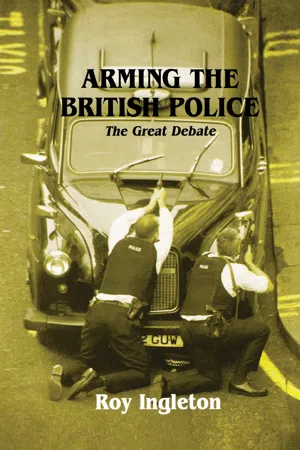
As the fear of violent crime escalates, there are calls for the police to carry guns. This examination of the history of violent crime and violence against the representatives of law and order looks at the extent to which the "unarmed" British police have had recourse to firearms in the past.
Information
1 Aux armes, citoyens!
No civilized nation … has to lament, as we have, the daily commission of the most dangerous and atrocious crimes, in so much that we cannot travel the roads, or sleep in our houses … without the most imminent danger of thieves and robbers …
A sentiment which will be echoed by many readers, alarmed at the current levels of crime in Great Britain. But, in fact, this was written over 200 years ago.1 So are things really so much worse than they were at the end of the eighteenth century, when there was no real police force as we know it?
A contemporary writer suggests that they are not:
Take crime. We are living in a period where lawbreaking seems to be rising inexorably. But history shows that crime moved in long waves, rising and falling for a complex variety of reasons. On a long historical view, levels are quite low — compared to the eighteenth or early nineteenth century. They are merely high compared with the fifties, a very unusual period.2
So this earlier period might be a good point at which to start our survey of violent crime in England and Wales.
The end of the eighteenth century was certainly a period of great unrest; there were revolutions in France and elsewhere and a bitterly fought War of Independence conducted in our American colonies. Although spared the Terror of revolutionary France and the turmoil elsewhere in Europe, the citizens of England, or at least the middle and upper classes, were apprehensive of a popular uprising matching those occurring on the continent. Already, in 1780, there had been serious rioting in protest against the Catholic Relief Act when Lord George Gordon led a crowd in a march on Parliament to present a petition. The ensuing disorder lasted a week, during which time a great deal of damage was done and, for a time, London was taken over by the mob. The Army was mobilized and, in suppressing the riots, some 200 protesters were shot dead by the military.
As the years went by, further riots occurred as a result of food shortages and rising prices and the recruiting demands associated with the Napoleonic Wars. With the country in the throes of the Industrial Revolution, a displaced and disenfranchized rural population was being compelled for economic reasons to make drastic changes in its lifestyle and to adjust to different work disciplines, all accompanied by unaccustomed pressures on family life. Between 1811 and 1815 these pressures and frustrations culminated in demonstrations against the mechanization of the weaving trade in the East Midlands, Lancashire and Yorkshire. Inspired by Ned Ludd, rioters destroyed the machinery which they saw as destroying their livelihood and the mill owners again called for the deployment of troops (there was still no regular police force in the country). So far-reaching were these events that the term ‘Luddites’ has now passed into the English language to describe those who are violently resistant to change and progress.
But perhaps the climax came in 1819 when a crowd of around 60,000 gathered in St Peter’s Fields in Manchester to listen to speakers demanding the repeal of the highly unpopular Corn Laws. Fearing that the inflammatory speeches would lead to disorder, the magistrates ordered the mounted Yeomanry to charge the crowd to disperse it. The repeated charges resulted in 11 people losing their lives while over 400 were injured. Coming so soon after the great victory of Waterloo, the event was quickly satirized as the ‘Battle of Peterloo’.
However, serious as public disorder is, it is not the only form of illegal violence and most people think of murder, robbery, rape and offences of that nature as ‘violent crime’, rather than riot, affray or unlawful assembly, which are frequently regarded as political rather than criminal. Certainly the average citizen has more to fear from the robber or burglar, whom he cannot always avoid, than from riotous demonstrators, with whom he usually need not get involved.
The problem in seeking to establish crime levels in Georgian England is the total lack of statistics before 1805. However, based on such evidence as exists (court records and newspaper reports, for instance) one historian suggests that there appeared to be a gradual increase in theft and assaults in the last half of the eighteenth century, becoming much steeper in the first quarter of the nineteenth.3 This evolution may be attributed to increases in the population, a growing urbanism and capitalization of industry, and a general increase in personal possessions. There was, in fact, more to steal!
Even at the beginning of the period under review, there were complaints that:
I sup with my friend; I cannot return to my home, not even in my chariot, without danger of a pistol being clapt to my breast. I build an elegant villa, ten or twenty miles distant from the capital: I am obliged to provide an armed force to convey me thither, lest I should be attacked on the road with fire and ball.4
Around the same time, the conclusion of the American War of Independence led George III to express his concern that ‘the number of persons this peace will occasion’ would increase the number of highwaymen. It is true that foreign wars tended to remove from these shores the active young men who might otherwise become involved in some form of crime. In fact, in time of war, those who committed crimes were often given the option of ‘volunteering’ for the Army as an alternative to transportation. But the country was experiencing a demographic explosion hitherto undreamed of. Throughout the first half of the eighteenth century the population of England and Wales remained fairly static at around six million fewer than the present population of London alone but it then started to increase and to increase rapidly. In the 20 years up to 1770 the population of London doubled and, nation-wide, the figure had reached 18 million by 1851. This meant that the average age was falling fast and the labour market was saturated with young persons, not all of whom could be found jobs, and it is the young who are traditionally the main authors of crimes and acts of violence.
The sharp increase in crime following the Napoleonic Wars is well documented (although perhaps inadequately explained) and resulted in a flurry of legislation aimed at rogues and vagabonds, idle and disorderly persons, beggars and those wandering abroad without visible means of support. The belief that crime was rising out of control was one of the great social factors affecting life in Georgian England and helped to formulate these Draconian laws and punishments. Despite the perception of the Middle Ages as a period of great cruelty, it is interesting to note that in the century and a half following the crowning of Charles II in 1660, 187 new capital statutes became law - nearly six times as many as in the preceding 300 years. One Act alone prescribed the death penalty for over 200 offences, most of which were aimed at the protection of property rather than persons; attempted murder was merely a misdemeanour until 1803. Homicide was not, in fact, a statistically prominent offence. It was a general anxiety about murder and robbery with violence — the ‘fear of crime’ — which led to more stringent legislation in 1752; but there were only ten convictions for murder that year, and that was exceptionally high for the times. The annual average murder rate in London and Middlesex between 1750 and 1770 was just four. Elsewhere, murder as a corollary of robbery was extremely rare and most homicides were of a ‘domestic’ nature.
This broad-brush approach to crime and punishment makes any comparison with modern times much more difficult. On the one hand, in the second half of the eighteenth century there were 3,608 capital convictions in London and Middlesex alone, resulting in 1,650 executions; but these represented a wide variety of comparatively minor crimes. On the other hand, the fact that conviction would inexorably result in the death penalty undoubtedly swayed a number of juries in the delivery of their verdict. In fact, crime continued to rise despite these measures until at least the middle of the nineteenth century.
One of the problems in the period up until the second quarter of the nineteenth century was the lack of an effective police system. Although France had long had its laws enforced by a police force in Paris and a maréchaussée in the countryside, these were regarded as totally foreign and abhorrent to any decent-thinking Englishman; the idea was not compatible with his concept of liberty! England continued to rely largely on parish constables (often merely part-time) in the countryside and a system of watchmen in the towns and cities. Many of the latter, known as ‘Charlies’, were elderly, often infirm and of little use against determined young thieves. Although usually armed with a cutlass, tended to avoid any kind of on as they walked their beat to give any criminals a timely warning of their approach. Failing this, they were easily bribed and were thus of minimal value as a crime prevention measure. Much more reliance was placed by the magistrates on the system of rewards which prompted a number of active men, not always of unimpeachable character themselves, to act as thief-takers, following the example of the famous Jonathan Wild
Most orthodox historians accept the arguments put forward by the nineteenth-century police reformers: first, that the old parochial system of policing was, at best, inefficient, and secondly, that England at the end of the eighteenth and the beginning of the nineteenth century was facing a serious increase in crime and disorder:
… there is no exaggeration in saying that, at the dawn of the nineteenth century, England was passing through an epoch of criminality darker than at any other in her annals.5
But, as has already been pointed out, it is extremely difficult to measure any increase in the levels of crime and disorder even in a society which keeps reliable statistics, and there were none at all kept in eighteenth-century England. There is a degree of agreement between historians, based on court records, that at this time larceny was probably increasing. The statistics kept from 1805 show a steady increase continuing until the middle of the nineteenth century. But how much of the recorded increase was due to an actual increase in occurrences of theft and how many could be put down to better policing, encouraging the reporting of crimes?
Where serious crimes of violence occurred these were the subject of public concern and outcry. It was the brutal murder of two East London families in December 1811 and known as the Ratcliffe Highway murders that led to the setting up of the first of four Parliamentary Select Committees on the policing of the capital. Resistance to any form of centrally organized police force continued to be expressed by both the public and many Parliamentarians. The working class saw, with some justification, the existence of an organized police force as a means of further repressing the poorer and disenfranchized members of the community, while the landowning class objected to having to fund a force which was to them unnecessary since they could protect themselves and their property quite adequately using their stewards, gamekeepers and other paid servants. Only the burgeoning middle class, the shopkeepers, mill owners and other small businessmen, saw any advantage in the proposals. Even when serious disorder in Lancashire led Sir Robert Peel to contemplate a reform of the policing of rural areas, public hostility to the idea of a police force controlled from Westminster remained firm; the proposals still smacked too much of the despised French system. That is not to say that there was not concern about the levels of crime and disorder outside London; towards the end of the 1820s the citizens of Cheshire were expressing their concern at the ‘wide-spreading and awfully increasing dissemination of crime’.6
By this time a limited number of criminal statistics were available, having been introduced in 1805 and revised in 1834 to show crimes under six main headings:
1 Offences the
2 Theft involving violence (including burglary);
3 Offences of theft not involving violence;
4 Offences against property (malicious damage);
5 Currency and coinage offences;
6 Miscellaneous offences.
Statistics are notoriously unreliable and these were certainly no exception. The existence of a dark figure (crimes committed but not reported) was known even at the end of the eighteenth century with Patrick Colquhoun noting that: ‘there is not above one offence in one hundred that is discovered or prosecuted’,7 while nearly 40 years later, Edwin Chadwick found that: ‘the number of cases pursued bore little or no relation to the cases of crime actually committed. We found large masses of crime with scarcely any pursuit at all.’8
But these comments refer to all types of crime. What about serious crime? What about murder and robbery with violence? In the decade between 1805 and 1815 there were around 15 convictions for murder each year (of whom some 13 were executed). In addition, around 35 were convicted of highway robbery each year in the same period, only around ten per cent of whom were executed. With a total population of about 12 million, these represent a murder ratio of 1:800,000 and a robbery ratio of 1:343,000. If one multiplies these figures by 4.25 to reflect the 1991 population of England and Wales, the number of murders would total 64 and robberies around 150. In fact, in 1991 there were around 200 convictions for murder and 5,100 for robbery. Can a threefold increase in the murder rate be entirely attributed to better reporting records or an improved detection rate? Almost certainly not. And no amount of statistical juggling can explain away a thirtyfold increase in robberies.
Meanwhile, the political and economic situation which afflicted the country sparked off a great many violent demonstrations in the period following Waterloo and which continued for some 30 years. The New Poor Law and the proposed electoral reform were widely unpopular and were the subject of several large-scale demonstrations, while the Chartist movement provoked other disorders. The late 1830s and 1840s saw a serious economic depression, giving rise to the term ‘The Hungry Forties’ and so, although Great Britain managed to escape the revolutions which characterized many European states in 1830 and 1848, the country was nevertheless wracked with internal disorder. The term les classes dangereuses, used by H. A. Frégier to describe the militant citizens of Paris, was quickly coined by the bourgeoisie in this country, although it has to be said that the British urban poor were much less of a danger than their French counterparts. Nevertheless, there was a riot of starving field hands in 1830, as a result of which three were hanged and 400 transported.
This civil unrest which, coupled with the growing crime figures, to a large extent prompted the formation of the Metropolitan Police in 1829, did not disappear with the formation of the force, much to the chagrin of the proponents of the New Police system. The Metropolitan Police was, of course, formed to police the metropolis of London and it is much to the credit of these pioneers that disorder in the capital was minimal, or at least much lower than in some provincial cities and in the countryside. Such was the rapidly growing reputation of this new panacea for all society’s ills that the Metropolitan Police were frequently called upon to assist in quelling violent disorders in other areas.
The introduction of a properly organized police in London was quickly copied by a number of other cities, although on the whole the counties were slower to recognize the need for policing on a similar style. The formation of these police forces had, paradoxically, an unfortunate effect on the crime statistics. Certainly many more criminal offences were reported but it is not clear to what extent this was a reflection of increasing crime levels or whether the existence of organized police forces, with proper police stations and the opportunity for the poor to get someone to deal with their problems when they fell victims to crime, merely led to hitherto unreported crimes receiving proper attention. The number of committals to courts of...
Table of contents
- Cover
- Half Title
- Title Page
- Copyright Page
- Table of Contents
- List of table
- Introduction
- 1 Aux armes, citoyens!
- 2 The policeman’s lot
- 3 Pistol-packing policemen
- 4 Deadly force
- 5 To be, or not to be …
- 6 Abroad is unutterably bloody!
- 7 Conclusions
- Appendix The New Zealand Police ‘Rules of Engagement’
- Notes
- Further reading and selected bibliography
- Index
Trusted by 375,005 students
Access to over 1.5 million titles for a fair monthly price.
Study more efficiently using our study tools.
Frequently asked questions
Yes, you can cancel anytime from the Subscription tab in your account settings on the Perlego website. Your subscription will stay active until the end of your current billing period. Learn how to cancel your subscription
No, books cannot be downloaded as external files, such as PDFs, for use outside of Perlego. However, you can download books within the Perlego app for offline reading on mobile or tablet. Learn how to download books offline
Perlego offers two plans: Essential and Complete
- Essential is ideal for learners and professionals who enjoy exploring a wide range of subjects. Access the Essential Library with 800,000+ trusted titles and best-sellers across business, personal growth, and the humanities. Includes unlimited reading time and Standard Read Aloud voice.
- Complete: Perfect for advanced learners and researchers needing full, unrestricted access. Unlock 1.5M+ books across hundreds of subjects, including academic and specialized titles. The Complete Plan also includes advanced features like Premium Read Aloud and Research Assistant.
We are an online textbook subscription service, where you can get access to an entire online library for less than the price of a single book per month. With over 1.5 million books across 990+ topics, we’ve got you covered! Learn about our mission
Look out for the read-aloud symbol on your next book to see if you can listen to it. The read-aloud tool reads text aloud for you, highlighting the text as it is being read. You can pause it, speed it up and slow it down. Learn more about Read Aloud
Yes! You can use the Perlego app on both iOS and Android devices to read anytime, anywhere — even offline. Perfect for commutes or when you’re on the go.
Please note we cannot support devices running on iOS 13 and Android 7 or earlier. Learn more about using the app
Please note we cannot support devices running on iOS 13 and Android 7 or earlier. Learn more about using the app
Yes, you can access Arming the British Police by Roy Ingleton in PDF and/or ePUB format, as well as other popular books in Politics & International Relations & Military & Maritime History. We have over 1.5 million books available in our catalogue for you to explore.