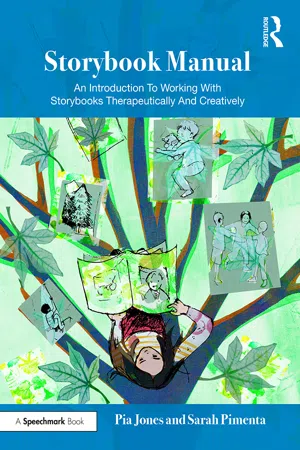
This resource has been designed to support practitioners and caregivers with practical and creative ideas on how to use illustrated storybooks therapeutically with children. Whilst this book is also available to purchase as part of a set, with three therapeutic fairy tales, all the content, worksheets and activities can be used with any illustrated story.
Exercises have been created to encourage imagination and free play, develop confidence and emotional literacy as well as deepen engagement and understanding of stories. It is a book that can be returned to again and again to inspire creative engagement with stories with individuals or groups.
Key features include:
An exploration of the importance of stories to modern life, and their use as a creative and therapeutic tool
Guidance for working with stories and their illustrations, including conversation starters, prompts and worksheets for process-orientated creative activities
Accompanying online activities designed for specific use with the storybooks in the Therapeutic Fairy Tales series
This is an invaluable resource for all professionals looking to work therapeutically with stories and images. It will be particularly valuable to those working in child and family mental and emotional health, social and youth care, community and participatory arts, school and education, and specialised health and hospital environments.
Oral storytelling forms part of our collective human history. Like breathing, it appears that it’s how we are made, with an innate need to share stories between families, peers and our wider communities.
Perhaps quite simply, story creates a thread for us to hang feelings and experiences, bringing a sense of order and meaning to life events. There are the stories we each tell in our daily lives, and those we inherit and receive from our wider culture. Evidence of myths, legends, folk and fairy tales are found in all corners of the world (Campbell, 1993). These ancient storytelling forms enabled generations to pass on experiences and culture to the next (Whittick, 1960). It is one of the ways that we understand and share our historical past, be that personal or collective.
In times past, storytelling often took part as a ritual, in a circle around a fire, a table, or in a special open-air place, like an amphitheatre. A designated storyteller would bring to life stories be it through their voice, physical actions, singing, music, masks and/or instruments such as a drum (Jones, 1996). This storyteller would ‘guide’ their audience through the story.
Our ancestors most likely told these more ‘formal’ stories for many reasons – to share learning with communities, to rule, to warn them, to celebrate important occasions, to preach, to explore the unknown, to entertain and enlighten.
Another important reason may have been to help people find meaning during times of painful change and loss. When going through any major life transition, unfamiliar feelings can frighten and overwhelm us, whether child or adult. Yet, attempts to block or avoid these emotions altogether can take away the very energy we need to support and guide us through times of change (Brett, 1988). Dealing with grief, loss, illness, sudden change, the vagaries of Nature, may well have fallen into the realm of story (Jung, 1984).
Using story and metaphor to make sense of the unknown and unfamiliar
As children, we learn about the world and make sense of it through story and metaphor. From an early age, objects, teddy bears and toys are imbued with real-life properties, ‘as if’ these objects were alive and communicating with us (Winnicott, 1971). Fairies, witches and demons, talking animals, superheroes all speak to a child’s imagination. Children are naturally at ease with metaphor, speaking its language and intuiting its deeper meaning (Mills & Crowley, 1986).
Bruno Bettelheim, child psychoanalyst, proposed that reading fairy tales enabled children to explore fears and themes of growing up that perhaps felt too big and unknown to discuss openly:
More often than not, he (the child) is unable to express these feelings in words, or he can do so only by indirection: fear of the dark, of some animal, anxiety about his body. The fairy tale takes these existential anxieties and dilemmas very seriously and addresses itself directly to them: the need to be loved and the fear that one is thought worthless; the love of life and the fear of death.
(Bettleheim, 1976: 10)
Equally for an adult audience, story remains important. The struggles and adventures of ‘characters’ or ‘heroes’ in myths and stories become metaphors – imaginary vessels to carry some of the conflict and difficulty in everyday people’s lives. Story enables us to bear some of life’s inevitable losses by creating a safe distance between audience and material (Jennings, 1998). Yet, even when it’s not our own story, if emotionally resonant, we identify with elements of a character’s situation (Jones, 1996).
By wrapping existential difficulties in metaphor and symbol, story can paradoxically bring children and adults more aware of and closer to their real feelings. The Ancient Greeks (Aristotle) coined the term “catharsis” to describe what they felt happened in audiences during theatre performances; “the process of releasing, and thereby providing relief from, strong emotions” (Oxford Dictionary of Phrase and Fable, 2005).
Whether feelings arrive quietly or noisily, it doesn’t matter. The importance is that the experience feels real and meaningful to the audience/reader, enabling a therapeutic process to begin. As the audience projects their own feelings and experiences onto the characters, the story can be used as a tool for psychological growth.
Fairy tales, picture books and storytelling in modern culture
Like language itself, over time stories shift and change shape. Myths, fairy and folk tales have been written down, turned into poems, plays, scripts, song. Printing presses and illustration techniques have brought us beautiful picture books, tangible objects to hold, look at and share.
Pictures and images speak to different parts of ourselves (McNiff, 1992). An image can contain different elements – multi-sensory feelings, themes, conflicts, potential resolutions. Most children don’t need to be taught visual literacy; they naturally respond to pictures and images in storybooks. Picture books seem designed to be shared and read together in a relational setting (Spitz, 1999). An image calls out look at me, as do verbal metaphors (Siegelman, 1990). This must-see quality of images enables readers to become a witness, with children often showing a real hunger to see images in picture books (Bulmer, 2000).
Stories are now told through a variety of new broadcast media; radio, film, TV, computers, tablets, mobile phones. Sharing images and photos have become an integral part of the modern world’s diet. Yet, despite the speed at which technology changes, the content often doesn’t. Many themes from our oldest stories still survive, finding their ways into our favourite TV programmes, songs, films and books. Just the words – once upon a time – evoke expectations around a storytelling experience. Traces of modern-day rituals in storytelling can be found all over the world.
Scouts/guides, forest schools, youth and drama clubs often tell stories and sing songs together. Some of these will take place in nature around a campfire. In nurseries and early school education, circle-time is a place to read out-loud stories and nursery rhymes to a group of young children. Shamans in non-Western cultures guide and heal through story and drumming. Audiences sit in groups to watch theatre and films.
The bedtime story ritual
In many parts of the world, bedtime stories are another left-over of a rich oral tradition. The deceptively simple act of reading a bedtime story to a young child can be key in promoting healthy, intimate relationships. If both parties are engaged, much goes on:
1. Adult reader and child listener/s position themselves, normally in comfort, and close physical proximity, so participants can see the book, both its words and pictures.
2. As the story begins, an air of relaxed concentration forms. Child and adult enter another space, what is often described as a liminal or transitional space, ‘another world’ (Winnicott, 1971; Levine, 1992). Even the concept of time might feel different, slower, stretchy.
3. In order to bring the story to life, the reader often slows down, changing voices for different characters. The cadence of ordinary speech changes. The reader ‘performs’ the story, speaking the words out loud, mediating the story for the child (Spitz, 1999).
4. The child seems to gain a surprising focussing ability to spot mistakes on the part of the reader. They may say: “You missed a bit!”
5. For the child ‘receiving’ the story, they may react in different ways, soaking it up in silence, or becoming an active participant, asking questions.
6. Often, the bedtime story, offering both visual and verbal stimulus, enables children to speak more freely about their life; thoughts, feelings or worries troubling them. Making associations and links with characters in a book can help a child reflect on their own life, get in touch with their own fears and anxieties, equally encourage their problem-solving abilities.
7. The story and its pictures can serve as a container for potentially difficult and painful themes, showing children that they are not on their own (Cattanach, 1994).
8. The reader and child have been on a shared journey, often feeling close and connected, and sharing an emotional bond as a result.
Bedtime stories are important because reading stories in therapy or a therapeutic setting draw upon some of the components of the ‘special’ feel of bedtime stories. Bedtime stories provide clues o...
Table of contents
Cover
Half Title
Series Page
Title Page
Copyright Page
Contents
Acknowledgements
Introduction to the Storybook Manual
Chapter 1: Background: The ancient art of storytelling
Chapter 2: Introduction to working with storybooks therapeutically and creatively, aims and benefits
Chapter 3: Setting the scene for safe therapeutic and creative storytelling
Chapter 4: Working with story
Chapter 5: Using stories and storybooks as a basis for creative art-making exercises
Summary and conclusions
Bibliography
Permissions
Trusted by 375,005 students
Access to over 1.5 million titles for a fair monthly price.
Study more efficiently using our study tools.
Frequently asked questions
Yes, you can cancel anytime from the Subscription tab in your account settings on the Perlego website. Your subscription will stay active until the end of your current billing period. Learn how to cancel your subscription
No, books cannot be downloaded as external files, such as PDFs, for use outside of Perlego. However, you can download books within the Perlego app for offline reading on mobile or tablet. Learn how to download books offline
Perlego offers two plans: Essential and Complete
Essential is ideal for learners and professionals who enjoy exploring a wide range of subjects. Access the Essential Library with 800,000+ trusted titles and best-sellers across business, personal growth, and the humanities. Includes unlimited reading time and Standard Read Aloud voice.
Complete: Perfect for advanced learners and researchers needing full, unrestricted access. Unlock 1.5M+ books across hundreds of subjects, including academic and specialized titles. The Complete Plan also includes advanced features like Premium Read Aloud and Research Assistant.
Both plans are available with monthly, semester, or annual billing cycles.
We are an online textbook subscription service, where you can get access to an entire online library for less than the price of a single book per month. With over 1.5 million books across 990+ topics, we’ve got you covered! Learn about our mission
Look out for the read-aloud symbol on your next book to see if you can listen to it. The read-aloud tool reads text aloud for you, highlighting the text as it is being read. You can pause it, speed it up and slow it down. Learn more about Read Aloud
Yes! You can use the Perlego app on both iOS and Android devices to read anytime, anywhere — even offline. Perfect for commutes or when you’re on the go. Please note we cannot support devices running on iOS 13 and Android 7 or earlier. Learn more about using the app
Yes, you can access Storybook Manual by Pia Jones,Sarah Pimenta in PDF and/or ePUB format, as well as other popular books in Psychology & Education General. We have over 1.5 million books available in our catalogue for you to explore.