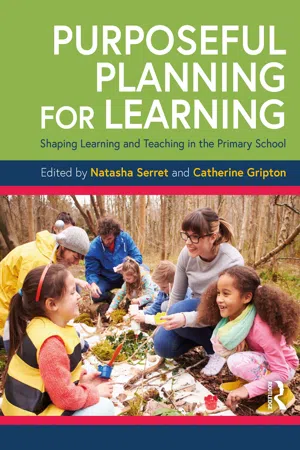
Purposeful Planning for Learning puts the passion and depth back into how teachers plan for learning in the primary classroom. Offering a unique perspective on what constitutes purposeful planning for learning, this book encourages a mindset where planning is integral to, supportive of and informed by learning, including learning that is social, emotional, physical and cognitive.
Written by a variety of teacher educators and primary teachers, this book reconceptualises planning by focusing on different themes such as outdoor learning, assessment, questioning and inclusion, that all influence and inform planning. In each chapter, you can find:
Voices of teachers and teacher educators
The unpicking of practice and key terminology
Vignettes that shed light on classroom life (examples from practice) and
Opportunities for reflection (points to ponder)
This cross-curricular resource provides aspirational, professional and practical insights into current issues that surround planning. It includes student and experienced qualified teacher insights which will serve as inspiration to support the reader in making real changes in their classroom.
If the goal of teaching is children’s learning and development, then the learning experiences and our teaching that facilitates this needs to be planned with thought, creativity and professional understanding. Planning is seen as preparation for learning.
The intention of this book is to encourage a mindset where planning is integral to, supportive of and informed by learning. This is learning in its broadest sense so includes social, emotional, physical and cognitive development. Within this conception, planning in this book is recognised as a holistic process. From the thinking that happens on the journey to school and the informal discussions that go on between staff during a school day to the stimuli captured outside of school and the creation of inspiring classroom environments, preparation for learning (or planning) is taking place. In this book, planning is not seen as an individual endeavour. It involves a collaboration with staff, parents, children and the wider school community.
When we set out to write this book, we had in mind an audience of beginning and more experienced teachers and other education professionals from different countries working with children in the 3–11 age range. A key challenge in planning is having a shared understanding of the terminology that is in everyday use in educational settings. In this book, we refer to:
Your curriculum – as the curriculum used in your setting
Children – as the children and young people (or pupils) that we teach
Lesson or activity – a more or less formal learning and teaching moment
Teacher or practitioner – a facilitator of learning, regardless of their qualification or title
Student teacher – a beginning facilitator of learning, someone who is studying to be a teacher
Teaching – facilitation of learning
Planning – preparation for learning
We have strived to take a common structural approach for every chapter in this book so that you, the reader, can weave in and out of different chapters and navigate your own professional development path, using identified chapters in this book to support aspects of your practice as and when they arise. In each chapter, you will find:
Voices of teachers and teacher educators
Unpicking of practice and some key terminology
Vignettes that shed light on classroom life (examples from practice)
Opportunities for reflection (points to ponder)
You will notice that we have maintained a tone that is collegiate. We regard ourselves as fellow professionals, and our chapters communicate our keenness and passion to engage with others about learning and teaching. Throughout this book, we invite you to critique accepted practice and your own understanding. We invite you to reflect, to question and to enter into dialogue with colleagues about learning and how we prepare for it through our planning. This critical engagement, we hope, serves to promote and sustain children’s curiosity – both inside and outside of school. The authors in this book work with student teachers on a daily basis across a range of professional courses. Our collective experience is echoed throughout all chapters. In each chapter, we present a perspective on planning, unpick pedagogy and, most notably, translate thinking into practice through our ‘examples from practice’ vignettes. Our shared belief that teaching is an ongoing and evolving reflective art is evident in the ‘points to ponder’ that can be found at the end of each chapter. These opportunities for reflection encourage you to continue your professional development journey and can be used to help refine and hone your practice.
There are some guiding principles that underpin the chapters in this book. First, planning is influenced by our personal educational philosophy. This requires us, as teachers, to reflect upon and examine what we individually believe are the fundamental purposes and goals of schooling and education. Is it, for example, to equip the next generation with basic and vital skills necessary to sustain a workforce in the future? Or is it to instil a set of core values? Or is it to inspire our future politicians, peace-makers, environmentalists, scientists, artists, writers, athletes and technological pioneers to continue and further human development? Or perhaps to make society fairer? Our personal educational philosophy enables us to justify our pedagogical choices, and this philosophy underpins (consciously and subconsciously) every planning decision we make as teachers.
Second, the implication for many of the chapters is that planning relies on having a good professional grasp of your curriculum whilst recognising that this can develop and change. Our knowledge of curriculum (including subject knowledge) arises out of our professional reading of literature, research and legislation. This knowledge deepens through our professional discussions with colleagues and others in the educational field and can be refined through our continual engagement with recent wider societal developments. This book recognises that our grasp and interpretation of curriculum is fluid and contextual. As teachers, we need to continue to adapt and innovate our planning and practice throughout our careers to meet changing demands, children’s needs and societal drivers.
The specialist knowledge of teachers is more than curriculum and subject knowledge (what we teach and what children need to learn). It includes how to teach (how learners learn and how we teach to support this). Some chapters in this book (in particular, Chapter 4 on lesson design) return to the first principles of planning underpinned by the belief that teachers can maintain an autonomous and professional approach when working with any published scheme or planning format. As teachers we are learners. We continually develop our knowledge of pedagogy based upon experience and reflection.
Our most important guiding principle is that planning supports the holistic development of a child, and therefore, learning opportunities should not be solely driven by legislative requirements. At the heart of the planning process is the learner; their strengths, experiences, interests and needs. Some of the chapters in this book (for example, Chapter 9 on outdoor learning) highlight the significance and place of planning for key characteristics of holistic learning such as risk-taking, resilience, critical thinking and being open to alternative ideas. Other chapters connect holistic learning with the argument for curriculum breadth and balance (for example, Chapter 12 on creativity). Chapters in this book that explore sustainability (Chapter 13) and also inclusion (Chapter 3) present a range of planning opportunities that recognise and draw from current local and global issues such as sustainable development and addressing inequalities surrounding gender, ethnicity and disability. Consequently, these chapters encourages us to plan for practices where children begin to see themselves as future citizens of a wider society, with a responsibility to contribute, protect and challenge. In planning for the holistic development of the child we recognise that one of the goals of education is to nurture active, respectful and passionate citizens of a global society.
We invite you to think about planning in its broadest sense; to consider all of the preparation for learning that teachers engage in and to review accepted practices through the lens of inclusive practice and the overall goals of education (your own and society’s). We offer to you our perspectives on what constitutes purposeful planning for learning in the hope that this supports, challenges and stimulates your professional thinking about how to shape learning and teaching in the primary school.
CHAPTER
2
Roles and responsibilities in learning
Paul Waring-Thomas and Catherine Gripton
Introduction
Before taking up a place on an Initial Teacher Education (ITE) course, most of us will have had a range of different experiences that will have shaped our thinking about what a teacher is and what they do. We are likely to have experienced some form of school education as learners ourselves and then possibly as observers or through work experience or classroom roles, seen how different teachers organise and support learning in different subjects and possibly had a go at doing some of this ourselves. All of our experiences, positive and negative, will have shaped our perceptions of how teaching works. Some of these experiences will have been inspirational, and some might have appeared to be quite pedestrian. Some experiences will have supported us in gaining confidence and trying out possibilities, and some will have resulted in us becoming inhibited and risk-averse. Some will have encouraged us to question and some to conform. In many of these instances the subject matter might have been the same, the constraints might have been the same but the outcome for the learners was different. In this chapter, we encourage you to consider, ‘What sort of teacher do I want to be?’ We offer some theoretical frameworks that enable us to reflect on and enhance our professional development journey. Our chapter then focuses on the role of the learner and how our planning can consciously and subconsciously reinforce different perceptions of a learner.
What sort of teacher do I want to be?
When we look at experienced teachers they often seem to be effortless in their approach. Their classrooms seem to be organised and focused, the children seem to be engaged and behaving well, the teacher seems confident and relaxed and everything just seems to happen automatically. Such a teacher might be described as ‘unconsciously competent’, in other words, able to complete multiple tasks at the same time, not having to think about how to respond to demands and able to pre-empt issues so that they never seem to develop into something that would derail the lesson and the learning. The beginning student teacher might look at such an experienced teacher unaware of the level of skill, knowledge and understanding underpinning such an approach within the classroom. They might think that teaching is simply a case of finding something for children to do that will occupy them, and that teaching is about how they perform rather than about how the children engage, respond and learn. Their stage of development might be termed ‘unconsciously incompetent’, where the beginner student teacher is unaware of the skills, knowledge and understanding that a teacher needs to be effective. In order to move from this position, the first thing that needs to happen is for the beginning student teacher to become aware of the qualities that teachers demonstrate and to recognise that these are aspects of their own practice that need to develop. Without the awareness that there are parts of a teacher’s practice that can be developed and the self-awareness that these things apply to them and their own current levels of skill or competence, then such a beginner will remain ‘unconsciously incompetent’ and never begin the process of improvement. The model in Figure 2.1 shows a representation of the stages that learners of a skill (or set of skills, knowledge and behaviours) need to go through to the stage exhibited by experienced members of the profession.
FIGURE 2.1 Conscious competency model of teacher development (adapted from Robinson 1974).
The journey might not be easy or straightforward – it is never comfortable to recognise that there are qualities of a role that we are unable to demonstrate effectively – but with practice, reflection and guidance we can move through the stages of development identified. We can recognise our ‘conscious incompetence’, a state where we might be painfully aware of the fact that we cannot yet carry out the role of a teacher because there are so many aspects of practice to focus on. Once we start to become aware of these skills and open ourselves up to developing them, then we are able to increase our proficiency and move towards ‘conscious competence’, where we are able to make choices and deploy these professional attributes within the classroom to support the children that we teach. For this to happen we need to make a commitment to personal development, we need to open ourselves up to mentoring and we need to reflect upon the effectiveness of our practice. Through this it is possible to move from the conscious decision-making and deployment of skills as a teacher through to being able to do this as if it is second nature (unconscious competence).
Whether we are at an early or later stage of our teaching career, our own perceptions, values and beliefs about the teacher’s role will influence the choices that we make within the classroom and, therefore, the outcomes for the children that we teach. As Hattie says, “…the ultimate requirement is for teachers to develop the skill of evaluating the effect that they have on their students” (Hattie 2012:32). In order to do this we need to look closely at the choices that we make and why we make them. Our choices are shaped by the teaching and learning experiences that we ourselves had and continue to have. They are shaped by our views about the world and our feelings (sometimes incorrect) about when teaching and learning is most effective. It can be difficult to change our beliefs about the way that we think things should be done. If we are open to experiences and new ways of working, if we are prepared to try things out and if we are able to evaluate the effect of that change, then we will have broadened the range of approaches available to us. In doing this, we will have developed our skills based upon evidence rather than assumptions. It can be uncomfortable, leading to ‘cognitive dissonance’ when our existing be...
Table of contents
Cover
Half Title
Title Page
Copyright Page
Dedication Page
Table of Contents
List of figures
List of examples from practice
List of tables
List of contributors
1 What is planning?
2 Roles and responsibilities in learning
3 Inclusive planning for learning
4 Principles of lesson design
5 Assessment and planning for progress
6 Questioning
7 Planning for learners of English as an additional language
8 Planning for children’s needs
9 Outdoor learning
10 Planning for sustainability
11 Lesson as narrative
12 Planning for children’s creativity
13 Promoting a positive climate for learning
Index
Trusted by 375,005 students
Access to over 1.5 million titles for a fair monthly price.
Study more efficiently using our study tools.
Frequently asked questions
Yes, you can cancel anytime from the Subscription tab in your account settings on the Perlego website. Your subscription will stay active until the end of your current billing period. Learn how to cancel your subscription
No, books cannot be downloaded as external files, such as PDFs, for use outside of Perlego. However, you can download books within the Perlego app for offline reading on mobile or tablet. Learn how to download books offline
Perlego offers two plans: Essential and Complete
Essential is ideal for learners and professionals who enjoy exploring a wide range of subjects. Access the Essential Library with 800,000+ trusted titles and best-sellers across business, personal growth, and the humanities. Includes unlimited reading time and Standard Read Aloud voice.
Complete: Perfect for advanced learners and researchers needing full, unrestricted access. Unlock 1.5M+ books across hundreds of subjects, including academic and specialized titles. The Complete Plan also includes advanced features like Premium Read Aloud and Research Assistant.
Both plans are available with monthly, semester, or annual billing cycles.
We are an online textbook subscription service, where you can get access to an entire online library for less than the price of a single book per month. With over 1.5 million books across 990+ topics, we’ve got you covered! Learn about our mission
Look out for the read-aloud symbol on your next book to see if you can listen to it. The read-aloud tool reads text aloud for you, highlighting the text as it is being read. You can pause it, speed it up and slow it down. Learn more about Read Aloud
Yes! You can use the Perlego app on both iOS and Android devices to read anytime, anywhere — even offline. Perfect for commutes or when you’re on the go. Please note we cannot support devices running on iOS 13 and Android 7 or earlier. Learn more about using the app
Yes, you can access Purposeful Planning for Learning by Natasha Serret, Catherine Gripton, Natasha Serret,Catherine Gripton in PDF and/or ePUB format, as well as other popular books in Didattica & Didattica generale. We have over 1.5 million books available in our catalogue for you to explore.