1
INTRODUCTION
This book is about geopolitics in the current era of globalisation and about its drivers. This writing draws upon the experience of a former diplomat who closely followed several inflection points in our contemporary history at different diplomatic stations in his career. They present a non-Eurocentric view of history’s twists and turns – a view which is anchored in the experience of India’s own historic political transition from a colonised country into an independent one. As the world observes, at the time of writing of these words, 150 years of Mahatma Gandhi’s birth, this phase in India’s millennial history has critical relevance in our times.
The following survey is about leaders making decisions on war and peace, drawing upon their convictions – their core beliefs – in the righteousness of their monumental choices. As they make those fateful decisions, they find anchorage in the organising principles of their polity, whose apex they occupy, and in the civilisational values of the communities organising themselves in such a political formation. In the final analysis, these reflections are about our lives and that of the succeeding generations. Reflecting upon the life and times, they in some way touch upon the human condition and upon the pathology of conflict.
This book takes the end of the Cold War as a starting point for the exploration of our contemporary dilemmas. At this sharp turn in our contemporary history, it is remarkable that both adversaries, the US and the USSR, looked at each other not with a steely, fierce gaze, but with a benign expectation that they will come together to make this world a better place and at peace with itself. Taking initial hesitant, wary steps, they tried marching lockstep towards that shared goal. But the chain of events set off from that ‘meeting of minds’ soon outpaced their decisions and the realisation of those decisions. There was triumphalism, no doubt, in the West, especially the US, over the seeming validation of the core principles of their political economy, which found expression in the rather doctrinaire application of these principles as the dynamics of this critical political transformation was sought to be steered towards their end objectives. The entirely unanticipated dialectics between these triggered trends and the constant readjustments by others to manage the ramifications for themselves are the subject of enquiry in this book. The consequences of this dialectics on geopolitics, on the global economy, and on societies are spelt out in the succeeding chapters. Now, there are openly expressed concerns about the viability of the Western liberal order, as it seems to be unable to gauge the anxieties of its own citizens and to meet the rising expectations of the younger generation. There are implications for India as well because of its complex neighbourhood and the country’s global reach.
The salient impact of those early decisions has been a loss of control over the course of events, paradoxically in a situation of historically unprecedented unchallenged military, technological, and economic power of the US: the era of globalisation, starting with the dissolution of the Soviet Union, had a distinctively American stamp. This loss of control also resulted in regional instabilities, splitting of nation states and state collapse, bloody conflicts within and between nation states and splitting of national identities, precipitate weakening of multilateral organisations and failure of attempts at their alternatives, considerable expansion of the reach of jihadist terrorism, mass movements of uprooted populations within and across countries, transnational criminal networks, and increasing frequency of global economic and financial disruption. The march of technology and weakening institutional capacities vertically and horizontally have contributed towards ecological ravaging and the destabilising potential of climate change. International geopolitical fluidity is a major contributor to deepening strategic distrust amongst major powers, a runaway arms rivalry combined with a dizzying pace of revolution in military affairs, and rapid disappearance of ground rules in managing big power relationships even of the Cold War period. With technological empowerment, the nation state has lost the capacity to control the narrative and even its coercive capacity vis-a-vis the individual. As various powers engage with the shifting patterns of great power relations, the phenomenon of collapsing states renders such power equations, pegged on nation states as solid units, as exercises in aspirational thinking. It can only be expected that, given the current strategic fluidity and unpredictability, theoreticians and policymakers alike find analysis of global trends a bewilderingly complex and uncertain task.
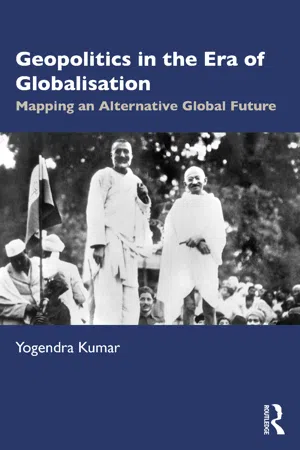
What kind of future awaits us, and can we escape the entrapment of this dialectics? The book explores whether the deepening global uncertainties, the economic costs, the human suffering, the environmental damage, and, ultimately, the widespread perplexion about our first principles of state organisation could be considered inevitable. It takes a point of departure in the narrative to bring in the role of Mahatma Gandhi, who managed a political transformation – the course of India’s freedom struggle– and the political steadiness of a poor and diverse country stepping forward as an independent nation. The Gandhian praxis, as it bore those results, has a universally valid lesson: only a mass-based political mobilisation, in support of any government policy action, can make a political transformation empowering and uplifting for the people by being inclusive of the weak and the disadvantaged. Only then can such political transformation be enduring and ennobling for the people. Despite its short-lived political legacy, but still relevant, is the contribution of another of Gandhi’s great contemporaries, Khan Abdul Gaffar Khan, through the highly successful, non-violent mobilisation of the Pushtoon communities in his day in the face of brutal repression by the British Raj, to which the ongoing mindless violence and great human tragedy in the same Afghanistan–Pakistan region, the recurring bouts of state collapse in Afghanistan, present a painful contrast.
The Gandhian praxis is also explored in the context of current, heated, and rhetorical discourse on identities, as they keep splitting ad infinitum, on ethnic polarisation, and even xenophobia. How was an inclusive identity nurtured during Gandhi’s time without any support from a hostile officialdom and which was quite distinct from the prevailing, officially crafted narrative? This exploration touches upon the quality of governance which is the ultimate catalyst for the fusion or for the splitting of identities, for social cohesion, or for societal fragmentation and collapse. This phenomenon and the conundrums of creating stable political institutions – hence, institutional capacities – strong enough to effectively meet the enduring and emerging challenges constitute the running thread throughout this book. The author approaches these issues, including the contemporary writings on geopolitics and IR theory, as enquiries into the dynamics of power transitions from this perspective.
This running thread is tracked in its different stands in different chapters whilst, given the vast scope and the availability of copious writings on each one of them, no attempt has been made to survey the corpus of the relevant literature. A chapter is devoted to a survey of literature on geopolitics and IR theory, especially with a view to trace the effect on them of the end of the Cold War, representing an inflection point in global events. The writings of key thinkers on the emerging post–Cold War geopolitics and the emerging shape of IR theories have been surveyed. The objective has been to show them both as influencing the thinking of the policymakers but also as theoretical rationalisations of their approaches towards making key decisions. From the same point of view, the chapter also looks at non-European theoretical work in terms of geopolitics and IR theory. Special attention has been paid to the evolution of the Chinese and the Indian traditions. References have been made to the methodological complexities in the proper theoretical assessment of the trends in geopolitical developments.
The next chapter looks at the evolution of global institutions, such as the United Nations (UN) and the World Bank, at the end of the Cold War as a result of deliberate decisions of its putative victors, who sought to realise their original, foundational ideas given the disappearance of their challenger superpower in the Soviet Union. The further institutional growth of other regional organisations, supported by the West due to their exclusive control, is also traced. Other regional and transnational organisations are also traced in their evolution as reflecting the growing power of the ‘non-West’ which also, conversely, reflected the inability of the Western organisations to fill in the relevant spaces. The end result has been the weakening of the global institutions precisely at a time when these are most needed to combat challenges beyond an individual nation’s capacity.
The following chapter provides a broad survey of global and regional developments from the time of the US–USSR détente presaging the end of the Cold War. The implications of the dissolution of Yugoslavia and, subsequently, the Soviet Union are analysed for their larger geopolitical impact. The Western policy and politics towards the unfolding events are also surveyed. The transformative processes, partly the result of the course of events in Europe, in other world regions are also surveyed as broad trend lines. The transition processes towards democratic systems, in their different dimensions, are analysed, including their implications for South Asian stability and for India. These trends are looked at in terms of the ongoing debate as to the reasons for the decline of the post–Cold War ‘liberal global order’. Their effect on the increasing geopolitical uncertainty has been commented upon.
The next chapter dwells upon the shift in geopolitics and its ramifications in today’s world. The wide spectrum of global challenges defining contemporary geopolitics is described in terms of the current scholastic and strategic analytical discourse. Looking into the medium-term future, various trend lines have been delineated. There is discussion of contemporary analysis of the phenomenon of state collapse and state fragility and of the current thinking to address it. The global megatrends, aggravating state vulnerabilities with their geopolitical ramifications, are discussed, including demographics, global economic trends and growth of anti-globalisation sentiment of the West, disruptive technologies, the changing nature of military conflict and the ‘Post-Westphalian Long War’, climate change, weapons of mass destruction, and jihadist terrorism. The conundrums of nation state building following conquest by the West, as illustrated in the case of Afghanistan and Iraq, are discussed, as are the associated methodological complexities perceived by the decision-makers.
After the survey of global trends and the growing challenges following the end of the Cold War, a chapter is devoted to the Gandhian praxis with regard to nation building and IR theory. This covers the discussion of the theoretical dimension of Gandhian political philosophy and also the key elements of his IR theory by contemporary political scientists, historians, and other observers of international developments. The different dimensions of his theoretical and practical approach to political mobilisation, as evident in his leadership of the Indian freedom struggle against the British, are looked at in terms of their contemporaneity: the different elements covered are managing rapid change, elite identification with the poor and the disadvantaged, the democratic culture of internal organisational discourse, techniques of crafting inclusive national identity, inculcation of Gandhian values in the Congress party as the main instrument for freedom struggle and post-independence governance, and the forging of resilient political institutions for independent India. There is also a discussion on the political life and teachings of Khan Abdul Gaffar Khan and his current relevance, especially as we follow the recent tragic history of a politically fragile Afghanistan.
The following chapter is more in the nature of summation of the narrative thus far and the approach inherent in it for a rethink about our current options. The discussion is about geopolitics and balance-of-power challenges, arms control and destabilising weapons technology, conflict and state fragility, ineffectiveness of global and multinational institutions, climate change, and global economic uncertainties. An exploration is undertaken of alternative possibilities in addressing these challenges at the global level and as to how the Gandhian approach to managing political change is relevant today against the background of current discussions on these challenges. There is discussion about South Asia’s challenges and its ramifications for India. The spectrum of challenges for South Asia is no different from the rest of the world but these challenges are menacing in no small measure given the magnitude of the geography and the diversity of the demography; all of this is complicated by active extra-regional great power interest in the region and the absence of commensurate pan-regional institutions. In this context, India’s role, as a rising power with the expanding interests farther beyond the region, is analysed both in terms of its neighbourhood policy and its complex relationships with the great powers.
The last chapter wraps up the narrative of this book. It ends on a sober note, given the overwhelming challenges before the world and the modest scale of the response to them. The interconnectedness of the world, brought about by technology, travel and commerce, and the global scale of the challenges, propels us all towards a globalised existence. The material and intellectual resources of humanity can overcome these challenges to deliver a more prosperous and secure future. The faltering certitudes and the orthodoxies about the conundrums of managing political change – of the increasingly restless and even inchoate aspirations of the millions of people around the world – can be reset by applying the basic techniques of political mobilisation as practised by Mahatma Gandhi. Thus, this sober concluding note is tinged with optimism in the thought that a path was shown by the life and teachings of Mahatma Gandhi. His teachings and those of Khan Abdul Gaffar Khan, the Frontier Gandhi, are not a past, forgotten chapter in world history but a script for our common future.