Our world is under pressure, with growing inequalities in wealth and access to food and clean water. We depend too heavily on polluting fuels and diminishing natural resources. Traditional cultural practices are being swamped by global popular culture.
The Thai model of sufficiency thinking aims to transform the mindset of a whole population to achieve the seemingly impossible: enriching everyone's lives in a truly sustainable way.
Innovative management practices developed by King Bhumibol Adulyadej of Thailand have been applied across Thailand in agriculture, education, business, government and community organisations for over two decades.
In this book, chapters written by eminent Thai scholars explain sufficiency thinking and review its implementation in different sectors including community development, business, agriculture, health care, schools, and even in prisons.
Is Thailand unique in having discovered the holy grail of a more responsible form of capitalism? No, it is not, but it is the first country whose government has adopted this kind of thinking as national policy.
'...we obviously need to revise dramatically our thinking about the outlines of a just economy and a decent society in which everyone can lead dignified lives. Sufficiency Thinking provides creative approaches to this quandary and this important volume is a brilliant addition to the growing literature critical of mainstream business-as-usual ideology.' - John Komlos, Professor Emeritus, University of Munich
eBook - ePub
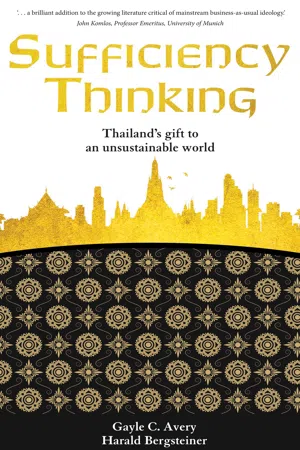
Sufficiency Thinking
Thailand's gift to an unsustainable world
- 328 pages
- English
- ePUB (mobile friendly)
- Available on iOS & Android
eBook - ePub
About this book
PART I Introduction
When we get our story wrong, we get our future wrong.
—DR DAVID KORTEN (2015: 1)
1 Thailand: An unexpected role model
GAYLE C. AVERY, PHD
AND
HARALD BERGSTEINER, PHD
AND
HARALD BERGSTEINER, PHD
This is a very different book about Thailand. It is not the usual book about the land of smiles, glorious Buddhist temples and wonderful landmarks and resorts. Instead, this book reveals how Thailand is setting an example for the rest of the world.
Thailand is introducing sustainable thinking across the nation—from schools and universities to agriculture, community development, the environment, prisons, business and public policy. By implementing the Sufficiency Economy Philosophy that King Bhumibol Adulyadej of Thailand bestowed on his people, this country is striving for outcomes of well-being, happiness and sustainability.
Sufficiency thinking within the Sufficiency Economy Philosophy seeks to balance the economic, societal, environmental and cultural spheres by following a middle path characterised by decisions and actions that are moderate, reasonable and prudent. The presumption is that individuals, families, communities and societies will embrace virtuous values that, when coupled with appropriate knowledge, enable them to decide and act with wisdom.
This chapter introduces the book by highlighting the need for sustainable development. It discusses some of the current issues affecting people and the planet that demand immediate action and notes the current level of action/inaction globally. This chapter places sufficiency thinking in the context of several other approaches to sustainable development based on moral and, in the final analysis, smart forms of development. We look at some of the innovative steps that nations, communities, business enterprises and individuals are taking to solve these problems within their sphere of influence. In the last section of this chapter, the rest of the book is introduced.
NEED FOR SUSTAINABLE DEVELOPMENT
Among the many definitions of sustainable development is the widely cited ‘Brundtland’ statement (World Commission on Environment and Development, 1987):
Development that meets the needs of the present without compromising the ability of future generations to meet their own needs.
However, this popular definition can be difficult to translate into action. Bolis, Morioka and Sznelwar (2014) argue that sustainable development should consider three dimensions:
- satisfying human needs (including social and economic aspects)
- using natural resources within the planet’s limitations, and
- making decisions based on values and ethics.
Even here, there is disagreement. A big question centres around whose values should form the basis of sustainable development. Ethicists argue about whether it is just the interests of humans that count or whether animals, plants and ecological systems should also be seen as valuable in their own right (Kolstad et al., 2014). More contentiously, do cultures and societies possess value over and above the interests of individual humans? At the moment, economic imperatives seem to be the overarching criteria for assessing the value of anything and everything, even on issues that are essentially non-economic. Under cost–benefit thinking, if the benefits—typically to humans—are perceived to exceed the overall—mostly economic—costs, an action is considered justified. However, using economics as the sole basis for decision-making is very limited and economic rationalisations need to be supplemented by other considerations based on broader values held by various stakeholder groups (Kolstad et al., 2014).
Threats to a sustainable world
Clearly, the world is far from developing sustainably under this kind of money-obsessed and unbalanced scenario. Indeed, the present generation is massively compromising the ability of future generations to satisfy even their basic needs. In many regions, rivers and other environments have become toxic and polluted, and precious resources are running out. We are effectively stealing from future generations through our overconsumption, despoliation and irresponsible management.
Let us consider some of the effects of probably the most pressing global issue: climate change. Experts conclude that humanity’s behaviour since the 1950s has almost certainly intensified the rate of global warming, creating significant widespread damage to the environment (Garnaut, 2011; Intergovernmental Panel on Climate Change [IPCC], 2014a, 2014b; Stern, 2007). According to the IPCC (2014a: 4), the current high levels of carbon dioxide, methane and nitrous oxide in the atmosphere have not been seen in at least the last 800 000 years. One effect is that in some large cities the air has become almost unbreathable for extended periods. But there are many other adverse effects as well.
Under some of the projected consequences of climate change (IPCC, 2014a), we can expect to see large-scale species extinction occurring. Oceans will continue to acidify and rising sea levels will affect coastal systems and low-lying areas, driving people from their homelands and livelihoods. Both renewable surface water and groundwater will dry up, thereby intensifying competition for fresh water. Climate change is predicted to undermine food security in agriculture and fishing. Existing human health problems will worsen, with many people’s lives shortened or their quality of life reduced. Furthermore, increasing combinations of high temperatures and humidity will affect basic activities such as growing food and working outdoors. City dwellers will suffer from increased heat stress, storms and extreme precipitation, flooding, landslides, air pollution, drought, water scarcity and higher sea levels. Those without essential infrastructure and services, or people living in exposed areas, will suffer most—and these are likely to be mainly poor people.
But climate change is just one of the many threats to sustainability. A scarcity of various kinds of resources is likely to lead to global instability. For example, serious and difficult-to-resolve conflicts are already occurring over the quantity and quality of water available on most continents (Hipel et al., 2015). Water management not only affects humans and their traditions; it has a physical effect throughout the entire ecosystem. Shortages of water are driving millions of humans from their drought-ravaged homelands, creating major social challenges in relocating them. Running out of fossil fuels and other critical resources is yet another threat that has already led to conflicts and human suffering—but fortunately it has also led to some technological innovation in renewable energy.
Social challenges
Yet another area in which our world is under pressure is in the social domain. Increasingly, the world’s leaders are realising how important it is to focus on sustainable development if we are to solve many existing social and humanitarian problems. In 2000, 189 countries signed up to a set of Millennium Development Goals (MDGs) to be achieved by 2015. These goals included eradicating extreme poverty and hunger, achieving universal primary school education, promoting gender equality and empowering women, reducing child mortality and improving maternal health, combating various diseases and collaborating to promote development. While much has been achieved in working towards these goals, much more remains to be done, as the Secretary General of the United Nations, Ban Ki-moon (2015: 3) pointed out:
Yet for all the remarkable gains, I am keenly aware that inequalities persist and that progress has been uneven. The world’s poor remain overwhelmingly concentrated in some parts of the world. In 2011, nearly 60 per cent of the world’s one billion extremely poor people lived in just five countries. Too many women continue to die during pregnancy or from childbirth-related complications. Progress tends to bypass women and those who are lowest on the economic ladder or are disadvantaged because of their age, disability or ethnicity. Disparities between rural and urban areas remain pronounced.
In 2015, most of the world signed up to the United Nations’ next set of aspirational goals, the Sustainable Development Goals (SDGs), which are intended to serve until 2030. The SDGs call for ‘socially inclusive and environmentally sustainable economic growth for the world’ (Sachs, 2015: 3), with the aim of sharing economic progress more equitably, eradicating extreme poverty, strengthening communities and protecting the environment.
Unbalanced focus on economics
The world has a lot of work ahead of it to achieve these new sustainable development objectives. One reason is the effects of economic unsustainability. As the Stern review (Stern, 2007) into the relationship between climate change and economics notes in its executive summary:
Climate change presents a unique challenge for economics: it is the greatest and widest-ranging market failure ever seen. The economic analysis must therefore be global, deal with long time horizons, have the economics of risk and uncertainty at centre stage, and examine the possibility of major, non-marginal change.
Many of the world’s problems can be attributed to a disproportionate emphasis on economic growth to the detriment of social and environmental considerations. While economic growth has undoubtedly brought prosperity to many humans, an unbalanced and unsustainable form of toxic capitalism has infected virtually every part of the globe and all industry sectors. For example, in 2010 industry consumed about 28 per cent of available energy and emitted 30 per cent of global greenhouse gases (GHGs)—amounts projected to increase by between 50 and 150 per cent by 2050 unless there is significant intervention (IPCC, 2014b). Urgent improvements are needed in the management of agriculture, forestry and related land uses because this sector accounts for about 25 per cent of GHGs. It is a critical sector because it plays a central role in food security in many economies, including in Australia, China and Thailand.
TIME FOR ACTION
Undeniably, we humans have known for decades what we—as individual citizens, as organisations and as governments—can and should be doing to preserve the Earth and facilitate just access to resources, goods and services. As individuals, we can start by rethinking our consumption patterns in terms of their impact on the environment—acquiring longer-lasting goods that are designed so that their components can be recycled on disposal; choosing technologies that reduce energy consumption; switching to power companies using renewable energies; and no longer wasting food and drinking water. Urban planners can contribute by designing more compact cities with integrated public transport systems and opportunities for walking or cycling to work, shopping and other activities; planning high-speed rail systems to compete with air travel; and designing low-energy buildings with low carbon footprints and long lifespans. Industry already knows what to do in terms of reducing water, energy and other scarce resources, in designing goods for disposal, and reducing and recycling waste. Some manufacturers have been doing this for decades, but others are slow to act.
We also know that we should not wait to introduce sustainability measures. Nicholas Stern’s report (Stern, 2007) and the warnings of other experts (Garnaut, 2011; Sachs, 2009, 2015) tell us that acting now will certainly cost a significant amount, but not nearly as much as delaying action. Yet governments worldwide are mostly delaying action. However, the good news is that some governments are acting. As we write, China is planning to launch the world’s largest emissions trading program in 2017, aimed at reducing its CO2 emissions. The United States has introduced a special form of company incorporation, the Benefit Corporation (or B-Corp), which legally allows a firm’s management to benefit other stakeholder groups apart from investors. Thailand has a sustainability philosophy placed at the very heart of its development: the Sufficiency Economy Philosophy.
Costs of acting now
Does sustainable development have to hurt? Mostly not. Indeed, there is overwhelming evidence that the benefits of most economic, social and environmental sustainability initiatives exceed their costs in the long term. There are, of course, situations where an initiative may not bring immediate benefits to those who choose, or are mandated to, implement it. One example is the catalytic converter, a device that auto-makers were required to install in vehicles with combustion engines to reduce toxic emissions. Many governments legislated to have catalytic converters fitted to such vehicles in an effort to make sure that, in the long run, everyone would be better off. In the short run, the car manufacturers and purchasers who had to pay more for their vehicles were not so sure.
Our over-consumption of resources is another matter. On current patterns of usage, significant sacrifices seem inevitable. However, even managing resources more intelligently can achieve surprising results. Since 1994, Germany has tracked its GDP trend against raw material consumption through local extraction and imports (FSOG, 2014). Compared with the base year 1994, GDP has continuously risen, while resource consumption has, with some minor bumps, continuously fallen. Germany’s objective is to double its raw material productivity by 2020. However, it would be illusory to think that we can succeed without some sacrifices (Stern, 2007)—particularly high consumers in the Western world. However, the social and environmental gains will benefit millions.
Why don't we act?
While consensus is growing that action is required, addressing our multiple problems is challenging. For a start, climate change and its impacts are intrinsically hard to understand (Weber & Stern, 2011). Furthermore, many people tend to put off dealing with change that happens gradually, and where the main effects—the nature of which is somewhat vague and uncertain—will happen in the future and are more likely to affect others. Politicians elected for three- to four-year terms may have little interest in imposing higher taxes or other costs on their constituents to combat distant sustainability problems.
Sustainable development often involves so-called ‘wicked’, complex problems, the solution to which revolves around conflicting values and ethics held by various stakeholder groups, or problems that it may not even be possible to solve. For example, the so-called developed world enjoys high standards of living with associated high levels of energy consumption, pollution, greenhouse gas emissions and waste. For the sake of the planet, these negative outputs should be reduced substantially; however, they are more likely to increase as people in developing economies seek higher standards of living. However, who has the right to tell emerging countries that they cannot aspire to the same standard of living as developed regions? Some solutions to this kind of ‘wicked’ problem may come from major innovations in technology—for example, renewable and low-energy equipment—and in consumer behaviour (for example, reducing waste and recycling). Some of this is already happening: examples include basic mobile phones in Africa and basic cars in India; producing gas in rural India using methane from cow manure and other organic waste materials; or using sand filtration to clean drinking water.
What is missing is a population that has been educated about what the problems are and an understanding of how individuals and organisations can contribute to the solutions. As this book will show, Thailand has already started introducing a curriculum fr...
Table of contents
- Cover
- Title Page
- Copyright Page
- Contents
- List of tables and figures
- Foreword
- Foreword
- Editors' preface
- Acknowledgements
- About the contributors
- Part I: Introduction
- Part II: The Sufficiency Economy Philosophy
- Part III: At the local and community levels
- Part IV: At the national level
- Part V: Sufficiency thinking in business
- Part VI: Actioning the future
- About Thailand
- References
- Index
Trusted by 375,005 students
Access to over 1.5 million titles for a fair monthly price.
Study more efficiently using our study tools.
Frequently asked questions
Yes, you can cancel anytime from the Subscription tab in your account settings on the Perlego website. Your subscription will stay active until the end of your current billing period. Learn how to cancel your subscription
No, books cannot be downloaded as external files, such as PDFs, for use outside of Perlego. However, you can download books within the Perlego app for offline reading on mobile or tablet. Learn how to download books offline
Perlego offers two plans: Essential and Complete
- Essential is ideal for learners and professionals who enjoy exploring a wide range of subjects. Access the Essential Library with 800,000+ trusted titles and best-sellers across business, personal growth, and the humanities. Includes unlimited reading time and Standard Read Aloud voice.
- Complete: Perfect for advanced learners and researchers needing full, unrestricted access. Unlock 1.5M+ books across hundreds of subjects, including academic and specialized titles. The Complete Plan also includes advanced features like Premium Read Aloud and Research Assistant.
We are an online textbook subscription service, where you can get access to an entire online library for less than the price of a single book per month. With over 1.5 million books across 990+ topics, we’ve got you covered! Learn about our mission
Look out for the read-aloud symbol on your next book to see if you can listen to it. The read-aloud tool reads text aloud for you, highlighting the text as it is being read. You can pause it, speed it up and slow it down. Learn more about Read Aloud
Yes! You can use the Perlego app on both iOS and Android devices to read anytime, anywhere — even offline. Perfect for commutes or when you’re on the go.
Please note we cannot support devices running on iOS 13 and Android 7 or earlier. Learn more about using the app
Please note we cannot support devices running on iOS 13 and Android 7 or earlier. Learn more about using the app
Yes, you can access Sufficiency Thinking by Gayle C. Avery,Harald Bergsteiner in PDF and/or ePUB format, as well as other popular books in Economics & Business General. We have over 1.5 million books available in our catalogue for you to explore.