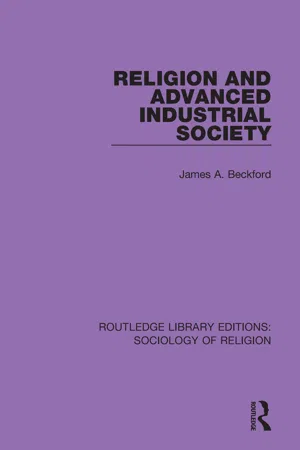
This book, first published in 1989, demonstrates that sociologists have much to gain from a strengthening of the connections between general theories about the changing character of modern western societies and specific studies of religion. It combines an exegesis of sociological classics in the study of religion, and a history of their influence upon the subject's development; a criticism of Talcott Parson's attempt to synthesise classical viewpoints into a single theory of modernity; a discussion of post-Parsonian theories of religion's declining importance; and an argument that some quasi-Marxist thinkers may offer fresh insights into the place of religion in capitalist societies.
- 198 pages
- English
- ePUB (mobile friendly)
- Available on iOS & Android
eBook - ePub
Religion and Advanced Industrial Society
About this book
Information
1
The isolation of religion
INTRODUCTION
The central argument of this book is that the contours of the sociology of religion have been shaped by specific ideas about industrial society. The sociological questions that have been asked about religion have therefore tended to reflect these ideas. I shall argue that the various meanings and different degrees of importance that have been attributed to such phenomena as secularization, rationalization and the rise of new religious movements are outcrops of underlying ideas about the transition from pre-industrial to industrial society. I intend to criticize these underlying, but rarely examined, ideas.
My main contention is that the legacy of ‘classical’ sociologists is so coloured by assumptions about the nature of industrial society that attempts to explain the character of religion in a world dominated by advanced industrial societies have been hindered. Contrary to much received wisdom and to common sense, I shall argue that religion remains highly problematic for the sociology of advanced industrial societies.
The present chapter will define some of the terms which are important for my general argument and will then chart, first, the process whereby the sociological study of religion moved from the centre to the periphery of sociology; secondly, the broad changes in twentieth century religion which have taxed the explanatory capacity of the sociology of religion; and, thirdly, the factors which have insulated the sociology of religion against, and isolated it from, the influence of wider intellectual debates. The legacy of classical sociology is shown in Chapter 2 to have propelled the modern sociology of religion towards marginality. The argument of Chapter 3 is that the crystallization of general theories of modernization and industrial society after the Second World War led to distinctive but limiting explanations of religion’s functional significance. Chapters 4 and 5 examine the responses to these limitations among sociologists who attempted to explain the increasingly controversial aspects of religion in the 1970s. Chapter 6 examines the evidence of a renewed interest in religion as a sociological problem among some Marxists and quasi-Marxists.
We must begin, however, with some brief comments on key terms. First, it should be made clear that the use of ‘industrial society’ and ‘advanced industrial society’ is intended to be as general and as inclusive as possible. I am well aware of the very special and diverse meanings that they have borne in the work of thinkers of many different outlooks. I also realize that these terms carry diverse ideological meanings.1 Nevertheless, I intend to use them in a deliberately non-specific and all-embracing way. ‘Industrial society’ refers to the kind of social formation that was believed to be emerging in parts of Western Europe and North America as early as the second decade of the nineteenth century. It implies, above all, a shift from agriculture to mechanized manufacturing on a large scale as the dominant means of producing goods for consumption or exchange. It cannot be separated from the decline of age-old communities, the growth of markets and companies based on share capital, the process of urbanization, the emergence of organized labour movements, the consolidation of nation-states as sovereign power holders and the growing impingement of science on all spheres of life. ‘Advanced industrial society’ refers to the kind of social formation that was believed to be emerging in various parts of the already heavily industrialized world in the 1960s. It is characterized primarily by the growth of world markets in goods and services, the ascendancy of service industries over manufacturing and agriculture, the growth in the numbers and power of multinational corporations, the separation of corporate management from share ownership, the levelling out of social class differentials and the crucial significance of theoretical knowledge and information technology.
For my purposes, these terms are merely convenient labels which signify that competing claims have been made about the general character and determinants of the forms of society which have emerged mainly, but not exclusively, in Western Europe, North America, Japan, Australia and New Zealand. The terms are clearly contestable and are more closely identified with the work of some social scientists than with that of others. But this will not represent a major problem because I shall indicate the precise ways in which the general notions of industrial and advanced industrial society are used in specific theoretical contexts. The main purpose of the terms here is to indicate that the understanding of religion has varied with the kind of interpretations that have been given of transitions to the two most important types of society identified in the past century and a half. In fact, the idea of major transformations in society is itself more significant than the precise labels given to the emerging forms of society.
It is certainly not my intention to suggest that the terms ‘industrial’ and ‘advanced industrial’ have any narrowly technological meaning for the character of societies in the late nineteenth and twentieth centuries. On the contrary, as we shall see, none of the major theorists of these two types of society attributes crucial significance to technology alone. Theorists have accounted for the distinctiveness of the two broad types of society in terms of complex sets of very varied factors and circumstances; and, in turn, they have identified widely different implications for religion. The failure to perceive these differences of conceptualization has enabled some sociologists of religion to make the mistake of believing that there was a single (or at least a compound) characteristic of industrial societies which could explain the problems of religion in the modern world.
The concept of ‘religion’ is no less contestable and variable than that of industrial or advanced industrial society. But, again, my strategy is to conceive of it in such an inclusive fashion that no important contribution to discussions of religious change since the early nineteenth century will be excluded by definition. For my purposes, then, it will be adequate to define religion as concern for the ‘felt whole’ or for the ultimate significance of things. It can take forms ranging from experiences in the individual person’s consciousness to widely deployed symbols of societal identity or even human essence. The advantage of this conceptualization is that it subsumes all narrower definitions without excluding others. In any case, very little turns on the definition that I have stipulated. It will not be employed in claims about the ‘real’ nature of religion; it will only demarcate the very broad areas of culture and society in which thinkers have located distinctive concomitants of the transition from pre-industrial to industrial society, and from the latter to advanced industrial society.
FROM INTEGRATION TO DIFFERENTIATION
Religion did not simply become a sociological problem for the first time with the initial wave of sociological classics which appeared in the mid- and late nineteenth century. The problems that arise from the fact that religion is necessarily embodied in social forms had already preoccupied thinkers from the beginnings of civilization. The rival claims of gods and humans; the necessity to store divine wisdom in earthen vessels; and the all-too-human frailties of the priestly representatives of gods - these and many other dilemmas and contradictions are deeply rooted in all major cultural traditions. But it is in the Judaeo-Christian culture spheres that the sociological problems of religion have been most methodically worked and reworked across the centuries. The periods of Late Antiquity, the Reformation and the European Enlightenment are especially important in this respect. It is not difficult to find in them the seeds of ideas and questions which eventually blossomed among the founders of would-be scientific sociology. There is considerable continuity, then, between pre-modern and modern thinking about the social aspects of religion, especially in respect of three broad ways in which theories of modernization have framed the sociological problems of religion.
First, thinkers such as Saint-Simon and Comte regarded much of the content of religious ideas and sentiments as outdated and obstructive to progress, whereas the social functions of religious institutions were considered essential for the more or less harmonious integration of societies entering the industrial era in the early nineteenth century. J. S. Mill, Alexis de Tocqueville and Herbert Spencer adopted similarly functionalist arguments to explain the persistence of religion, although they each had different reasons for doing so. And the subsequent generations of British and United States anthropologists including Edmund Tylor, J. G. Frazer, L. H. Morgan and L. Ward devised still more theoretical reasons for believing that, whereas science had already supplanted magic and religion as a method of understanding events in the world, the socially and culturally integrative functions of religion, myth and ritual still had to be fulfilled if societal stability were to be preserved. A less instrumentalist version of this argument appears in Emile Durkheim’s claim that the very constitution of society is by definition a religious process in so far as it involves the establishment of homologous categorizations of people (clans, tribes, nations) and other features of the world (sacred or profane). The argument was that as long as there were societies, the sacred/profane distinction would serve as the symbolic reminder and celebration of individual and collective subjection to them.
Secondly, by contrast, thinkers such as Feuerbach, Marx, and Engels regarded both the content of religious ideas and the supposedly integrative functions of religious institutions as outdated in industrial society and obstructive of socio-political progress. They were among the direct descendants of the anti-clerical, if not actually atheistic, wing of the Continental European and Scottish Enlightenments. They tended to interpret the persistence of religion in both cultural and organizational forms as evidence of deep-rooted resistance to inevitable social change. Their argument was that the human potential for benign development was being frustrated and side-tracked by vestiges of spiritual immaturity in religion. For Feuerbach, the problem was psychological and cultural; human beings had projected their psychological aspirations and uncertainties on to supposedly external powers which then took the form of spirits and divinities with the capacity to control human affairs. His philosophical project was to enable humans to reclaim responsibility for their own world by exposing the psychological origins of religious dependence. Feuerbach’s belief was that humans would then become more aware of their common humanity and more capable of devising a just and peaceful social order for themselves.
According to Marx and Engels, religion’s persistence was more closely associated with the exploitative and alienating aspects of the class-divided capitalist order; the psychology of projection and dependence was one of the means by which an oppressive social formation reproduced itself. Their aim was therefore to create the conditions for the overthrow of this formation but not in terms of abstract or static psychology. Marx and Engels sought to transform directly the pattern of exploitative social relations to the point where alienation could no longer be experienced and, consequently, religious distortions of reality would supposedly become unnecessary.
A third position was occupied by such thinkers as Max Weber, Ernst Troeltsch, Georg Jellinek and Georg Simmel. In their different ways they each analysed religion as a repository of fundamental cultural meanings through which both individuals and collectivities are able to interpret their conditions of existence, to construct identity for themselves and to attempt to impose order on their environment. Religion is regarded, in this perspective, as a largely symbolic resource or code in terms of which meaning is continuously produced, transmitted and contested. Religion is distinguished from other facets of culture only by the extent to which it provides a warrant for claims to ultimate significance. In some respects, these thinkers tended to regard religion as a kind of cope-stone which locked all the other components of human culture into place - because religious values acted as ‘trumps’ in the game of culture and/or because the social institutions and organizations of religion had acquired the power to control culture in the interests of powerful groups, classes, or strata.
Despite the differences between these theoretical positions, the approach of sociologists and social anthropologists to the study of religion at the end of the nineteenth century was at least of a piece in its insistence on locating religions in the context of other social processes and structures. They refused to isolate religious from other phenomena. As a result, the sociological study of religion was an integral part of a wider project for understanding the continuities and changes in the very constitution of society at the level of individuals, national societies and ‘humanity’. It is as if classical sociologists were, willy-nilly, honouring Marx’s epigram: ‘The critique of religion is the beginning of all criticism.’
In other words, religion was regarded as an important key to understanding the structures and processes of human societies. For some thinkers, this was because religion necessarily functioned in order to hold societies together. A second school of thought held that it was because religion was the mask which necessarily disguised the ‘real’ driving forces of societal continuity and change. And a third position regarded religion as a symbolic and organizational resource which could be adapted to suit the interests of particular sections of any society. None of these theoretical positions isolated religion from society’s complex web of social relations and processes. Indeed, religion would not have been important for classical theorists if it had been conceptualized as anything other than an integral part of society. As the rest of this book will argue, however, religion became progressively invisible in sociological analysis despite the fact that the classical problematics were never completely dissolved. Only since the 1970s have there been signs of a renewed attempt to make sociological sense of religion in ways which are not constrained by the twin temptations either of regarding everything social as religious or of exclusively identifying religion with formal organizations like churches. At the same time, religion has changed in ways which necessitate a rethink of the widespread tendency among social scientists to disregard its importance in advanced industrial societies and in societies which are affected by them.
One of the major themes of classical sociological theorizing about the social significance of religion, for example, is that the process of differentiation has tended to separate religion from other kinds of social institution. The argument is that, as institutions have become more specialized, religion has been progressively divorced from law, politics, education, economics, etc. The sociology of religion has therefore been marginalized along with its subject-matter. Yet, what has been much less clearly perceived is that the process of differentiation has also taken place within the sociological study of religion. Whereas contributors to the founding works of the sociology of religion in the nineteenth century were mainly content to employ all-purpose concepts of religion which treated it as an essentially unitary phenomenon, more recent contributions are usually careful to make distinctions between, for example, religious organization, knowledge, beliefs, emotion, ethics and rituals. In other words, there is nowadays a reluctance to consider religion as a monolith. It has to be broken down into constituent parts or seen from different aspects. The differentiation of religion in society has been mirrored in the differentiation of the concept of religion in sociology. In both cases there has been a shift from a unitary to a partial outlook. One of this book’s main objectives is, therefore, to chart the process whereby the sociological study of religion has become separated from the study of other social phenomena.
FROM INDUSTRIAL SOCIETY TO ADVANCED INDUSTRIAL SOCIETY
At a time when wage labour, the factory system, labour movements, urbanization and the consolidation of sovereign nation-states were all combining to produce radically new types of society in many parts of Western Europe and North America in the late nineteenth century the primary concern of sociologists was with questions of social integration and societal stability. The all-important questions concerned the conditions in which it would be possible either to ensure continuity in patterns of socialization and political order or to achieve a revolutionary transition to a totally different social order. Religion, as the social institution which had previously acted as one of the main vehicles of continuity and stability in older forms of society, was widely thought, by extension, to have crucial significance for the prospects of the nascent form of society. As we shall see, however, the precise character of these prospects varied systematically with the different conceptions of the emerging society.
The predominance of questions about religion’s contribution to social integration and societal stability is perfectly understandable in the context of the rapid disintegration or transformation of time-honoured social forms and practices. Religion was variously conceptualized as the key to traditional order, the safeguard of future order, the first obstacle to effective social change and the necessary, but indispensable, casualty of capitalist society. In each case, but for very different reasons, the pivotal role of religion could only be maintained against a theoretical-cum-historical background which made ambitious claims about religion’s functions (positive as well as negative) at all times and in all places. The prevailing uncertainty about the nature of industrial (and/or capitalist) society only induced theorists to adopt the kind of postulates about religion’s social significance which transcended the limitations of time, culture and space.
The visions of industrial society which had inspired Saint-Simon and Comte, and terrified Burke and Bonald, cast religion in a crucial role. On the assumption that it had been the linchpin of the ‘old order’, religion was believed to be critical for the well-being of future types of society. The most conservative thinkers could hardly conceive of the possibility of a human society without strong religious institutions; many liberal and positivist thinkers were optimistic that certain functions ...
Table of contents
- Cover
- Half Title
- Title Page
- Copyright Page
- Original Title Page
- Original Copyright Page
- Dedication
- Table of Contents
- Introduction
- 1 The Isolation of Religion
- 2 Religion in Classical Models of Industrial Society
- 3 Fallow Period and Second Harvest
- 4 Systems, Symbols, Societalization, Secularization, Subjectivity
- 5 Differentiation and its Discontents
- 6 Ideology, New Social Movements and Spirituality
- Conclusions
- References
- Index
Trusted by 375,005 students
Access to over 1.5 million titles for a fair monthly price.
Study more efficiently using our study tools.
Frequently asked questions
Yes, you can cancel anytime from the Subscription tab in your account settings on the Perlego website. Your subscription will stay active until the end of your current billing period. Learn how to cancel your subscription
No, books cannot be downloaded as external files, such as PDFs, for use outside of Perlego. However, you can download books within the Perlego app for offline reading on mobile or tablet. Learn how to download books offline
Perlego offers two plans: Essential and Complete
- Essential is ideal for learners and professionals who enjoy exploring a wide range of subjects. Access the Essential Library with 800,000+ trusted titles and best-sellers across business, personal growth, and the humanities. Includes unlimited reading time and Standard Read Aloud voice.
- Complete: Perfect for advanced learners and researchers needing full, unrestricted access. Unlock 1.5M+ books across hundreds of subjects, including academic and specialized titles. The Complete Plan also includes advanced features like Premium Read Aloud and Research Assistant.
We are an online textbook subscription service, where you can get access to an entire online library for less than the price of a single book per month. With over 1.5 million books across 990+ topics, we’ve got you covered! Learn about our mission
Look out for the read-aloud symbol on your next book to see if you can listen to it. The read-aloud tool reads text aloud for you, highlighting the text as it is being read. You can pause it, speed it up and slow it down. Learn more about Read Aloud
Yes! You can use the Perlego app on both iOS and Android devices to read anytime, anywhere — even offline. Perfect for commutes or when you’re on the go.
Please note we cannot support devices running on iOS 13 and Android 7 or earlier. Learn more about using the app
Please note we cannot support devices running on iOS 13 and Android 7 or earlier. Learn more about using the app
Yes, you can access Religion and Advanced Industrial Society by James A. Beckford in PDF and/or ePUB format, as well as other popular books in Social Sciences & Sociology. We have over 1.5 million books available in our catalogue for you to explore.