This book was written because much of what I had read in the specialist literature, as a Holocaust trauma survivor, felt fundamentally flawed and disappointing. My growing experience of working with Holocaust survivors and trauma victims, amounting to more than 30 years, taught me that my fundamental understanding did not derive from the existing trauma theory; that the insights and the language I used in the work was not found in specialist papers or manuals and textbooks, but had developed from my efforts to understand my survivor community, my survivor family, and my own psychic struggles and processes.
This fundamental misunderstanding led me to begin the book with the statement, “Holocaust survivors were ordinary human beings who were forced to endure extraordinary events. The mental processes available to them to survive these events were the same as those available to all humankind.”
The purpose of this book is to attempt to make Holocaust trauma accessible; that is, to make massive psychic trauma accessible. Some of this inaccessibility can be understood to derive from our unconscious defences that are activated in order to protect us from vicarious traumatisation. Due to my own Holocaust trauma, I do not have the ability to avoid painful material with the defensive capacities of non-survivors. This has been a source of understanding as my defences were not adequate to prevent my emotional reaction. I have been unavoidably living with and reliving my trauma history and psychic deformations. When writing, I began to realise that I have been struggling with their effects all my life.
In writing my first papers, I took the unusual step of using material from my family’s Holocaust past as well as my own childhood. The response I received led me to believe this had added to the authenticity of the theorisation and brought to life the trauma survivors and their experiences. It became clear to me that in order to make Holocaust trauma, and thus massive psychic trauma, accessible, it would be necessary to offer sufficient biographical and autobiographical details such that readers could consider and understand where my theorisations came from; that it should allow readers to analyse and reflect on these traumata like clinical material they might meet in their clinical work.
The exploration of my family’s and my Holocaust experiences involved much material that was a part of my psychoanalysis and my group analysis. Until I had embarked upon writing this book, I was not fully aware of how psychically painful it would be, how long it would take, and how challenging it would become to return to the material and describe these traumata. In order for the biographical writing to have authenticity, these sections needed to be honest, searching and emotionally open. This only came at great emotional cost.
Chapter 2 is entitled “Legacies.” This focuses on our pre-Holocaust and Holocaust experiences. I describe my parents’ childhoods and a number of events that would have a life-or-death impact on us. This is followed by the brief initial time under the Nazi occupation, followed by the Russian occupation and the effects of the Russian army conscriptions. Next came Operation Barbarossa and the return of the Nazis, the ghetto and Bergen-Belsen concentration camp. I have given careful description to this time and our concentration camp experiences. This chapter ends with our liberation.
Chapter 3, entitled “The war after,” describes our return to Poland and our flight as displaced persons. The struggle to gain British nationality follows, and those painful early first years include a period in a children’s home. I have focused on our refugee experience and my time at school as these reflect many parallels with current refugee experiences. It proceeds through the next period of becoming assimilated and engaging with English society in order to find a place in English society.
Chapter 4 is entitled “Escape” and describes my medical school training. This is followed by my marriage and a series of disastrous life events and my reparative response to these. This is followed by the war crimes trial and my return to Bergen-Belsen and the struggle to address my Holocaust childhood. Then comes a section on child survivors and my reparative steps and healing, and lastly my psychoanalysis and group analysis as a trauma survivor.
Chapter 5 is in some ways the most important of the biographical chapters. It is entitled “Adaptation and maladaptation.” In it, I review the key events and relationships and explore their psychic impact and how they affected our psychic function. A constant focus here is the formative and deformative effects of these events. The last part of this chapter is a candid self-analysis of the psychic function and dysfunction the events of the earlier chapters had on my psyche. My lifelong secrecy made it intensely difficult to be open and revealing in the service of authenticity. This was the most painful and difficult to write.
Chapter 6, entitled “Child survivors of the Holocaust: groups and groupings, healing wounds,” begins with a history of child Holocaust survivors as an entity. It describes their efforts to organise psychosocial self-help groups worldwide. International gatherings are described in which I have actively participated as a therapist. These are important sources of healing. In this chapter, I offer a clinical account of my work with child survivors that has taken place in the US, Israel and Europe. It includes working with groups for the abused and homogenous groups for the youngest survivors. Problems of countertransference are examined. This complex work creates many clinical challenges, which are described and explored, including Holocaust imposters.
My psychotherapy training and work led to my writing on the enigmatic subject of survivor guilt, entitled “The Holocaust and the power of powerlessness: survivor guilt an unhealed wound.” This paper used my family’s Holocaust history to illustrate their survivor guilt symptoms and offered a novel psychic reaction formation as a defence against powerlessness to explain this trauma symptom. This paper was selected by the editors for inclusion in the book Terrorism and War (Covington et al., 2002). My next paper was entitled “Psychic security: its origins, development, and disruption.” This was awarded the student essay prize of the British Journal of Psychotherapy. It arose from observations of my patients in my general practice, many of whom displayed great variation in their security and insecurity. Here, I combined my disciplines, and so it may be regarded as a psychobiological paper.
The third paper, entitled “Life, death and the power of powerlessness,” was written and accepted for publication soon after my first paper but was delayed for six years due to administrative problems. It begins with the neonate at birth and presents some recent research that allows a hypothesis regarding our sensitisation to powerlessness, which I suggest is instinctively driven and may have an impact on our development and our lifelong choices. This is extrapolated to its effect on adult life and society. It was included in Earl Hopper’s special edition of Group Analysis on the Social Unconscious (Garwood, 2001).
My therapeutic work with the youngest child survivors always included the impact of having suffered their traumatisation in their developmental period of infantile amnesia. The inaccessibility of biographical memory and other forms of memory were a frequent focus. For this reason, I address early trauma memory in “Inaccessible memory: recovered traumatic memory, true and false.”
Psychologists specialising in trauma theory have for decades described trauma symptoms as being due to a failure of psychic processing. However, normal or successful trauma processing has not been fully described. This lacuna led me to begin observations and hypotheses that resulted in my offering a proposed hypothesis of the initial trauma response being the equivalent to psychic fight/flight, as well as a second set of hypotheses proposing that psychic management of survival is undertaken by the psychic guardian function using established psychic structures and organisations, offered in the paper entitled “Psychic survival management: the psychic guardian and compartmentalisation.”
The final chapter is entitled “Functional disorders of the psychic guardian and pathology: clinical implications.” It explores some common psychic pathology that appears to be linked to psychic guardian dysfunction. Then some exploration of current treatments are discussed in relation to the psychic organisation and processes postulated.
Introduction
David Faber was sent to Bergen-Belsen concentration camp in his tattered prisoner pyjamas in early April 1945. He recounts the following story:
I woke on a bunk, dead men on either side of me. The stench of death was everywhere: boach (abdominal) typhus.1 Delirious and shivering with fever I knew I must get out or die with them. Somehow I dragged myself into the fresh air and sat against the side of the barrack warming my body in the sun (p. 190). Gradually as my vision cleared I saw through the barbed wire a sight beyond belief. Between the piles of bodies a man dressed in normal clothes with a yellow star was looking at me. He was carrying a blonde child in his arms and holding a little girl by the hand. I could not believe my eyes. He called to me in Polish and asked me to look for his “mishpucha,” his family. He promised to give me bread. He threw some over the barbed wire and I struggled to reach it in the desperate scramble it created. I clung onto a piece that I ate lovingly.
He returned the next day. I had not been able to find any of his family but he still threw another piece of bread over. That bought me another day’s life. The following day, when I looked for him, his part of the camp was deserted. I thought it must have been a delusion caused by delirium. My fever was worse and I soon became too weak to leave the barrack.
Later, I cannot tell how long, I heard the voices of British soldiers. After I had been fed and nursed back into health, a British soldier approached me. Miraculously, it was my brother in law. My sister had gone to England before the War and they had married. He arranged for me to go to London to live with them in Black Lion Yard, just off the Whitechapel Road, the main street of the Jewish East End.
Walking along Black Lion Yard one afternoon I saw a man coming towards me carrying a blonde child. He looked just like the man who had saved my life in Belsen. I hesitated, then approached him cautiously. I asked apologetically so as not to offend him. “Excuse me, but a man who looked just like you saved my life in Belsen?” The man confirmed that it was he who had thrown the bread. We embraced, wept, then walked arm in arm to the man’s tiny flat in Old Montague Mansions, on the corner of Black Lion Yard, amazingly just a few yards from my sister’s flat.
(Faber, 1990)
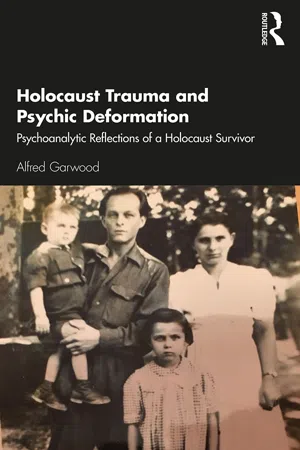
I was that child. The man carrying me was my father. As I write in the relative security of my life today, I am struck by the unreal quality of my experiences. This speaks powerfully of the defensive capacity of my mind. As I continue to remember, that familiar but indescribable awfulness rises to the surface and overwhelms me. It is a reminder that it was all too real and it is still with me. This piece of my history may convey the sense of dreadfulness that has pervaded my life as well as the sense that my existence is miraculous.
Holocaust survivors were ordinary human beings who were forced to endure extraordinary events. The psychic processes available to them to respond were the same as those available to all humankind.
I stress this self-evident truth because it does not seem understood by non-survivors and the psychotherapeutic professions. This has led me to open this volume with a description of the Holocaust experiences of my family and an account of my formative experiences during and after the Holocaust, as a child refugee, a medical practitioner and a psychotherapist. Additionally, I have explored my experiences of many years of psychoanalysis and group analysis as a trauma survivor.
Primarily, my desire is to make Holocaust trauma accessible through a description of my childhood trauma, which was both formative and de-formative. My years of therapy have trained me to observe and reflect on my psychic function and responses.
It is now more than 70 years since the beginning of the Holocaust, the Shoah, to give it its Jewish name. In this time, several generations of psychotherapists have trained and have what might be considered to be only a superficial knowledge of this momentous period, which has been called the most tragic event and the most important enigma of modern civilisation.
Child Holocaust survivors will be the last of the living witnesses. From the 1980s, there was a surge of Holocaust testimonies written. Many were remarkable, full of the pain and the miracle of survival. They rarely analyse the post-Holocaust effects of these traumatic events. Few, if any, were written for clinicians working with trauma victims.
The inclusion of this biography may assist in understanding why I have been drawn to certain psychological theories and have rejected others. These have played an important part in the theoretical constructs presented. During the writing and rewriting of the biographical opening, I have included much material that I presented and worked through during my analyses. The main difference during the writing of this book was that I was obliged to re-experience the emotional effects of these traumata in isolation and in a condensed way. This frequently overwhelmed my defences and left me struggling to regain equanimity. My response confirmed that the representations of these traumatic events were still present in my psyche and were capable of being reactivated. Thus, they are still central to my current psychic function and dysfunction.
This volume offers a body of writing, including trauma theories that derive from these reflections. I believe I have had a rare, if not unique, opportunity to examine my family’s and my own Holocaust and post-Holocaust traumata.
In most trauma survivors, there is an intense desire to keep their traumatic past in the past. This comes at a high price in psychic energy. There is often a conflicting desire to show the world one’s scars, presenting them like war wounds, to shock and shout, “What could you possibly understand if you have not had this experience?” These dynamics may well play a significant role here, but my conscious purpose is to describe enough of our lives to allow readers to understand the impact of massive psychic trauma on my family and of the many post-war generations who suffered their own massive traumata and genocides.
What I present here is part of my fight for my psychic life in which annihilation threat and death were ever-present. When I present some of our history, I can recall how it was told to me, as well as the dreadfulness that permeated the narrative, which gave it the horror and terror that pervaded so many of these moments in my Holocaust past.