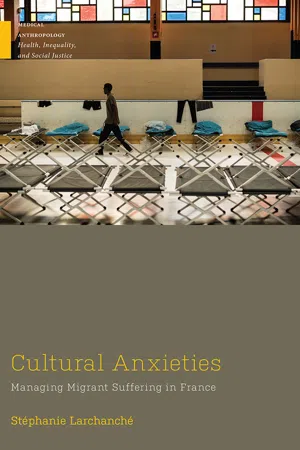
Cultural Anxieties is a gripping ethnography about Centre Minkowska, a transcultural psychiatry clinic in Paris, France. From her unique position as both observer and staff member, anthropologist Stéphanie Larchanché explores the challenges of providing non-stigmatizing mental healthcare to migrants. In particular, she documents how restrictive immigration policies, limited resources, and social anxieties about the "other" combine to constrain the work of state social and health service providers who refer migrants to the clinic and who tend to frame "migrant suffering" as a problem of integration that requires cultural expertise to address. In this context, Larchanché describes how staff members at Minkowska struggle to promote cultural competence, which offers a culturally and linguistically sensitive approach to care while simultaneously addressing the broader structural factors that impact migrants' mental health. Ultimately, Larchanché identifies practical routes for improving caregiving practices and promoting hospitality—including professional training, action research, and advocacy.
- English
- ePUB (mobile friendly)
- Available on iOS & Android
eBook - ePub
About this book
Information
Publisher
Rutgers University PressYear
2020Print ISBN
9780813595375
9780813595382
eBook ISBN
9780813595399
Topic
MedicinePART I THE CONTEXT
In the first part of this book, I describe the context in which specialized mental health care emerged. To do so, I address the evolution of scientific discourse in the management of racial and cultural difference in mental health initiatives in the French colonies and in France. In the context of migration to France, I examine how migrant subjectivities are socially constructed; travel through time; and are reproduced, contested, or negotiated through the scientific discourse of specialized mental health.
I then situate Centre Minkowska within this field of specialized mental health care. I describe how the center developed and gained legitimacy within the field, and the tensions it met in the process. I focus on how France’s ideological context and the recent managerial policies in health care underpinned Centre Minkowska’s choice of a medical anthropology approach to mental health care as a way to destigmatize the patient-clinician encounter and to better evaluate clinical practice through public health standards.
1 • A GENEALOGY OF “MIGRANT SUFFERING”
The figure of the migrant has dominated the global collective imaginary in the twenty-first century (Nail 2015). Specific social representations of migrants have evolved in different contexts at different times: the labor migrant, asylum seeker, refugee, sans-papiers, unaccompanied minor. For migrants in general, social legitimacy is often evaluated institutionally and popularly by their cause of displacement—was it voluntary or involuntary? Voluntary migration is often perceived as less legitimate on the grounds that migrants may be searching for economic opportunity; this can activate social anxieties over limited resources in host countries. An exception is the “expatriates” category—a form of voluntary migration, often motivated by economic opportunity, but interestingly never labeled as migration. Moral demarcations around migration are fluid, and even the politics of hospitality in any given place or time can be contradictory.
The politics of migration in France are the embodiment of such contradiction, and social debates around the right to health care provide lively discussions about notions of integration and belonging (Larchanché 2012; Sargent and Larchanché 2009; Ticktin 2011). For example, shortly before his election as president in 2017, Emmanuel Macron declared in an interview that France was not confronted with “a wave of immigration” as portrayed by the media, that “the immigration issue should not worry the French population,” and that “immigration is constitutive of the world we live in … [and] can even be an opportunity from an economic, cultural and social perspective” (Casadesus 2017, my translation). Shortly thereafter, his appointed interior minister, Gérard Collomb, announced that the necessary regulation of migration entailed a clear distinction between refugees and economic migrants: “Our policy must combine efficiency and generosity. We welcome those who flee wars and persecutions, but we distinguish refugees from those whose migration obeys other motivations, including economic ones” (Le Monde 2017, my translation). Beyond refugees, whose suffering and vulnerability are perceived as legitimate, it appears from Collomb’s words that other migrants are unwelcome. Representations like these, largely disseminated through media and political rhetoric, rarely address the survival logics forcing perceived voluntary migrants to leave their homes in the midst of structural violence and economic inequality. The global war on terror has further complicated the dynamic by raising suspicion even about refugees.
Simultaneously, we are bombarded with media images of migration-related suffering: people fleeing brutality in war-torn zones, being rescued from the Mediterranean Sea, experiencing inhumane living conditions in cramped French encampments, or facing new forms of slavery in Libya. These images “engage in emotional and political work, producing sympathy and empathy, as well as fear and othering” (Holmes and Castaneda 2016, 17). Images of suffering in places far away can be particularly effective at instilling sympathy (Boltanski 1999), particularly when that suffering concerns children. This was illustrated through the case of Alan Kurdi, a three-year-old Syrian boy of Kurdish ethnic background who died on a beach in Turkey in 2015 and was photographed lying facedown in the sand. The photograph of Kurdi’s body triggered profound emotional responses, expressed through social media across the globe. Images of suffering at home, however, can trigger uneasiness. Indeed, reports of appalling life conditions in encampments like Calais and Grande-Synthe in northern France, or the Stalingrad neighborhood in Paris, are unlikely to cause a similar outpouring of communal sympathy, even though children Alan Kurdi’s age or younger suffer intensely from infectious pathologies in these areas (L’Express 2015).
When you hear the phrase “migrant suffering,” you may presume that the acknowledgment of suffering itself is indicative of compassion or sympathy, meaning that suffering individuals are deserving of care and attention. But in relation to migrants in France, there are clear hierarchies of suffering, and the moral judgments that underpin them are shaped by complex interactions between local “cultural representations, collective processes, and subjectivity, interactions that are in turn shaped by large-scale changes in political economy, politics, and culture” (Kleinman 1998, 373). Moral experience, then, possesses both a locality and a genealogy that can be traced.
In this chapter, I trace the evolution of the notion of “migrant suffering” as a moral experience in France. A specialized form of mental health support directed at migrants developed in France in the aftermath of World War II. Fassin and Rechtman (2009, 226) argue that the genesis of this approach to mental health care for migrants occurred at the transition between two historical stages, each characterized by singular representations of cultural difference: the colonial era, with its image of the indigenous colonized “other,” and the postcolonial period, with the figure of the migrant foreigner in search of employment or asylum. Mental health practitioners interested in the mental health of migrants found themselves caught between two psychopathological paradigms: the culturalist model of colonial psychiatry—imbued by racist interpretations of cultural personality types and ultimately concerned more with political order than psychopathology—and the universalist model of the French health-care system, which rejects the idea that migrants require “specialized” treatment. What structural context produced the necessary conditions for the emergence of a specialized field of mental health focused specifically on figures of alterity? What are the contemporary representations of cultural others that animated the growth of this field? In answering these questions, I begin to explore a genealogy of the management of otherness in French health care and the types of institutional and individual anxieties produced in the process.
COLONIAL LEGACIES: PATHOLOGIZING RACIAL AND CULTURAL DIFFERENCE
Theories of human behavior surrounding French psychiatric practice from the 1870s to the 1950s were racially biased and influenced by debates among anthropologists as well as psychiatrists. Colonial psychiatry generated discussion among both clinicians and scholars about the influence of race on mind and behavior, questions of cultural difference, and the political evolution of colonial subjects. As British historian Megan Vaughan (2007) notes, colonial psychiatry provided a scientific language with which to frame dilemmas encountered by colonial administrations. Alongside anthropologists, psychiatrists elaborated theories of “acculturation,” “culture contact,” and the “educability” of people from African countries. Such theories were politically relevant and addressed “the question of whether and when increasingly ‘detribalized’ Africans would ever be ready to govern themselves” (Vaughan 2007, 8). Both anthropology and psychiatry provided negative answers to this question and encouraged the pursuit of colonial management (Vaughan 2007).
In some colonial psychiatric theories, “culture” was merely a more acceptable term for “race.” While anthropologists concentrated on changes at the level of “tribal” entities, psychiatrists offered a distinct medico-psychological approach, which located the detrimental effect of “culture contact” within individual personality and psyche. The basis for this approach was the notion of biological difference and its influence on relationships between race and psychopathology. Biological racism provided a scientific basis for the ideological opposition between “civilized” (European) and “primitive” mentalities (Vaughan 2007, 24).
The Case of the Algiers School: Colonial Psychiatry in the French Colony
In his exhaustive account of the practice of psychiatry in colonial North Africa, medical historian Richard Keller (2007) accounts for colonial psychiatrists’ fascination with the relationship between psychology and culture. In the so-called primitive mind of the colonized, many of these psychiatrists found elements of a primordial, universal human subjectivity and considered this proof of the existence of an essential psychic unity. Yet psychiatrists working in colonial North Africa sought to demonstrate a clear separation between the minds of Europeans and those of North Africans based on bodies and traditions. They followed the lead of French psychiatrist Antoine Porot, who in his 1918 publication “Notes de psychiatrie musulmane” (Notes on Muslim psychiatry) presented the scientific bases for such psychic demarcation, from which the Algiers School emerged. Difference between Europeans and North Africans existed, Porot’s followers argued, and this was exacerbated by the colonial encounter, which thrust primitive people into an alienating modern environment. Drawing on the legacy of psychological anthropologists, physicians, and racial biologists of the time, their work produced a new science of colonial psychiatry with pragmatic applications for judicial, social, and military institutions. At the time, French psychiatrists characterized North African Muslim populations as inferior to civilized Europeans “by documenting the Maghrebian’s temperamental violence, fatalism, superstitions, and mental debilitation” (Keller 2007, 123).
This type of colonial psychiatry constituted a form of “military organism” (Keller 2007, 123), articulated around the language of battle and deployed in the service of colonial power to tame unruly indigenous populations and shape debates over law enforcement and immigration. According to Keller, the outbreak of war in 1914 and the presence of colonial subjects in the infantry provided psychiatrists with the opportunity to study indigenous populations under stress and draw conclusions on racial and cultural influences on psychopathology. French psychiatrists Antoine Porot and Angelo Hesnard (1918) even established a racial hierarchy of suitability for military service. In it, North Africans were considered particularly suited to acts of brutality and praised as first-line soldiers. However, Porot and Hesnard also noted the impulsivity of North Africans, which put them at risk for hysteria; therefore, they recommended that this population be supervised closely. Of all North Africans, psychiatrists of the time characterized only Muslims as posing particular problems; this conclusion was linked to Muslims’ alleged resistance to civilized modernity, technological order, and military discipline.
Colonial psychiatry literature triggered an explosion of interest in primitivism in postwar France and contributed to French philosopher Lucien Lévy-Bruhl’s (1923) famous work, Primitive Mentality. Rather than the biological, Lévy-Bruhl evoked cultural and environmental factors as causes of primitive mentality. According to his perspective, the minds of people deemed primitive could, through “psychological and psychiatric instruction,” be reversed in “the fulfillment of France’s civilizing mission” (Keller 2007, 133). The interest in primitive mentality in the interwar period also “indicated that an ethnological sub-specialty was gaining steam within the French psychiatric profession” (Keller 2007, 136). Psychiatrists practicing in North Africa insisted that close contact with colonial patients revealed the practical and political importance of specific, rather than general, ethnopsychiatric knowledge. Their work departed significantly from that of their metropolitan colleagues; their insistence on the biological nature of psychological constitution was aimed at forging local, pro-colonial political advocacy.
With the independence movements in the 1950s, ethnopsychiatric knowledge gained traction within yet another group: the French army’s newly founded Fifth Bureau, which led psychological operations during the Algerian war. Keller (2007) notes that in response to Algerian Front de Libération Nationale (FLN, National Liberation Front) propaganda, this French unit developed strategies to convince Algerians of the benefits of French presence. They used press censorship, loudspeaker announcements, and street flyers to influence public opinion, which they believed could only be accomplished if the psychological characteristics of the “normal” North African were taken into account.
In France, medical journals and scholars enthusiastically received the work by the Algiers School and praised it for advancing psychiatric knowledge through a wealth of clinical experience. However, some French psychiatrists voiced dissent—particularly those who worked with migrants in the metropole and who attributed the high prevalence of mental disorders to feelings of nostalgia and dislocation rather than to intrinsic fatalism, impulsivity, or general deviance as described by the Algiers School (Alliez and Descombes 1952). But with the outbreak of the Algerian war in 1954, there was an influx of migrant populations to France, and general fears of instability exacerbated scathing representations of migrants within the medical and public spheres. Media outlets linked North Africans’ alleged “tribal ways” to higher crime rates, which drew the attention of police authorities and led to migrants being characterized as innately criminal, deviant, and unable to assimilate.1
Other Colonial Psychiatry Approaches in Sub-Saharan Africa
Not all French psychiatric practice of the colonial period relied on a biologically racist paradigm. Before independence movements, other analyses emerged that were more nuanced and sketched the beginnings of a critical perspective on the colonial enterprise. Among them, French ethnologist and psychiatrist Octave Mannoni’s Psychologie de la colonisation (1949), later published in English as Prospero and Caliban (1950), was based in the French colony of Madagascar and offered the first psychological study to problematize the colonial relationship itself. Mannoni considered the colonial situation an encounter that created relations of dependence between two kinds of personality: an inferior one (the colonized) and a superior one (the colonizer). He noted how a “dependency complex” among the Malagasy prefigured the arrival of the Europeans and explained their unconscious compliance with colonization.
Mannoni’s innovation was his attention to the psychology of the colonizer, which he considered dominated by the same “perverse and infantile needs” as colonial subjects (McCulloch 1995, 102). He believed that colonizers were illegitimate representatives of European civilization and were responsible for colonial racism. To Mannoni (1950), racism was an aberration. Reflecting on the Malagasy revolt against French colonizers in 1947—one of the bloodiest episodes of the colonial period in Africa—Mannoni argued from a psychoanalytical perspective that what the Malagasy sought “was not political rights but relief from fear of abandonment. They wanted to project their own shortcomings onto Europeans and so they behaved like impossible children who wanted one thing but demanded another. If they were granted self-government at the wrong time, they would simply regress” (McCulloch 1995, 103). His interpretation relied on the analysis of Malagasy dreams, in which the theme of terror was recurrent. The limit of such an interpretation, however, was that it depoliticized distress by approaching independence strictly as a psychological problem while ignoring the economic and political demands made by the Malagasy during riots.
Generally, throughout the accounts of colonial psychiatrists of the time, colonized societies were cha...
Table of contents
- Cover
- Series Page
- Title Page
- Copyright
- Dedication
- Contents
- Foreword
- List of Abbreviations
- Introduction
- A Day at Centre Minkowska
- Part I: The Context
- Part II: Referral Narratives and Ethical Double Binds
- Part III: Ethical Deliberations
- Conclusion
- Acknowledgments
- Notes
- References
- Index
- About the Author
Trusted by 375,005 students
Access to over 1.5 million titles for a fair monthly price.
Study more efficiently using our study tools.
Frequently asked questions
Yes, you can cancel anytime from the Subscription tab in your account settings on the Perlego website. Your subscription will stay active until the end of your current billing period. Learn how to cancel your subscription
No, books cannot be downloaded as external files, such as PDFs, for use outside of Perlego. However, you can download books within the Perlego app for offline reading on mobile or tablet. Learn how to download books offline
We are an online textbook subscription service, where you can get access to an entire online library for less than the price of a single book per month. With over 1.5 million books across 990+ topics, we’ve got you covered! Learn about our mission
Look out for the read-aloud symbol on your next book to see if you can listen to it. The read-aloud tool reads text aloud for you, highlighting the text as it is being read. You can pause it, speed it up and slow it down. Learn more about Read Aloud
Yes! You can use the Perlego app on both iOS and Android devices to read anytime, anywhere — even offline. Perfect for commutes or when you’re on the go.
Please note we cannot support devices running on iOS 13 and Android 7 or earlier. Learn more about using the app
Please note we cannot support devices running on iOS 13 and Android 7 or earlier. Learn more about using the app
Yes, you can access Cultural Anxieties by Stéphanie Larchanche in PDF and/or ePUB format, as well as other popular books in Medicine & Medical Theory, Practice & Reference. We have over 1.5 million books available in our catalogue for you to explore.