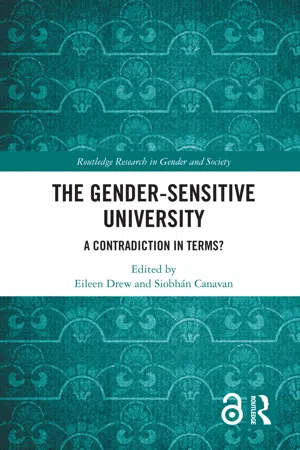
The Gender-Sensitive University explores the prevailing forces that pose obstacles to driving a gender-sensitive university, which include the emergence of far-right movements that seek to subvert advances towards gender equality and managerialism that promotes creeping corporatism.
This book demonstrates that awareness of gender equality and gender sensitivity are essential for pulling contemporary academia back from the brink. New forms of leadership are fundamental to reforming our institutions. The concept of a gender-sensitive university requires re-envisioning academia to meet these challenges, as does a different engagement of men and a shift towards fluidity in how gender is formulated and performed. Academia can only be truly gender sensitive if, learning from the past, it can avoid repeating the same mistakes and addressing existing and new biases. The book chapters analyse these challenges and advocate the possibilities to 'fix it forward' in all areas.
Representing ten EU countries and multiple disciplines, contributors to this volume highlight the evidence of persistent gender inequalities in academia, while advocating a blueprint for addressing them. The book will be of interest to a global readership of students, academics, researchers, practitioners, academic and political leaders and policymakers who share an interest in what it takes to establish gender-sensitive universities.
This book is available for free in PDF format as Open Access from the individual product page at www.routledge.com. It has been made available under a Creative Commons Attribution-Non Commercial-No Derivatives 4.0 license
An overview of gender inequality in EU universities
Rodrigo Rosa, Eileen Drew and Siobhán Canavan
Introduction
Gender equality has become an increasingly important policy requirement for academic institutions. Faced with enduring inequalities between female and male academics and administrators at all levels, university leaders have been charged with defining action strategies to ensure the effective implementation of structural measures to reduce and eliminate gender bias in their organisations. Universities play a crucial role in promoting gender equality and diversity; the last 20 years has produced a range of positive changes, through an enlarged pool of highly qualified women in academia and the wider labour market. Notwithstanding these positive developments, universities are structured around gender regimes where ‘the current state of play is reflected in the macro politics of gender’ (Connell 1987, 20). Gender regimes continue to impact on: who is recruited to do what work; what social divisions exist in the workplace and away from it, particularly in the domestic sphere; how emotional relations are conducted in the workplace; and how institutions relate to one another in relation to gender sensitivity. Universities are gendered since, like any other organisation, they are still defined by the fact that ‘advantage and disadvantage, exploitation and control, action and emotion, meaning and identity, are patterned through and in terms of a distinction between male and female, masculine and feminine’ (Acker 1990, 146).
EU policy context
Equality between women and men is one of the European Union’s founding values, dating back to 1957 when the principle of equal pay for equal work became part of the Treaty of Rome. In accordance with the Treaty, the European Commission (2015) published the Strategic Engagement for Gender Equality 2016–19, setting out the framework for the Commission’s future work towards improving gender equality. The strategic engagement focused on the following five priority areas:
1 increasing female labour market participation and equal economic independence;
2 reducing the gender pay, earnings and pension gaps and thus fighting poverty among women;
3 promoting equality between women and men in decision-making;
4 combating gender-based violence and protecting and supporting victims;
5 promoting gender equality and women’s rights across the world.
The document set out objectives in each of these priority areas and identified more than 30 concrete actions, reaffirming the European Commission’s commitment to gender mainstreaming through a gender equality perspective integrated into all EU policies as well as into EU funding programmes. The strategic engagement also supported the implementation of the gender equality dimension in the Europe 2020 Strategy. Progress is reported annually and presented in annual reports on equality between women and men (for example, European Commission 2019a).
EU policy framing and leading gender equality in research—initially STEM
The new millennium saw the emergence of a number of significant reports and policy directions from the European Commission, from key actors such as the European Technology Assessment Network (ETAN), and cross-EU policy formulation on women and science and technology specifically. The strategic objective of the European Research Area (ERA) required action to promote gender equality in science, recognising the need to promote research by, for and about women to optimise the value that they could contribute to European society (European Commission 2001).
The ETAN Report (European Commission 2000) described the continuous leakage of women at each level of the academic ladder, on which women comprised less than 10 per cent of the leaders in the ‘scientific system’, despite the fact that half the Science, Technology, Engineering and Mathematics (STEM) graduates were women. It pinpointed the forms of discrimination, often unconscious, against women and identified the key problems faced by women in scientific careers. The flawed operation of the peer review system was highlighted along with the low level of engagement by women in shaping scientific policy and setting the agenda in the top committees of the EU and of member states. The report advocated a sustainable improvement of women’s standing in science and research, requiring a significant transformation of science and scientific institutions (European Commission 2000).
The WIRDEM (Women in Research Decision-Making) expert group report (2008) identified nomination procedures, cultural barriers and funding limitations as hindering factors in the progress of women in their academic careers. It reviewed member states’ policies and existing procedures for evaluating and promoting researchers to senior positions, outlining examples of good practice at national and institutional levels and proposed recommendations for more targeted actions at the European level, arguing that European research and higher education institutions could no longer afford to exclude potential innovators.
The Helsinki Group Gender in Research and Innovation was established by the European Commission in 1999 as an advisory group to help to overcome this disadvantage of women in STEM. In 2017, the Helsinki Group was transformed into the Standing Working Group on Gender in Research and Innovation (SWG GRI) of the European Research Area and Innovation Committee (ERAC). It consists of representatives from member states, associated countries and the European Commission. The group sought to integrate a gender dimension into the mainstream of the research policy process, starting with the benchmarking of national research policies, in which the gender dimension should be integrated in all the indicators to be developed. The overall objective of the Group is to advise the Council and the European Commission on policies and initiatives on gender equality in Research and Innovation, for the benefit of scientists, research institutions, universities, businesses and society at large.
In response to these gender issues, a European Research Area (ERA) Survey pointed to actions that research organisations could take, such as recruitment and promotion measures, targets to ensure gender balance in recruitment committees, flexible career trajectories (for example, schemes after career breaks), work-life balance measures and support for leadership development (European Commission 2015). According to their survey conducted in 2014, around 36 per cent of research performing organisations had introduced Gender Equality Plans (GEPs) in 2013. The gendering of indicators on human resources in science was to be tackled in three ways: top-down (the introduction of the gender variable in the collection of data on human resources in research and development), bottom-up (organising existing data collected at national level, and developing indicators on the basis of this data), and the gendering of the benchmarking exercise. In summary:
European research policy has been a model for ‘gender mainstreaming’ (consideration of gender in all aspects of policy) since 1999… . Some Member States were already paying attention to the issue, while others took their lead from the Commission, with more or less enthusiasm depending on their cultural and historical backgrounds… . Over the years, three research Framework Programmes supported activities to increase the number and role of women scientists, as well as to mainstream gender in the content of research. Despite the fact that the momentum for gender equality had been slowing down, progress towards a European Research Area ‘by/for/on women’ was continuing, albeit more slowly than previously. Therefore, a new policy direction was decided upon by the Commission. The new focus for activities was on the research institutions and organisations where women in science work, rather than just on the women themselves. ‘Fixing the administration’ became the new objective.
(European Commission 2010, 12)
The stocktaking of Women in Science policy by the European Commission 1999–2009 illustrates how the European Commission ‘provided the impulse, and acted as a catalyst and multiplier, shaping and coordinating the efforts’ (European Commission 2010, 7).
Despite the global feminisation of the third-level student population as a striking feature of higher education over the last 40 years, women are not progressing at the same rate as men in their academic careers. At the leadership level, women accounted for only 24 per cent of grade A professors (professorial chairs) and 22 per cent of heads of institutions in the higher education sector across the EU in 2017, thereby indicating the need to take action and identify good practices in the sector to attract and promote women in research and innovation (European Commission 2019b). The European Commission’s SHE figures 2018 reveal that a range of gender differences and inequalities persist in research and innovation. Whilst women were once under-represented at doctoral level, in 2018 they made up 48 per cent of doctoral graduates in the EU-28. However, in 2018, women accounted for just 29 per cent of doctoral graduates in engineering, manufacturing and construction and only 21 per cent of those graduating from computing (European Commission 2019b).
Striking gender inequalities persist in career advancement and participation in academic decision‐making. Despite significant progress in their level of education relative to men in recent decades, women are increasingly under-represented as they move up the stages of an academic career (Figure 1.1). The pool of female graduate talents has increased, but the availability of female role models as careers progress is still sparse, reflecting the differential in career progression by women and men. Despite the growth in numbers of female undergraduates and postgraduates, the career trajectories of men and women in academia continue to show significant inequalities. Gender trajectories take the form of a scissors-shaped trend, which shows a significant loss of female potential after the award of doctoral degrees. Work-life imbalance is one among the major barriers to gender equality since it still most frequently impedes the career advancement of women in academia, 13 per cent of whom work part-time, compared with 8 per cent of male academics (European Commission 2019b). Women’s representation diminishes significantly during academic careers so that the percentage of women academic staff at grade A (7.4%) is less than half of the corresponding proportion for men (16.7%). This results in: far fewer female academics in more powerful positions; a gender pay gap; gender imbalance in the composition of research teams; and a higher proportion of women, especially those in junior academic positions or other positions, relying on third-party funding, employed on precarious working contracts (European Commission 2019b). These gender differences are even more acute among students/staff in science and engineering disciplines (Figure 1.2).
Figure 1.1Percentage of men and women in a typical academic career, students and academic staff (EU-28) 2013–2016
Source: SHE Figures, European Commission 2019
Figure 1.2Percentage of men and women in a typical academic career in science and engineering, students and academic staff (EU-28) 2013–2016
Source: SHE Figures, European Commission 2019
Internationally, the leaky pipe metaphor (Alper 1993) has been coined to represent the progressive decrease in the presence of women in academia at each career stage and this pattern is all too evident in the SHE Scissors Diagrams (Figures 1.1 and 1.2). UPGEM (Understanding Puzzles in the Gendered European Map) noted with concern that well-qualified female scientists often leave the research system prematurely and those who stay rarely, or never, reach the top-level positions (grade A professors) or achieve distinguished careers in research and development in the same way as their male counterparts do (UPGEM 2008). The underlying causes of this phenomenon have been studied extensively across the EU with the general conclusion that contemporary academic careers, through various mechanisms, reward members of the male gender (Badaloni et al 2008). Policies for the recruitment, retention, promotion and leadership of researchers in EU research bodies often affect the career progression of female researchers adversely, as illustrated by the differential exit of female researchers at, or after, their doctoral studies across the EU. Moreover, when it comes to appointing skilled professionals to decision-making positions in national research and academic institutions, women are already at a disadvantage because of their smaller numbers, which in turn prevents them from participating more equitably in the highest echelons of their institutions.
US policy interventions for gender equality in STEM
The need for institutional transformation, involving organisational and cultural change within research bodies and universities was first recognised outside Europe, most visibly in US initiatives. In 1981, the US Congress adopted the National Science Foundation Authorization and Science and Technology Equal Opportunities Act. Under this law, the Director of the National Science Foundation (NSF) is required to send Congress and government officials a statistical report on the numbers of women and other minorities (sic) in employment and training in the science and engineering sectors every two years. Since 2001, the US National Science Foundation’s pioneer ADVANCE (Increasing the Participation and Advancement of Women in Academic Science and Engineering Careers) programme has successfully encouraged major universities in the US to change thei...
Table of contents
Cover
Half Title
Series
Title
Copyright
Contents
List of figures
List of tables
Notes on contributors
Foreword
1 An overview of gender inequality in EU universities
2 The challenge of neoliberalism and precarity for gender sensitivity in academia
3 Gender in academic recruitment and selection
4 In pursuit of career advancement in academia: do gendered pathways exist?
5 Work-life balance in academia: myth or reality?
6 Sexual violence on campus: objectification, awareness-raising and response
7 Gender pay gap reporting: lessons from Queen’s University, Belfast and Trinity College, Dublin
8 Men and masculinities in academia: towards gender-sensitive perspectives, processes, policies and practices
9 Unconscious bias in academia: a threat to meritocracy and what to do about it
10 Change management to initiate and accelerate gender equality
11 Understanding leadership in higher education as a tool for change in relation to gender
12 Addressing gender inequality in academia: the role of Irish funding agencies
13 What does not happen: interrogating a tool for building a gender-sensitive university
14 Towards a gender-sensitive university
Glossary
Index
Trusted by 375,005 students
Access to over 1.5 million titles for a fair monthly price.
Study more efficiently using our study tools.
Frequently asked questions
Yes, you can cancel anytime from the Subscription tab in your account settings on the Perlego website. Your subscription will stay active until the end of your current billing period. Learn how to cancel your subscription
No, books cannot be downloaded as external files, such as PDFs, for use outside of Perlego. However, you can download books within the Perlego app for offline reading on mobile or tablet. Learn how to download books offline
Perlego offers two plans: Essential and Complete
Essential is ideal for learners and professionals who enjoy exploring a wide range of subjects. Access the Essential Library with 800,000+ trusted titles and best-sellers across business, personal growth, and the humanities. Includes unlimited reading time and Standard Read Aloud voice.
Complete: Perfect for advanced learners and researchers needing full, unrestricted access. Unlock 1.5M+ books across hundreds of subjects, including academic and specialized titles. The Complete Plan also includes advanced features like Premium Read Aloud and Research Assistant.
Both plans are available with monthly, semester, or annual billing cycles.
We are an online textbook subscription service, where you can get access to an entire online library for less than the price of a single book per month. With over 1.5 million books across 990+ topics, we’ve got you covered! Learn about our mission
Look out for the read-aloud symbol on your next book to see if you can listen to it. The read-aloud tool reads text aloud for you, highlighting the text as it is being read. You can pause it, speed it up and slow it down. Learn more about Read Aloud
Yes! You can use the Perlego app on both iOS and Android devices to read anytime, anywhere — even offline. Perfect for commutes or when you’re on the go. Please note we cannot support devices running on iOS 13 and Android 7 or earlier. Learn more about using the app
Yes, you can access The Gender-Sensitive University by Eileen Drew, Siobhán Canavan, Eileen Drew,Siobhán Canavan in PDF and/or ePUB format, as well as other popular books in Education & Education Administration. We have over 1.5 million books available in our catalogue for you to explore.