International contributors from the fields of political science, cultural studies, history, and literature grapple with both the local and global impact of World War I on marginal communities in China, Syria, Europe, Russia, and the Caribbean. Readers can uncover the neglected stories of this World War I as contributors draw particular attention to features of the war that are underrepresented such as Chinese contingent labor, East Prussian deportees, remittances from Syrian immigrants in the New World to struggling relatives in the Ottoman Empire, the war effort from Serbia to Martinique, and other war experiences. By redirecting focus away from the traditional areas of historical examination, such as battles on the Western Front and military strategy, this collection of chapters, international and interdisciplinary in nature, illustrates the war's omnipresence throughout the world, in particular its effect on less studied peoples and regions. The primary objective of this volume is to examine World War I through the lens of its forgotten participants, neglected stories, and underrepresented peoples.
eBook - ePub
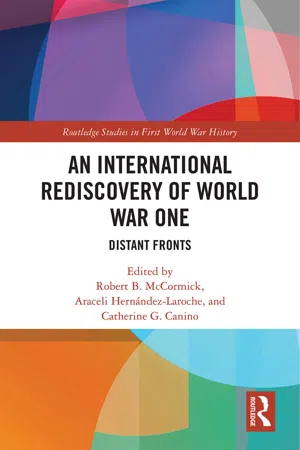
An International Rediscovery of World War One
Distant Fronts
- 182 pages
- English
- ePUB (mobile friendly)
- Available on iOS & Android
eBook - ePub
An International Rediscovery of World War One
Distant Fronts
About this book
Information
1 Forgotten prisoners of the tsar
East Prussian deportees in Russia during World War I
Charles Perrin
Introduction
Look through these letters. Read them. You will not find any complaining. You will only find some kind of unemotional, yet chilling story about a terrible human tragedy, about suffering… about unshed tears, about new Lithuanian graves here and there in the distant east on the banks of the Volga, Ob, and Irtysh… Yes, on the banks of these rivers our nation raises a new cross! So be it. Another painful page is added to our history!1
This passage eloquently describes a forgotten story from World War I: the deportation of about 13,600 inhabitants of the German province of East Prussia, including 4,000 women and 2,500 children, to Russia by the Russian military between August 1914 and March 1915. This multiethnic group, which was composed of Lithuanians, Germans, and Masurians (Poles who belonged to the Lutheran faith), spent the war, and, in some cases, the Russian civil war that followed, interned at sites throughout Russia under very harsh conditions. Although they received assistance from local residents at internment sites, governments, and private relief organizations, only 8,300 (61%) returned.3 In the memory of the Lithuanian and German publics, the deportation of East Prussian civilians has been forgotten because it pales in comparison to two greater tragedies that took place soon afterward involving the same ethnic groups: the mass deportation of about 111,000 civilians from Soviet-occupied Lithuania to sites in the Soviet Union and the flight and expulsion of about eight million people from the eastern part of Germany to the West during and after World War II.4
Both the author of the above passage, who identifies himself using only his first name, Petras, and the authors of the letters he describes were Lithuanians, a small ethnic group whose territory was divided at that time between Germany and Russia. Petras was from Lithuania Major, a region of the Russian empire that bordered East Prussia (now the independent state of Lithuania). The authors of the letters were mostly from Lithuania Minor, also known as Prussian Lithuania, a region of East Prussia that bordered the Russian empire (now the Klaipėda region of Lithuania and part of the Kaliningrad region of Russia).5 When war broke out the Lithuanians in Germany and Russia found themselves on opposing sides. For Lithuanian nationalists like Petras, however, the bonds of language and culture that united Lithuanians were stronger than the political boundaries that divided them.
Although Petras’ nationalism opened his eyes to the suffering of his ethnic brothers from across the border, it also blinded him to the suffering of other ethnic groups. His brief description of the letters written by Prussian Lithuanian deportees suggests that they were the only ethnic group deported from East Prussia. They were not. The practice of focusing narrowly on the experiences of a single ethnic group among the deportees, and either marginalizing or completely ignoring the presence of other ethnic groups, is not unique to Petras. A survey of other contemporary accounts of the deportations in Lithuanian and German, and the scholarly works that have been published on the subject, reveals that this is the norm. This study will challenge these accounts of the deportations by going beyond the paradigm of national suffering. More broadly, it will correct some misconceptions about civilian internment during World War I.
Few scholars have shown an interest in the deportation of East Prussians civilians. The most important study of this subject is a chapter in a work by Fritz Gause about the Russian invasions of East Prussia during World War I.6 Alexander Watson, who has compared this work with the surviving archival evidence, declares it a “sound piece of historical research” and points out that it includes some important material that is now lost.7 S.G. Nelipovich uses documents from the Russian State Military History Archive to examine the decisions made by the Russian military that resulted in the deportations. He concludes that the deportations “exhibit the character of genocide” and that the deportees were the “victims of a war crime.”8 Watson, who examines Russian atrocities in East Prussia during 1914–1915, convincingly argues that the deportation of civilians “was only debatably a war crime, as such action had not been foreseen or forbidden by the 1907 Hague convention.”9 Serena Tiepolato uses the memoirs of German female deportees to reconstruct their experiences, and Liudas Subačius describes the creation and activities of the Lithuanian relief organization Lithuanian Care to Provide Assistance to Our Captive Lithuanian Brothers from Prussian Lithuania (Lietuvių globa mūsų broliams lietuviams belaisviams iš Prūsų Lietuvos šelpti, henceforth Lithuanian Care).10 The author of this chapter uses a variety of sources to explore what factors were the most important in enabling Martynas Jankus, who became the most well-known deportee in the Lithuanian-speaking world during the war, to survive deportation.11
These works belong to a larger body of scholarly literature about civilian internment during World War I. Some misconceptions exist in this literature, however, about how civilians were interned. For example, Matthew Stibbe and Annette Becker suggest that enemy aliens were only interned in camps during the war.12 According to Becker, deportation during the war “became synonymous with ‘concentration camps’.”13 Serena Tiepolato describes the prisoner of war camps in which some East Prussian deportees were interned as “internment camps.”14 There were no concentration camps or internment camps, however, for civilian prisoners of war in Russia during World War I.15 These misconceptions about civilian internment are the result of faulty generalizations based on case studies in Britain, France, Germany, and the United States.
The study of the deportation of East Prussian civilians is complicated by several problems involving sources published during the war: the existence of sources in several languages, the practice of self-censorship by the authors of some sources, and the practice of censorship by Russian military censors. Primary sources for the study of the deportations exist in German, English, Russian, Lithuanian, Polish, French, and probably Swedish as well. With the exception of the article published by the author of this chapter, however, the few scholarly works that have been published about this topic use sources only in German and English, only in Russian, or only in Lithuanian. This chapter uses primary sources in German, Lithuanian, English, and French, and secondary sources in German, Lithuanian, English, Russian, and Italian.
This chapter will attempt to answer two questions. What implications does the deportation and subsequent internment of civilians from East Prussia have for the study of civilian internment during World War I? Was the deportation and subsequent internment of civilians from East Prussia genocide?
The journey into the unknown
During World War I, the Russian army invaded East Prussia three times. The first invasion, which began on August 2 (15), 1914, resulted in the occupation of two-thirds of the province for one month. The second invasion, which took place at the beginning of November, resulted in the occupation of one-fifth of the province for three and half months. The third invasion, which began on March 4 (17), 1915, resulted in the occupation of the town of Memel and its surroundings for four days. During all three occupations, the Russian army used deportation as a means of eliminating threats that it believed the civilian population posed to military operations. The deportations during the first occupation began as a result of decisions made by local military commanders and did not involve large numbers of people. The victims of deportation were almost all men. Many were of military age and were taken to prevent them from joining the German army. Others ...
Table of contents
- Cover
- Half Title
- Series Page
- Title Page
- Copyright Page
- Dedication
- Table of Contents
- List of contributors
- Acknowledgments
- Foreword
- Introduction
- 1 Forgotten prisoners of the tsar: East Prussian deportees in Russia during World War I
- 2 The forgotten front? Serbia, memory and World War I
- 3 From George Tom in Cleveland, Ohio, to his father Tannous Gergis, Mt. Lebanon, Syria: remittances as transnational relief during World War I
- 4 The Treaty of Versailles and the rise of Chinese feminism
- 5 Distanced, disembodied, and detached: Women’s poetry of the First World War
- 6 The Martinican War experience through the lenses of Raphaël Confiant, Jacques Dumont, and Stéphane Dufoix
- 7 Between Scylla and Charybdis: Chinese laborers under the French-American supervision in France during World War I
- Index
Trusted by 375,005 students
Access to over 1.5 million titles for a fair monthly price.
Study more efficiently using our study tools.
Frequently asked questions
Yes, you can cancel anytime from the Subscription tab in your account settings on the Perlego website. Your subscription will stay active until the end of your current billing period. Learn how to cancel your subscription
No, books cannot be downloaded as external files, such as PDFs, for use outside of Perlego. However, you can download books within the Perlego app for offline reading on mobile or tablet. Learn how to download books offline
Perlego offers two plans: Essential and Complete
- Essential is ideal for learners and professionals who enjoy exploring a wide range of subjects. Access the Essential Library with 800,000+ trusted titles and best-sellers across business, personal growth, and the humanities. Includes unlimited reading time and Standard Read Aloud voice.
- Complete: Perfect for advanced learners and researchers needing full, unrestricted access. Unlock 1.5M+ books across hundreds of subjects, including academic and specialized titles. The Complete Plan also includes advanced features like Premium Read Aloud and Research Assistant.
We are an online textbook subscription service, where you can get access to an entire online library for less than the price of a single book per month. With over 1.5 million books across 990+ topics, we’ve got you covered! Learn about our mission
Look out for the read-aloud symbol on your next book to see if you can listen to it. The read-aloud tool reads text aloud for you, highlighting the text as it is being read. You can pause it, speed it up and slow it down. Learn more about Read Aloud
Yes! You can use the Perlego app on both iOS and Android devices to read anytime, anywhere — even offline. Perfect for commutes or when you’re on the go.
Please note we cannot support devices running on iOS 13 and Android 7 or earlier. Learn more about using the app
Please note we cannot support devices running on iOS 13 and Android 7 or earlier. Learn more about using the app
Yes, you can access An International Rediscovery of World War One by Robert B. McCormick,Araceli Hernández-Laroche,Catherine G. Canino in PDF and/or ePUB format, as well as other popular books in Storia & Storia del XX secolo. We have over 1.5 million books available in our catalogue for you to explore.