- 248 pages
- English
- ePUB (mobile friendly)
- Available on iOS & Android
eBook - ePub
About this book
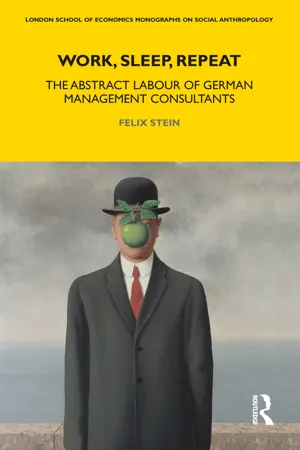
Work, Sleep, Repeat is a fascinating account of the work regime of German management consultants. Examining one of the most sought-after – and secretive – graduate professions, the book provides a first-hand account of the boardroom culture of Europe's strongest economy. Analyzing how knowledge and power operate in this sector, Felix Stein explores a number of paradoxes. For example, while it is the job of management consultants to analyse the activities of other employees, they actually spend most of their time in luxurious seclusion away from them. In addition, despite having a strong sense of the importance of their work, consultants often find it difficult to explain to outsiders what it is they do. The book addresses these and other paradoxes by arguing that consultants are engaged in abstract labour. Anthropologists have long struggled with the question of how to describe contemporary work regimes which do not produce anything tangible. Stein demonstrates that elite work is predominantly abstract, in the fourfold sense that it is epistemically removed from the object of analysis, emotionally detached from it, several steps away from the assumed sources of economic value creation, and increasingly hard to grasp. In doing so, he offers new ways to think about white collar work and elites in the 21st century and establishes the notion of 'abstract labour' as a key category in social anthropology.
Information
CHAPTER ONE Background: A Brief History of Management Consulting
The following short history of management consulting will show that its success goes hand in hand with an increasingly stark differentiation between management and operational labour in large-scale corporations. The increasing degree of abstraction of managerial activity is the condition of possibility for consulting work. Yet, it is not sufficient to explain the organizational particularities of consultancy firms. After all, managerial support and advice can be provided through a vast variety of institutional forms, ranging from state-funded institutions to industry- or firm-specific research and training divisions. Far from being a natural outcome of the rise of managerialism, contemporary consulting, in its current institutional form, will therefore be shown to be the result of a long history of corporate financialization and state activity, which began in the United States. The chapter also situates the work of management consultants in contemporary national class dynamics. In making these arguments, this chapter will point out that consulting constantly creates the conditions for its own demand. It highlights the autopoietic qualities of abstract labour, which will be further investigated in the following chapters.
The beginnings of management consulting
The question of when exactly the history of modern-day management consulting begins depends on how authors define the profession. Kipping (1999: 195) and Canback (1998: 4) trace its roots to the last quarter of the nineteenth century, when US ‘experts’ in the fields of engineering, accounting and advertising first started offering independent advice to companies. Fink (2014: 15) as well as Ernst and Kieser (2002: 47) do the same, by commencing their historical reviews of the industry with the foundation of the consulting company Arthur D. Little, in 1886. The Boston-based company started by working in the chemical industry, where it provided clients with quality control assessments for productive processes. They enabled clients to check whether the goods they procured were of a high enough quality and helped them fight competitors in patent infringement lawsuits. The focus on quality control was paired with a series of cost-reduction projects in which Arthur D. Little would evaluate the cost-efficiency of different bleaching techniques in paper production or investigate how the process for keeping dried paint insoluble could be rendered less expensive (Kahn 1986: 28 –9). Initially, their focus lay mostly with the engineering part of production.
Even during these early days, when consulting work was still mostly concerned with quality control and engineering issues, its focus on cost reduction came hand in hand with attempts of realigning the labour force. This was done according to Frederick W. Taylor’s socio-scientific principles. Taylor held that inefficiency ‘in almost all of our daily acts’ was America’s main problem and promised that systematic management, based on clear rules of behaviour, active training of workmen as well as managerial guidance would constitute an apt remedy (Taylor 1998: iv). In a similar vein, early management consultants like Arthur D. Little promised clients to combine ‘the perfection of products’ with ‘the improvement of processes’ (Kahn 1986: 27), visibly blending corporate concerns for people and things as expressions of costs. By engaging in quality control and cost analyses, early-day chemical and engineering consultants were already concerned with processes of standardization, as well as the socio-scientific production of commensurability, which still marks their line of work today. While the fairly close engagement with production processes meant that that their work was initially still fairly concrete in nature, their early concern with production costs already hints at the greater degree of abstraction that management consulting was to acquire until today.
The condition of possibility for the rise of management consultants was the increasingly complex nature of American corporate capitalism. Since the first half of the twentieth century, US companies have transformed from small, owner-run, single-product firms into large, dispersed and decentralized corporations with a broad portfolio of products and production activities. As part of this transformation, administrative tasks were increasingly separated from production (Chandler 1998, 2004; Sassen 2001: 97–101). ‘Strategic management’ was invented as an independent activity for salaried managers, whose main job was to monitor overall corporate performance and to decide how to allocate resources in the long term. Production, in turn, was equally redefined. It was now the task of operating divisions that were structured either according to product lines or according to increasingly dispersed geographical areas in which corporate activity took place (Chandler 1998, 2004; Lazonick 1993: 27–36). The drastic division of administrative tasks from production, often among several steps of corporate hierarchy, opened the possibility for ‘administrative experts’ to offer their services to management. Thereby, consultants increasingly played the role of mediating agents between blue- and white-collar workers. Throughout the beginning of the twentieth century, however, consultants could position themselves more and more as experts of administrative work itself.
This is why, in contrast to the management historians mentioned so far, McKenna (1995, 2006) argues that the history of modern-day consultancy companies really begins only in the 1920s and 1930s, when the advice industry gradually shifted its focus from the scientific management of the shop floor to a reorganization of white-collar labour. By the late 1920s, American consulting companies had both grown and diversified. A. T. Kearney had been in existence for thirty years, and firms such as Edwin Booz & Company, McKinsey & Company and the former Stevenson, Jordan and Harrison had by then all been founded (Edersheim 2004: 17). By now, they focused on corporate reorganization more widely and increasingly employed cost accountants or professionals with a background in law and banking. Consultants became increasingly confident that it was possible to improve managerial tasks, regardless of the activities that were to be managed. Their work thereby became more and more abstract, as people, objects and practices under concern grew both conceptually and often physically distant.
While the division of management from production thus laid the groundwork for the activity of management consulting, it does not explain the institutional establishment and continuous growth of organizations specializing in it. Several authors have attempted to explain the success of this particular corporate form, with reference to the entrepreneurial virtues of the founders of consulting firms (e.g. Fink 2014; Kahn 1986; Edersheim 2004). While these well-educated, well-connected and rhetorically gifted white American men were certainly intelligent and industrious, their characters and business decisions can tell us little about the collective rise and the sustained boom of the consultancy industry over more than a century. This ongoing industry-wide success has its roots in the broader political economy, notably the ascent of economic financialization, and a mixture of state legislation and state demand.
During the 1930s, the Great Depression was a major driving force for American management consultancies. It had caused many corporations whose customer base was breaking away to face midterm bankruptcy, unless they drastically cut costs. Management consultancies were happy to step in, analysing where savings could be made, legitimizing lay-offs to management and staff, and allowing management to share part of the blame for lay-off decisions. Crucially, the Great Depression also allowed banks and insurance groups that held industry bonds to take control over loan-defaulting companies. As members of so-called ‘bondholder’s committees’, they now owned a series of Depression-ravaged manufacturing companies. They needed to make these companies profitable again, but did not know how to organize industrial business activity (Fink 2014: 17). Management consultants made it their job to either restructure industrial activity or ‘at least wring some value out of [company] remnants’ (Edersheim 2004: 16). Thus, they grew as the result of the increasing financialization of industrial activity, serving as debt advisors for creditors, who had taken corporate control but did not know what to do with it. These origins point at a long history of rise of finance. They show that the currently much-discussed spread of corporate and private debt and credit obligations is in essence a more extreme version of a longer capitalist drive for financialization, which dates back at least to the early nineteenth century (Lazonick 1992; Polanyi 2001: 10ff; Thrift 2005: 5).
During the 1930s, the state was a second critical force behind the rise of contemporary management consulting. The 1933 Glass-Stegall Banking Act boosted the newly instituted consulting business by outlawing banks from providing lucrative corporate advice. At the same time the 1933 US Securities Act imposed strict auditing requirements to all corporate financing activity ( McKenna 2006: 17–19). Unsurprisingly, the new-found management consultancies thrived in this mixture of state-induced demand for auditing and excluded competition. The 1930s anti-monopoly legislation under the US American New Deal strengthened them further, by prohibiting corporate executives from sharing information through trade associations or industry cartels. This enabled consultancy companies to become exclusive providers of benchmarking services and other forms of inter-firm knowledge exchange in the United States (ibid.: 20). Contrary to their frequent invocation of free market values, the origins of current-day management consulting are thus closely interwoven with acts of government decree.
Consolidation and growth
From the 1940s to the 1960s American consultancy companies became well established as advisors of CEOs in the fields of business organization and market analysis. Some of them, who had counted one or two dozen consultants in the 1930s, grew to several hundred employees by the early 1960s ( Kipping and Kirkpatrick 2005: 8). The role of state demand is usually underestimated in this development, and contemporary observers tend to act surprised at the close involvement of consultancy firms and government entities (e.g. The Guardian 2010; Der Spiegel 2013a). However, early on in US history, war efforts had already significantly boosted government demand for consultancy services. The tremendous increase in US public spending on the mass mobilization of people and goods during the First and Second World Wars meant both an immediate and a lasting push to management consulting firms. Particularly Booz Allen & Hamilton and Arthur D. Little thrived on co-organizing the American military-industrial complex (David 2012: 76–8). A sustained rise in US post-Second World War public defence budgets provided them and their competitors with further consulting contracts in the following decades (ibid.). Additionally, the companies’ closeness to the military established a ‘revolving door’ for military personnel and consulting executives (e.g. Kahn 1986: 57–8). It founded the close connection between management consultancy companies and state entities, which still marks this line of work today (e.g. Transparency International UK 2012: 3).
The sustained involvement between consultancy firms and government entities is linked to the increasingly managerial understanding of politics on the side of US government officials (Arnold 1976). Early non-military use of management consultants by the US federal government was explicitly meant to adopt a ‘general efficiency approach’ that was assumed to prevail in private business (David 2012: 79). From the late 1940s until the late 1970s, management consultants were thus involved in improving the workings of the US healthcare sector, the US Post Office, the Department of Transportation, The National Science Foundation (NSF), Internal Revenue Service (IRS), the US Olympic Committee and a series of urban development offices, to name but a few examples. During this time, the establishment of business schools and the expansion of the business press fostered the view that management was a craft on its own, regardless of content. This conviction was crucial if consultants wanted to find employment with companies and state officials in vastly different sectors of the economy (ibid.).
During the late 1950s and early 1960s, management consultancies began a rapid expansion to Western Europe ( Kipping 1999: 209). While their goal had initially been to serve European divisions of American companies as part of a post-Second World War overseas investment boom, they quickly built a regional basis among European corporations, who wanted to ‘protect themselves’ from US competition by tapping into their expertise ( McKenna 2006: 172). As a shield against global competition, management consultancies spread the decentralized multidivisional model of corporate organization. They became the principal conduit for American managerial capitalism in Europe during the 1960s and 1970s (ibid.: 190), disseminating a business model that distanced management from production, and lent itself to the provision of their own services (Ernst and Kieser 2002). Their work thereby increased the likelihood of its own future demand by diffusing a corporate form in which they themselves could thrive. Consultants thus engaged in an act of economic autopoiesis that is typical for regimes of abstract labour.1
The themes of managerialism, financialization and state involvement also marked the consolidation and expansion of management consulting. In the 1960s, when American consultants thrived on following established recipes abroad, two further developments facilitated their growth. First, their international expansion roughly coincided with what Thrift has called the rise of ‘soft capitalism’ (Thrift 1997, 1998 ). Spanning across the boundaries of public and private institutions, soft capitalism is marked by new discourses of management that stress – among other features – corporate knowledge production, routinized innovation and heightened self-reflexivity. These new-found virtues were supposed to guide the collective totality of a firm, as well as the individual existence of manager and worker. Thrift has linked this change in the nature of capitalism to a ‘cultural circuit of capital’, a ‘machine’ consisting of business schools, management consultants and management gurus (including publishing houses and a management-oriented media) who have learnt to use fear of uncertainty and desires for self-improvement as the basis for highly profitable business activity ( Thrift 2002: 19, 2005 ). Soft capitalism continues until today, allowing consultancies in the 1980s and 1990s to bridge stagnant market conditions in Europe. At that time, most major companies had already taken on the multidivisional corporate model, as well as recipes for greater white- and blue-collar efficiency, so consultancies relied more heavily on projects concerned with improving ‘corporate culture’ as the new essence of soft capitalism (cf. Chong 2012 ).
Secondly, management consultancies began to focus in earnest on IT projects. They did this, riding another wave of state support. As part of US post-Second World War antitrust legislation, IBM had been prohibited from offering computer-consulting services in the 1950s (McKenna 2005: 20ff.). The rapid rise of computing technology, and the hurdles from competition set up through state legislation, thereby opened up a wide field of corporate advice in which management consultancies prospered. Rather than concerning themselves with the actual set-up of computer systems, they focused on the associated managerial problem of establishing a fit between IT and general business activity (Davenport 1998; Westrup and Knight 2000). Chong (2012), who has provided us with a first ethnographic study of Chinese IT consultants, shows that the nexus between their work and state activity has remained close until today. IT consultancies in China continue to tap into government projects of ‘modernisation’ and macroeconomic reform (ibid.: 12–16). In her example, they continue to be part of explicit state attempts at economic renewal, partially geared at emulating Western corporate role models.
Finally, consultants did well out of the effects of the shareholder revolution, which was a ‘massive shift in cultural understandings of the corporation from the 1950s to the present time’ (Ho 2009: 123). This revolution culminated in the mergers and acquisitions waves of the 1980s and 1990s. At its most basic, this shift consisted in redefining the purpose of a corporation from a multiplicity of socioeconomic objectives – such as providing employment, producing desirable goods and services for customers and paying taxes – to the single most important goal of maximizing shareholder value.2 The origins of this shift lay in a mixture of state regulatory measures and technological change. Changes in government regulation since the 1970s enabled the large-scale transfer of shares, from individual households to huge institutional investors, such as pension funds, mutual funds and life insurance companies, who could now exert pressure on management. Moreover, they allowed these and other investors to put money into much riskier products than previously possible, and to increase their share-buying power through ‘leverage’, that is, by accumulating vast debt obligations for investment purposes (Lazonick and O’Sullivan 2002; Sennett 2006: 37–8).
While these developments frequently resulted in substantive job losses and greater work precariousness for employees (Lazonick and O’Sullivan 2002), they were beneficial to top management, investors and management consultants. They profoundly changed managerial work by rendering managers accountable both for company results and for the ways in which these results were represented to potential investors and the public (Froud et al. 2006). Consultants prospered in this new situation. While in 1980 less than five firms with more than a thousand consultants existed, there were more than thirty in 1997 (Ernst and Kieser 2002: 2). They could foster their old roles as unbiased mediators between business and finance and they could take on an additional, largely symbolic function. In their strong and extrovert adherence to the demands of finance, their sheer presence in a company now constituted a message to shareholders that their desires would be met. Managers could thereby send a positive signal to investors simply by hiring consultants. Consultancy companies thus embraced shareholder value, with most of them developing and spreading proprietary metrics for how to measure ...
Table of contents
- Cover
- Half Title
- Series Page
- Title Page
- Copyright Page
- Dedication
- Contents
- List of figures
- Acknowledgements
- Note on the use of German terms
- Introduction
- 1 Background: A Brief History of Management Consulting
- 2 Selling Speed: Capitalist Acceleration and Temporal Angst
- 3 Economies of Legitimacy
- 4 Abstract Labour and the Absurd
- 5 Selves and Commodities
- 6 Uncertainty at Work
- Conclusion: In the Business of Critique
- Notes
- Bibliography
- Index
Trusted by 375,005 students
Access to over 1.5 million titles for a fair monthly price.
Study more efficiently using our study tools.
Frequently asked questions
Yes, you can cancel anytime from the Subscription tab in your account settings on the Perlego website. Your subscription will stay active until the end of your current billing period. Learn how to cancel your subscription
No, books cannot be downloaded as external files, such as PDFs, for use outside of Perlego. However, you can download books within the Perlego app for offline reading on mobile or tablet. Learn how to download books offline
Perlego offers two plans: Essential and Complete
- Essential is ideal for learners and professionals who enjoy exploring a wide range of subjects. Access the Essential Library with 800,000+ trusted titles and best-sellers across business, personal growth, and the humanities. Includes unlimited reading time and Standard Read Aloud voice.
- Complete: Perfect for advanced learners and researchers needing full, unrestricted access. Unlock 1.5M+ books across hundreds of subjects, including academic and specialized titles. The Complete Plan also includes advanced features like Premium Read Aloud and Research Assistant.
We are an online textbook subscription service, where you can get access to an entire online library for less than the price of a single book per month. With over 1.5 million books across 990+ topics, we’ve got you covered! Learn about our mission
Look out for the read-aloud symbol on your next book to see if you can listen to it. The read-aloud tool reads text aloud for you, highlighting the text as it is being read. You can pause it, speed it up and slow it down. Learn more about Read Aloud
Yes! You can use the Perlego app on both iOS and Android devices to read anytime, anywhere — even offline. Perfect for commutes or when you’re on the go.
Please note we cannot support devices running on iOS 13 and Android 7 or earlier. Learn more about using the app
Please note we cannot support devices running on iOS 13 and Android 7 or earlier. Learn more about using the app
Yes, you can access Work, Sleep, Repeat by Felix Stein in PDF and/or ePUB format, as well as other popular books in Social Sciences & Organisational Behaviour. We have over 1.5 million books available in our catalogue for you to explore.