eBook - ePub
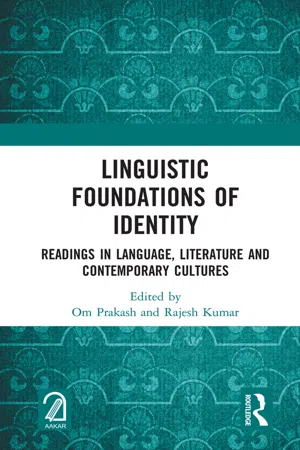
Linguistic Foundations of Identity
Readings in Language, Literature and Contemporary Cultures
- 372 pages
- English
- ePUB (mobile friendly)
- Available on iOS & Android
eBook - ePub
Linguistic Foundations of Identity
Readings in Language, Literature and Contemporary Cultures
About this book
The collection of chapters in this book brings together researchers working in paradoxes and complexities of cultural identities through uses of language and literature from varied perspectives. This volume is an important step towards achieving the goal of reaching out to many who have been looking at the complexities of identity formation from linguistic, cultural, social and political perspectives.
Please note: This title is co-published with Aakar Books, New Delhi. Taylor & Francis does not sell or distribute the Hardback in India, Pakistan, Nepal, Bhutan, Bangladesh, Maldives and Sri Lanka.
Information
1
From a Symbol of Culture to a Marker of Identity: The Trajectory of Urdu in Colonial India
Introduction
The name Urdu was not used in the beginning for the language we now call Urdu. In its initial years—sometime around 16th century—Urdu was the language of saints and Faqirs. The word Hindi too acquired a strictly linguistic connotation towards the beginning of the 20th century. Earlier Hindi meant “of Hind” or something related to India. In Hindi Nationalism, Alok Rai has argued that there was a common language of North which has been described differently as Hindi, Urdu, Hindustani, Hindavi, Rekhta, Bhasha.1 Hindi in that case is to be understood as the overarching term used in North India which included several dialects and sub-dialects. Also, Hindi was used to imply the language of the people of Hind as against a foreign country (Persia and Arab in the case of India). Contrary to the generally-held understanding we have in relation to Hindi as a language solely identified as well as distinguished from Urdu on the basis of Nagari script2, the common language of North India in the late 18th and 19th century, known as Hindi, was written in the Perso-Arabic script and words from Persian and Arabic enriched its vocabulary. Renowned Urdu critic Shamsur Rahman Faruqi informs us that ‘the spoken language was almost always referred to as Hindi even in the early 20th century the name Hindi was used to mean Urdu’.3
Shamsur Rahman Faruqi’s analysis in the context of Urdu’s trajectory is extremely informative. Drawing on multiple sources he concludes that the word Urdu (in the sense of a language) was used for the first time around 1780.4 A work that pin points the exact date of the usage is by T. Graham Bailey. On the basis of his research related to the earliest use of the word Urdu, Bailey has specified the date to be May 26, 1782.5Having mentioned the date, Bailey requested his readers to share information, if any, related to an earlier usage strictly specifying that ‘the date sought for is that of the earliest use of the word standing by itself and meaning the Urdu language’.6 Prior to the usage of this word, the names used were Rekhtah and Hindi, while the ordinary, spoken version (bazaar Urdu) was and still is almost identical with popular, spoken Hindi.7
This language Urdu had its written form in the Nagari script as well. In the year 1800, the British established the Fort William College in Calcutta where emerged, to borrow from Alok Rai, ‘the idea of two-ness, of linguistic duality’.8 It was at Fort William College that, on grounds of script and vocabulary, the available language called Hindustani was divided into Hindi and Urdu. The four Munshis commissioned by the College were required to produceworks in two different scripts i.e. Nagari and Perso-Arabic.9 The invention of modern Sanskritised Hindi is traced back to this commissioning at Fort William College as a result of which words of “Muslim” origin were removed in order to produce a language ‘more suitable to Hindus’.10 Therefore, in the early years, Hindi and Urdu were distinguished from each other strictly on the basis of script. However, there came a time when Urdu became an attribute of a certain community and was pitted against Hindi. In the following sections, by means of touching upon important events, I intend to outline the trajectory of Urdu in India underlining its gradual shift from the linguistic to the religious.
Decline of the Mughal Rule and Quest for Islamic Reform
Drawing an interesting connection between the decline of the Mughal Empire and Urdu literature Lehmann has outlined the ‘paradox’ of the Mughal period by highlighting the outburst of cultural creativity coinciding with the ‘political collapse of the empire’.11 Moreover, with the decline of the Mughal empire there was also a shift from Persian to Urdu. Consequently, the writers, Lehmann argues, ‘ceased to write for an international Islamic civilization and, in composing their major work in Urdu, they were now writing for a purely Indian audience’.12
While on the one hand the 18th century gave us excellent literary achievements, on the other hand the fall of the Mughal Empire was to lead to a severe unease amidst Muslim scholars. As Muslim control over India declined Shah Waliullah of Delhi urged the Muslim community to distinguish itself from the Hindus by strictly refraining from all kinds of un-Islamic practices. He translated the Quran in Persian in 1738,13an act not at all supported by the erstwhile ulamaand other authentic Islamic figures.14 Arabic was considered a holy language and therefore the Quran’s translation into Persian, notwithstanding its literary and cultural merit, was looked down upon. It was more of an act of blending the holy and the mundane. Quran was explained by numerous scholars who preceded Waliullah but those engagements with the holy text belonged to the tradition of commentaries and exegeses. Translation of the verse of the Quran was a new phenomenon but Waliullah’s move marked the beginning of a series of translations that were to subsequently surface in the subcontinent.
While Arabic and Persian were known as languages of Islam during the Mughal period,15 Urdu remained a language beyond the confines of religion during its initial phase. It was only around the late 18th century that marked the beginning of Urdu’s second phase when, in the year 1790, the first Urdu translation of Quran was done by Shah Abdul Qadir, Waliullah’s third son. The translation was titled Mozehal Quran (Quran Explained).16 Subsequently, Shah Rafiuddin, Waliullah’s second son produced a literal translation of Quran titled Faa’iq-al-Bayaan (Exemplary or Distinguished Explanations).17 These two translations of the Quran would lead to a lot of unease among Muslim scholars.18 If Waliullah was criticised for translating the Quran into Persian (a language still closer to Islam) one can safely assume that the reaction generated by the Urdu translation must have been much worse. Regardless of the criticisms, the Urdu translations of the Quran expanded the literature to those Muslims who were not formally educated.19
Around the end of the first quarter of the 19th century, a great deal of activities (intellectual, religious and cultural) were taking place in Urdu.20 Around this time, Sayyid Ahmad of Bareli, who died fighting the Sikhs at Balakot in 1831, wrote two pamphlets to guide ordinary Muslims with regard to saying their prayers and understanding the verses of the Quran. Interestingly, although written in Urdu (the Perso-Arabic script), he called the language Hindi. Tariq Rahman asserts that Sayyid Ahmad used the term Hindi because of the accessibility of the language.21 While one can agree with Rahman’s thesis what is also to be understood is that the term Hindi was used for the common language spoken by people. Therefore, there is a possibility that Sayyid Ahmad called the language simply because it was called Hindi and not because of being mindful of its accessibility.22
Maulana Ismail, Sayyid Ahmad’s close associate in the fight against the Sikhs, wrote Taqwiyatul Iman (The Bliss of Faith) and Sirat al-Mustaqeem (The Right Path)—classic treatises in original religious literature—in Urdu. These works were produced for the common people as the topics are discussed in an ordinary manner without the least of philosophical undertones. This is the occasion when Urdu is used for a categorically Islamic literature. Urdu in the case of these two works is used keeping only Muslims in mind and therefore, I believe, this specific momentmarks the beginning of Islamisation of Urdu. Hence, it will not be wrong to assert that this time onwards Hindi and Urdu were to gradually embark upon separate journeys.
1857 and the Urdu Movement
The event of 1857 is considered as the watershed in India’s engagement with the British. In the case of Urdu’s journey and its relationship with Hindi too, 1857 totally transforms the landscape. While for a long time there were reflections on the Indian response, now it is well known that actually there were distinct Muslim23 and Hindu responses to the failure of the struggle towards throwing the British out of the country. Since it was the time that produced, in the words of Sudhir Chandra, ‘a consciousness that recognised no incongruence between loyalism and nationalism’, it was nearly impossible for Hindus and Muslims to remain on the same page in terms of their response.24
Strictly in the realm of Urdu culture, poetry suffered a great deal. Given the way in which the aristocratic families of Delhi and other major cities of North India were ruined, Urdu poetry lost its patrons and was orphaned. However, as the British strategies of control systematically ruined the aristocratic families in particular, in a short span of time there emerged a Muslim middle class, one that comprised educated modern Muslims more than willing to join hands with the British for progress and prosperity.
To this class belonged Syed Ahmad Khan (1817–1898), the most significant Muslim reformer of colonial India. Rather than one that swore by rhetoric and all kinds of linguistic embellishments, Urdu according to Syed Ahmad Khan had to acquire a much simpler and de-Persianised form. He wanted the language to develop sensitivity towards the demands of the changing times and altogether do away with rhetoric and artificiality in the name of linguistic promise. His journal Tahzeeb-al-Akhlaq which mostly carried pieces on morality, ethics, religion and worldly life is a testimony to usage of de-Persianised Urdu.
Syed Ahmad Khan’s reformist vision raised several extraordinary figures who led the Urdu movement during the second half of the 19th century. People like Nazir Ahmad, ShibliNomani and Altaf Husain Hali transformed the literary and linguistic landscape of the language forever. Notwithstanding the fact that the interventions made by these scholars were literary, in what follows, I intend to argue that their writings gradually Islamicised Urdu.
Nazir Ahmad (1830–1912) is t...
Table of contents
- Cover
- Half Title
- Title Page
- Copyright Page
- Contents
- Foreword
- Introduction
- 1. From a Symbol of Culture to a Marker of Identity: The Trajectory of Urdu in Colonial India
- 2. Symbolic Acts, Implied Character: Constructing the Peer Identity
- 3. Echoes of Language in Cultural Domains
- 4. Politics of Language and Countering Colonialism: A Study of Amitav Ghosh’s The Shadow Lines
- 5. Negotiated Culture and Negotiated Identity in Amitav Ghosh’s River of Smoke
- 6. English and Postcolonial Subjectivity in Indian Literature
- 7. Language Identity in India and Canada: A Comparative Study
- 8. Remapping Identity via Race and Language: A Reading of Philip Roth’s The Human Stain
- 9. Reconstructing Identity: African American Women, Language, and Their Portrayal in Literature
- 10. ‘Trans-creating’ Identity: Issues of Identity Projected by Different Texts
- 11. Coexisting in Conflicting Togetherness: A Sociolinguistic Perspective on English and Identity in India
- 12. Syntactic Innovations in Kiran Desai’s The Inheritance of Loss
- 13. Globalisation and Identity: Interventions during Adolescence in School Education
- 14. Understanding Language and Politics of Identity and Mass Persuasion in India: A case of Telangana
- 15. Politeness in Santali: Implicit Social Aspects
- 16. The Construction of Gender Identity in the Novels of Manju Kapur
- 17. National Literature: A Morass
- 18. From Honey Singh’s ‘Bomb Figure’ to Jennifer Lopez’s ‘Booty’: Culture Industry, Language and Identity of Women amidst ‘Spicy’ Lyrics
- 19. “Who is/are Seth’s Suitable Boy(s)?”: Reading Desirable Masculine Identity of Post-independent India in Vikram Seth’s A Suitable Boy
- 20. Reconstructing Femininity; Commercially and Ideologically: A Critical Discourse Study of the Editor’s Notes to the first issue of Femina and Woman’s Era
- 21. The Sense of Place and Search for Identity: The Case of Refugees from Myanmar in India
- 22. Role of Language in Identity Formation: An Analysis of Influence of Sanskrit on Identity Formation
- 23. Code-mixing, Digital Media and Negotiated Identity of the Urban Youth in India
- 24. Can We Step Outside Language?: Language and Identity in Margaret Atwood’s Cat’s Eye
- 25. ‘Angikan’ Identity: A Socio-linguistic and Socio-cultural Perspective
- 26. Language as Real as Magic Realism: Many worlds and beyond in One Hundred Years of Solitude
- 27. Instrumentality of Language: How Dravidian Politicians Use Language
- About the Editors
- About the Contributors
- Praise for the Book
Trusted by 375,005 students
Access to over 1.5 million titles for a fair monthly price.
Study more efficiently using our study tools.
Frequently asked questions
Yes, you can cancel anytime from the Subscription tab in your account settings on the Perlego website. Your subscription will stay active until the end of your current billing period. Learn how to cancel your subscription
No, books cannot be downloaded as external files, such as PDFs, for use outside of Perlego. However, you can download books within the Perlego app for offline reading on mobile or tablet. Learn how to download books offline
Perlego offers two plans: Essential and Complete
- Essential is ideal for learners and professionals who enjoy exploring a wide range of subjects. Access the Essential Library with 800,000+ trusted titles and best-sellers across business, personal growth, and the humanities. Includes unlimited reading time and Standard Read Aloud voice.
- Complete: Perfect for advanced learners and researchers needing full, unrestricted access. Unlock 1.5M+ books across hundreds of subjects, including academic and specialized titles. The Complete Plan also includes advanced features like Premium Read Aloud and Research Assistant.
We are an online textbook subscription service, where you can get access to an entire online library for less than the price of a single book per month. With over 1.5 million books across 990+ topics, we’ve got you covered! Learn about our mission
Look out for the read-aloud symbol on your next book to see if you can listen to it. The read-aloud tool reads text aloud for you, highlighting the text as it is being read. You can pause it, speed it up and slow it down. Learn more about Read Aloud
Yes! You can use the Perlego app on both iOS and Android devices to read anytime, anywhere — even offline. Perfect for commutes or when you’re on the go.
Please note we cannot support devices running on iOS 13 and Android 7 or earlier. Learn more about using the app
Please note we cannot support devices running on iOS 13 and Android 7 or earlier. Learn more about using the app
Yes, you can access Linguistic Foundations of Identity by Om Prakash,Rajesh Kumar in PDF and/or ePUB format, as well as other popular books in Languages & Linguistics & Journalism. We have over 1.5 million books available in our catalogue for you to explore.