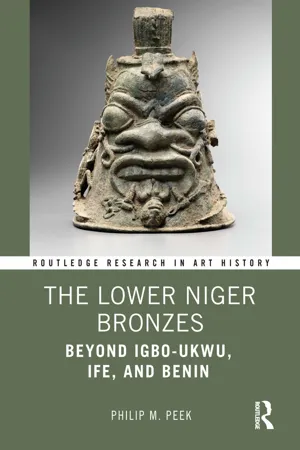
This book demonstrates that copper-alloy casting was widespread in southern Nigeria and has been practiced for at least a millennium.
Philip M. Peek's research provides a critical context for the better-known casting traditions of Igbo-Ukwu, Ife, and Benin. Both the necessary ores and casting skills were widely available, contrary to previous scholarly assumptions. The majority of the Lower Niger Bronzes, which we know number in the thousands, are of subjects not found elsewhere, such as leopard skull replicas, grotesque bell heads, ritual objects, and humanoid figures. Important puzzle pieces are now in place to permit a more complete reconstruction of southern Nigerian history.
The book will be of interest to scholars working in art history, African studies, African history, and anthropology.
Fagg’s Prophecy, Previous Research, and Lower Niger Bronze Forms
The first major presentation of works to which William Fagg attributed the “Lower Niger Bronze Industry” label was his Nigerian Images (1963), but this was not the first time such pieces were displayed publicly. While Fagg never intended this label to be permanent, he did imagine a single “industry” or cultural complex to be responsible for these castings.1 Although he had referred earlier to this corpus that did not seem to fit with other copper-alloy works from Benin, Ife, or Igbo-Ukwu (1952; Fagg and Elisofon 1958), Nigerian Images illustrated fourteen exceptional pieces that established a sort of definition of Lower Niger Bronzes (LNBs). These pieces do not reflect the delicate castings found in Igbo-Ukwu burial sites, nor the exquisite realism of the Ife heads or the stately dignity of the royal busts and plaques of Benin. While there are some fascinating correspondences that will be examined, there are virtually no formal features to firmly locate LNBs in these well-known centers. “Lower Niger” identifies the area below the confluence of the Niger and Benue Rivers and between Nigeria’s borders with the Republic of Benin and Cameroon. Virtually all of the LNBs have been associated with this area.
While introducing the LNBs, Fagg was emphatic in his praise of these unusual pieces: “this is no mere miscellany of pieces otherwise unaccounted for, but in my estimation the very pinnacle of Nigerian artistic achievement”; “if the source of the far more sculptural style of the antelope-hunter [see Figure 1.1] can be identified, it may well prove more important than Ife itself”; and, with reference to the fine male head (1963: fig. 59), “among the most beautiful African examples of poetic generalization of the human head” (1963: 39–40).
Figure 1.1The Hunter. Trustees of the British Museum (# 1952.11.1), 36 cm high. Note the “second right leg.”
There are many possible explanations for the uniqueness of these works, which so impressed Fagg. The “freedom of expression” that attracted him could be the result of an apprentice’s efforts or work by an accomplished caster simply producing slightly different works, perhaps for a non-Edo patron. For example, as different as the two LNB heads (1963: figs 63 and 69) are – from each other as well as from other court works – they have no parallels outside of Benin and do reflect a number of Benin characteristics. Possibly Fagg felt the vast number of busts, plaques, and other royal cast works dictated that these somewhat different pieces could not be included. I am sure that Fagg never imagined the number of cast-metal works that would eventually be grouped under his rubric. I have tracked down over 1,000 copper-alloy objects that can be attributed to the LNBs. Not all of the pieces that Fagg illustrated in 1963 can be considered LNBs.
Virtually all of those bronzes that Fagg distinguished as different came out of Benin with all the loot from the 1897 Punitive Expedition; therefore, it is indisputable that they were present in Benin City at the end of the nineteenth century. The thousands of cast-metal pieces taken by individuals formed a truly heterogeneous collection of masterpieces and truly minor works (see, for example, catalogs of the time such as Read and Dalton 1899; von Luschan 1919; and Pitt-Rivers 1976). I do not think this mix of quality has ever been commented upon.
Of Fagg’s original selection of fourteen pieces, the most striking are probably the three figures: the famous Hunter (1963: fig. 58) (see Figure 1.1), the warrior figure with a square helmet (1963: fig. 62), and, my favorite, the “Mudfish Man” (1963: fig. 70) (see Figure 1.2). He also included two unusual heads, each with very different expressions than most Benin heads (1963: figs 59 and 69). Two vessels are distinguished – a small vase with three human heads (1963: fig. 60) and a pedestal bowl with monkeys on the stem (1963: fig. 63a). Another category includes two small castings of figural groupings perhaps meant as shrine decorations or possibly prestige items. One tableau is of a male and female couple facing a game board with possibly a leopard lying down behind them (1963: fig. 61). The other grouping is of two helmeted hunters with axes following two small elephants (1963: fig. 67).
Figure 1.2Mudfish Man. Ethnologisches Museum, Staatliches Museum zu Berlin (# IIIC 10873), 32cm high.
Photograph: Claudia Obrocki.
Fagg’s 1963 illustrations also include two very different bells that he calls LNBs. One is a fairly large flared bell with six ram or antelope heads (1963: fig. 63b), while the other is a horned humanoid head bell (1963: fig. 65). Of the final three items, one is a “mask” of an elephant (1963: fig. 64), while another is a “pendant plaque” with the familiar Benin triad of a central figure bracketed by two attendants (1963: fig. 66). Finally, Fagg has included a very realistic replica of a leopard skull (1963: fig. 68).
If we review each of these fourteen works in the context now available of cast-metal works from throughout southern Nigeria, only two will clearly fit our revised LNB corpus. Both the humanoid head bell and the leopard skull are very similar to a significant number of works that have been found outside of Benin. The comparisons will be developed in separate chapters below. If only because of its unique transformational aspects, the “Mudfish Man” may be ascribed to the LNBs but the importance of mudfish to Benin iconography certainly keeps it close to Benin.
That these works came from Benin does not prove they were cast there because they could have been brought to the capitol as tribute or stolen from elsewhere; but it certainly means that Benin must be our first consideration. Fagg himself offered several possible alternatives. The first such reference in regard to the Hunter is an attribution to “some centre within the limits of the Benin empire. Udo, a small town near Benin with royal connections was suggested. As well this alternative might have been one of the Yoruba towns to the west or north of Benin”; but then he turns to a friend’s suggestion “that it may be Igbirra or Igala work, that is, from the region of Idah on the Niger some 90 miles to the northeast of Benin – a region which, with that of the lower Benue may prove crucial in Nigerian art history” (Fagg 1952: 145).
This remained his most explicit estimation of the LNBs’ origin, which he extended a few years later when he added “the Bassa-Komo tribes of the Confluence” (Fagg 1960; see also Fagg and Plass 1964: 123). In later publications, as the LNB corpus grew to incorporate the bronzes of Tada and Jebba as well as the distinct Igbo-Ukwu, Andoni Creek, and Forcados River discoveries, he allowed the possibilities of origins from the Yoruba (especially Ijebu-Ode), Igala, Igbira, Igbo, and Ijọ (1963: 40) and later he included Owo. While Fagg continued to hope for archaeological evidence to allow firm attributions for these intriguing works, he never considered the Niger riverain or the Cross River areas as possible sources of LNBs; but, as will be demonstrated, these areas are rich in LNBs.
Turning back to earlier-twentieth-century commentary, it is interesting that colonial government anthropologists offered little information on cast-metal objects although Benin’s heritage was well known by then. N.W. Thomas reported that while there were blacksmiths “everywhere,” “except for Edo [Benin] itself there appears to be little brasswork, though bracelets of brass, and in some parts broad brass collars, are not infrequent” (1910: 23). A few years later, this conclusion was echoed by P.A. Talbot concerning the Igbo: “Practically no brass-work is done by the Ibom among whom, however iron-work seems to have flourished from earliest times” (1926: 927).
K.C. Murray, first director of antiquities for Nigeria, had a much lower anticipation of future finds than did Fagg. Dark (1975: 98, note 65) quotes Murray: “I still see no evidence for any brass industry in the Lower Niger Region unless the term is taken in relation to the whole River Niger and not to Nigeria alone.” I would certainly second Murray here in the sense that the Niger River should have always been considered as an avenue of trade and object dispersal; but, as will be overwhelmingly demonstrated, there can no longer be any question that there were numerous Lower Niger Bronze “Industries.”
The only other firmly established groupings of copper-alloy cast art works are Ife and Igbo-Ukwu, which have nothing in common with each other. The famous Ife heads provide no correspondences with LNBs but there are some important similarities among LNBs to works from Igbo-Ukwu.
Given the decades of analytical discussion of cast-metal works from Igbo-Ukwu, Ife, and Benin, no attempt at summaries of those complexes will be attempted here. Where appropriate correspondences can be found, references to other centers will be made throughout this study. One previously recognized group of copper-alloy pieces does necessitate further comment. This is the wildly heterogeneous “Tsoede Bronzes,” so-called because they were said to have been brought to the small villages of Jebba and Tada from Idah (just below the confluence of the Niger and Benue) by Tsoede, the Nupe cultural hero. Over the years, Fagg vacillated about including these works with the LNBs. In fact, the “Tsoede Bronzes” have attracted much speculation, which will be reviewed in Chapter 13.
It is of historical interest to note that several of the key LNBs noted by Fagg were exhibited at the Museum of Modern Art in their ground-breaking 1935 exhibition of “African Negro Art” (Figure 1.3). The square-helmeted warrior (Fagg 1963: fig. 62) was labeled “figure with bell at neck” (Sweeney 1935: # 249) and the beatific male bust with a lattice-work hat (Fagg 1963: fig. 59) was labeled “man’s head” (Sweeney 1935: # 248).
Figure 1.3“African Negro Art,” March 18–May 10, 1935; Museum of Modern Art, New York; MOMA Archives IN 39.15. Lower Niger pieces are in foreground.
Photograph: Soichi Sunami.
Despite the decades that have passed since Fagg’s first identification of this body of work, despite the decades of collecting by museums and individuals of works associated with LNBs, and despite the decades of occasional scholarly commentary, there has never been a comprehensive study of all LNB copper alloy objects. In the following chapters, I will carefully review what little is known about various aspects of the LNBs, such as their alloy compositions and formal features, by surveying all those works in public and private collections that have been (or should be) attributed to LNBs. While fieldwork is incorporated in the following discussions where possible, the major methodology here is, frustratingly, analysis of objects out of context and mostly freed of firm temporal or spatial links.
Previous Research on Lower Niger Bronzes
The vast majority of research and discussion about southern Nigerian copper-alloy cast arts has been devoted to the three major complexes of Igbo-Ukwu, Ife, and Benin. If LNBs are mentioned at all, they are essentially marginalized as incidental works. Even the most impressive of “unclaimed” bronzes, such as those from Jebba and Tada, remain unstudied mysteries.
Nevertheless, when one carefully considers the record, there have been a few publications that shed light on parts of the LNB puzzle in addition to Fagg’s initial work. Perhaps the earliest entry was Horton’s survey of “brasswork” among the Ijo. of the Niger Delta (1965). In a short research note, Denis Williams (1964) outlined an ambitious research project to study all forms of Yoruba bronze art; in fact, his list of objects parallels this study. Several years later he published a major study of southern Nigerian arts, Icon and Image (1974), which included valuable observations on the LNBs. Working from an art historian’s perspective, Williams identified five casting “schools”: Ife, Benin City, Ijebu-Ode, Abeokuta, and Obo-Aiyegunle (and possibly Oyo), but he did not distinguish the Lower Niger Bronzes as a separate entity because they did not constitute a “school” (1974: 115–119). Frank Willett’s survey of the Benin City Museum’s holdings includes a number of works that he considers to be LNBs (1973).
My own early research on the Isoko was later augmented by limited comparative study (1976, 1980, 2002). Recently, this work has expanded to a full survey of LNBs (2013, 2015, 2019a), an entry on the ǫvǫ/ǫfǫ complex (2020), and an article on Osun bell heads with John Picton (Peek and Picton 2016). Nancy Neaher Maas focused primarily on the role of Awka smith-casters (1976, 1979, 2019), lost wax casting along the Benue River Valley (2011), and various LNB bell types (2020). Keith Nicklin contributed the most thorough research in his study of copper-alloy works from the Cross River and Andoni Creek areas (1980, 1982, and 2002). He also co-authored two valuable studies with Fleming (1980, 1982). Another very helpful entry in The Art of Metal in Africa (Brincard 1982) was Carol Ann Lorenz’ valuable review of LNB bell types. Kathy Curnow has contributed significantly based on her work in Benin City and among ...
Table of contents
Cover
Half Title
Series Information
Title Page
Copyright Page
Dedication
Contents
List of Figures
List of Plates
Preface
Acknowledgments
1 Introduction: Fagg’s Prophecy, Previous Research, and Lower Niger Bronze Forms
2 Historical and Ethnographic Background
3 Southern Nigerian Copper-Alloy Components, Sources, and Analyses
4 Manillas and Bracelets
5 Replicas, Skeumorphs, and Vessels
6 The Ọvọ/Ọfọ/Ovuo Complex
7 Human and Humanoid Figures
8 Heads, Faces, and Costume Masks
9 Leopard Skulls, Rams’ Heads, Hippopotami, and Other Creatures
10 “Pectorals, Hip Ornaments, and Waist Pendants” or Pendant Plaques
11 Bells and Bell Heads
12 Scepter Finials and the “Aro Knot”
13 “Tsoede Bronzes,” “Enowe’s Girdle,” and “Death Rings” – More Mysteries
14 The End Game: Possible Solutions for an Ongoing Puzzle
References Cited
Plates
Trusted by 375,005 students
Access to over 1.5 million titles for a fair monthly price.
Study more efficiently using our study tools.
Frequently asked questions
Yes, you can cancel anytime from the Subscription tab in your account settings on the Perlego website. Your subscription will stay active until the end of your current billing period. Learn how to cancel your subscription
No, books cannot be downloaded as external files, such as PDFs, for use outside of Perlego. However, you can download books within the Perlego app for offline reading on mobile or tablet. Learn how to download books offline
Perlego offers two plans: Essential and Complete
Essential is ideal for learners and professionals who enjoy exploring a wide range of subjects. Access the Essential Library with 800,000+ trusted titles and best-sellers across business, personal growth, and the humanities. Includes unlimited reading time and Standard Read Aloud voice.
Complete: Perfect for advanced learners and researchers needing full, unrestricted access. Unlock 1.5M+ books across hundreds of subjects, including academic and specialized titles. The Complete Plan also includes advanced features like Premium Read Aloud and Research Assistant.
Both plans are available with monthly, semester, or annual billing cycles.
We are an online textbook subscription service, where you can get access to an entire online library for less than the price of a single book per month. With over 1.5 million books across 990+ topics, we’ve got you covered! Learn about our mission
Look out for the read-aloud symbol on your next book to see if you can listen to it. The read-aloud tool reads text aloud for you, highlighting the text as it is being read. You can pause it, speed it up and slow it down. Learn more about Read Aloud
Yes! You can use the Perlego app on both iOS and Android devices to read anytime, anywhere — even offline. Perfect for commutes or when you’re on the go. Please note we cannot support devices running on iOS 13 and Android 7 or earlier. Learn more about using the app
Yes, you can access The Lower Niger Bronzes by Philip M. Peek in PDF and/or ePUB format, as well as other popular books in Art & Art General. We have over 1.5 million books available in our catalogue for you to explore.