eBook - ePub
Microparticulate Systems for the Delivery of Proteins and Vaccines
- 552 pages
- English
- ePUB (mobile friendly)
- Available on iOS & Android
eBook - ePub
Microparticulate Systems for the Delivery of Proteins and Vaccines
About this book
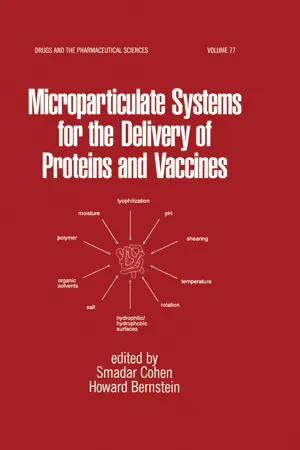
This practical guide offers concise coverage of the scientific and pharmaceutical aspects of protein delivery from controlled release microparticulate systems-emphasizing protein stability during encapsulation and release.
Information
1
Stability of Proteins and Their Delivery from Biodegradable Polymer Microspheres
Steven P. Schwendeman,*, Michael Cardamone, Alexander Klibanov, and Robert Langer
Massachusetts Institute of Technology
Cambridge, Massachusetts
Cambridge, Massachusetts
Malcolm R. Brandon
The University of Melbourne
Parkville, Australia
Parkville, Australia
* Current affiliation: The Ohio State University, Columbus, Ohio
I. INTRODUCTION
Not long after it was understood that molecules of any size, including large globular proteins (e.g., bovine serum albumin; BSA) could be delivered slowly and continuously from biocompatible polymers [1], the field of controlled release of proteins and peptides has grown immensely. If this concept could be combined successfully with polymers that are both biodegradable and have been processed into microspheres having distinct advantages for oral and parenteral administration, the therapeutic value of such dosage forms could be enormous. Development of this field is a very likely requisite for creation of a supervaccine capable of immunizing individuals against several diseases in a single dose [2]. In addition, patient compliance and comfort, as well as control over blood levels, may be improved with the development of controlled-release protein injectables because regular invasive doses can be avoided. This latter concept is the primary objective in developing insulin-delivery systems [3, 4, 5] and has been accomplished for delivery of luteinizing hormone-releasing hormone (LH-RH) analogues such as leuprolide, using controlled-release polymer microspheres, (Lupron Depot), which deliver the peptide for 1 month [6].
Although it has become a routine objective to analyze release kinetics of proteins, the number of publications that consider the stability of protein being delivered from polymers is very low [7, 8, 9, 10]. Mechanistic analysis of the stability of proteins during processing, storage, and delivery from polymers is also virtually nonexistent. Recombinant DNA technology has been responsible for the current increase in commercial production of proteins for pharmaceutical use. Several hundred investigational new protein drugs are currently undergoing clinical trials [11,12]. Unfortunately, proteins possess intrinsic properties that, to a large extent, are responsible for the low numbers of therapeutic proteins that have received US Food and Drug Administration (FDA) approval [12]. Thus, it is likely that protein stability is one of the most important obstacles for successful formulation of biodegradable polymer microspheres that control the release of proteins. The aim of this chapter is to combine the concepts of biochemistry, polymer science, and microencapsulation to examine the complexity of formulating these dosage forms; particular emphasis is placed on the strategies and experimental methods used to handle the problems associated with protein stability.
Unlike low molecular weight drugs, proteins as biopolymers have very large globular structures (typically 2–8 nm a side or even larger [13]), possess complex internal architecture that defines their unique biological functions, and contain numerous chemically reactive moieties on their side chains, as well as chemically labile bonds. In contrast, small molecules, and even most peptides, do not have a. higher-order structure that may be lost. The fundamental concept behind most rational stabilization approaches is that protein stability must be investigated at the molecular level. Thus, knowledge of the amino acid sequence is essential to developing this approach. Proteins may become inactive by chemical alteration, denaturation, and aggregation [14,15]; also, they may undergo complex adsorption processes that can denature them, particularly when the surface is hydrophobic [16]. Finally, the size of the protein will present special mass transport issues. For example, small molecular weight stabilizers in the formulation that can regulate the environment of the protein (i.e., pH, ionic strength, surface tension, and viscosity) will be transported more freely through the degrading polymer than will the protein. This fact, no doubt, will have stability repercussions as well.
The term stability, as it relates to proteins, has several definitions. It is important to distinguish between pharmaceutical and conformational stability and to have specific objectives relative to these before carrying out in-depth stability studies of proteins. For example, Creighton states that a protein is usually most stable at its isoelectric point (referring to the following biochemical definition) [17]. Yet, to avoid aggregation or irreversible conformational changes at surfaces, it is suggested that one move the pH away from the isoelectric point [14,16]. Thus, the term stability is often used loosely in a variety of ways. The pharmaceutical definition according to the US FDA considers a stable pharmaceutical product as one that deteriorates no more than 10% in 2 years [18]. We define the conformational or physical stability of a protein as the ability of the protein to retain its tertiary structure (see Section II.A.3). The three-dimensional structure dictates the properties that allow enzymes, for example, to recognize and bind their natural substrates as well as to have the reactive functional groups properly aligned for catalysis. There is some debate among immunologists of whether the conformational stability of proteinaceous vaccine antigens is essential for a long-lasting and neutralizing immune response, although it is becoming clearer that preservation of the native antigenic determinants on the antigen is necessary to attain protective immune responses [19]. Chemical stability involves the reactivity of the side chains and lability of the peptide bonds. The alteration of even one crucial amino acid can seriously impair or abolish the protein’s function. The single amino acid substitution in the hemoglobins of sickle cell anemics is evidence of this fact [20]. Biochemists often use the term protein stability to denote the magnitude of the change in Gibbs free energy between the folded and unfolded state of the protein [21]. This biochemical definition can be distinguished from physical stability, in that the latter may depend on both thermodynamic and kinetic factors, whereas the former is a function of thermodynamic factors only.
The stability of proteins encapsulated in biodegradable polymer microspheres may be separated into at least three complex themes and their interrelations: processing polymers into microspheres, hydration and erosion of the polymer during release incubation, and the intrinsic stability of the protein. During preparation of microspheres, the use of organic solvents [7], formation of the microsphere [9], and lyophilization, all are processes able to inactivate proteins [22]. During release incubation, the protein becomes slowly hydrated (i.e., slower than direct reconstitution), a process known to cause inactivation of proteins by so-called moisture-induced aggregation [23,24]. Other processes during release, such as a reduction in pH, resulting from the formation of new carboxylic acid end groups of the polymer; the presence of the hydrophobic polymer surface; and the creation of water-soluble polymer fragments and monomers, all are potential sources of protein inactivation. In addition, during all of these processes there is a potential of chemical reactions between the protein and the polymer [25,26]. The intrinsic stability of the protein will determine whether it is susceptible to processes, such as deamidation, oxidation of methionine and cysteine residues, or the many other deleterious reactions encountered during storage and release, the latter of which is carried out at physiological temperature for extended time periods. Thus, there is a time-line of physical-chemical events during processing, lyophilization and storage, and release from the polymer at which protein inactivation can occur (see later discussion).
We choose to examine predominantly the poly(lactide-co-glycolide) (PLGA) family of copolymers, because these are the only synthetic biodegradable polymers that are currently US FDA approved for biomedical applications and are the subject of the vast majority of research in this area. We will also discuss other polymers that have pharmaceutical potential, such as the poly(ortho esters) and polyanhydrides, when examining the preparation of micropheres and polymer erosion.
The subject of protein stability, as it relates to biodegradable polymer microspheres, is in its infancy. Therefore, for the time being, we must rely on what is known about both protein stability developed for...
Table of contents
- Cover
- Half Title
- Title Page
- Copyright Page
- Preface
- Table of Contents
- Contributors
- 1. Stability of Proteins and Their Delivery from Biodegradable Polymer Microspheres
- 2. Injectable Biodegradable Microspheres for Vaccine Delivery
- 3. Preparation of Microparticulates Using Supercritical Fluids
- 4. Polyphosphazene Hydrogel Microspheres for Protein Delivery
- 5. Lipospheres for Vaccine Delivery
- 6. The Characterization of Polyanhydride Microspheres
- 7. Nanoparticulate Drug Carrier Technology
- 8. Biodistribution of Surface-Modified Liposomes and Particles
- 9. Poly(Ethylene Glycol)-Coated Biodegradable Nanospheres for Intravenous Drug Administration
- 10. Polymerized and Microencapsulated Liposomes for Oral Delivery and Vaccination
- 11. Pharmacokinetics of Microparticulate Systems
- 12. Adjuvant-Active Polymeric Microparticulate Vaccine-Delivery Systems
- 13. Oral Vaccination by Microspheres
- 14. Biodegradable Gelatin Microspheres for Drug Delivery to Macrophages
- 15. Bioadhesive Liposomes for Topical Treatment of Wounds
- 16. Ultrasound-Triggered Delivery of Peptides and Proteins from Microspheres
- 17. Polyacrylate Microcapsules for Cell Delivery
- Index
Trusted by 375,005 students
Access to over 1.5 million titles for a fair monthly price.
Study more efficiently using our study tools.
Frequently asked questions
Yes, you can cancel anytime from the Subscription tab in your account settings on the Perlego website. Your subscription will stay active until the end of your current billing period. Learn how to cancel your subscription
No, books cannot be downloaded as external files, such as PDFs, for use outside of Perlego. However, you can download books within the Perlego app for offline reading on mobile or tablet. Learn how to download books offline
Perlego offers two plans: Essential and Complete
- Essential is ideal for learners and professionals who enjoy exploring a wide range of subjects. Access the Essential Library with 800,000+ trusted titles and best-sellers across business, personal growth, and the humanities. Includes unlimited reading time and Standard Read Aloud voice.
- Complete: Perfect for advanced learners and researchers needing full, unrestricted access. Unlock 1.5M+ books across hundreds of subjects, including academic and specialized titles. The Complete Plan also includes advanced features like Premium Read Aloud and Research Assistant.
We are an online textbook subscription service, where you can get access to an entire online library for less than the price of a single book per month. With over 1.5 million books across 990+ topics, we’ve got you covered! Learn about our mission
Look out for the read-aloud symbol on your next book to see if you can listen to it. The read-aloud tool reads text aloud for you, highlighting the text as it is being read. You can pause it, speed it up and slow it down. Learn more about Read Aloud
Yes! You can use the Perlego app on both iOS and Android devices to read anytime, anywhere — even offline. Perfect for commutes or when you’re on the go.
Please note we cannot support devices running on iOS 13 and Android 7 or earlier. Learn more about using the app
Please note we cannot support devices running on iOS 13 and Android 7 or earlier. Learn more about using the app
Yes, you can access Microparticulate Systems for the Delivery of Proteins and Vaccines by Smadar Cohen,Howard Bernstein in PDF and/or ePUB format, as well as other popular books in Biological Sciences & Biotechnology. We have over 1.5 million books available in our catalogue for you to explore.