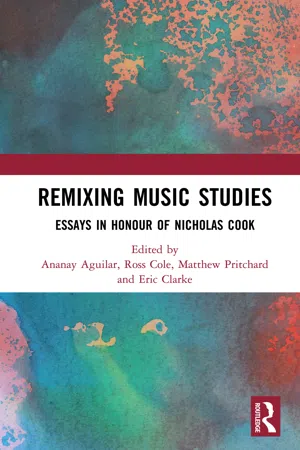
Where is the academic study of music today, and what paths should it take into the future? Should we be looking at how music relates to society and constructs meaning through it, rather than how it transcends the social? Can we 'remix' our discipline and attempt to address all musics on an equal basis, without splitting ourselves in advance into subgroups of 'musicologists', 'theorists', and 'ethnomusicologists'? These are some of the crucial issues that Nicholas Cook has raised since he emerged in the 1990s as one of the UK's leading and most widely read voices in critical musicology. In this book, collaborators and former students of Cook pursue these questions and others raised by his work—from notation, historiography, and performance to the place of music in multimedia forms such as virtual reality and video games, analysing both how it can bring people together and the ways in which it has failed to do so.
eBook - ePub
Remixing Music Studies
Essays in Honour of Nicholas Cook
- 224 pages
- English
- ePUB (mobile friendly)
- Available on iOS & Android
eBook - ePub
Remixing Music Studies
Essays in Honour of Nicholas Cook
About this book
Information
Part I
Media, notation, and performance
1
Transforming musical (multi)media
Virtual reality and the goals of music research in the twenty-first-century humanities
Beginnings
It’s a beautiful spring day in the 1990s: the sun is shining, the sky is blue, and I’m sitting having lunch in a 1960s-built English university quad beneath a magnolia tree, its huge white petals glowing against bare bark. Despite the lovely setting and efforts of my host, I’m feeling shy and awkward—this is after all an interview to study for a doctorate, and I’m still not sure what project I want to do. Behind it all the lurking shadow, that nagging feeling that studying music is a self-indulgent luxury that, while utterly self-transformative, serves a small group of privileged people. We talk about my various ideas as to what I might focus my doctorate on, and my potential supervisor’s expertise in those areas. At some point he labels himself, self-dismissingly, a ‘butterfly’, not settling on any one thing very long. Reflecting on this on the journey home, I realize that while the topics might change, there’s a critical thread to be taken from his ‘butterfly work’: that what musicologists choose to value as music manifests societal equalities and inequalities; that musicological methods are socio-historically situated ways of knowing music whose particularity becomes clearer when viewed from other musical worlds; and that there can be a purpose to musical study compatible with wanting to do good in the world.
Fast-forward 30 years and the question of why academic music researchers approach music as they do looms large as part of a broader disquiet regarding the value and purpose of music studies, and of the study of arts and humanities more broadly. This tension, perceived as a ‘crisis in the humanities’ (Fish 2010) in some quarters, is manifest in the marketization of students, a perceived shift to vocational and STEM subjects, and the widespread sense that the arts and humanities are being ‘cut away’ at all levels of education (Nussbaum 2010, 2). This is accompanied by an increased prioritization of research funding to address societal ‘grand challenges’ such as global warming, unequal access to energy, water, and food, and an ageing population. These in turn are framed as complex problems necessitating multi-disciplinary collaboration with non-academic partners, a scenario to which the arts and humanities may seem (wrongly, I would argue) to have little direct relevance (Madsbjerg 2017).
In the UK the increasingly corporatized and instrumentalized education and research context manifests in the need to evidence the benefits of research, including music, for the ‘economy, society, culture, public policy or services, health, the environment or quality of life’ (Lund Declaration 2009), measured through assessment exercises such as the UK Research Excellence Framework, and enquiry into the cultural value of the arts and humanities (Crossick and Kaszynska 2016; Arts Council England 2014). These evaluations can be seen as a direct response to the need to justify funding for the arts, for education and research in arts and humanities, and to show the preparedness of the sector to serve the creative economy. The value of research into music is intimately bound up with the cultural value of music, but in the context of this discussion I focus on the purpose and value of the research rather than that larger question. My once fledgling desire for a more explicit articulation of the value of research into music, illustrated in my opening anecdote of meeting Nicholas Cook, is today realized in a third pillar of ‘knowledge exchange’ alongside those of teaching and research. Be careful what you wish for, some might say.
Even while we might choose to label this moment in the arts and humanities a ‘crisis’, we should recognize the historicity of that phrase. English literature scholar Paul Jay points out that many aspects of the tensions described form a recurring debate throughout the twentieth century: he highlights persistent questioning of the value of knowledge for its own sake versus its utilitarian value, the practical worth of a humanities education, and the extent to which the curriculum should include the knowledge and skills of the professions (Jay 2014). The current trans-national ‘crisis’ in humanities is explored in academic discussions of the future of the humanities. In Not for Profit: Why Democracy Needs the Humanities, Martha Nussbaum argues that governments are increasingly treating education as though its primary goal is to teach students to be economically productive, rather than to think critically and become knowledgeable, creative, and empathetic individuals (Nussbaum 2010). John Russo, in The Future without a Past: The Humanities in a Technological Society, argues that technological values have eroded human values instead of being ‘humanized’ by them (Russo 2005). And a number of writers make powerful cases for the importance of arts and humanities methods and knowledge in informing technological and economic development, which without them often ignores vital cultural and human perspectives (Hartley 2017; Madsbjerg 2017). When it comes to music studies, there has been less direct response to these larger issues; instead, there has been a pragmatic focus on articulating the value of music education for employability, socialization, and subjectification (All-party Parliamentary Group for Music Education, Incorporated Society of Musicians, University of Sussex 2019), advocating the value of art music (Johnson 2002), and revitalizing musicology (Cook and Everist 2001). This chapter takes a different stance by questioning much more directly the value of music research, beyond, as well as within, its instrumentalized role in the creative economy.
One way to understand this situation is to look more closely at areas of study themselves. In his book The Transformative Humanities: A Manifesto, Mikhail Epstein (2012, 2) speaks from the perspective of literary studies, speculating self-critically that:
Perhaps twenty-first-century society, and conceivably even the academe itself, are turning away from the humanities because in the twentieth century, and especially in its second half, the humanities turned away from humans? Instead they focused on texts. To a certain extent, humanities stopped being human studies and became textual studies.
Regardless of whether one would choose to characterize the whole of arts and humanities research in this way, its perceived irrelevance is nonetheless an accusation to which researchers are called to respond. Epstein himself proposes a re-orientation to ‘Transformative Humanities’ which takes as its foundation the idea that the humanities have a unique focus on processes of human creativity, communication, and interpersonal relations, and the critical ‘denaturalization’ of human beings (‘the unmasking of everything viewed by the natural and social sciences as the solid and positive foundation of objectivity’ (Epstein 2012, 8)). What distinguishes humanistic as opposed to scientific discourse, he argues, is that it ‘has human individuals as its subject matter’ (2012, 290–91):
Not purely informative, humanistic discourse is potentially as transformative as a declaration of love (or of hatred); it addresses the same subject about which it speaks. Unlike technological or political activity, activity in the humanities is directed not to material objects or social masses, but to creative and responsive individuals, engaging them in events of creative communication.
A second approach, not antithetical to Epstein’s ideas, is that of global humanities (a term foregrounded by the University of Sheffield).1 This approach points to the uniquely human aspects of the humanities disciplines, and the way in which literature, philosophy and the arts are mediums through which people imagine the world differently in order to shape the future.
Rethinking music studies from these perspectives highlights how the study of music, and the arts and humanities more generally, transforms social, economic, and artistic life worlds by contributing varied insights into
- different people, their worlds, and how they make sense of them with music, revealing the structures which shape those different realities;
- human flourishing, namely our emotional lives, consciousness, strong experiences, the sense of the meaningfulness of our lives; and how music’s expressions, practices, and institutions foster or suppress individual and sociable fulfilment and expression;
- human interactions and relationships with the environment, other species, and technology as realized through music;
- how our musical past, and the way we think about it, shapes our present and our future; and
- methods which enable critical thinking and the identification of alternative perspectives.
This includes probing negative aspects of music. As the sociologist Dave Hesmondhalgh (2013) has commented, given music’s evident involvement in social processes of a modern society marked by ‘inequalities, exploitation and suffering’, the effects of musical engagement cannot possibly be free of these more negative aspects of modern life. An illustrative example of this, and one close to home for anyone studying music, is laid bare in Georgina Born and Kyle Devine’s (2015) analysis of the social inequalities of ethnicity, gender, and class reproduced in the bifurcation of music technology and traditional music degree courses in the UK.
To think through the question of the value of music research I focus on music in the immersive, extended reality experiences of virtual reality. One reason for choosing this as the case study is that the significant impacts of computational technology on music making, engagement, and music deployment are not just economic (e.g. how can the recorded music industry make money?) or technological (e.g. how can we best spatialize sound to make engaging virtual reality musical experiences?), but humanistic: how might new music media contribute to human flourishing? It represents one of the interdisciplinary ‘grand challenges’ central to the current moment of the UK’s research funding priorities (Department for Business, Energy and Industrial Strategy 2017). Moreover, this area of cultural growth and experimentation is largely occupied by commercial capital, within which music is situated as a form of ‘content’ used to sell hardware. How will arts and humanities researchers respond to this moment?
A second reason for focusing on immersive media is that it allows me to extend some of the themes in Nicholas Cook’s work, which consistently highlights the need to address music as multimedia, to recognize flattened hierarchies and changing definitional boundaries for the roles of performer, composer, and audience, and for presentational and participatory forms of music-making; to consider music as space (Cook 2013); and to examine the social dimension of music participation in virtual worlds as well as the physical (Gagen and Cook 2016). It also necessitates reflecting on the dominance of reception ideologies promoted by capitalist neoliberalism, above all the dominant valuation of music for its authenticity and immediacy, and for the affective labour it performs.
In what follows I present a music-analytical interpretive account of the artefact-focused variety. I do this not because this is the only way to approach this topic (one can imagine ethnographies of the extended reality music industry, its social networks, and theoretical accounts of the human-technology relationship afforded by extended reality experiences), but because it epitomizes a method and critical outcome that might currently seem furthest from purely economic ‘worth’ beyond academia. There are many areas of music research which have direct application to societal challenges, but the kind of musicological critique that follows—what might be described as aesthetic criticism—can seem at odds with this context, partly because it is most attuned to the musical experience rather than any practical application beyond it. This goes to the core of one of Nicholas Cook’s major contributions to musicology—the idea that theories of music, and meaning in music, are not intrinsic to music but ‘imagined’ (1990). In this context, authoritative ‘readings’ of music take on the status of interpretive guides, giving the listener new ways to hear (‘imagine’) music. According to Cook, music theory and criticism are part of the production culture of music; they can change the way we perform, compose, and listen, affording reflection on the experience engendered by music and openness to its transformative potential. The analysis which follow...
Table of contents
- Cover
- Half Title
- Title Page
- Copyright Page
- Dedication Page
- Contents
- Acknowledgements
- List of contributors
- Introduction: a hedgehog in fox’s clothing
- PART I Media, notation, and performance
- PART II Meanings and values in history
- Afterword: knowing Nick
- Index
Trusted by 375,005 students
Access to over 1.5 million titles for a fair monthly price.
Study more efficiently using our study tools.
Frequently asked questions
Yes, you can cancel anytime from the Subscription tab in your account settings on the Perlego website. Your subscription will stay active until the end of your current billing period. Learn how to cancel your subscription
No, books cannot be downloaded as external files, such as PDFs, for use outside of Perlego. However, you can download books within the Perlego app for offline reading on mobile or tablet. Learn how to download books offline
Perlego offers two plans: Essential and Complete
- Essential is ideal for learners and professionals who enjoy exploring a wide range of subjects. Access the Essential Library with 800,000+ trusted titles and best-sellers across business, personal growth, and the humanities. Includes unlimited reading time and Standard Read Aloud voice.
- Complete: Perfect for advanced learners and researchers needing full, unrestricted access. Unlock 1.5M+ books across hundreds of subjects, including academic and specialized titles. The Complete Plan also includes advanced features like Premium Read Aloud and Research Assistant.
We are an online textbook subscription service, where you can get access to an entire online library for less than the price of a single book per month. With over 1.5 million books across 990+ topics, we’ve got you covered! Learn about our mission
Look out for the read-aloud symbol on your next book to see if you can listen to it. The read-aloud tool reads text aloud for you, highlighting the text as it is being read. You can pause it, speed it up and slow it down. Learn more about Read Aloud
Yes! You can use the Perlego app on both iOS and Android devices to read anytime, anywhere — even offline. Perfect for commutes or when you’re on the go.
Please note we cannot support devices running on iOS 13 and Android 7 or earlier. Learn more about using the app
Please note we cannot support devices running on iOS 13 and Android 7 or earlier. Learn more about using the app
Yes, you can access Remixing Music Studies by Ananay Aguilar, Ross Cole, Matthew Pritchard, Eric Clarke, Ananay Aguilar,Ross Cole,Matthew Pritchard,Eric Clarke in PDF and/or ePUB format, as well as other popular books in Arte & Arte generale. We have over 1.5 million books available in our catalogue for you to explore.