This book examines how Rwandan elites within the government, private sector and civil society perceive the nation's political and economic relationship with the international community. Using testimonies and interviews of Rwandan political, military and economic leaders, and bureaucrats, this book examines the intersubjective beliefs that formulate how Rwanda engages with the international community. The book presents and analyses three primary intersubjective themes: historical and possible future abandonment of Rwanda; implementing an ideology of agaciro to promote self-respect, dignity and self-reliance for state security and economic development; and the belief in the government's obligation to promote human security for those who identify as 'Rwandan'. These perceptions help us understand how post-genocide Rwanda engages with the international community in the pursuit of state security, economic development and to prevent a future genocide. This book will be of interest to students and scholars of African politics and international relations as well as the politics of post-genocide states.
eBook - ePub
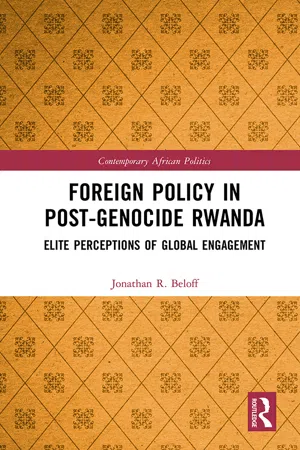
Foreign Policy in Post-Genocide Rwanda
Elite Perceptions of Global Engagement
- 260 pages
- English
- ePUB (mobile friendly)
- Available on iOS & Android
eBook - ePub
About this book
Information
Part I
Rwandan history and its impact on Rwandan foreign affairs
1 Early history of the RPF’s interpretation of state–global relations (1959–1994)
Historical experiences significantly influence the everyday by not only establishing the setting, but perceptions of the individual. No other event beyond the 1994 genocide has influenced Rwanda more, but it cannot be the only event in understanding how present-day Rwanda operates. Rwanda’s historical events prior to the genocide greatly impact on how the current government perceives itself and others. This section contains two chapters that connect historical events with perceptions from those periods as well as today. Rwandan foreign policy is largely impacted on by events beginning during colonisation until the 1994 genocide. This and the following chapter examine the history of the international community’s engagement with Rwanda and its past refugee populations, and the ways in which these engagements influenced and shifted the RPF’s, and later the RPF-government’s, perceptions of international actors and adds to our understanding of Rwandan history by describing how high-ranking members of the Rwandan government view the state’s international relations, based on major historical moments in the RPF’s as well as the nation’s history. It attempts to present a broader examination of historical Rwandan foreign policy understandings prior to examining currently held tenets.
The chapter is aligned with Mitzen’s (2006, 348) assertion of the necessity for humans to understand and ‘make sense of their world’ through developing meaning out of a complex and usually stressful situation. Thus this chapter examines responses to historical events and applies different international relations theories to best help explain those beliefs at the time. During each historical period, each of the tenets of abandonment, agaciro and Rwandan security are present, highlighting their profound influence on many interviewees’ perceptions. Each period classifies major moments of Rwanda’s and the RPF’s history. Events that are deemed important fulfil three specific requirements. The first is that interviewees introduced events that they saw as important in illustrating the changes in their perceptions of the international system. This includes historical moments that informants believed provide a description of one or all of the tenets. The second is the frequency of their mention throughout the interviews. A specific affair can show its importance in that it affects government policy if most or all my informants have mentioned it. Finally, the last requirement is the widespread discussion of particular tenets within existing understanding of Rwandan history. This does not contradict the previous paragraph, as most historical moments are discussed by scholars. Rather, the tenets are either not uncovered, missing factual information, such as from privately held meetings, or fully explored in understanding how history affected current elites’ perceptions of the international system.
This and the following chapter illustrate, through a constructivist lens, how perceptions can be altered based on changing environments. The tenets do not change in terms of existence; they exist in different time periods. Rather, what changes is how Rwandan elites, whether as refugees, RPF fighters or as members of the current government, perceive how the international system operates and engage with foreign actors. While much of this chapter focuses on providing a historical context to Rwandan foreign policy, in terms of detailing historical events, its primary goal is to view how tenets remain relatively similar and how Rwandan elites perceived the world in order to hold onto and enact those tenets. Shifting perceptions of how the international order operates are interpreted through different international relations theories. This stems from how the chapter relies on historic material rather than collected interview data, as well as how it consists of interpreting the historic reactions of Rwandan leaders rather than overall perceptions. The shift in focus illustrates how this chapter is a broader examination of Rwandan/RPF relations as perceived by the international community through various international relations theories, rather than stating that elites explicitly followed specific theories.
Very few Rwandan officials were able to clearly relate specific periods to a specific international relations theory. Instead, they described how the RPF rebel group or government party viewed how the international order operated, as well as how they promoted their regional and global interests during particular events. It must be stressed that this section is not attempting to argue that Rwandan refugees, RPF or later government officials held specific informed international relations perspectives. As the next two sections will illustrate, only once was there a specific period witnessed when explicit theory was being taught and held as an explanation for the international system. This was in the form of Senator Rutaremara, who was trained and taught dependency theory to Rwandan actors as a way to understand the international system, as used within this research. The intended goal of this chapter is to examine, using the current literature and the data from the collected interviews of Rwandan elites, how tenets historically operated when actors held different tenets about how the international system works. Thus, how the tenets were enacted through policy is examined through various international relations theory to better understand the assumptions and tenets of Rwandan refugees, RPF/A and the current Rwandan government about how the world operated. The lack of exact agreed dates provides space for different informants to disagree with their colleagues in terms of which mentality related to specific moments or events. However, it became possible, when they explained why they enacted a certain foreign policy during precise historical moments, to relate this to the explanations of how states operate within international relations theory.
Once this connection is created, trends can be seen of how the Rwandan government interpreted the international system through historical analysis. Because of the significance of the genocide in Rwandan perceptions, the chapter provides basic information about the formation of ethnicity and early Rwandan history. This includes the First (1962–1973) and Second (1973–1994) Rwandan Republics, during which Rwandan refugees, who would later form the RPF, would experience the tenets of abandonment, the drive for determination and the need for security of all who identify as Rwandan. After this historical context, the chapter focuses on illustrating different historical periods with their accompanying perceptions of international relations. This is how it is possible to say that during the early formation of the RPF (1987–1990), many held a rather Marxist/dependency interpretation, or how during the Second Congo War (1998–2003) many within the Rwandan government followed a more offensive realist interpretation of how states interact. This grants us two avenues of analysis. First, it displays that policy makers’ rationale and ideology changed over the last thirty years. The second is that it provides us the necessary lenses for the remainder of the research in terms of providing an understanding of how Rwandan informants perceived how the international system operates. The use of multiple international relations theories, like the use of neorealism by later chapters, are a mechanism to help explain those perceptions and behaviours.
Historical context of pre-RPF Rwanda
A great deal of Rwanda’s foreign policy responds directly to the experiences and legacies of the 1994 genocide. However, the origins of the genocide can be found well before the start of the Rwandan Civil War, during the times of German (1884–1919) and Belgian (1919–1962) colonisation (Pottier, 2002, 14–16; Prunier, 1997, 23). It was during the colonial period that the socioeconomic labels of Hutu, Tutsi and Twa were converted into ethnic classes (Bertrand & Ensign, 2010, 5–6; Prunier, 1997, 5–16, 23–35). For the purposes of this research, it is not necessary to cover the pre-colonial period up to the decline of the Hutu Republics (1962–1994) in great detail, as it does not play a significant role in how crafters of Rwandan foreign policy perceive the international system. However, there are a few significant historical events of international engagement with Rwanda and refugees that are worth noting, as they will impact on how future Rwandan leaders perceive and engage with the international community. The first is the racial divisions that colonisation imprinted on Rwandan society. As mentioned before, the shift from socioeconomic to ethnic classes of Rwandans affected access to education and services. During the colonial period, Tutsis were granted access to these services over the Hutu population (Pottier, 2002, 20–23; Prunier, 1997, 26–40). After independence in 1962 and the rise of the Hutu Republic, access shifted to enhance the Hutu population, while leaving the Tutsi population in a very weak position, victims of pogroms and the exile of over 120,000 people throughout the African Great Lakes (Kinzer, 2008, 12; Prunier, 1997, 48–53, 61–74; Waugh, 2004, 9–10, 23–24). As the decades passed, the international community abandoned its commitments to help the Rwandan refugees. The conditions within the refugee camps were poor, with many facing restrictions to development and educational opportunities. Some refugees decided in 1987 to form the Rwandan Patriotic Front (RPF), with many joining during the late 1980s. The movement promoted the concept of refugees joining together to defend their security from the persecution of their host countries. However, its central desire was for Rwandan refugees to return to their homeland through the promotion of self-reliance, rather than reliance on the international community.
The second significant detail of this period is the shifting relationship between the Rwandan government and European powers. At the end of Belgian colonisation, the colonial officials switched political and social allegiances from the Tutsis to the Hutus. This had great significance in defining the nature of governance for the following three and half decades in Rwanda. But even more important was the rise of French influence, especially during the Habyarimana regime from 1972 to 1994. Wallis (2019) and Melvern (2000, 24–36) describe the cosy relationship between President Juvénal Habyarimana and French President François Mitterrand.1 President Mitterrand facilitated large amounts of foreign aid to try to both boost economic development and keep Rwanda within France’s sphere of influence. However, substantial aid was siphoned off to sustain Habyarimana’s power and to create, finance, train and equip Hutu militias during the 1994 genocide (Kinzer, 2008, 54, 77–79, 92–95; Melvern, 2000, 43–49, 66–68; Prunier, 1997, 90–99, 159–160). The previous close relationship between the two is a factor, but not the major one, as to why the current Rwandan government has poor relations with France.2 Current Rwandan elites still distrust the French government because of its assistance to the Habyarimana regime during the Rwandan Civil War (1990–1994) and its perceived support of the 1994 genocide government.
The final major historical factor is the lasting effects of decisions made by the Habyarimana regime. Political and economic reforms were foisted on Rwanda by the IMF and the World Bank, alongside nations such as France, to service its large debt. As seen in other nations, such as Mexico (1994–1995) (Lairson & Skidmore, 2003, 1–8, 382–398) and Argentina (1998–2002) (Lairson & Skidmore, 2003, 182, 297, 374–375, 82–89; Stiglitz, 2003, 18–19, 79–98, 231) that enacted these types of structural reforms, it led to greater national instability. Specifically, the World Bank supported an IMF-induced 1988 structural agreement programme (Chossudovsky, 1996, 938; Storey, 1999) alongside Mitterrand’s 1987 (Kinzer, 2008, 54; Prunier, 1997, 89) declaration during the Francophone conference of democratic and economic reforms. By the late 1980s, the Washington Consensus became the mainstream viewpoint of most developmental economists, donor nations and financial institutions (Kennedy, 1988, 184–190; Lairson & Skidmore, 2003, 17–38). For Rwanda, which continually faced fiscal deficits and large sovereign debt, this period forced the government to cut major subsidies on food and energy programmes, which were instrumental in Habyarimana’s political patronage system. These reforms not only had the negative consequence of impacting on the lives of everyday Rwandans in terms of prices, but they coincided with the bottoming out of the international coffee and tea market. This had been the main source of income for the Rwandan government outside of foreign financial assistance (Prunier, 1997, 160).3 These three events led to a destabilising of Habyarimana’s grip on power in the late 1980s, and paved the way for opportunists, whether Hutu extremists or the RPF, to seize power. There has been a lasting impact of the 1988 IMF Agreement on the current government. Since the end of the Rwandan Civil War, President Kagame has sustained a narrative for Rwanda to be self-reliant, rather than dependent on foreign powers, and for the state to have full sovereignty over its decisions. Foreign aid dependency did grow after the genocide, but its percentage of the national budget has declined significantly over the past decade.
1 He was President of the French Republic between 1981 and 1995.
2 Interview with Honore Gatera, on 12 August 2014.
3 Interview with Leonard Rugwabiza, in June 2012.
Early formation of the RPF (1987–1990)
Distrust of the international community and the need for self-reliance by the current RPF government stemmed from a period of abandonment of exiled refugees. A historical examination of this period illustrates perceptions of the international system following the assumption of dependency theory. Since the 1959 exile movement after the first anti-Tutsi pogrom, Rwandan refugees tried to organise themselves politically in the hope of returning to Rwanda. This was the first instance of the Rwandan refugees attempting to promote self-reliance after being abandoned by the newly independent Rwanda. However, political self-reliance based on unity quickly dwindled. The divisive question was on the matter of the reestablishment of the monarchy, the Mwami, with some supporting and some against the establishment of the political position (Kinzer, 2008, 48–49; Waugh, 2004, 8–9, 19–29). From 1959 until 1967, refugees felt abandoned by their home nation, with little promise of a right to return. More importantly, it affected how Rwandan refugees viewed the international community, as they felt abandoned not only by their home nation but by the world. As stated by one refugee, “By 1967 there was a type of joke that the UN would save the day ...
Table of contents
- Cover
- Half Title
- Series Page
- Title Page
- Copyright Page
- Dedication
- Table of Contents
- List of illustrations
- Abbreviations
- Introduction
- PART I: Rwandan history and its impact on Rwandan foreign affairs
- PART II: Rwandan state interests and foreign policy practices
- PART III: Rwandan engagement with neighbours and the broader international community
- Appendix 1 Description of named interviewees
- Appendix 2 Unnamed informants
- Appendix 3 Quantitative data
- References
- Index
Trusted by 375,005 students
Access to over 1.5 million titles for a fair monthly price.
Study more efficiently using our study tools.
Frequently asked questions
Yes, you can cancel anytime from the Subscription tab in your account settings on the Perlego website. Your subscription will stay active until the end of your current billing period. Learn how to cancel your subscription
No, books cannot be downloaded as external files, such as PDFs, for use outside of Perlego. However, you can download books within the Perlego app for offline reading on mobile or tablet. Learn how to download books offline
Perlego offers two plans: Essential and Complete
- Essential is ideal for learners and professionals who enjoy exploring a wide range of subjects. Access the Essential Library with 800,000+ trusted titles and best-sellers across business, personal growth, and the humanities. Includes unlimited reading time and Standard Read Aloud voice.
- Complete: Perfect for advanced learners and researchers needing full, unrestricted access. Unlock 1.5M+ books across hundreds of subjects, including academic and specialized titles. The Complete Plan also includes advanced features like Premium Read Aloud and Research Assistant.
We are an online textbook subscription service, where you can get access to an entire online library for less than the price of a single book per month. With over 1.5 million books across 990+ topics, we’ve got you covered! Learn about our mission
Look out for the read-aloud symbol on your next book to see if you can listen to it. The read-aloud tool reads text aloud for you, highlighting the text as it is being read. You can pause it, speed it up and slow it down. Learn more about Read Aloud
Yes! You can use the Perlego app on both iOS and Android devices to read anytime, anywhere — even offline. Perfect for commutes or when you’re on the go.
Please note we cannot support devices running on iOS 13 and Android 7 or earlier. Learn more about using the app
Please note we cannot support devices running on iOS 13 and Android 7 or earlier. Learn more about using the app
Yes, you can access Foreign Policy in Post-Genocide Rwanda by Jonathan R. Beloff in PDF and/or ePUB format, as well as other popular books in Politics & International Relations & African Politics. We have over 1.5 million books available in our catalogue for you to explore.