The idea behind this book is to simplify the journey of aspiring readers and researchers to understand Big Data, IoT and Machine Learning. It also includes various real-time/offline applications and case studies in the fields of engineering, computer science, information security and cloud computing using modern tools.
This book consists of two sections: Section I contains the topics related to Applications of Machine Learning, and Section II addresses issues about Big Data, the Cloud and the Internet of Things. This brings all the related technologies into a single source so that undergraduate and postgraduate students, researchers, academicians and people in industry can easily understand them.
Features
Addresses the complete data science technologies workflow
Explores basic and high-level concepts and services as a manual for those in the industry and at the same time can help beginners to understand both basic and advanced aspects of machine learning
Covers data processing and security solutions in IoT and Big Data applications
Offers adaptive, robust, scalable and reliable applications to develop solutions for day-to-day problems
Presents security issues and data migration techniques of NoSQL databases
7 Latest Data and Analytics Technology Trends That Will Change Business Perspectives
Kamal Gulati
Contents
7.1 Introduction
7.2 Strategic Planning Assumptions and Analysis
7.3 Driving Factors for Latest Data and Analytics Technology Trends
7.3.1 Trend 1: Augmented Analytics
7.3.1.1 What Does It Enable?
7.3.1.2 Use Cases
7.3.1.3 Recommendations
7.3.2 Trend 2: Augmented Data Management
7.3.2.1 What Does It Enable?
7.3.2.2 How Does This Impact Your Organisation and Skills?
7.3.2.3 Use Cases
7.3.2.4 Recommendations
7.3.3 Trend 3: NLP and Conversational Analytics
7.3.3.1 What Does It Enable?
7.3.3.2 How Does This Impact Your Organisation and Skills?
7.3.3.3 Use Cases
7.3.3.4 Recommendations
7.3.4 Trend 4: Graph Analytics
7.3.4.1 What Does It Enable?
7.3.4.2 How Does This Impact Your Organisation and Skills?
7.3.4.3 Use Cases
7.3.5 Trend 5: Commercial AI/ML Will Dominate the Market over Open Source
7.3.5.1 What Does It Enable?
7.3.5.2 How Does This Impact Your Organisation and Skills?
7.3.5.3 Use Cases
7.3.5.4 Recommendations
7.3.6 Trend 6: Data Fabric
7.3.6.1 What Does It Enable?
7.3.6.2 How Does This Impact Your Organisation and Skills?
7.3.6.3 Use Cases
7.3.6.4 Recommendations
7.3.7 Trend 7: Explainable AI
7.3.7.1 What Does It Enable?
7.3.7.2 How Does This Impact Your Organisation and Skills?
7.3.7.3 Use Cases
7.3.7.4 Recommendations
7.3.8 Trend 8: Blockchain in Data and Analytics
7.3.8.1 What Does It Enable?
7.3.8.2 How Does This Impact Your Organisation and Skills?
7.3.8.3 Use Cases
7.3.8.4 Recommendations
7.3.9 Trend 9: Continuous Intelligence
7.3.9.1 What Does It Enable?
7.3.9.2 How Does This Impact Your Organisation and Skills?
7.3.9.3 Use Cases
7.3.9.4 Recommendations
7.3.10 Trend 10: Persistent Memory Servers
7.3.10.1 What Does It Enable?
7.3.10.2 How Does This Impact Your Organisation and Skills?
7.3.10.3 Use Cases
7.3.10.4 Recommendations
References
7.1 Introduction
This is an era of big data. These data and analytics technology trends will have significant disruptive potential over the next three to five years. Data and analytics leaders must examine the impact on business and adjust their operating, business and strategy models accordingly.
The expanded and strategic role of data and analytics in digital transformation is increasing the complexity of data, the number of variables to analyze and the types of analyses required for success. This is pushing the limits of current capabilities and approaches.
Virtually every aspect of data management, analytics content, application development and sharing of insights uses machine learning (ML) and artificial intelligence (AI) techniques to automate or augment manual tasks, analytic processes and human insight to action.
Intelligent capabilities that enable emergent and agile data fabrics, and explainable, transparent insights and AI at scale, are necessary to meet the new demands and expand adoption.
7.2 Strategic Planning Assumptions and Analysis
By 2020, augmented analytics will be a dominant driver of new purchases of analytics and business intelligence as well as data science and machine learning platforms, and of embedded analytics.
Through 2022, data management manual tasks will be reduced by 45% through the addition of machine learning and automated service-level management. By 2020, 50% of analytical queries will be generated via search, natural language processing or voice, or will be automatically generated.
By 2021, natural language processing and conversational analytics will boost analytics and business intelligence adoption from 35% of employees, to over 50%, including new classes of users, particularly front-office workers. The application of graph processing and graph databases will grow at 100% annually through 2022 to continuously accelerate data preparation and enable more-complex and adaptive data science. By 2022, 75% of new end-user solutions leveraging AI and ML techniques will be built with commercial instead of open-source platforms. By 2022, cloud-based ML services from the hyperscale cloud providers (Amazon, Google and Microsoft) will achieve the digital tipping point of a 20% share in the data science platform market.
By 2022, every personalised interaction between users and applications or devices will be adaptive.
Through 2022, custom-made data fabric designs will be deployed primarily as a static infrastructure, forcing organisations into a new wave of “cost to complete” redesigns for more dynamic data mesh approaches. By 2023, over 75% of large organisations will hire artificial intelligence specialists in behavior forensics, privacy and customer trust to reduce brand and reputation risk. By 2021, most permissioned blockchain uses will be replaced by ledger DBMS products. By 2022, more than half of major new business systems will incorporate continuous intelligence that uses real-time context data to improve decisions. By 2021, persistent memory will represent over 10% of in-memory computing memory GB consumption.
7.3 Driving Factors for Latest Data and Analytics Technology Trends
The expanded and strategic role of data and analytics in digital transformation is increasing the complexity of data, the number of variables to be analysed, the types of analysis and the speed of analysis required for success. With this increasing complexity comes ever more subtle and potentially damaging risks and challenges, such as the potential for bias and the need for transparency and trust in analytics and in ML and AI models.
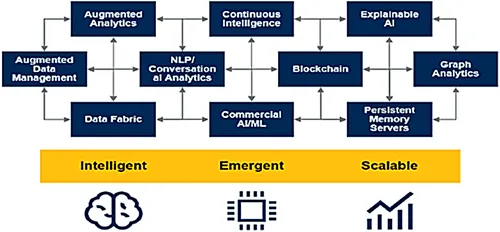
The size, complexity and distributed nature of data needed for increasingly closer to real-time and optimised decision-making means that rigid architectures and tools are breaking down. This complexity is pushing the limits of current approaches, and is leading to unprecedented cycles of rapid innovation in data and analytics to meet the new requirements. At the same time, to have impact, data and analytics must be pervasive and scale across the enterprise and beyond to customers, partners and to the products themselves. The strategic technologies covered in this research in Figure 7.1 represent trends that you cannot afford to ignore. They have the potential to transform your business and will accelerate in their adoption over the next three to five years.
FIGURE 7.1 Latest data and analytics technology trends.
Many of the trends are interrelated as they are enabled by many of the same technology disruptions, but have an impact on different parts of the data and analytics technology stack (Agrawal, 2020). All have three attributes in common – they support intelligent, emergent data and analytics and are scalable for pervasive AI- and ML-driven insights and agile data-centric architectures:
Intelligent: Advanced analytics – including AI and ML techniques – are at the core of future platforms, solutions and applications. We see the green shoots of this today. Virtually every aspect of data management, analytic content and application development, and sharing of insights incorporate ML and AI techniques. These are used to automate or augment manua...
Table of contents
Cover
Half-Title
Series
Title
Copyright
Contents
Preface
Acknowledgement
Editors
Contributors
Section I Applications of Machine Learning
Section II Big Data, Cloud and Internet of Things
Index
Trusted by 375,005 students
Access to over 1.5 million titles for a fair monthly price.
Study more efficiently using our study tools.
Frequently asked questions
Yes, you can cancel anytime from the Subscription tab in your account settings on the Perlego website. Your subscription will stay active until the end of your current billing period. Learn how to cancel your subscription
No, books cannot be downloaded as external files, such as PDFs, for use outside of Perlego. However, you can download books within the Perlego app for offline reading on mobile or tablet. Learn how to download books offline
Perlego offers two plans: Essential and Complete
Essential is ideal for learners and professionals who enjoy exploring a wide range of subjects. Access the Essential Library with 800,000+ trusted titles and best-sellers across business, personal growth, and the humanities. Includes unlimited reading time and Standard Read Aloud voice.
Complete: Perfect for advanced learners and researchers needing full, unrestricted access. Unlock 1.5M+ books across hundreds of subjects, including academic and specialized titles. The Complete Plan also includes advanced features like Premium Read Aloud and Research Assistant.
Both plans are available with monthly, semester, or annual billing cycles.
We are an online textbook subscription service, where you can get access to an entire online library for less than the price of a single book per month. With over 1.5 million books across 990+ topics, we’ve got you covered! Learn about our mission
Look out for the read-aloud symbol on your next book to see if you can listen to it. The read-aloud tool reads text aloud for you, highlighting the text as it is being read. You can pause it, speed it up and slow it down. Learn more about Read Aloud
Yes! You can use the Perlego app on both iOS and Android devices to read anytime, anywhere — even offline. Perfect for commutes or when you’re on the go. Please note we cannot support devices running on iOS 13 and Android 7 or earlier. Learn more about using the app
Yes, you can access Big Data, IoT, and Machine Learning by Rashmi Agrawal, Marcin Paprzycki, Neha Gupta, Rashmi Agrawal,Marcin Paprzycki,Neha Gupta in PDF and/or ePUB format, as well as other popular books in Computer Science & Artificial Intelligence (AI) & Semantics. We have over 1.5 million books available in our catalogue for you to explore.