- 232 pages
- English
- ePUB (mobile friendly)
- Available on iOS & Android
eBook - ePub
About this book
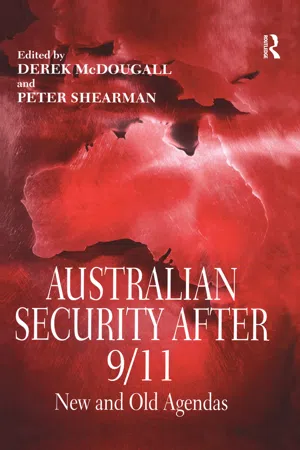
Debates on security became more intense following the unanticipated end of the Cold War conflict and took on added force after the terrorist attacks on the US on September 11, 2001. Generally viewed as a part of the wider 'West' despite its separation by enormous geographical distances from both Europe and the United States, Australia is a regional power in its own right. It has been an active and loyal member of the US-led coalitions of the willing, first in Afghanistan and then in Iraq. The terrorist attacks in Bali one year after the attacks in the United States brought home to Australia the direct nature of the new global terrorist threats to its own security. This volume brings together leading experts on international security and Australia's foreign and security policies in a critical examination of Australia's adaptations to the new security challenges. It is the first in-depth and comprehensive analysis of Australia's defence and security policies as well as the country's role in countering regional and global challenges to international security since the war on terrorism began.
Information
Part 1
Setting the Scene: Global and Australian
Chapter 1
The New Global Security Agenda
Gareth Evans
My most formidable current challenge comes with my role as a member of the UN Secretary-General’s High Level Panel on Threats, Challenges and Change, in which I find myself trying, in the context of the sixtieth anniversary of the UN system in 2005, to take stock of the whole international security system, with its handful of strengths and innumerable weaknesses, and to suggest how we might begin to change it for the better.1
What is immediately clear is that the global security agenda, as it is perceived to be now and for the next few decades ahead, is fundamentally different from that which preoccupied the founding fathers of the UN in 1945. Reeling from the horrors of half a century of unprecedented bloodshed, they were concerned above all to find a way, in the language of the Charter’s Preamble, ‘to save succeeding generations from the scourge of war, which twice in our lifetime has brought untold sorrow to mankind’. And by subjecting the use of force to internationally agreed rules much more clearly than ever before, and creating a Security Council with more power to act than any intergovernmental body had ever previously had, they did take a giant step forward.
But the statesmen and women of 1945 could not, and did not, anticipate the world as it is now found in the first years of this new century.
Although individual human rights were given a toehold in the Charter, there was no reference to the scourge of intra-state conflict and massive scale human rights violations, which reached genocidal intensity with Cambodia in the 1970s, and the Balkans and Rwanda in the 1990s, and which may be confronting us again, right now, in Sudan.
There was no reference to the threat of terrorism, or the risks associated with proliferation of weapons of mass destruction, let alone the nightmare scenario it is now necessary to contemplate – those weapons becoming available to non-state terrorist actors, harboured in or supported by, in turn, rogue states or failed states. There was no reference to the huge problem of international crime as it is now found, embracing everything from drug trafficking to human trafficking to gun running.
- 1 This is an edited version of the Keynote Address at the Conference on New Security Agendas: European and Australian Perspectives, London, 1 July 2004. Some of the ideas in this address are developed further in Gareth Evans, ‘When is it Right to Fight?’, Survival, 46/3 (2004): 59-82. A more secure world: Our shared responsibility. Report of the Secretary-General’s High-level Panel on Threats, Challenges and Change was released in December 2004. See <http://www.un.org/secureworld/>, accessed 10 January 2005.
And although there was a recognition of the need for a development agenda, and a decolonization one, to accompany and reinforce the peace agenda, and to begin making the world a better place for the great majority of its peoples to live in, there was little recognition of the sheer scale of the human security needs which, sixty years later, the world is still only beginning to come to grips with -the security threats posed by poverty, and disease and environmental degradation.
Not only is the threat environment different: so too is the geopolitical environment in which these threats have to be addressed. Although the founding fathers of 1945 all too soon had to confront a world sorely divided and threatened by the rivalry of two great powers and their supporting blocs, they could not have foreseen a world quite as lopsided in its power balance as the one that has evolved in recent years, and quite so inclined to operate in a spirit of go it alone unilateralism very much at odds with the principles of collective or multilateral action on which the whole post World War II security system was built.
The High Level Panel has identified the new global security agenda as built around meeting four basic classes of threats to both state and human security, constituted by:
- violent conflict, between and within states;
- the proliferation of weapons, both WMD and conventional;
- non-state actors, in the form of terrorism and organized crime; and
- poverty, disease and environmental breakdown (as identified in the Millennium Development Goals).
In identifying these threats, no attempt has been made to rank them in order of significance – not least because they resonate very differently in different parts of the world. It is not only a matter of the supposed northern preoccupation with ‘hard’ threats and the southern with ‘soft’ ones, but also, perhaps, of basically different worldviews within this great divide.
The Panel is less anxious to dwell on what divides than what unites: the core message is the interconnections between so many of these threats, and the necessity for them to be taken seriously – with appropriate policy responses – by all people around the world.
The difficulty for the Panel is coming to grips with the answers to the big challenges posed by these threats, of which there are three: what should be done about the international rules in which people seem to be losing confidence; about the policies and strategies which seem currently so inadequate to address them; and about the international institutional structures in which there also seems to be much diminished confidence.
Here is a personal take – not in any way comprehensive – on how some of the more important issues which arise in each of these areas might be approached.
Restoring Confidence in Rules
In terms of the way in which the world’s security challenges are being handled, the most basic problem is a weakening of confidence – a growth of cynicism and scepticism – in the international rules governing the use of force, with too many states (and one in particular) seen to be making up rules as they go along, going to war when they should not be, and not going to war when they should.
There are three different situations which have to be disentangled: the right to take military action against another state in self-defence; the right to take such action against a state posing a threat to any other states or individuals outside its borders; and the right to intervene against a state when the only threat involved is to those within it.
Self Defence
On self defence, Article 51 of the UN Charter clearly acknowledges that there is an ‘inherent right of individual or collective self-defence if an armed attack occurs against a Member of the United Nations’ – which can be exercised without prior UN Security Council authorization (as it was by the US, without much argument from anyone, in Afghanistan after 9/11).
It is well accepted in international practice that this right extends beyond an actual attack to a threatened one, at least where the threatened attack is ‘imminent’. What is very much challenged is the US notion, asserted in relation to Iraq in 2003, that the right to react in self-defence extends without check to situations where the threatened attack is neither actual nor imminent – and where the state reacting is, in effect, the sole judge of whether there is a real threat at all.
The problem is not so much with the notion of preemption as such. Countries have never been expected to wait until an imminently threatened attack became actual, and it is perfectly possible to imagine threats, including the nightmare scenario combining rogue states, WMD and terrorists, which are very real indeed, albeit not imminent. But international unease has to be expected when, as Sandy Berger has put it, this Administration has ‘elevated preemption from an option every President has preserved to a defining doctrine of American strategy’.
It is difficult to argue with the proposition that, if the whole international security system is not to descend into anarchy, when threats are manifestly not imminent the decision as to whether it is right to use force is one that must be made not unilaterally but collectively, through the only body legally empowered to make such a decision, the UN Security Council.
External Threats Generally
Moving beyond self-defence cases to response to external threats generally, Chapter VII of the UN Charter clearly empowers the Security Council to take any action ‘necessary to maintain or restore international peace and security’. It can take such action reactively, or it can take it preventively. And it can take it by authorising or endorsing the use of force by blue helmets, or by multinational forces, or by ‘coalitions of the willing’ or by individual states – as well as endorsing (sometimes after the event) military action by regional organizations operating under Chapter VIII – for example, ECOWAS in Liberia and Sierra Leone.
Internal Threats
For wholly internal threats, raising the issue of so called humanitarian intervention, the UN Charter is conspicuously unhelpful. Article 2.7 expressly prohibits intervention ‘in matters which are essentially within the jurisdiction of any state’ although this is in tension with language elsewhere acknowledging individual human rights, and a mass of law and practice over the last few decades which have set real conceptual limits to claims of untrammelled state sovereignty, not least the Genocide Convention.
The Security Council can always authorize Chapter VII military action against a state if it is prepared to declare that the situation, however apparently internal in character, does in fact amount to a ‘threat to international peace and security’ – as it did for example in Somalia, and eventually Bosnia, in the early 1990s.
But more often than not, even in conscience shocking situations like Rwanda in 1994, it has declined to initiate or authorize any enforcement action at all: a hot current topic is whether it will be prepared to do so if this becomes necessary in Darfur. Most people accept that the Security Council should continue to be the first port of call in these situations; the question is whether it should be the last. This is the issue that was brought to a head by NATO’s intervention in Kosovo in 1999, bypassing the Security Council. And it has been brought to a head again in Iraq 2003, with the emergence of the argument – as other rationales in terms of bombs and terrorists drop away – that it was Saddam’s murderous tyrannizing of his own people that made him a suitable case for humanitarian intervention treatment.
Five Criteria of Legitimacy
So what is the task ahead for those who want to reverse the trend toward unilateralism rather than collective action in the use of force; who want to see a new consensus emerge, in the context of internal threats to human security, not only as to when states should not go to war, but when they should; and who, above all, want to recreate the kind of confidence in the role and judgement of the Security Council that will lead to a dramatically reduced inclination to bypass it on the part of those capable of doing so?
The key issue is not the available international law tools. New rules are not needed, nor is any modification of the existing rules nor any new rule-making or rule-applying institutions. Article...
Table of contents
- Cover
- Half Title
- Title Page
- Copyright Page
- Table of Contents
- List of Contributors
- Preface
- Acknowledgements
- List of Acronyms
- Part 1: Setting the Scene: Global and Australian
- Part 2: Perspectives on Australian (and Australasian) Policy
- Index
Trusted by 375,005 students
Access to over 1.5 million titles for a fair monthly price.
Study more efficiently using our study tools.
Frequently asked questions
Yes, you can cancel anytime from the Subscription tab in your account settings on the Perlego website. Your subscription will stay active until the end of your current billing period. Learn how to cancel your subscription
No, books cannot be downloaded as external files, such as PDFs, for use outside of Perlego. However, you can download books within the Perlego app for offline reading on mobile or tablet. Learn how to download books offline
Perlego offers two plans: Essential and Complete
- Essential is ideal for learners and professionals who enjoy exploring a wide range of subjects. Access the Essential Library with 800,000+ trusted titles and best-sellers across business, personal growth, and the humanities. Includes unlimited reading time and Standard Read Aloud voice.
- Complete: Perfect for advanced learners and researchers needing full, unrestricted access. Unlock 1.5M+ books across hundreds of subjects, including academic and specialized titles. The Complete Plan also includes advanced features like Premium Read Aloud and Research Assistant.
We are an online textbook subscription service, where you can get access to an entire online library for less than the price of a single book per month. With over 1.5 million books across 990+ topics, we’ve got you covered! Learn about our mission
Look out for the read-aloud symbol on your next book to see if you can listen to it. The read-aloud tool reads text aloud for you, highlighting the text as it is being read. You can pause it, speed it up and slow it down. Learn more about Read Aloud
Yes! You can use the Perlego app on both iOS and Android devices to read anytime, anywhere — even offline. Perfect for commutes or when you’re on the go.
Please note we cannot support devices running on iOS 13 and Android 7 or earlier. Learn more about using the app
Please note we cannot support devices running on iOS 13 and Android 7 or earlier. Learn more about using the app
Yes, you can access Australian Security After 9/11 by Derek McDougall, Peter Shearman in PDF and/or ePUB format, as well as other popular books in Politics & International Relations & International Relations. We have over 1.5 million books available in our catalogue for you to explore.