- 224 pages
- English
- ePUB (mobile friendly)
- Available on iOS & Android
eBook - ePub
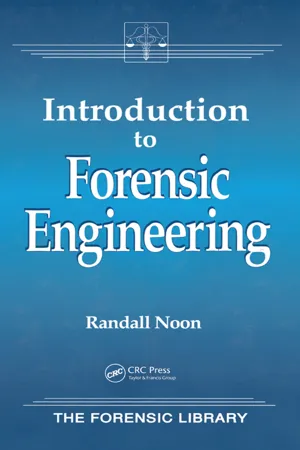
Introduction to Forensic Engineering
About this book
Forensic engineering is generally defined as the application of engineering principles and methodology to answer questions of fact that may have legal ramifications. This new book provides an introduction to the science, methodology, and engineering principles involved in the diagnosis of some common types of accidents and failures, such as fires, explosions, automobile accidents, storm damage, industrial accidents, slips and falls, arson, water pipe damage and more. Each chapter stands alone and can be read without reference to the others. The chapters have been written so that non-technical professionals can easily digest the information and immediately apply it. The book will also be useful to technical professionals who are unfamiliar with particular investigative methodology or technical points of interest.
Introduction to Forensic Engineering will benefit lawyers, insurance investigators, engineers, and other professionals who must handle investigative and legal aspects of accidents or failures.
Table of contents
- Cover
- Title Page
- Copyright Page
- Introduction
- Table of Contents
- Chapter 1. Vehicular Accidents
- Chapter 2. Vehicle Accident Reconstruction Using Basic Energy Analysis Techniques
- Chapter 3. Application of the Classical Scientific Method to Accident Reconstruction
- Chapter 4. Motorcycle Accidents
- Chapter 5. Photographic Documentation of Accident-Damaged Vehicles
- Chapter 6. Vehicular and Marine Lighting
- Chapter 7. Storm Lightning Damage
- Chapter 8. Vibration and Blasting Damage
- Chapter 9. Explosions
- Chapter 10. Combustion
- Chapter 11. Determining the Point of Origin of a Fire
- Chapter 12. Arson for Profit
- Chapter 13. Electrical Shorting
- Chapter 14. Hail Damage
- Chapter 15. Drought and its Effects
- Chapter 16. Lighting
- Chapter 17. Slip-and-Fall Accidents
- Chapter 18. Water Pipe Freeze-Ups
- Chapter 19. Principles of Machinery Guarding
- Chapter 20. The Engineer as Expert Witness
- Chapter 21. Reporting the Results of Investigative Engineering
- Index
Trusted by 375,005 students
Access to over 1.5 million titles for a fair monthly price.
Study more efficiently using our study tools.
Frequently asked questions
Yes, you can cancel anytime from the Subscription tab in your account settings on the Perlego website. Your subscription will stay active until the end of your current billing period. Learn how to cancel your subscription
No, books cannot be downloaded as external files, such as PDFs, for use outside of Perlego. However, you can download books within the Perlego app for offline reading on mobile or tablet. Learn how to download books offline
Perlego offers two plans: Essential and Complete
- Essential is ideal for learners and professionals who enjoy exploring a wide range of subjects. Access the Essential Library with 800,000+ trusted titles and best-sellers across business, personal growth, and the humanities. Includes unlimited reading time and Standard Read Aloud voice.
- Complete: Perfect for advanced learners and researchers needing full, unrestricted access. Unlock 1.5M+ books across hundreds of subjects, including academic and specialized titles. The Complete Plan also includes advanced features like Premium Read Aloud and Research Assistant.
We are an online textbook subscription service, where you can get access to an entire online library for less than the price of a single book per month. With over 1.5 million books across 990+ topics, we’ve got you covered! Learn about our mission
Look out for the read-aloud symbol on your next book to see if you can listen to it. The read-aloud tool reads text aloud for you, highlighting the text as it is being read. You can pause it, speed it up and slow it down. Learn more about Read Aloud
Yes! You can use the Perlego app on both iOS and Android devices to read anytime, anywhere — even offline. Perfect for commutes or when you’re on the go.
Please note we cannot support devices running on iOS 13 and Android 7 or earlier. Learn more about using the app
Please note we cannot support devices running on iOS 13 and Android 7 or earlier. Learn more about using the app
Yes, you can access Introduction to Forensic Engineering by Randall K. Noon in PDF and/or ePUB format, as well as other popular books in Law & Forensic Science. We have over 1.5 million books available in our catalogue for you to explore.