- 384 pages
- English
- ePUB (mobile friendly)
- Available on iOS & Android
eBook - ePub
Library Information Technology and Networks
About this book
Offers an historical perspective of the past 25 years of computers in libraries, profileing currently available processing systems according to their size and platform. The short- and long-term future of information technology in libraries.;College or university bookstores may order five or more copies at a special student price which is available from Marcel Dekker upon request.
Information
1
The Decade of the Seventies
By a fiction as remarkable as any to be found in law, what has once been published, even though it be in the Russian language, is spoken of as “known”, and it is often forgotten that the rediscovery in the library may be a more difficult and uncertain process than the first discovery in the laboratory.
I. Introduction
This volume begins with a historical examination of automated library systems of the seventies, eighties and early nineties and the evolution of the functions that these systems were to provide. Stephen R. Salmon’s Library Automation Systems (New York: Marcel Dekker, 1975) provides a classic reference to the prior historical periods, which are not within the scope of this volume.
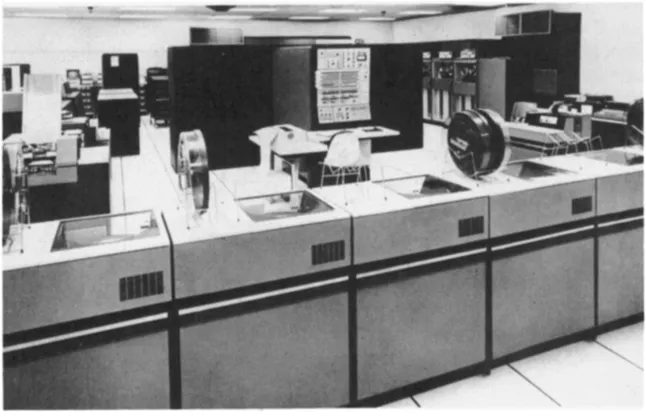
Early library automation efforts were founded on the principle that library staff could improve their effectiveness and efficiency in serving their library users through application of current information technology. Prior to the seventies this meant the application of punched card-based systems using mechanical card-sorting and -tabulating equipment manufactured largely by IBM Corp. and represented by such devices as the IBM tabulating machines, which produced listings and could accumulate and total data in a specific set of columns on a punched card. These wire-board-programmed machines and tabulating systems were replaced by early stored-program computers such as the IBM 1401/1410 systems. These early computers used punched cards for entry of programs and data, with magnetic tape a usual permanent storage form. Serial batch processing applications were used, as these systems had no interactive online capability, either through hardware or software in their operating systems. Their operating consoles in the computer room permitted computer operators to perform initial program loads of the operating system software and to do some job scheduling of the batch jobs as these facilities were added to basic operating system capabilities. From this basic premise that library automation should improve the operation and services of a library, it became evident through the experiences of libraries that some further principles emerged. These were:
- Increasing the breadth of access to the libraries’ collections and services since automation could provide portability to the library catalog
- Improving the workflow in library technical processing together with improved book inventory control
- Developing possible operating cost savings in one area to reallocate resources to other library service areas
- Creating a more integrated functional perspective of managing a library to accommodate swings in funding and patron demand for new services
- Using more standard bibliographic data, once early experiments showed the difficulty of developing systems without agreed-upon data definitions, as later embodied in the development of the MARC (Machine Readable Cataloging Record)
- Fostering more interlibrary cooperative efforts designed to increase the breadth of a library’s collection and its responsiveness to actual document delivery needs.
With the emergence of online interactive systems by the late seventies and the development of high-speed communications networks and the Internet by the late eighties, these early principles of library automation, while still valid, could be supplemented with additional new principles. These were:
- Expanding the role of information technology beyond the traditional technical services and book inventory applications to encompass document imaging and full-text abstracting and indexing databases with broader and broader access by both librarians and users
- Expanding the application of information technology to typical office automation functions made possible through desktop microcomputers
- Extending the use of the desktop computer to the interactive device for delivery of bibliographic services via first local area network (LAN) connections and later wide area connections exemplified by the emergence of library catalogs and other electronic document collections on the Internet.
- Viewing the library as an extended manager and provider of organized world knowledge independent of the physical format of the recorded knowledge, with increasing demands for electronically stored and accessed material making it necessary for libraries to develop strong, proactive institutional collaborative directions to develop these capabilities with vendors of automated library systems and institutional information technology infrastructures
As Lord Rayleigh observed, librarians have sought for years to improve their ability to provide information services. The development of the computer offered the promise of yet another, better technology to be applied to the information service enterprise. The decade of the sixties provided the opportunity for libraries to experiment with available batch processing computer technology. The decade of the seventies brought to light the following complexities:
- The interrelationships between typical library computing applications
- the need for more practical and affordable software and hardware
- the need for standardization beyond that of the MARC format
- the need for more generalized application software and improved ways to develop software to an operational and tested state
- the need for collaborative development work, interlibrary cooperation and networking
If more widespread applications of data processing in the library and information center were to occur, these problem areas would require considerable attention from the profession.
The intent of this chapter is to review the trends, events and milestones in the seventies. This should provide a historical perspective from which to view current developments in computer applications to the library. I am concentrating on systems and not attempting to historically portray political or economic developments that may have played a lesser or greater role in nurturing the emergence of information technologies in particular settings. Without extensive risk taking and cost to develop library computer applications by a pioneering set of libraries, later commercial or cooperative network support might not have occurred when it did. Certainly, libraries through this period—and even to this day—could not justify their computer efforts on cost savings but rather had to justify them on planned service improvements to library users.
A. Major Trends
Library automation as a concept began with the task of applying first punched card equipment and later stored-program computer technology to improve library operations and management. Early work concentrated on such applications as printing catalog cards, creating book form catalogs, producing orders for purchasing and providing means to circulate materials from the collections. Most of these early systems were not visible to library users except when either using a library catalog or checking out materials.
With the coming of the seventies and improved mainframe computers such as the IBM 360/370 series, it became practical to think in terms of broader applications having increased functionality. Also, it became practical to move toward some online interactive capabilities within systems. The minicomputer facilitated this migration to interactive computing as these computers were initially built to serve real-time computing situations. As mainframe operating systems began to incorporate facilities for handling remote terminals, library systems designers began to use these facilities, first to upgrade existing batch systems and later to provide increasingly interactive input/output-based applications. Second-generation computers such as the IBM 1401, which was the mainstay of the sixties, really were not designed in their operating system software and device support for interactive processing, although several online experiments were carried out on these systems.
By 1975, with the advent of the minicomputer, the desirability and the necessity for library systems to be dynamic, real-time interactive systems was no longer conjecture. Interactive computing made it possible to seriously adopt the concept of a fully integrated multiple application system solution for performing library operations and services. The emergence of online bibliographic networks such as OCLC (Ohio College Library Center), UTLAS (University of Toronto Library Automation System), and RLG/RLIN (Research Libraries Group/Resrearch Libraries Information System), together with the pioneer work performed through individual institution systems such as Northwestern University’s NOTIS and Stanford University’s BALLOTS, the era of online systems for performing library applications was on its way to becoming the accepted and standard technology. Moreover, developments in interactive database searching through commercial vendors, such as SDC and BRS, fostered increased interest in bringing the same immediacy and power of information processing to the library’s local information base.
By the mid to late 1970’s, the emergence of vendor interest in developing software for performing library operations coupled with the lessening of research grant funding had made library administrators begin to think in terms of procuring and installing commercially available software rather than beginning their own development efforts. By the end of the decade, institutions that had done their own development increasingly began to examine alternatives for successor systems that would obviate the need for large in-house technical staff and the time and fiscal uncertainties connected with software development. Lower-cost hardware, e.g., the minicomputer, and increasingly intelligent peripherals, e.g., the microprocessor-based display terminal, and a sufficiently large market base interested potential vendors to invest in software development for the library market. As Jesse Shera stated, “There are fashions, then, in librarianship as in clothes, and their virtues and idiosyncracies are debated with equal heat, and often with as little intelligence.” (1)

Let us examine these automation fashions of the seventies in more detail through the major systems efforts that brought to light a basis of knowledge which permitted the evolution of systems designed to provide computer assistance for major library tasks.
B. Changing Attitudes in the Profession
In 1965, Paul Wasserman conducted a questionnaire-based study of library automation in which 50% of the respondents expressed concern with the need to introduce machine procedures but were unable to start any program because of a variety of reasons. The second group of respondents were either not convinced that applying computer technology was desirable or were decidedly of the opinion that computer technology would not improve libraries in any way. Only 20% of the respondents had taken any action at all to explore use of the data processing. (2)
Contrast this to the Library Automation Research and Consulting (LARC) survey, which showed 2,000 library automation projects in all types of libraries by 1968 and estimated that there were some 20,000 library automation projects under way in the world by 1973. (3)
Although this estimate might have been somewhat high, given that information about developments in many countries are difficult to determine, it is obvious that skepticism about applying computer technology decreased throughout the decade. Consequently, application of the computer to the library’s operations and services became a question of the approach to take and the rationalization of the cost reductions and benefits to be obtained. Early in the period, it was still believed by many librarians that long term cost savings could result from computerization. In certain operations, such as cataloging, lower per-unit costs could be achieved by libraries using the OCLC system as OCLC’s database grew in number and quality of records; however, computerization did not always yield true savings, as start-up and production costs of creating alternative forms of a public catalog on microfilm or in printed book form were not always lower than the cost of maintaining a catalog in card form, particularly for the small to medium-size library.
The emphasis on the development of individual institution systems focussed on the broad application areas, but within the context of a future goal of an integrated multifunctional system. Since the necessity for data standardization had emerged, but much standardization work still remained on both bibliographic and operational forms of data, it was both difficult and impractical to achieve any greater degree of system integration at a more rapid rate than was actually realized during the seventies. Although some institutions were conceiving of library automation systems as multiple application subsystems where there is an integration of both database and system functions, the reality was that institutions were concentrating their efforts on developing distinct operational applications, e.g., acquisitions, cataloging, serials management and circulation. In contrast to the previous decade, these were viewed in a somewhat broader light, in that more subfunctions or directly related printed output products were conceived. Throughout the 1970’s, library automation was still viewed primarily as the application of the computer to the operational tasks necessary to provide the information services offered by the library. Only occasionally did there emerge the concept of library automation as the application of electronic technologies to office operations, services and knowledge systems themselves.
Perhaps the single most significant occurrence that fostered library cooperation and also pushed the Library of Congress ultimately to take a serious interest in leading the library networking init...
Table of contents
- Cover
- Half Title
- Series Page
- Title Page
- Copyright Page
- Dedication
- Preface
- Table of Contents
- 1. The Decade of the Seventies
- 2. New Directions for Library Systems 1980’s Progress
- 3. Bibliographic Utilities and Cooperative Programs
- 4. Networks, Internetworking and Standards
- 5. Evaluation, Procurement and Other Factors Affecting the Shaping of Your Library System
- 6. Old Establishment Silicon and Iron: The Big Concurrent User Systems
- 7. The Newer Breed of Concurrent Multiuser Systems
- 8. Microcomputer/LAN-Based Bibliographic Software
- 9. Information Technology: The Tools of Tomorrow
- Index
Trusted by 375,005 students
Access to over 1.5 million titles for a fair monthly price.
Study more efficiently using our study tools.
Frequently asked questions
Yes, you can cancel anytime from the Subscription tab in your account settings on the Perlego website. Your subscription will stay active until the end of your current billing period. Learn how to cancel your subscription
No, books cannot be downloaded as external files, such as PDFs, for use outside of Perlego. However, you can download books within the Perlego app for offline reading on mobile or tablet. Learn how to download books offline
Perlego offers two plans: Essential and Complete
- Essential is ideal for learners and professionals who enjoy exploring a wide range of subjects. Access the Essential Library with 800,000+ trusted titles and best-sellers across business, personal growth, and the humanities. Includes unlimited reading time and Standard Read Aloud voice.
- Complete: Perfect for advanced learners and researchers needing full, unrestricted access. Unlock 1.5M+ books across hundreds of subjects, including academic and specialized titles. The Complete Plan also includes advanced features like Premium Read Aloud and Research Assistant.
We are an online textbook subscription service, where you can get access to an entire online library for less than the price of a single book per month. With over 1.5 million books across 990+ topics, we’ve got you covered! Learn about our mission
Look out for the read-aloud symbol on your next book to see if you can listen to it. The read-aloud tool reads text aloud for you, highlighting the text as it is being read. You can pause it, speed it up and slow it down. Learn more about Read Aloud
Yes! You can use the Perlego app on both iOS and Android devices to read anytime, anywhere — even offline. Perfect for commutes or when you’re on the go.
Please note we cannot support devices running on iOS 13 and Android 7 or earlier. Learn more about using the app
Please note we cannot support devices running on iOS 13 and Android 7 or earlier. Learn more about using the app
Yes, you can access Library Information Technology and Networks by Charles Grosch in PDF and/or ePUB format, as well as other popular books in Computer Science & Computer Networking. We have over 1.5 million books available in our catalogue for you to explore.