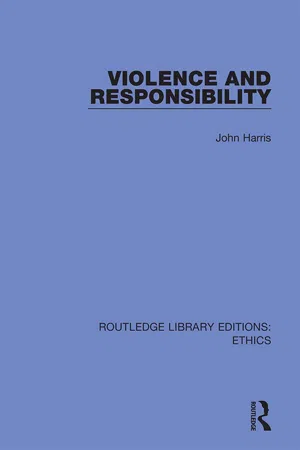
Originally published in 1980 this book argues that we are all responsible for the harm we could have prevented and explores the effect of this conclusion on a morality which makes fundamental the belief that we ought not to harm others if we can possibly avoid it. A theory of responsibility is developed and defended which has consequences for the way we live as well as for a number of problems in contemporary moral, political and social philosophy, and in jurisprudence. In particular, the author attacks the view that there is a moral difference between killing and letting die and proposes a radical conception of violence. Among other controversial issues covered in the book are neutrality, the ethics of organ transplants and the allocation of scarce resources.
- 184 pages
- English
- ePUB (mobile friendly)
- Available on iOS & Android
eBook - ePub
Violence and Responsibility
About this book
Information
Chapter 1
Humans and persons
If we are responsible for harm which we could have prevented and if we believe that we should not harm others, we will find ourselves committed to a morality which challenges many of our basic beliefs and one which makes disturbing demands. I shall argue that we are indeed responsible for the harm we could have prevented and explore the effect of this conclusion on a morality which makes fundamental the belief that we ought not to harm others if we can possibly avoid it. This belief is very widely if not universally held, it has a fundamental place in most moralities including our own, and it is, therefore, of some importance to be clear about just what it entails. Since those fates that people consider to be worse than death are rare, the principle that heads the list of those which are expressions of this belief, is the absolute prohibition of killing. For this reason we shall often concentrate on death as the most extreme form of harm.
There are two ways in which we inflict harm on our fellows. I am interested particularly in one of these, one which although it has a very long history, has never played a part commensurate with its importance in our moral thinking. One way of inflicting harm on others is to do something which results in their being harmed; the other, is to fail to do something the consequence of which is that they are harmed, in short, to fail to prevent harm. This distinction can be characterised in a number of ways: sometimes as a distinction between acts and omissions, or between positive and negative acts, between harming and failing to help or, where life and death are at issue, as a distinction between killing and letting die.
We have, then, two ways of determining the state of any world in which we are able to intervene. One is to intervene and to change the state of that world, the other is to refrain from intervention and to leave everything as it is. This page can stand for a world in which you are able to intervene. You have two ways of determining how this world will be, one is by leaving it as it is, the other by changing it, writing in the margins, striking out remarks with which you disagree, or reducing the entire world to ashes. Whatever you decide the decision is yours and yours the responsibility.
For those who have allowed our world to survive: it is the omissions, the failures to save, the negative actions which result in harm to persons, that I wish to examine here. I am going to concentrate exclusively on this dimension of the harm we inflict on one another for a number of reasons: because it is the most problematic, because if we are consistently to follow the principle that we should not harm others, it is the avoidance of this sort of harm that is most difficult to reconcile with our other moral beliefs, because it has until recently been largely neglected by moral philosophy and lastly and most important, because I believe that the neglect of this dimension of harm has been responsible for untold misery in the world.
The formulation of the distinction between acts and omissions that I prefer is that between positive actions and negative actions, for my concern is to sensitise people to what they are doing to each other. This will strike some people as a highly controversial way of putting the point but I hope to justify it in the course of this essay.
Much of the harm which results from our negative actions can, I believe, be directly attributed to the wide acceptance of the view that the distinction between positive and negative actions marks a distinction both in the causal efficacy of what we do, and in its moral significance. Those who accept this distinction hold that it is always worse to cause harm or death positively rather than negatively and, often, that the causal connection between an act and its consequences is necessarily somehow closer than that between an omission and its consequences.
There is perhaps a difficulty about drawing this distinction at all since it is always possible to re-formulate any action description or any omission description so that each becomes the other. Although I fail to save you I am still doing something instead, and if your death is a consequence of my failure to save you, it is a consequence of whatever else I do when I could be saving you, more tortuously: if I shoot you, your death is a consequence of my failure not to shoot. Despite these rather devious locutions, the distinction between acts and omissions is an obvious enough one and I will continue to use it.
The belief that we should not harm others is sometimes expressed in terms of rights. We talk of the right to life and the right not to be killed. I shall here avoid talk of rights for I am not concerned with what rights people happen to have, but with what we ought to do if we believe that we should not harm others. It may be that in the light of our deliberations we would wish to change our system of rights, or abandon it, or understand it differently. But I will not draw these conclusions specifically.
The argument to the effect that we are responsible for the harm we could have prevented and the exploration of the consequences of this conclusion for our morality, will run concurrently throughout this essay. This method of proceeding is dictated by the nature of the enquiry; for showing just how we are equally responsible for what we do and for what we fail to prevent, and meeting objections to this view, itself reveals the ways in which our morality is affected by it.
For our purposes it is not important to decide precisely what is and what is not to count as harm. It is, however, tempting to believe that there are a number1 of natural shocks and disasters that flesh is heir to. One of the purposes of this essay is to modify our conception of how many of the disasters that so often befall us are inevitable, and how many are, so to speak, man-made. I shall, therefore, assume that we are fairly good at recognising a disaster when we encounter it and concentrate on re-assessing the proportion of them for which we are responsible, and on looking at some of the consequences of this re-assessment.
But who are we? If we believe that we should not harm others if we can avoid doing so, it does very much matter, especially to them, who is to be included. Clearly, we usually have in mind here other people, and this is most often taken simply to mean other human beings; but we need a more sophisticated concept of the person than one which confines its use unproblematically and parochially to the human species.
We might, for example, want to know whether a particularly sophisticated machine, a type of computer perhaps, had acquired personality, had become a person, or whether a human being, heavily patched up with mechanical bits and pieces, had remained one. It is also, of course, a real question as to whether there are persons on other planets.
Treating these as real and problematic issues has important consequences. If we consider that feature which has perhaps the clearest claim to being the most significant among any that would lead us to call something a person, namely language (and the sorts of thinking which language makes possible)2, then these consequences are already with us. Much work has been done recently towards the education of a number of animals, and some chimpanzees have been taught quite rich forms of language.3 In view of this we will have to take seriously not the issue of animals’ rights, but of full rights for articulate animals.
But even if we feel lazy about recognising the status of chimpanzees as fully fledged persons on the basis of a few cases of proven capacity to learn language, there are possible circumstances that would concern us more closely.
Fred Hoyle wrote about one such possibility in his science fiction novel The Black Cloud. The story so far: a huge cloud of gases has descended on our solar system and now blocks out the sun threatening to cool the earth to extinction. Scientists have discovered that it must be a vast brain possessing immense intelligence and comparatively unlimited powers.4 They try to communicate with it in the hope of persuading it to go away. The method is to bombard it with radio and television signals supposing that it will be able to learn our language, if we give it enough information, much more quickly than we could possibly learn its own. We drop in on two scientists discussing whether their plan has any hope of success. Now read on… .5
‘But seriously, do you think this communication business will work?’
‘I very much hope so, it’s quite crucial that it should.’ ‘Why do you say that?’
‘Think of the disasters the Earth has suffered so far, without the Cloud taking any purposive steps against us. A bit of reflection from its surface nearly roasted us. A short obscuration of the sun nearly froze us. If the merest tiny fraction of the energy controlled by the Cloud should be directed against us we should be wiped out, every plant and animal.’
‘But why should that happen?’
‘How can you tell? Do you think of the tiny beetle or the ant that you crush under your foot on an afternoon’s walk? One of those gas bullets that hit the moon three months ago would finish us. Sooner or later the Cloud will probably let fly with some more of ’em. Or we might be electrocuted in some monstrous discharge.’
‘Could the Cloud really do that?’
‘Easily, the energy that it controls is simply enormous. If we can get some sort of message across, then perhaps the Cloud will take the trouble to avoid crushing us under its foot.’
‘But why should it bother?’
‘Well, if a beetle were to say to you, “Please Miss Halsey, will you avoid treading here, otherwise I shall be crushed”, wouldn’t you be willing to move your foot a trifle?’
Here is a case where we might have a tremendous interest in being recognised as persons ourselves. So the concept of a person which may be broadened in one direction to include articulate animals and machines may from another direction be broadened to include ourselves!
Having put ourselves as persons into some sort of perspective I intend now to concentrate on human persons. But we should just note that beings that do not count as persons do not therefore count for nothing. All questions as to how non-persons are to be treated must be decided on their merits. Animals have found powerful champions recently with arguments that will prove hard to answer,6 and the human foetus, if not a person is not, for that reason at any rate, fair game.
The principle with which this work is concerned, that we should not harm others if we can avoid it, can of course be applied to all other creatures, although I shall not do so.
I have said that we will often concentrate on killing as the most extreme form of harm, but there are some cases where killing others may be considered to benefit them. There are three sorts of case that arise here. The first two concern people whose lives are, or are about to become, so dreadful that we judge death to be preferable to living under those conditions. The cases are of those who
1 consequently wish to die or,
2 nonetheless wish to go on living.
The other case concerns those whose lives we cannot think are so bad that death would be preferable but who
3 nonetheless wish to die.
I shall assume that it is sensible to say that in case 1 we and they agree that to kill them would not be to harm them but would rather benefit them, and that in cases 2 and 3 we and they disagree about just this point.
Case 1 then does not present problems to people who believe that they should not harm others if they can help it, for here all are agreed that we would be harming people if we compelled them to go on living.
Case 2 involves either disagreement as to whether continuing alive is a fate worse than death7, or agreement that it is, but a wish to experience a fate worse than death. Now, to deny people the direction of their own lives, to deprive them of the power of choice over their own destiny, in short, to treat them as incompetent to run their own lives as they choose, is to offer them the most profound of insults. It may also lead to the most acute frustration and the sense that life has lost its meaning and importance. Autonomy has a very special role. People have been prepared to lay down their lives in order to win autonomy with respect to quite minor sorts of decisions. Many things that we would find delightful if we had chosen them for ourselves, lose all their charm when they are seen to have been chosen for us by others. So to deny people autonomy is to do them a very fundamental sort of harm. Our sense of ourselves as autonomous beings so colours the whole conduct of our lives that it is difficult to know what weight to give it. A life that seems thoroughly rich and worthwhile may be so only on the assumption that we wish to live it; if we are condemned to live it, it may be worthless to us.
Even in the timeless case of soldiers forced to abandon a wounded comrade in the face of an advancing and exceptionally cruel enemy, at whose hands his fate will almost certainly be unspeakable, there does seem to be something wrong with killing the wounded soldier against his will. Sure, his fate will be worse than death, and sure we would prefer to die now rather than live a little longer and then die under torture. But so long as the wounded soldier does not wish to die now, so long as he chooses to fall into the hands of the enemy, there does seem to be something wrong with killing him.
If we think so, we will also have to allow the autonomous choice of those in case 3, whose lives are worth living but who nonetheless wish to die. This is perhaps the usual case where we encounter attempted suicide. It is rare for those who know in detail about the lives of those who have tried to kill themselves to say, ‘yes, if I had your life to lead I would prefer to be dead’. They think that if the attempted suicides had a proper perspective it would not seem to them that life was not worth living, or that they would see this feeling as transitory and so see the sense of hanging on until things improved. But so long as someone has decided sincerely and soberly that they would prefer to be dead, then it does seem outrageous for us to condemn them to live lives that we, not they, judge to be worth living; not because we are wrong about their lives, we may not be, not because they know better, they may not, but because it’s their lives.
Is the reason that we must respect autonomy then because to fail to do so is to harm others more than does whatever it is that we wish to prevent them doing to themselves? We could make this a definition, but it does not seem...
Table of contents
- Cover
- Half Title
- Title Page
- Copyright Page
- Original Title Page
- Original Copyright Page
- Contents
- Acknowledgments
- Epigraph
- Chapter 1 Humans and persons
- Chapter 2 A defence of non-’violent’ violence
- Chapter 3 Negative actions
- Chapter 4 Killing and letting die
- Chapter 5 The survival lottery
- Chapter 6 The fate of others and our distance from it
- Chapter 7 Integrity, sympathy and negative responsibility
- Chapter 8 Neutrality
- Chapter 9 The bounds of obligation
- Notes
- Bibliography
- Select bibliography
- Index
Trusted by 375,005 students
Access to over 1.5 million titles for a fair monthly price.
Study more efficiently using our study tools.
Frequently asked questions
Yes, you can cancel anytime from the Subscription tab in your account settings on the Perlego website. Your subscription will stay active until the end of your current billing period. Learn how to cancel your subscription
No, books cannot be downloaded as external files, such as PDFs, for use outside of Perlego. However, you can download books within the Perlego app for offline reading on mobile or tablet. Learn how to download books offline
Perlego offers two plans: Essential and Complete
- Essential is ideal for learners and professionals who enjoy exploring a wide range of subjects. Access the Essential Library with 800,000+ trusted titles and best-sellers across business, personal growth, and the humanities. Includes unlimited reading time and Standard Read Aloud voice.
- Complete: Perfect for advanced learners and researchers needing full, unrestricted access. Unlock 1.5M+ books across hundreds of subjects, including academic and specialized titles. The Complete Plan also includes advanced features like Premium Read Aloud and Research Assistant.
We are an online textbook subscription service, where you can get access to an entire online library for less than the price of a single book per month. With over 1.5 million books across 990+ topics, we’ve got you covered! Learn about our mission
Look out for the read-aloud symbol on your next book to see if you can listen to it. The read-aloud tool reads text aloud for you, highlighting the text as it is being read. You can pause it, speed it up and slow it down. Learn more about Read Aloud
Yes! You can use the Perlego app on both iOS and Android devices to read anytime, anywhere — even offline. Perfect for commutes or when you’re on the go.
Please note we cannot support devices running on iOS 13 and Android 7 or earlier. Learn more about using the app
Please note we cannot support devices running on iOS 13 and Android 7 or earlier. Learn more about using the app
Yes, you can access Violence and Responsibility by John Harris in PDF and/or ePUB format, as well as other popular books in Philosophy & Education Counseling. We have over 1.5 million books available in our catalogue for you to explore.