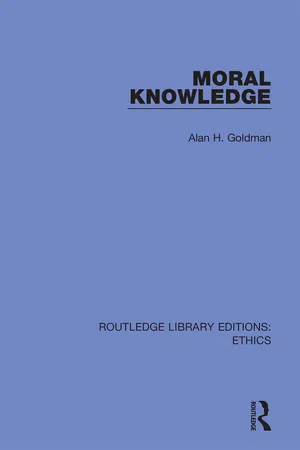
Originally published in 1988, this book discusses if moral knowledge exists, and if so, if it is similar to other forms of knowledge. This book approaches the issues from both historical and contemporary perspectives and in order to determine whether there is a real property of rightness, looks to the ethical theories of Hobbes, Hume and Kant. This historical analysis leads to a systematic comparison of three theories of the nature of ethics: realism, emotivism and coherentism. The nature of coherence is explained using legal reasoning as a model. Moral reasoning is compared and contrasted with reasoning both in science and law, showing how ethics differs from science and empirical disciplines.
- 232 pages
- English
- ePUB (mobile friendly)
- Available on iOS & Android
eBook - ePub
Moral Knowledge
About this book
Information
CHAPTER I
Hobbes: Subjective Realism and Prudential Rationality
The fitness of ordinary empirical knowledge as a model for moral knowledge depends on the possiblity of naturalist reductions of moral properties along the lines suggested in the introduction. The first plausible attempt at such reductions was made by Hobbes. In this chapter I shall describe Hobbes’s implicit position on the properties of goodness and rightness, draw the implications of these analyses for the question of moral knowledge, and comment on the acceptability of the proposed reductions.
A. Goodness
In a famous passage in Leviathan, Hobbes writes:
But whatsoever is the object of any man’s appetite or desire, that is it which he for his part calleth good: and the object of his hate and aversion evil; and of his contempt, vile and inconsiderable. For these words of good, evil, and contemptible, are ever used with the relation to the person that useth them: there being nothing simply and absolutely so; nor any common rule of good and evil, to be taken from the nature of the objects themselves; but from the person of the man, where there is no commonwealth; or, in a commonwealth, from the person that representeth it; or from an arbitrator or judge, whom men disagreeing shall by consent set up, and make his sentence the rule thereof. (I, 6, 48–9)1
This passage is a good place to begin (but not end) an exposition of Hobbes’s views on the nature of the good. At first glance the passage might suggest that Hobbes was (in contemporary terms) an emotivist. It might seem that, according to the view expressed, when I say ’X is good’, I mean simply that I desire X; or, more true to the spirit of emotivism, by uttering these words I simply express my desire for X. Certainly Hobbes is explicit that values are subjective, relative to evaluators, and not to be found in objects themselves apart from their effects on evaluating subjects. In other places Hobbes notes that there are no universal (first-order) desires, no uniformity or fixed structure to desires for objects in the lives of individuals over time, and no natural coherence among the desires and values of different persons. This may seem to combine an extreme relativism with the emotivism previously suggested and the subjectivism that Hobbes clearly intends to endorse.
But although Hobbes is a subjectivist, and a relativist of sorts, his considered view is not that of an extreme relativist nor of an emotivist. There are clues to a different view in the very passage cited. First, he says that men call good what they happen to desire. This leaves room for a different notion of real goodness, although this notion will have to remain relativist, given what Hobbes says in the remainder of the passage. Second, he suggests that conflicts arising from different values should be settled by appeal to a judge or arbitrator, who will determine what is really good for the group of individuals. The latter might be interpreted as what they should rationally desire, so as to avoid the conflicts that might otherwise ensue. He says later that judging value solely by private measure or appetite is a sin within a commonwealth, suggesting once more that the individual is not to have the final word on goodness (II, 30, 252).
The interpretation of the good as the object of rational desire is coherent with Hobbes’s overall moral theory and psychology. According to him all actions of an individual aim at some good for her, but individuals can nevertheless act irrationally (I, 6, 54). Hobbes explicitly contrasts good and evil consquences that may occur as distant effects of one’s present actions from apparently good or evil consequences that one envisages in deliberating (I, 6, 55). One can therefore be mistaken as to the best means to realize one’s desires, be overwhelmed by passion for the short-term benefit as opposed to the greater long-term good, or mistake the true object of one’s desire. In the first of these cases, one will be mistaken in desiring false means to the satisfaction of one’s other desires; in the second, in desiring more what one should desire less; and in the third, in desiring what one should not. In all these cases, recognized by Hobbes, the implication is that an individual might desire what is not truly good for him, the latter coinciding with his rational desire.
This account of goodness or value also coheres nicely, as we shall see, with what Hobbes has to say about rightness or obligation. The right for him coincides with rational prudence and opposes certain natural passions and their immediate fulfilment. If one acts rightly in pursuing true value, then this suggests again that the good is the object of rational desire, and not simply the object of any desire that individuals might momentarily possess. If individuals are rational in pursuing what is (truly) good, then we cannot equate the good with the objects of all desires, since such pursuit would lead to irrational and irresolvable conflict, the greatest social evil for Hobbes.
Goodness as what is rationally desired qualifies as a real property in the sense previously defined, in that, as noted, individuals can err in their beliefs about it. The property nevertheless remains relational and subjective. Hobbes adds further coherence or unity to our conception of the good by specifying certain universal values of special importance to morality or rational prudence. In his view there is unbounded diversity among particular first-order desires for objects, but at the same time there are certain second-order desires, those relating to first-order desires, that all agents rationally must have. Pleasure is not among them, as many later moral philosphers thought. For Hobbes pleasure is hot the object of desire, but rather its appearance, or the appearance of its fulfilment, or of the vital motion expressed as desire (I, 6, 49). It is an epiphenomenon, not a motivating force. Universal objects of rational desire rather include self-preservation, power, happiness, and peace.
The fundamental desire is for self-preservation. According to Hobbes one naturally fears death itself, but also, and more pertinent to our present point, the loss of a necessary condition for satisfying one’s other desires (loss of power). Power is defined straightforwardly as the means to the future satisfaction of other desires (I, 10, 72). Happiness or felicity is the continual satisfaction of desires over time (I, 6, 55; I, 11, 80). Peace and the means to peace are universally good as necessary for the achievement of happiness or ‘comfortable living’ (I, 15,123–4). Thus all universal rational desires (desires that rationality requires agents to have) are second-order. They are either necessary as means to the satisfaction of first-order desires, or represent a process of such satisfaction.
I have not yet said what it is for a desire to be rational or rationally required. To my knowledge Hobbes is not explicit about this. One possible analysis is that a desire is rational if its object would be desired for the agent by a perfectly benevolent and omniscient observer. Another is that a desire is rational if it would be supported by informed second-order desires of the agent, reflecting what he would prefer to desire given knowledge of the objects in question. A analysis akin to the latter that is more in the spirit of what Hobbes has to say about prudence, and one that avoids appeal to an ideal being, holds desires to be rational if they fit the most coherent, fullest set of informed first- and second-order desires of the agent (strength of desires would also need to be taken account of in specifying this set). Desires are coherent if mutually realizable, and more so if the satisfaction of some makes more probable or easier the satisfaction of others. They will be irrational if based on ignorance of the true nature of their objects, or if their satisfaction would block the realization of other stronger or more numerous desires. The most coherent set for any agent will include those second-order desires that she is rationally required to have. An agent is rationally required to have those desires whose fulfilment is necessary for the satisfaction of other desires within coherent sets.
We may note the implications of this account of the property of goodness for the possibility of knowledge of values. As pointed out, the property remains relational and subjective when we add the property of rationality as a component. But this occasionally counterfactual component renders the property of which it is a part clearly real in the sense defined, in that our beliefs about what is rationally desired do not determine what is truly rationally desired. Nevertheless, if we can unpack rationality here as suggested above, in terms of coherence among informed first- and second-order desires, then the full property of goodness, while complex, is reducible to physical and psychological properties. A particular object’s being good (for a particular agent) consists in its being such as to prompt rational desire (from that agent).
This is the sort of property of which we can have fallible knowledge. We will be motivated to aim at such knowledge, but we will not acquire it automatically, either by introspection or by observation of the objects of our desires. Even if we are automatically aware of our desires when we reflect on them (something that psychoanalysts deny), we will not, by that process, automatically become aware that these desires are rational, that is, informed and coherent in the sense defined. Nevertheless, when we do attain beliefs about what we should rationally desire, these beliefs may qualify as knowledge under the explanatory criterion briefly defended in the previous chapter. If we have carefully reflected on the relevant full set of our desires and on the characteristics of their objects, then the best explanations for why we believe these objects good, that is, objects of rational desire or worthy of being desired, may include appeal to the fact that they are good. Furthermore, the fact that certain objects are, or would be, rationally desired by particular agents, may explain aspects of the agents’ behavior (which may in turn explain beliefs about their behavior and the objects toward which it is directed).
Such explanations will be especially pertinent when agents discover irrationality in their previous desires and adjust their behavior accordingly. Consider first an everyday adaptation of a Hobbesian example. A child who is punished for violating cooperative agreements after having made them may come to realize that such behavior is not truly good (for him). He will then become inclined to pursue more genuine benefits or goods. There are many other everyday cases in which we appeal to genuine, as opposed to apparent or short-range, values or disvalues to explain behavior and attitudes as well as judgments about behavior and attitudes. Suppose, for example, that Susan has for years smoked cigarettes, unaware of their connection with lung cancer. If her discovery of this connection leads her to break the habit, then we can say that she acted as she did because she realized that smoking was bad for her (not simply bad for her health, but bad tout court, given her stronger desire to be healthy and to live to satisfy her other desires). Or consider nineteen-year-old John, who had always desired the life of a professional tennis player, and had deluded himself into thinking that he had talent and had simply lacked luck in tournaments. In his second year in college he reached a moment of truth, which could be described as the realization that pursuit of a tennis career was not good (for him), and perhaps that pursuit of a career in law was better, given his real talent for analysis and debate. The latter would cohere better with his other first- and second-order desires, desires for material success, self-respect, exercise of his real talents, and so on. This realization of what was more likely to be of true value could explain John’s change of heart and subsequent change of behavior, and this in turn could alter others’ perceptions of his behavior and beliefs about what is good for him.
Thus the Hobbesian account of goodness or (non-moral) value as interpreted here provides a promising reduction of the property that suggests an account of knowledge of values as a kind of empirical knowledge. The reduction allows for relativity and diversity in values, which are subjective but real, while also positing certain things of universal value, such as life, power, peace and happiness. Relativity and diversity here can be incorporated into a coherent and knowable property, since what is good for each agent will be what is rationally desired by him, what it is rational for him to desire given his other desires.
It remains to be seen whether Hobbes can provide an account of morality, rightness, or obligation along similar lines and with similar implications for the possibility of moral knowledge. For him, as we shall see, morality lies in the pursuit of universal values, so that a similar account should indeed follow. But here, as we shall also see in the end, diversity may prove to be a more intractable stumbling block, since now we will have to be concerned not only with desires of different individuals, but more directly with conflicts among their desires and interests. The question now becomes whether there are universally rational solutions to such conflicts, whether rationality requires particular solutions, as Hobbes claims.
B. Morality, Prudence, and the State of Nature
Hobbes states in many places, in Leviathan and other works, that all voluntary actions aim at happiness or at some good to the agent (I, 11, 80; I, 14, 105; I, 15, 114, 118; II, 19, 145; II, 25, 191; II, 27, 218). Since he defines good in terms of the satisfaction of any rational desires, and defines happiness as the continual satisfaction of desires, whatever their objects, this claim does not imply psychological egoism of an interesting narrow sort. The satisfaction of desires for the welfare of others would count as contributing to an agent’s good on this view. On the other hand, there may be agents who care little for the welfare of others; and altruism, where it exists, is normally directed toward specific other persons to whom one is personally related, a basis altogether too narrow to support moral obligations generally. Hobbes wants to argue, not only that moral rules apply to non-altruists as well, but that they should be rationally motivated to obey them, motivated under a conception of rationality that does not demand impartiality between themselves and others.
He also accepts a version of the principle that ‘ought implies can’. In arguing, for example, for the inalienability of the right to self-defense, he combines the broad egoist premise with the claim that one cannot be understood to be obligated to do what one by nature could not volunatarily renounce one’s right not to do (I, 14, 110). These psychological and moral premises together entail that all moral obligations must at least accord with prudence, where prudence is understood as the adoption of the most efficient means to satisfy one’s rational desires. But Hobbes also wants to argue for a stronger connection. As we shall see from his concept of natural laws, he holds that moral rules that determine obligations or what is right are themselves justified or determined by the long-range self-interests of each individual.
Before expanding on his concept of moral rules or laws of nature, we should note at the beginning, as Hobbes himself does, the immediate objection to the equation of moral rightness and rational prudence, the fact that it can sometimes be in my interest to harm others. Hobbes recognizes this fact in the state of nature, a pre-political condition, in which reason not only condones but requires non-cooperation and aggressive strikes against other persons and their possessions. Rational prudence in this condition is, however, self-defeating, in that all individuals remain worse off than they could be by doing the best they can in its terms. In this situation each individual would be irrational to accept unilaterally moral rules as guides to behavior, but all remain in a dire situation when all fail to do so. For Hobbes moral restraint becomes rational only in escaping from this condition into a political society; only then can the contradiction between individual and collective rationality be resolved. Since it is in the interest of all to resolve it, all have an interest in establishing the conditions in which moral restraint becomes rational.
Thus there are two major parts of the argument that equates morality with prudential rationality: the description of the initial paradox of rationality and its resolution, and the equation of morality and rationality that reflects this resolution. Let us first briefly review the first part of the argument. Hobbes, remember, holds that all agents desire power, defined as the means to satisfy other desires (I, 11, 80). Since the power of each individual is relative to that of others, the only way to insure the retention of the power one has is to prevent increases in power by others. And the only way to insure that is to attempt to gain power over them. Similarly, since one has no security in this pre-political condition against attacks by others, the best way to prevent such aggression is by pre-emptive attacks against them (I, 13, 99). Worse still, each, if rational, recognizes that others, if rational, will reason in the same way. Thus each must expect others to be more ready to strike in recognizing her own readiness, and for Hobbes the self-defeating character of the state of nature is also self-reinforcing. Finally, there are some who come to desire power for its own sake, and the presence of such characters renders the aggressive strategy even more dominant from the point of view of prudential rationality.
In this situation the fruits of co-operation are unavailable. Since all benefit from co-operation and the restraint that makes it possible, it might be in the interest of each to enter into agreements to co-operate and end the state of nature, or state of war, with particular other individuals. Unfortunately, according to Hobbes, it will not be rational to be the first to comply with such agreements in the absence of security that the other party will comply as well. Thus the paradox of prudence is simply repeated at this level. What is rational for each is irrational for all.
We see, then, that Hobbes is not only aware of the obvious objection to egoistic moralities; he spells it out with great specificity in his description of the natural condition for individuals in contact with each other. He points out that, in contrast to other creatures, the common good for humans is not a simple sum of their separate private goods (II, 17, 131). Thus, in pursuing my interest I do not automatically further the interests of others. Rationality for me does not necessarily counsel selfishness, but it is committed to the maximal satisfaction of my coherent and informed desires. As such, conflicts between my interests and those of others are real, and I may even be rationally required to harm others in order to avoid harm myself.
But it is precisely because rational prudence is collectively self-defeating (at least initially) that this objection i...
Table of contents
- Cover
- Half Title
- Title Page
- Copyright Page
- Original Title Page
- Original Copyright Page
- Dedication
- Contents
- Acknowledgments
- Introduction
- Chapter I Hobbes: Subjective Realism and Prudential Rationality
- Chapter II Hume: Subjectivism, Relational Properties, and Utility
- Chapter III Kant: Objective Rationality and Obligation
- Chapter IV Realism, Emotivism, Coherentism
- Chapter V Coherence, Moral Reasoning, and Knowledge
- Notes
- Index
Trusted by 375,005 students
Access to over 1.5 million titles for a fair monthly price.
Study more efficiently using our study tools.
Frequently asked questions
Yes, you can cancel anytime from the Subscription tab in your account settings on the Perlego website. Your subscription will stay active until the end of your current billing period. Learn how to cancel your subscription
No, books cannot be downloaded as external files, such as PDFs, for use outside of Perlego. However, you can download books within the Perlego app for offline reading on mobile or tablet. Learn how to download books offline
Perlego offers two plans: Essential and Complete
- Essential is ideal for learners and professionals who enjoy exploring a wide range of subjects. Access the Essential Library with 800,000+ trusted titles and best-sellers across business, personal growth, and the humanities. Includes unlimited reading time and Standard Read Aloud voice.
- Complete: Perfect for advanced learners and researchers needing full, unrestricted access. Unlock 1.5M+ books across hundreds of subjects, including academic and specialized titles. The Complete Plan also includes advanced features like Premium Read Aloud and Research Assistant.
We are an online textbook subscription service, where you can get access to an entire online library for less than the price of a single book per month. With over 1.5 million books across 990+ topics, we’ve got you covered! Learn about our mission
Look out for the read-aloud symbol on your next book to see if you can listen to it. The read-aloud tool reads text aloud for you, highlighting the text as it is being read. You can pause it, speed it up and slow it down. Learn more about Read Aloud
Yes! You can use the Perlego app on both iOS and Android devices to read anytime, anywhere — even offline. Perfect for commutes or when you’re on the go.
Please note we cannot support devices running on iOS 13 and Android 7 or earlier. Learn more about using the app
Please note we cannot support devices running on iOS 13 and Android 7 or earlier. Learn more about using the app
Yes, you can access Moral Knowledge by Alan H. Goldman in PDF and/or ePUB format, as well as other popular books in Filosofía & Educación inclusiva. We have over 1.5 million books available in our catalogue for you to explore.