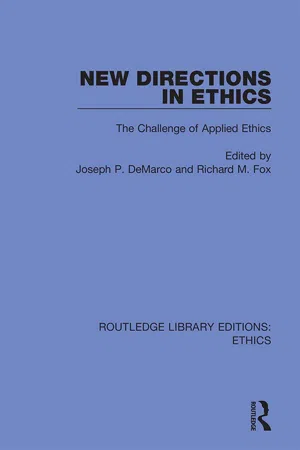
Originally published in 1986, this book examines the extent to which existing ethical theory can provide an adequate framework for the resolution of practical moral issues. The contributors, all leading moral philosophers, provide an authoritative and comprehensive account of developments in ethical theory, with emphasis on issues in applied ethics. They explain the dominant ethical theories, survey major field of applied ethics and speculate about the future of ethics.
eBook - ePub
New Directions in Ethics
The Challenges in Applied Ethics
- 346 pages
- English
- ePUB (mobile friendly)
- Available on iOS & Android
eBook - ePub
New Directions in Ethics
The Challenges in Applied Ethics
About this book
Information
1
THE CHALLENGE OF APPLIED ETHICS
Richard M. Fox and Joseph P. DeMarco
For little more than a decade, philosophic ethics has been faced with a relatively new challenge: to provide theoretical frameworks within which practical moral problems can be solved. This challenge has been posed from many quarters, from outside as well as within philosophy. It is heard in the form of calls from diverse professional and policy making organizations for the study and teaching of ethics in medicine, law, business and government. Such concerns reflect the growing awareness of the many moral, social and political issues which beset the modern world: problems of war, persecution, poverty, social injustice and inequality. Crime and corruption on the one hand, and moral controversy and indifference, on the other, have called attention to an apparent lack of moral knowledge and sensitivity. In opposition to traditional beliefs, a new morality seems to have emerged, as evidenced by changing attitudes towards sex and various rights movements. New problems have also been created by scientific and technological changes, including the many issues of bioethics which focus on matters of life and death.
New philosophical concerns have been evoked especially by a growing number of moral controversies. In the past, there seems to have been more agreement about matters of right and wrong conduct and a stronger commitment to doing what was considered right, at least among persons of the same cultural background. Traditional philosophers, therefore, shared many beliefs about the rightness or wrongness of particular acts, about the appropriateness or inappropriateness of moral rules, and about the possibility of demonstrated moral knowledge. Assured by widespread moral agreement, philosophers could concentrate on finding principles which would support shared moral convictions and serve to resolve doubtful cases. Today, by contrast, there is relatively little consensus on moral issues, so that the problem of moral philosophy is not so much one of justifying moral beliefs already known or assumed to be true but, rather, one of finding a method for determining which beliefs are true. The problem is to find what counts as evidence in moral reasoning, how such evidence can be weighed, and how persons can reach consensus in cases of disagreement, ignorance or doubt.
It should not be surprising then that, in this century, the work of philosophers has focused more on problems of theory construction than on problems of application. This focus has been evident in the seemingly inordinate amount of attention given to metaethics by analytic philosophers: by their speculation over the nature, scope, and even the possibility of moral reasoning, on the one hand, and their disproportionate inattention to substantive issues, on the other. In fact, most analytic philosophers have felt that it is not the business of philosophers to address practical issues. Some of them have called into question the efficacy of moral reasoning and even the existence of moral truth. The emotivists, for example, have taken the position that there is no such thing as moral truth, and intuitionists have argued that moral truth cannot be discovered by reasoning. Relativists, in turn, have claimed that morality is a matter of individual or cultural perspective.
Despite this movement toward metaethics, there are contemporary philosophers who have proposed substantive ethical theories, and some have even questioned the distinction between metaethics and normative ethics. Those influenced by Kant have argued that moral rules can be established on the bases of universal applicability and respect for persons. Contemporary utilitarians argue that the rightness or wrongness of actions is determined by the values of consequences, and Thomists, on the basis of intentions. But, so far, no one has yet been able to fully mediate these views. Thus, skepticism over the validity of ethical reasoning and opposition between the various schools of ethical theory has created the impression that philosophy has little to offer in the way of solutions to everyday, practical concerns.
Yet since the late 1960s and the early 1970s, philosophers have been addressing contemporary moral issues, and whole new fields of applied ethics have developed. In the past ten years, there has been a vast increase in the number of conferences, societies, journals and texts devoted to the subject of applied ethics. At the same time, on the theoretical level, new models have been developed to provide procedures for making practical decisions and resolving disputes.
In many respects, the movement toward applied ethics has shown that philosophers do have something to offer by way of clarifying issues and positions, and even by showing how, or to what extent, one or another theory can be applied. Nevertheless, many critics feel that there is still a serious gap between theoretical and applied ethics. One reason for the criticism is that much of the work in applied ethics presupposes the position of one or another school of philosophy and hence does not face up to the problem of opposing philosophical views. In other cases it turns out that one or another existing theory is simply not refined enough to yield answers, even according to the principles it lays down. In still other cases, applied philosophy is done without any explicit attention to theory at all.
It is, therefore, important to investigate the relation of theoretical ethics to applied ethics, not only from the point of view of what philosophers have to offer to the solution of practical problems, but also from the point of view of seeing how philosophical ethics itself might be improved by considering problems of application. How, for example, does the question of the applicability of a theory bear upon the question of its truth? In addition to the test of internal coherence, should there also be a test of completeness, based upon a theory’s ability to resolve practical disputes? How can principles be elicited from the subject-matters in which moral questions arise in order to resolve differences between theories or to construct a more comprehensive ethical view?
ETHICAL THEORY AND MORAL PRACTICE
Moral theorizing and the application of moral theory in practical moral judgment is not limited to moral philosophers. Practically everyone theorizes about values, and disciplines other than philosophy use moral theories of one kind or another to justify their activities or to resolve problems within their fields. Science, for example, is thought to be justified by its pursuit of knowledge, or a particular economic structure by its efficiency. Recent psychotherapies are founded upon ethical theories as various as hedonism and self-realization. Implicitly at least, ethical theories are being applied. Philosophy, however, retains the distinction of being the only discipline explicitly engaged in the study of ethical theory as one of its special subject-matters. Unlike practitioners or theoreticians in other disciplines, who assume the truth of one ethical theory or another without critical investigation, philosophers traditionally attempt to justify the theories they propose. Ethics is sometimes supposed to fall within the province of religion as well as philosophy, but practitioners in religion, like practitioners in other non-philosophical fields, are apt to simply assume that the principles expressed in their codes are true – although theologians sometimes attempt to justify religious beliefs on philosophical grounds. Therefore, when one seeks answers, not only to what is right or wrong in particular cases, but also to questions of correct principles, it seems only natural to turn to philosophy for answers.
The problems of moral philosophy arise quite naturally when anyone begins to reflect upon his or her moral practices, questioning the justification of actions or the reasons for judgments. Disagreement is often the source of such reflection; it also arises when people are genuinely perplexed about what they should do. In their attempts to resolve a controversy or remove doubt, they seek reasons for or against particular actions and, in so doing, they often appeal to personal codes or socially accepted rules. However, such rules may also be disputed, when, for example, there is disagreement about the acceptability of the rules, or when the accepted rules appear to conflict. An accepted rule may also seem inapplicable to a particular case, or the case may appear to be an exception, or it may not be clear which judgment the rule requires. When rules are in question, the next step is to move to higher ground, so to speak, to seek principles which will justify the rules, resolve conflicts between them, determine the range of their application, justify exceptions, or clarify their meanings. Moral reasoning does not always proceed in this way, of course, for persons may begin by appealing directly to accepted moral principles, or to contextual values, and some simply refuse to reason in support of their opinions. Traditionally, it has been the philosopher’s job to sort out such responses.
Historically, philosophers have sought to examine and defend ethical principles in order to guide action and enlighten moral judgments. Their answers to questions about the nature and justification of moral principles, therefore, may serve to distinguish the different types of moral theory. Such answers are, for the most part, simply highly articulated accounts of the kinds of answers anyone might propose as an ultimate justification for his or her own actions or beliefs. The major difference between popular opinions on ethics and the theories of moral philosophers is that philosophers usually try to clarify their positions and demonstrate their truth. Philosophers use logical analysis and argumentation to test whether any principles being proposed really are the first principles of ethics and whether any principles can be established. Philosophers also tend to give explicit attention to the methodology employed in their examination.
Ethical theories are influenced by philosophical traditions, but moral philosophers also arrive at their positions by analyzing the values of the societies in which they live, or by analyzing ordinary moral reasonings and judgments. Philosophies therefore tend to reflect basic cultural views; yet culture is often influenced by the views of philosophers. One expects to find Christian philosophies among Christians, or communist philosophies among communists, for such philosophies both express and influence the beliefs of their adherents. The differences in the moral beliefs of different cultures have, in fact, led many people to believe in the general relativism of values. A belief in cultural or individual relativism, however, is not peculiar to our time. It is a form of moral skepticism which finds expression in all periods of philosophic history. In ancient times, Plato, for example, tried to refute the sophists, the moral skeptics of his day; St Augustine, at the end of the Roman Empire, argued against ‘the academics’; and in the early modern period Descartes thought he could teach ‘the infidels’ how to walk with confidence in the conduct of life.
The argument which many philosophers have used to defeat the skeptic is relatively simple. They have argued that there must be universal principles discoverable by reason, because otherwise moral judgments and moral disputes would not make sense. There would be no point in having a moral opinion, or in disputing the opinion of another, unless one had reason to suppose that opinions could be either correct or mistaken. If there were no principles for determining which opinion is correct, there would be no point in having an opinion, for a moral opinion would then be an opinion about nothing. One way to confront such an argument would be to allow that moral judgments are really not judgments about anything, or that moral disagreements are not really logical disagreements, as, in this century, logical positivists and emotivists have claimed. They have held that so-called moral judgments are simply expressions of feeling and hence not really judgments at all.
Many philosophers have also maintained that concerning principles there is no disputing. They mean that that ultimate moral principles cannot be proved by deductive reasoning, for if they could be so proved, there would have to be still higher principles. But if there were higher moral principles, the principles being proved would not be ultimate, and the same argument applies to any supposedly higher principles. However, this argument ignores the possibility of establishing principles in other ways. For example, moral principles might be established by intuition, or by non-moral principles, or by showing that the principles in question really are ultimate. Within teleological reasoning, or reasoning according to ends and means, one might try to show, as many philosophers have, that a given value (or set of values) functions as an ultimate end, and one may even try to show why it is ultimate by citing certain facts about the world, or certain characteristics of human nature. Plato, for example, argues that there is no higher principle than goodness itself, because it bestows value on all other things. Hedonists have argued that, when all is said and done, the only reason anyone could give for thinking anything valuable is that it gives pleasure. But one need not suppose that there is only one ultimate principle, for there may be several, as Aristotle, for example, maintained. Indeed, the American pragmatist John Dewey held that there are different values in different contexts and, according to his ends-means continuum, that values which function as ends in some contexts function as means in others. In a system which has more than one principle, it is usually thought that some method needs to be devised for resolving possible conflicts in principle, but Thomas Aquinas appeared to believe that ultimate ends need not conflict, for he thought that a person could always be positively oriented toward several ultimate goods without ever acting in opposition to any of them.
TRADITIONAL ETHICAL VIEWS
If the arguments against skepticism are sound and there are answers to moral questions, what are the answers? Or if, philosophically, we cannot hope to propose an answer to every particular question, how in general can we go about finding answers? Many philosophers have felt that, if, as a matter of principle, we could find out what makes right acts right or wrong acts wrong, we would then know how to make a determination. But there is a question about whether acts are right or wrong independently of how we or anyone may happen to reason about them, or whether they are right or wrong because they correspond to right reasoning. In this century, extreme objectivists, such as the act-deontologist and intuitionist H.H. Prichard, have argued that acts are right or wrong in and of themselves, regardless of how anyone might reason about them. Some utilitarians, such as G.E. Moore, also seem to have held this position. On such accounts, intuition or reasoning is thought to be a way of finding out which acts are right, but intuition or reasoning does not make them right.
Such extreme objectivism is unusual in the history of moral philosophy, for although most moral philosophers have assumed that there are correct answers to moral questions, they have not supposed that moral truths are wholly independent of minds or ideas. Most have recognized, indeed, that moral judgments are prescriptive in nature and not simply descriptive, and hence that they must issue from some authority, even if the authority of reason itself. However, in many ancient and medieval accounts, the authority of reason was not limited to human reason, for the entire universe was thought to have a rational structure to which human reason is subordinate. In traditional theological ethics, for example, the value of things was thought to be determined by God’s reason, or by God’s creative act, for God was supposed to have conferred his goodness upon the world. Such moral theories were ontological in the sense that being and value were understood to be correlative terms. That is, things were thought to have value according to their level of being in a hierarchy of nature, and things could be evil, or lack value, only by failing to actualize their potentiality, or by failing to achieve the perfection of the species to which they belong. Such reasoning has been the basis of self-realization theories offered by a number of philosophers from Plato and Aristotle to Augustine and Aquinas. However, many theories which today are called self-realization theories do not have this logical or ontological foundation, for they are often quite individualistic or relativistic and do not presuppose a belief in essential natures or transcendent values.
Not all traditional philosophers held the same views, of course. In ancient philosophy, the Epicureans, for example, were materialists who believed that man’s natural end is pleasure in this life and that there is nothing beyond. The stoics believed in a natural law based upon one’s place in the universe, but they were more concerned with attaining peace of mind by controlling one’s emotions than they were with self-realization. Indeed, most subsequent philosophies can be classified according to the extent to which they have been influenced by ancient positions: by Platonism and/or Aristotelianism, on the one hand, or by stoicism and/or Epicureanism on the other. The rationalists in the seventeenth century and the idealists in the nineteenth century were influenced mostly by Platonism, although many of these theories also contained stoic elements. The eighteen-century British empiricists were influenced mostly by Epicureanism, thinking that morality could be founded on human emotions or sentiments. Thomas Hobbes, a seventeenth-century materialist, developed a social contract theory on the basis of a hedonistic account of human motivation.
According to traditional Platonic and neo-Platonic theory, our ability to know what is right or wrong is guaranteed by the divine illumination of human understanding, and in early modern rationalistic philosophies, such as those of Descartes, Leibniz and Spinoza, by innate ideas. A belief in innate ideas, however, or ideas which all persons share by nature, need not be based on a belief in God, or on principles which transcend human thinking, for they may be based upon an analysis of the structure of human thought itself. Thus Immanuel Kant claimed that there is a first principle of practical reasoning implicit in moral reasoning – although he certainly did not deny the existence of God. This principle, often called the principle of universalizability, was supposed to be a principle according to which everyone does in fact reason when reasoning morally. Kant held that, according to this principle, moral laws are maxims which can be universally applied.
Kant opposed the thinking of the eighteenth-century empiricists who, like the Epicureans, thought morality could be founded on human feelings or sentiments. However, in the nineteenth century, the classical utilitarians, Bentham and Mill, did not so much deny Kant’s principle of universalizability as they did amend and supplement it by arguing that moral reasoning requires a consideration of the consequences of actions, and that consequences, in turn, can be evaluated only on hedonistic grounds. Indeed, like Kant, Bentham and Mill hoped to lay the foundations for a science of ethics by uncovering the logic of moral reasoning.
Kant believed that his principle applied to all rational beings, not just humans, and Hegel, following Kant, spoke of Reason not simply as a human faculty but as an historically developing aspect of world Spirit of Mind. This latter doctrine expresses one of the elements of nineteenth-century idealism which, like Platonism, tended to see human reason as a finite expression of the Absolute. Many of the post-Hegelian movements in the nineteenth century were, however, a reaction to one or another of Hegel’s doctrines. Kierkegaard, who is sometimes thought to be the first existentialist, accepted Hegel’s idea of an Absolute, but he rejected Hegel’s rationalistic account of ethics, thinking that persons are united with God, not by reason, but by choice. Marx accepted Hegel’s idea of dialectical historica...
Table of contents
- Cover
- Half Title
- Title Page
- Copyright Page
- Original Title Page
- Original Copyright Page
- Contents
- Contributors
- Preface
- Acknowledgments
- 1 The challenge of applied ethics
- Section I: Contemporary ethical theory
- Section II: Fields of applied ethics
- Section III: The future of ethics
Trusted by 375,005 students
Access to over 1.5 million titles for a fair monthly price.
Study more efficiently using our study tools.
Frequently asked questions
Yes, you can cancel anytime from the Subscription tab in your account settings on the Perlego website. Your subscription will stay active until the end of your current billing period. Learn how to cancel your subscription
No, books cannot be downloaded as external files, such as PDFs, for use outside of Perlego. However, you can download books within the Perlego app for offline reading on mobile or tablet. Learn how to download books offline
Perlego offers two plans: Essential and Complete
- Essential is ideal for learners and professionals who enjoy exploring a wide range of subjects. Access the Essential Library with 800,000+ trusted titles and best-sellers across business, personal growth, and the humanities. Includes unlimited reading time and Standard Read Aloud voice.
- Complete: Perfect for advanced learners and researchers needing full, unrestricted access. Unlock 1.5M+ books across hundreds of subjects, including academic and specialized titles. The Complete Plan also includes advanced features like Premium Read Aloud and Research Assistant.
We are an online textbook subscription service, where you can get access to an entire online library for less than the price of a single book per month. With over 1.5 million books across 990+ topics, we’ve got you covered! Learn about our mission
Look out for the read-aloud symbol on your next book to see if you can listen to it. The read-aloud tool reads text aloud for you, highlighting the text as it is being read. You can pause it, speed it up and slow it down. Learn more about Read Aloud
Yes! You can use the Perlego app on both iOS and Android devices to read anytime, anywhere — even offline. Perfect for commutes or when you’re on the go.
Please note we cannot support devices running on iOS 13 and Android 7 or earlier. Learn more about using the app
Please note we cannot support devices running on iOS 13 and Android 7 or earlier. Learn more about using the app
Yes, you can access New Directions in Ethics by Joseph P. DeMarco, Richard M. Fox, Joseph P. DeMarco,Richard M. Fox in PDF and/or ePUB format, as well as other popular books in Philosophy & 20th Century History. We have over 1.5 million books available in our catalogue for you to explore.