eBook - ePub
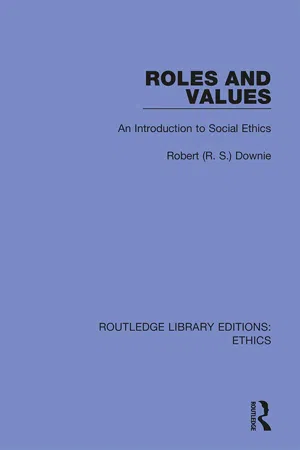
Roles and Values
An Introduction to Social Ethics
- 204 pages
- English
- ePUB (mobile friendly)
- Available on iOS & Android
eBook - ePub
About this book
Originally published in 1971, this book provides a lucid philosophical investigation of the area in which the demands of social and political institutions impinge on individual values and responsibilities, using the concept of a social role to focus attention on the problems and tensions which are necessarily involved. This approach to social and political philosophy will be of interest to students of social sciences as well as of philosophy.
Information
1
The Nature of Social Ethics
1. SOCIAL ETHICS
What is ‘social ethics’? There are a number of puzzles about the term, but let us begin by considering the meanings of the term ‘ethics’.
In the first place, ‘ethics’ can be used simply as a synonym for ‘morality’. It is indeed the mark of one kind of superior person to use the word ‘ethics’ instead of the word ‘morality’. In the second place, ‘ethics’ can be used to mean ‘morality’ but with the added implication that, for once, it is not sexual morality which is under discussion. The appearance of this use reflects the fact that the terms ‘morality’ and ‘immorality’ have come to be increasingly overlaid with sexual significance. Thus, commenting on a political scandal, someone wrote to The Times that it was not the lying which he deplored so much as the immorality! Presumably he would call the lying simply unethical. Thirdly, ‘ethics’ is used to refer to codes of conduct which consist partly of ordinary moral rules, partly of rules of etiquette, and partly of rules of professional conduct. It is this sense which is in use when we speak of ‘medical ethics’ or ‘the ethics of journalism’. Fourthly, ‘ethics’ is used to refer to the philosophical study of morality, which is also known as ‘moral philosophy’. The word is used in this sense in titles such as The Principles of Ethics, and in the expression ‘social ethics’. This book, then, is an introduction to the philosophical study of social morality, or at least, as we shall see, of one aspect of social morality.
But what is meant by a ‘philosophical study’? A great deal can be said about this, but it may be that the best way of understanding the nature of philosophy is to engage in it. Hence, let us simply accept the provisional description of a philosophical investigation as one which attempts to analyse basic concepts and principles with the aim of clarifying them and relating them to one another. For example, a philosophical study of the nature of knowledge will compare claims to knowledge in the sciences with those in religion and in everyday life. It will examine the nature of the evidence thought to be relevant in each sphere and in general attempt to draw a clear picture of the concept of knowledge which will enable us to distinguish it from related concepts such as that of belief.
It is sometimes said by philosophers that the aim of a philosophical investigation is to provide a logical map to enable us to pick our way through the confused areas of human thought and action. On this account the philosophical study of social ethics will be an analytical investigation of the main concepts and institutions of social morality with the aim of making clear their meanings, interrelations, and implications. Returning from the metaphor of logical mapwork to that of picturing we might say that social ethics gives us a synoptic picture of the principles and concepts of human thought and action with those of social morality and its institutions in the foreground and the others in the background but still (let us hope) in perspective. In order to develop this account of the nature of social ethics let us compare social ethics first of all with social reform or preaching and secondly with social science.
2. SOCIAL ETHICS AND SOCIAL REFORM
The aim of social ethics, we said, is to clarify the nature of social life in its moral aspect. The aim of social reform is rather to improve the conduct of social life in its moral aspect. Thus the aims of the two activities are essentially quite distinct. To leave the matter there, however, may be misleading, for historically there has been considerable overlap between the two activities. For example, the writings of Marx and Engels have as their basic aim the reform of society, but the method used is that of philosophical analysis. Thus they use philosophical analysis to try to demonstrate the class basis of all morality, and they introduce new concepts, such as ‘alienation’, to be conceptual tools in their diagnosis of the ills of social life. Hence, although the social philosopher and the social reformer have quite different aims, there may be considerable overlap in the methods used and the content of what is said.
In a similar way, the aim of preaching is to tell people what they ought to do or believe – that they ought, for example, to forgive their debtors. Now a philosopher will not issue moral advice or imperatives in this direct way. But although the aims of the preacher and the philosopher are quite distinct there may be a considerable overlap in the methods of argument used and the content of what is said. For a good preacher will not simply say, ‘Forgive your debtors’, but will try to explain what is meant by forgiveness; and in so doing he may engage in the conceptual analysis which distinguishes philosophical activity. Sometimes, of course, he may explain what it is to forgive by means of a story or parable, but there is no reason why he should not do so by means of philosophical analysis; and many sophisticated preachers have in fact done so. For example, Bishop Butler actually delivered his Sermons at the Rolls Chapel in 1729 with the express aim of altering the practical beliefs and conduct of his congregation. Yet his Sermons are a standard text for students of moral philosophy. The reason for this is that he tried to explain to his congregation such matters as the fallacious nature of the view which was common among the sophisticated men-about-town of his time (and our time too) that all actions are self-interested, or the various meanings of the slogan ‘Follow nature!’ The clarification of these and similar ideas was a necessary condition of recommending the appropriate conduct. Hence, Butler’s concerns as a preacher involved him in philosophizing. We may say, then, that although the aim of preaching and of social reform is to alter a man’s beliefs and conduct there is no reason why such an aim should not be compatible with, or even in some contexts have as a necessary condition of its adequate fulfilment, the conceptual clarification in terms of which the aim of philosophy is here being characterized.
So far I have tried to show that despite the essentially distinct aims of social reform or preaching and social ethics there may in practice be a blurring of the distinction between the two activities because the one may use the methods of the other. There is, however, a more important reason why the two activities have, historically speaking, affected each other. It is that a clarification (whatever its aim) of ordinary beliefs about social morality will in fact have an influence on social conduct and the principles which govern it. The explanation of this close connection between the theoretical study of social ethics and social practice is that the accounts of social morality developed by philosophers are created from materials which already exist in some form. Indeed, the great moral or political philosopher is distinguished not so much by his ability to create an entirely new set of ideas as by his ability to crystallize those which are already current but lack definite formulation, or which are so general that, like the air we breathe, they pass unnoticed. The result is that when the philosopher produces his system of social ethics we may become explicitly aware of ideas which we have already implicitly accepted. The outcome is a clarification of our moral and political concepts which may well affect our conduct. It is true that the clarification may be described as ‘intellectual’ or ‘theoretical’, but a clarification of one’s concepts will affect one’s views on the facts, and the way in which one sees the facts cannot but affect one’s practical conduct in respect of them. Hence, although we can make a sharp distinction between the aims of social ethics and those of social reform or preaching, in practice the two types of activity will be more closely involved since the one may involve the methods of the other and have its practical ideas crystallized by the other.
A good example of the close connections in practice between social reform and social ethics is provided by the history of the Utilitarian movement in the eighteenth and nineteenth centuries. Consider, for instance, the utilitarian views of David Hume. According to Hume, the nature of our morality is determined by the constitution of our human nature, and so the key to an understanding of morality is provided by an understanding of the principles according to which human nature operates. But Hume also believed that the most effective method of investigation was that exemplified in the new experimental science of his day, and he therefore attempted to examine human nature scientifically, inquiring why men called certain actions virtuous and others vicious. The answer he gave was that men call those actions virtuous or vicious which afford them a characteristic kind of pleasure or pain, and the kind of actions which provide the characteristic pleasure are precisely the ones we regard as useful to others or to the person himself, or which are agreeable to others or to the person himself. This is Hume’s version of the utilitarian principle: it purports to be a clarification of the principles in terms of which we all habitually act. As such it has the logical status of a statement of fact rather than that of a recommendation as to what we ought to do.
But this is not the whole truth about Hume’s principle of utility: the clarification of moral ideas which it achieved was accomplished by the selection of certain beliefs and attitudes from the consciousness of the eighteenth-century gentleman and the creation from them of a coherent and persuasive system. In other words, Hume’s moral and political philosophy reflected his own moral valuations, which were typical of those of the cultivated men of his times. Further, Hume’s utilitarianism acted not only as a clarification of the principles in terms of which the cultivated men of his time in fact behaved, but also as a disguised recommendation that they should continue to behave in this manner. The principles implicit in enlightened eighteenth-century conduct were drawn and erected into a recommended norm. The practical consequences of the utilitarian clarification of moral ideas is even more apparent in the nineteenth century, where we find that utilitarian ideas are used as a theoretical basis for the reform of the criminal code by writers such as Jeremy Bentham and the Philosophical Radicals.
The close connection between philosophical theory and social reform in the history of the Utilitarian movement is only one of many historical examples of the way in which practical social ideals may be affected by philosophical analysis. To say this, however, is not in the least to disturb the central contention that in aim social reform and social philosophy are essentially distinct.
3. SOCIAL ETHICS AND SOCIAL SCIENCE
If we turn now to a comparison of the aim of sociology and kindred social sciences with that of social ethics, we find that the former inquiries aim at providing knowledge about how people in fact behave in social contexts, and about how social institutions in fact operate in given societies at given times. Now a philosopher may (and perhaps ought to) make use of the findings of social scientists, but his own aim is not to add to this knowledge of society and social behaviour. Rather (as we have seen), his aim is to clarify the concepts which ordinary people themselves use in describing and evaluating their social behaviour, and to scrutinize the concepts and methods of the social scientists in investigating ordinary social behaviour. For example, a sociologist might inquire into people’s attitudes towards authority and conclude that Group A (factory-workers, say) resent authority whereas Group B (ex-soldiers, say) respect it. Again, a psychologist might inquire into what sorts of upbringing in fact tend to produce certain attitudes to authority, the place of father-figures in developing respect for authority, and so on. But a philosopher is interested in the concept of authority as such. He will therefore ask questions such as: Is authority the same as power? Is there basically only one kind of authority? What does it mean to say that conscience has authority? Social science, then, is factual and additive whereas social ethics, as a philosophical study, is conceptual and clarificatory. Of course, social scientists do attempt to clarify their own concepts, by definitions, etc., but their aim is properly restricted to clarification within the confines of their own and closely related disciplines. If they attempt to analyse their concepts in a wider way and relate them to our ordinary uses of the concepts and attitudes to the world, then they have become to that extent philosophers. And indeed social science, and science in general, does frequently have philosophical moments in it.
Philosophy is especially liable to occur in the theories of social scientists. It would be quite misleading to suggest that a social scientist is concerned exclusively with seeking facts about society and social behaviour for he is also interested in explanations of these facts, and to this end he will make use of concepts and laws which attempt to create theoretical understanding of social phenomena. Now it is not always easy to distinguish such social theories from social philosophy, and the reason is simply that large-scale social theories, such as those developed by Max Weber or Talcott Parsons, are, in fact, philosophical in nature. If they fall short of being fully-fledged philosophical theories it is because their breadth is limited. A philosophical theory will aim at being synoptic; at relating and explaining human behaviour not simply as a sociological or psychological phenomenon but also as the ordinary agent sees it or as the theologian might see it.
A precisely similar situation arises in physics. If a physicist formulates a theory of considerable breadth and explanatory force – such as the General Theory of Relativity – a case can be made out for regarding it as a philosophical theory; it is not for nothing that theoretical physics used to be called ‘natural philosophy’. Some philosophers of course might argue that the presence of quantitative formulations in physics or the use of experimental techniques disqualify it for the title of philosophy. But if one insists on being litigious about these matters (and it must be admitted that some philosophers are very litigious about what is or is not properly philosophy), a better reason for ruling out theoretical physics as philosophy would be that it is not synoptic – its aim is to explain the events of a limited aspect of nature whereas philosophical theories tend towards complete world-pictures.
It seems, then, that in distinguishing philosophy from science, and in particular social ethics from social science, we can have no grounds for laying down necessary and sufficient conditions which would enable us to say in any case whether a given study was social science or social philosophy. The best we can do is to say as a rough guide that social ethics, like other branches of philosophy, is non-factual, conceptual, clarificatory and synoptic in its theorizing.
4. SOCIAL ETHICS AND MORAL PHILOSOPHY
It might be objected that if the field of discourse of social ethics is the whole area of social morality then social ethics is no different from moral philosophy in general. For moral philosophy investigates the nature of morality in general, and all morality is social morality.
In reply to this point we might deny that all morality is social morality; it is at least arguable that there is a private or self-referring aspect of morality. It is arguable, in other words, that a person has duties to develop in himself his gifts and his characteristic human endowment. If this is so, then not all morality is social morality. But even supposing we do not insist on this we are not obliged to think of social ethics as being simply another name for moral philosophy. In the first place, there are aspects of moral philosophy which are beyond the scope of social ethics. For example, it is a legitimate concern of the moral philosopher to consider whether moral judgements are better regarded as imperatives or as expressions of emotion or as statements of fact; but such questions lie beyond the scope of social ethics. In the second place, there are aspects of social morality which are characteristically the subject-matter of social ethics rather than of moral philosophy. These are the aspects of social morality in which the influence of institutions is strongest.
It does not, of course, follow from the fact that social ethics is particularly concerned with the institutional side to social morality, that it is not concerned with what might be termed ‘face-to-face’ relationships; for a relationship can still be face-to-face although it is institutionally structured. The relationships which hold between social worker and client or teacher and pupil illustrate that a moral situation can be both face-to-face and institutionally structured. Indeed, it does not even follow that the relationships which fall within the field of discourse of social ethics are necessarily in all senses impersonal.* Certainly they are impersonal in the sense that institutional concepts may be necessary to describe them, but they may in another sense be deeply personal. For example, the relationship between husband and wife is one which is institutionally structured and in that sense impersonal, but clearly it is in the more common sense a deeply personal relationship. It may therefore be less misleading to say that social ethics, while it is by no means exclusively concerned with, at least concentrates on, those aspects of social morality in which people can be said to act in social roles which are given their structure by social institutions. It will provide analyses of the problems which arise as a result of tensions between the actions ...
Table of contents
- Cover
- Half Title
- Title Page
- Copyright Page
- Original Title Page
- Original Copyright Page
- Dedication
- Contents
- Preface
- 1 The Nature of Social Ethics
- 2 The Principles of Social Morality
- 3 Responsibility
- 4 Authority, Legitimacy, and Representation
- 5 The Morality of Government Action
- 6 Persons and Roles
- 7 Resenting, Forgiving, Punishing, and Pardoning
- 8 Moral Change and Moral Improvement
- Postscript
- Bibliography
- Index
Trusted by 375,005 students
Access to over 1.5 million titles for a fair monthly price.
Study more efficiently using our study tools.
Frequently asked questions
Yes, you can cancel anytime from the Subscription tab in your account settings on the Perlego website. Your subscription will stay active until the end of your current billing period. Learn how to cancel your subscription
No, books cannot be downloaded as external files, such as PDFs, for use outside of Perlego. However, you can download books within the Perlego app for offline reading on mobile or tablet. Learn how to download books offline
Perlego offers two plans: Essential and Complete
- Essential is ideal for learners and professionals who enjoy exploring a wide range of subjects. Access the Essential Library with 800,000+ trusted titles and best-sellers across business, personal growth, and the humanities. Includes unlimited reading time and Standard Read Aloud voice.
- Complete: Perfect for advanced learners and researchers needing full, unrestricted access. Unlock 1.5M+ books across hundreds of subjects, including academic and specialized titles. The Complete Plan also includes advanced features like Premium Read Aloud and Research Assistant.
We are an online textbook subscription service, where you can get access to an entire online library for less than the price of a single book per month. With over 1.5 million books across 990+ topics, we’ve got you covered! Learn about our mission
Look out for the read-aloud symbol on your next book to see if you can listen to it. The read-aloud tool reads text aloud for you, highlighting the text as it is being read. You can pause it, speed it up and slow it down. Learn more about Read Aloud
Yes! You can use the Perlego app on both iOS and Android devices to read anytime, anywhere — even offline. Perfect for commutes or when you’re on the go.
Please note we cannot support devices running on iOS 13 and Android 7 or earlier. Learn more about using the app
Please note we cannot support devices running on iOS 13 and Android 7 or earlier. Learn more about using the app
Yes, you can access Roles and Values by Robert (R.S) Downie,Robert (R. S.) Downie in PDF and/or ePUB format, as well as other popular books in Philosophy & Ethics & Moral Philosophy. We have over 1.5 million books available in our catalogue for you to explore.