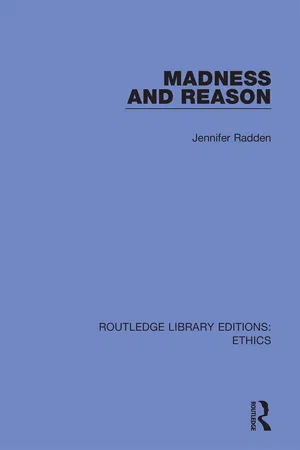
Originally published in 1985, this book provides a philosophical analysis of the concepts of madness and moral responsibility. It challenges the view that because they are victims of mental illness, the insane should not be blamed for actions resulting from their condition. The author urges a return to the neglected equation between madness and a want of reason, arguing that the impulse to excuse the criminally insane must be grounded in an appeal to their irrationality and unreasonableness. Through meticulous examination of the psychological states and behaviour patterns of major mental abnormalities, such as schizophrenia and depression, the author develops a notion of exculpating unreason. This is an interdisciplinary book which encompasses analytical philosophy, abnormal psychology and law.
- 184 pages
- English
- ePUB (mobile friendly)
- Available on iOS & Android
eBook - ePub
Madness and Reason
About this book
Information
1
Madness and Moral Responsibility
Introduction
It is widely agreed that insanity serves as an excuse. The issue explored here is not whether but why it should.
An impulse or moral intuition to excuse the insane wrongdoer lacks adequate theoretical grounding or justification today, I would argue, due to two developments in the way madness has been understood in the twentieth century. One is the adoption and entrenchment of a medical model in which madness is seen as analogous to physical disease. The other, paradoxically, is the anti-psychiatry movement which arose as an explicit reaction to the influence of that model.
One of the most vivid reflections of this problem is found in law relating to insanity which has been subjected to an increasing medical influence at both a theoretical and a procedural level, with the adoption in the influential Durham Rule of a blanket medical classification to distinguish the sane from the insane wrongdoer and with the courtroom practice of abdicating responsibility for legal decisions about insanity to clinicians in their role as expert witnesses.
Moreover, the influences of the medical model and of the anti-psychiatry movement have together brought about the eclipse of an earlier analysis of madness to which appeal could be made in grounding the moral intuition to excuse: madness construed as a form of irrationality or ‘unreason’, analogous to the exculpating want of reason we acknowledge in children.
The central proposal of this book is that we must recover the earlier conception of madness as unreason in order to justify and ground our important conviction that madness is an excuse.1
Due to the influences of the medical model and anti-psychiatry, but also, perhaps, to the very obviousness of the equation between sanity and reason, which has invited its trivialization, the thesis that madness is a want of reason has been overlooked. Even the tradition of analytic philosophy in which this work is placed, has contributed to its neglect. Philosophers have consistently disregarded madness in their discussions of irrationality. They have accepted the standard view that analyses in terms of a want of reason fail to capture the vagaries of madness [see Fingarette (1967), Boorse (1975), Flew (1975) and, more recently, Culver and Gert (1982)], and they have adopted too readily the prevailing medical conception of it.
There are several significant exceptions to this generalization, however, and these deserve mention. Feinberg (1970) has explored the notion that certain neurotic disorders might be characterized in terms of a particular kind of irrationality and, while he was concerned with conditions less severe than those which I discuss, his work stimulated my own interest in this area. More recently, Edwards (1982) —with his model of mental health as rational autonomy – and Moore (1975, 1980) have both proposed the neglected thesis that irrationality accounts for the exculpating nature of severe derangement although neither author has acknowledged the seriousness of the challenges to that claim – challenges, in my view, to which a response must be offered before it can be maintained.
Both a critique and a positive proposal are set forth here. The analogy with disease underlying the medical view of madness is found wanting, particularly as it is reflected in contemporary legal trends, and so also are certain tenets of anti-psychiatry. Positively, I urge that we return to the earlier notion of madness as unreason which could serve to ground our impulse to excuse the insane.
The positive thesis that madness is unreason and that unreason counts to exculpate, rests on three points. First, appeal is made to a sixteenth- and seventeenth-century conception of madness derived from Foucault’s work (1961, 1963) where it is suggested that between the Renaissance and the Age of Reason, a shift occurred in the nature of insanity and the way it was understood. From being unreason (déraison) arid viewed as a form of illogicality or unreasonableness allied to the ordinary, imperfectly rational thought of sane people, it came to be madness (folie) and to be seen as a medical condition and as – in certain respects -removed, remote and inexplicable. The earlier structure, in which madness was unreason, is the one from which my analysis is derived.
Secondly, the thesis that mad people are less rational or reasonable – that they exhibit unreason — is defended. The variety of claims associated with the use of the terms ‘rational’, ‘irrational’ and ‘reasonable’ are explored, thereby explaining the force of Foucault’s term ‘unreason’. It is shown how the thesis is confirmed in the paradigms of derangement – schizophrenia and other psychotic states. Moreover, it is argued that even in cases of severe derangement seemingly recalcitrant to such an unreason analysis – like paranoia and affective disorders — a closer examination reveals that there are particular patterns of perceiving and feeling in each which must be expected to lead to irrationally held beliefs and desires and to errors of judgement.
Thirdly, it is shown that, since strong parallels link the want of reason exhibited by the insane and children alike, the same principle of exculpating nonrationality found in juvenile law can be appealed to in grounding our intuition to excuse the insane. It is, then, because of their unreason that we want to exonerate the insane.
Next, the question of the normativism endemic to any account of madness is addressed. The ‘irrationality’ of madness when that term merely connotes deviance is unremarkable. It is necessary to go further and argue – as the term unreason suggests – that the insane are distinguished not merely by unusual responses but by defects of judgement.
Finally, the ramifications of my thesis for the legal notion of insanity are broached directly and suggestions are put forward as to legal procedures and practice which could overcome the problem raised at the outset: that our intuition to excuse the insane must be better grounded.
A few words are now required about the scope of the concept of madness and the terminology employed here, and finally about my own philosophical method.
When we speak loosely of mental aberration, we often evisage a spectrum of cases ranging from the most pervasive and severe derangement – sheer lunacy, or psychosis – at the one extreme to minor, specific, neurotic reactions like a faintly unusual or dysfunctional attitude towards love, or neatness or enclosed spaces, at the other. This conception is favoured by the mental health profession shaping the ‘psychological society’ (Gross, 1978) we inhabit at this end of the twentieth century. We may be sane, the platitude runs, but we are all a little neurotic. Mental health is as much an unreachable ideal as it is a state we might expect to find embodied in an actual person.
The minor neurotic conditions at the sane end of the spectrum, however, are of no importance to my thesis and will not be dealt with in this book. The concept of madness with which I am concerned is restricted to more severe afflictions: to psychotic states where reality testing is impaired, together with a small number of other conditions included because of the pervasiveness of their effect on the mind, personality or behaviour of their sufferer. Among psychotic conditions the most central are the schizophrenias and the severest forms of affective disorder, mania and depression. Among nonpsychotic conditions, I am concerned primarily with pervasive and serious manic and depressive reactions, and with the condition known as pure paranoia.
With the exception of the latter, nonpsychotic conditions and with the special case of compulsive behaviour, then, my thesis is not intended to cover what are classified as neurotic disorders, such as anxiety reactions, nor personality disorders like the obsessional personality.
This restriction is in keeping with the use of the word ‘madness’, it seems to me. The sufferers of anything less serious than the conditions described above may be mentally unhealthy, but we would hesitate to describe them as mad. More importantly, however, the restriction I have sketched roughly corresponds to a moral intuition: only the conditions I have named, it seems, are included in the widespread belief that mental derangement counts as an excuse for wrongdoing. Beyond these boundaries, evidence of the general agreement which marks the adoption of that moral stance is no longer present, either in technical or in lay discussions.2
Because the moral stance in which I am interested is not univocal over the less severe conditions, I shall say little about these states. It may be that there is a kind of irrationality or unreason to be found in such disorders, but whether or not this is so remains unimportant for my thesis, since about those conditions the impulse to excuse does not seem to be consistently felt.
Thus, while I have tried to use terms corresponding in their usage to the category of mental aberration with which I am concerned, my primary intention here is not to give a general characterization of madness; indeed, I am not convinced that such a general characterization would be possible or useful. Rather, my purpose is to explain why insanity excuses when it seems to do so.
The choice of terminology for the class of aberrant mental states described above, and for particular conditions within that class, was not an easy one. The sanitized vocabulary of the medical framework is inappropriate in a work taking issue with that model; we cannot speak of these conditions as mental ill health if the very analogy giving life to that expression is in question. Of the abusive, archaic and extreme alternatives which remain, I have chosen to speak of the states to which I refer as derangement, madness and insanity, indifferently – ignoring, in the case of the last term, the increasing specialization its meaning has acquired as a legal equivalent of ‘criminally insane’. Inmaking reference to particular conditions, I have used traditional psychiatric terminology. Such terminology, while not immune from the evils of labelling to which anti-psychiatry writers have rightly drawn attention, nor from implicit medical assumptions, is āt least free from explicit appeal to the analogies with disease and illness shaping those assumptions.
Finally, some comment is required on the philosophical method and presuppositions found here.
It hardly needs remarking that the thesis of this book presupposes a view of human action whereby the ordinary, sane wrongdoer is rightly held responsible for his or her crime and punished on its account; it is an assumption, indeed, which is central to the Anglo-American legal tradition. However, I shall avoid offering a full account of voluntary action and agent responsibility. Instead, my focus – like Aristotle’s in the Nichomachean Ethics — will be on the circumstances under which we are inclined to withhold blame for action and to offer excuses.
To understand better when and why we want to excuse the insane should be to understand better the positive notions of agency and freedom. Austin remarks in his A Plea for Excuses that Aristotle has been chidden wrongly for overlooking ‘the real problem’ of freedom, for ‘In examining all the ways in which each action may not be “free”, i.e. the cases in which it will not do to say simply “X did A” we may hope to dispose of that problem’ (Austin, 1956–57, p. 180). Austin is at least correct, I would insist, in asserting that we are not required to confront the problem of agency directly. Although I do not share his confidence that an adequate analysis of excuses would make any positive account of agency unnecessary – indeed I point to the need for such an account in outlining how our moral intuitions concerning madness and responsibility might find ultimate justification —it is not one which it is necessary to undertake here.
My argument relies on certain beliefs or moral intuitions about madness and responsibility. These are appealed to in particular cases to determine whether legal excuses should be extended to a wrongdoer who is deranged. They are also introduced in an exploration of the reasons to favour one account of madness over another. So it is important to look more closely at them.
The expression ‘moral intuition’, while apt, is in certain respects a misleading one. Moral intuitions have sometimes been taken to connote reactions which are at once precognitive, unchanging and unjustifiable. In pointing to the impulse to excuse insane wrongdoers I wish to imply none of these features. These moral intuitions reflect judgements in the sense of considered conclusions and not mere immediate and unthinking reactions. Moreover, they may change. They depend on a certain view of madness. Were our view to change, so that we ceased to regard madness as the affliction of a helpless sufferer, then the intuitions themselves could be expected to diminish or disappear. Finally, these convictions are justifiable. Support for the intuition to excuse mad people who commit crimes can be found in a theory about excusing conditions – ignorance, compulsion and, I shall argue, unreason. We accept the particular judgement that this insane wrongdoer ought to be excused because we recognize the validity of the general principle that, for example, ignorance excuses.
In asserting that these moral intuitions are justifiable, however, I am not proposing that they ought to be adopted by everyone. Contrary beliefs about the insane are also held by some people and it is not my purpose to mount an attack on their views. The convictions I am concerned with are widespread, which is sufficient for my argument. While I share them, I draw attention to these beliefs in order to explore the relationship they bear to certain ideas about the nature of madness, not to defend them.
My use of Foucault’s ideas also requires clarification, but I shall leave this until Chapter 4 when those ideas are introduced.
Beliefs About Madness and Moral Responsibility
The attitudes towards the insane which are fundamental to my analysis now require closer scrutiny. The belief that insanity is an excuse is one of several widespread – although not universal -beliefs about madness and responsibility which influence and in turn are influenced by how we see the mad person. These beliefs centre around our inclination to treat insane people differently from the sane on account of their affliction: to regard them as innocent victims and as at least partially blameless in a moral sense, or as less than fully culpable or accountable for what they do. Such attitudes are expressed in a passage by the great reformer Pinel (1806, pp. 323–4). Those who are ‘mentally sick’, as he describes the insane,
far from being guilty persons who merit punishment, are … people whose miserable...
Table of contents
- Cover
- Half Title
- Title Page
- Copyright Page
- Original Title Page
- Original Copyright Page
- Editors’ Preface
- Dedication
- Acknowledgements
- Contents
- 1 Madness and Moral Responsibility
- 2 A Disease Model of Madness
- 3 Diseases as Excuses for Wrongdoing
- 4 Madness as Unreason
- 5 Irrationality and Unreasonableness
- 6 Hallucination and Thought Disorder
- 7 Paranoid Delusion and Affective Disorder
- 8 Deviance and Defect
- 9 The Legal Tradition: Exculpating Ignorance and Compulsion
- 10 Exculpating Unreason in Children
- 11 The Insanity Plea
- References
- Index
Trusted by 375,005 students
Access to over 1.5 million titles for a fair monthly price.
Study more efficiently using our study tools.
Frequently asked questions
Yes, you can cancel anytime from the Subscription tab in your account settings on the Perlego website. Your subscription will stay active until the end of your current billing period. Learn how to cancel your subscription
No, books cannot be downloaded as external files, such as PDFs, for use outside of Perlego. However, you can download books within the Perlego app for offline reading on mobile or tablet. Learn how to download books offline
Perlego offers two plans: Essential and Complete
- Essential is ideal for learners and professionals who enjoy exploring a wide range of subjects. Access the Essential Library with 800,000+ trusted titles and best-sellers across business, personal growth, and the humanities. Includes unlimited reading time and Standard Read Aloud voice.
- Complete: Perfect for advanced learners and researchers needing full, unrestricted access. Unlock 1.5M+ books across hundreds of subjects, including academic and specialized titles. The Complete Plan also includes advanced features like Premium Read Aloud and Research Assistant.
We are an online textbook subscription service, where you can get access to an entire online library for less than the price of a single book per month. With over 1.5 million books across 990+ topics, we’ve got you covered! Learn about our mission
Look out for the read-aloud symbol on your next book to see if you can listen to it. The read-aloud tool reads text aloud for you, highlighting the text as it is being read. You can pause it, speed it up and slow it down. Learn more about Read Aloud
Yes! You can use the Perlego app on both iOS and Android devices to read anytime, anywhere — even offline. Perfect for commutes or when you’re on the go.
Please note we cannot support devices running on iOS 13 and Android 7 or earlier. Learn more about using the app
Please note we cannot support devices running on iOS 13 and Android 7 or earlier. Learn more about using the app
Yes, you can access Madness and Reason by Jennifer Radden in PDF and/or ePUB format, as well as other popular books in Philosophy & Ethics & Moral Philosophy. We have over 1.5 million books available in our catalogue for you to explore.