Originally published in 1968, this book traces the development of the emotive theory of ethics from its outline by Ogden and Richards in The Meaning of Meaning to the elaborate presentation by Stevenson in Ethics and Language. Attention is paid to the positive features of the ethical theory whilst the author also shows how a more adequate view can be reached through critical reflection on it.
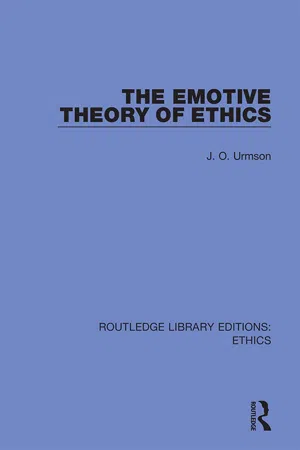
- 150 pages
- English
- ePUB (mobile friendly)
- Available on iOS & Android
eBook - ePub
The Emotive Theory of Ethics
About this book
Trusted by 375,005 students
Access to over 1.5 million titles for a fair monthly price.
Study more efficiently using our study tools.
Information
Topic
PhilosophySubtopic
Linguistic Semantics1
PRELIMINARIES
No doubt the most important questions in the moral sphere are those that are most concrete; it matters more that we should answer correctly such questions as whether this or that, between which we must choose, is better, or what we ought to do in the situation with which we are faced, than that we should be clear on general moral and philosophical issues. But if we raise such concrete practical issues we often find it hard to find answers that are satisfactory even for practical purposes, answers leaving us in no doubt how to act and undisputed by others. Moreover, it is hard for us to see why such answers as do recommend themselves to us are satisfactory; at the best they may seem only to postpone a problem. We decide that we ought not to pull the cat’s tail because we ought not to be cruel to animals, without thereby achieving any notable advance. Faced with difficulties of this kind, difficulties so familiar to us all that it is unnecessary to enlarge on them, men at all times have been constrained to raise the general question how in principle such particular practical problems are to be properly solved.
But as soon as we raise the question how a certain type of assertion, the moral, the mathematical or the aesthetic, for example, can be reasonably arrived at or defended, it is clearly necessary to determine the general character of such assertions, to make it explicit what sort of claims in what sorts of fields they make. Thus, to take a platitudinous example from outside ethics, it is the beginning of wisdom in determining how the assertions of pure mathematics are to be rationally supported to see that at least they are not factual records of the way things are, so that it would be pointless to try to prove them by the collection of empirical evidence. If we want to know what sort of support a claim needs, we surely need to be clear what sort of a claim is being made.
We can make the point clearer to ourselves by briefly considering two analyses of one type of ethical judgement, both, I think, wildly unplausible, which have from time to time been proposed. According to these analyses it is not merely the case that right actions are in accord with the will of God or that right actions tend to promote the survival of the human species; the contention is that ‘It is right to do action X’ means exactly the same as, on the one view, ‘Action X is in accordance with the will of God’, or, on the other view, ‘Action X tends to promote the survival of the human species’. It is irrelevant to discuss now the merits and demerits of either of these proposed analyses; the point is that if we could determine that one of these analyses was correct we should have completely determined how questions about the rightness of actions were to be decided. If the former analysis is correct, then obviously the way to decide how to act is to research into the revelations of God’s will; and we shall thus be determining what is right, not indirectly by means of resorting to an infallible authority, but directly, since being right will be the same thing as being in accordance with God’s will. If, on the other hand, we decided that rightness was the same thing as tending to promote the survival of the human species, then the way to determine how to act would be by an empirical, statistical investigation of the effect on human survival of different kinds of action; and, analogously to the former case, a tendency to promote the survival of the human race would not be merely a reliable sign of the rightness of an act, but the same thing as its rightness. Further, if we accept the theological analysis, but doubt the possibility of knowing the will of God, we shall have to be also moral sceptics; on the other analysis we may have to be temporary moral sceptics pending the development of a specialised branch of statistical sociology which will be the new science of ethics. Though we have considered, for illustrative purposes, two very implausible analytical theses, they none the less make clear the importance in ethical inquiry of the analysis of moral terms. We are continually and wearisomely admonished that to raise questions of moral analysis is to neglect substantive moral issues. It is certainly true that moral insight and philosophical insight are no substitutes for each other; but we may be led to seek the latter by a desire to achieve the former.
The point of this brief attempt to make clear the relevance of the analysis of ethical terms and utterances, apart, of course, from the intrinsic interest of such analysis to anybody with a suitable cast of mind, is that the emotive theory of ethics, our main concern in this book, is an analytical theory about the nature of ethical utterances, or at least claims to be such. It is reasonably clear that considerations similar to those adduced with regard to ethics arise also in the field of aesthetics and other areas in which evaluations are made. The analyses offered by the emotive theory were intended by most of its proponents to cover all cases of evaluation and not merely those found in moral contexts. ‘The emotive theory of value judgements’ might have been a better name for the view than ‘The emotive theory of ethics’.
2
THE GROUNDS FOR EMOTIVISM
Before we start to examine the details of the emotive theory we should examine what have seemed to many philosophers (no doubt, erroneously) to be the only two other possibilities. If it be asked what is meant by saying of something that it is good, one possible answer seems to be that we thereby say something capable of empirical confirmation or overthrow; such an answer is called naturalistic.
If one asks what such a word as ‘good’ means it is manifestly implausible to answer that it stands for any fairly simple feature of things directly accessible to observation as do the words ‘red’, ‘sweet’ and ‘loud’, for example, and no naturalist would make such an answer. But it is not so manifestly unplausible to hold that it stands for some empirically determinable, though not directly observable, feature of things, just as it is a matter for empirical investigation, though not for direct observation, whether a certain chemical is or is not alkaline. Thus there is some plausibility in the view that ‘good’ means the same as ‘satisfying desire’; if this view is correct, in its crudest form, then statements that things are good will require to be tested by empirical methods in a field of applied psychology closely allied to consumer research. It has also seemed plausible to some to say that ‘good’ means the same as ‘approved by most people’, in which case the test will again be in the field of empirical statistics. Many more naturalistic analyses have been suggested, some of them much more subtle than those given, but it would be out of place to consider such suggestions now.
Naturalism is, then, one possible type of ethical analysis. But many recent philosophers, including those who came to accept emotivism, have become convinced that there are general arguments which show that any form of naturalism is in principle erroneous. For our purposes the important fact is that these arguments were accepted by the emotivists and we need not enter the battle in support of them. It was G. E. Moore who first put forward the general arguments against naturalism. The main reason for rejecting it is simply that it is always clear, if we consider, that a thing having any natural features we care to think of may not be good, so that goodness cannot be identical with any of these natural features. Even if it were true, as it is not, that everything satisfying our desires was good, we could still envisage the possibility of something satisfying our desires and yet not being good; so ‘good’ cannot mean the same as ‘satisfying our desires’.
This argument against naturalism seemed to Moore to be decisive also against any metaphysical or theological definition of ‘good’. If, for example, we take the theological definition of ‘good’ as meaning the same as ‘willed by God’, it would follow from the definition that it would be self-contradictory to deny that what God wills is good. But the very falsity, impiety and blasphemy involved in denying that what God wills is good requires the view that ‘good’ means something different from ‘willed by God’; to contradict oneself is futile rather than impious.
Thus naturalism had to be rejected, Moore thought. It seemed to him that the only view which could escape the naturalist fallacy was that ‘good’ named some absolutely simple characteristic; but, since it was clear that it did not name any simple sensible characteristic, since good things do not share some characteristic smell, taste, look, sound or feel never mentioned in empirical science, the only possible alternative seemed to him to be that ‘good’ was the name of a simple non-natural characteristic apprehended by the moral intelligence rather than by the senses. This view commended itself to many others as well as Moore in the earlier years of the twentieth century, especially in Britain. Ross, Prichard and the other intuitionists accepted it, as did even Russell for a time.
Thus the two existing possibilities with which the emotivists regarded themselves as faced were naturalism and non-naturalism— apparently an exhaustive dichotomy. But empirically minded philosophers could hardly accept Moore’s solution. If there were technical reasons for rejecting the otherwise attractive naturalistic analysis of ethical terms, Moore’s alternative, involving the acceptance of what amounted to a priori concepts, was impossible to accept on the most basic grounds. Moore himself understood very well what the situation was, and he well described it in Philosophical Studies (pp. 258-9): ‘Many of those who hold strongly (as many do) that all kinds of value are “subjective” certainly object to the so-called “objective” view, not so much because it is objective, as because it is not naturalistic or positivistic. To a view which is at the same time both “naturalistic” or “positivistic” and also “objective”, such as the Evolutionary view which I sketched just now [to the effect that ‘good’ means approximately the same as ‘leading to survival’] they do not feel at all the same kind or degree of objection as to any so-called “objective” view. With regard to so-called “objective” views they are apt to feel not only that they are false, but that they involve a particularly poisonous kind of falsehood—the erection into a “metaphysical” entity of what is really susceptible of a simple naturalistic explanation. They feel that to hold such a view is not merely to make a mistake, but to make a superstitious mistake. They feel the same kind of contempt for those who hold it, which we are apt to feel towards those whom we regard as grossly superstitious, one which is felt by certain persons for what they call “metaphysics” ‘. Moore is undoubtedly right; in the language of the logical positivists we might say that these objective or non-natural characters are a kind of innate idea or a priori concept; consequently any sentence containing a word which is alleged to name a non-natural character must be unverifiable and therefore nonsensical. Naturalism was at the worst false, as Moore had no doubt shown; but non-naturalism was not a genuine alternative at all.
But subjectivism, the popularity of which Moore was explaining in the passage just quoted, was no third possibility for the philo sopher who accepted Moore’s attack on naturalism while rejecting his alternative. For a definition of ‘good’ is no less naturalistic, plainly, when couched in terms of goings on in the mind of the beholder than when couched in terms of any other transactions and therefore suffers from the same defects. So naturalistic definitions of value terms, it was held, were unacceptable on technical grounds, and this remained true whether the definition was in so-called ‘objective’ or ‘subjective’ terms; non-naturalism was on general epistemological grounds a non-starter. The dichotomy ‘natural— non-natural’ seemed to be exhaustive, yet ‘good’ seemed to have neither of these kinds of meaning. What were philosophers to say, once they had argued themselves into this position? The conclusion that value terms do not have, or do not have only, a meaning of the kind envisaged, that they do not name any quality whether natural or, per impossibile, non-natural stares us in the face. We are familiar with this view nowadays, and we draw it from the premises, as a matter of formal logic, easily enough; it was drawn by I. A. Richards in 1923 and by a few other bold spirits in the years that followed, but it seemed at the time to be not an obvious conclusion but a bold new theory.
It should be noted that the considerations just adduced in support of the view that value words name no character or relation, whether natural or non-natural, are of a very general epistemological character and did not arise out of a careful and close reflection on the nature of value judgements. Thus considerations from epistemology and philosophy of language rather than from ethics were the original ground for the modern British-American emotive theory of value terms in its earliest formulations. That this general presentation of the situation is correct can be confirmed by an examination of the early history of emotivism.
The earliest statement of the emotive theory of value terms in the modern British-American tradition (as opposed to statements in such continental writers as Haegerstroem which became known to English-speaking philosophers only comparatively late and had no early influence) was, so far as I know, that given by I. A. Richards in a general linguistic and epistemological work, The Meaning of Meaning, written in conjunction with C. K. Ogden and published in 1923. Some of their most important remarks are conveniently quoted, facing the Preface, in Stevenson’s Ethics and Language (though he does not give the reference, which is to page 125 of the second edition). We need quote only the historic sentence; ‘The peculiar ethical use of “good” is, we suggest, a purely emotive use.’ The general context makes clear, as the title of the book implies, that this remark is made in the context of a general theory of meaning.
The next reference to the emotivist analysis that I have noticed is, once again, in a non-ethical work; it is in Susan Stebbing’s A Modern Introduction to Logic (1930), a general logic which makes no pretence to take a special interest in value theory. There Stebbing says: ‘Many statements are made, however, not for the sake of conveying information, but in order to arouse in the hearer a certain response, to create in him a certain state of mind. . . . To mark the distinction Mr I. A. Richards has suggested the convenient terminology “the scientific use of language” and “the emotive use of language”. . . When [language] is used in order to arouse an emotional attitude in the hearer, to influence him in any way other than by that of giving him information, then its use is emotive.’ (op. cit., pp. 16-19). Like Richards, speaking in the context of a discussion of meaning in general, Stebbing does not pursue the topic further.
The first time, so far as I can ascertain, that the emotive theory was advocated in print in a specifically ethical context was March 1934, when it was stated by W. H. F. Barnes in his brief ‘A suggestion about value’, published in Analysis; this was apparently a fragment of a paper on Hartmann’s Ethics read to the Jowett Society at Oxford. It is impossible to determine from this brief extract what Barnes’s main theme was, but having begun by saying that ‘value judgements in their origin are not strictly judgements at all. They are exclamations expressive of approval’, much of the three short paragraphs is devoted to distinguishing this expressive view from subjectivism and discussing its relation to naturalism and non-naturalism; so apparently the problem is once again how to escape from that dichotomy. An interesting feature of Barnes’s view is that he says that value judgements in their origin are not judgements at all, but exclamations of approval, and goes on to say that they ‘will only express meaning in so far as the society in which they are used is agreed on what things it approves. And then “good” and “value” will be terms that have meaning only by referring to the actual nature of the thing.’ Thus Barnes anticipates in a rudimentary way both the first and the second patterns of analysis offered by Stevenson, but does not, strictly, advocate an emotive theory of meaning; he recognised only ‘descriptive’ or ‘cognitive’ meaning and regards the expression of approval as the pre-meaningful origin. Here we have not the emotive theory of the meaning of ethical terms, but the emotive theory in the making.
We find the full-fledged emotive theory stated for the first time in an ethical context in June 1934, when it was outlined, with an attribution to A. S. Duncan Jones, by Broad in an article entitled ‘Is “goodness” the name of a simple non-natural quality?’ The article appeared in the Proceedings of the Aristotelian Society, 1933-4, the relevant pages being 250-4. Here, once again, the discussion arises out of the epistemological problem of definition rather than from a close examination of ethical discourse, and the chief merit that Duncan Jones is quoted as claiming for his theory is that ‘it explains why all attempts to define ethical words in purely non-ethical terms seem unsatisfactory’. Incidentally, we find in Broad’s article the first instance of a once popular version of the emotive theory when he offers, non-committally, as an analysis of a statement that a certain act was good: ‘That’s an act of self-sacrifice. Hurrah!’ From this, and parallel examples in which ‘Boo!’ takes the place of ‘bad’, arose the name ‘the boo-hurrah theory of ethics’ which the emotive theory was often given in the 1930s.
We find an essentially similar background to the emotive theory if we examine the contribution of the logical positivists. Wittgenstein, in his Tractatus Logico-Philosophicus, most notably in the paragraphs numbered 6.4 to 6.421, had denied meaning to ethical propositions and called them nonsensical on the ground that they were neither significant like empirical truth-functions nor empty of sense, though well formed, like the necessary truths of logic. In line with this the logical positivists of the Vienna Circle had declared ethical judgements to be nonsense. Once again, this judgement was not made on the merits of the case, and after careful attention to the character of ethical discourse; ethical discourse was nonsensical as being neither empirical nor tautological. Thus Carnap, on page 26 of his Philosophy and Logical Syntax, published in 1935, revealingly says that value judgements have ‘no theoretical sense. Therefore we assign them to metaphysics.’ So what the logical positivists had to say about ethics (with a few exceptions, such as Schlick in his Fragen der Ethik) applied to ethics merely as being a sub-branch of metaphysics, in the esoteric sense in which they used that word. But there was a general formula in use among the logical positivists for explaining the prevalence and attractiveness of the many kinds of metaphysical nonsense that they had diagnosed—moral talk, religious and theological talk, aesthetic talk, and so on. It was allowed that all these ways of talking were attractive because they were one and all ways of expressing our emotions; it was very common to say that metaphysics (a word used dyslogistically to cover all the newly recognised varieties of nonsense) was a way of expressing emotion similar to poetry. So, I repea...
Table of contents
- Cover
- Half Title
- Title Page
- Copyright Page
- Original Title Page
- Original Copyright Page
- Contents
- Preface
- 1 Preliminaries
- 2 The grounds for emotivism
- 3 Emotive meaning
- 4 Stevenson’s Ethics and Language
- 5 Stevenson’s Ethics and Language (continued)
- 6 Stevenson’s Ethics and Language (concluded)
- 7 Validity
- 8 The vocabulary of evaluation
- 9 Good of a kind and good from a point of view
- 10 A test for evaluative terms
- 11 Meaning and illocutionary force
- 12 Conclusion
- Select Bibliography
- Index
Frequently asked questions
Yes, you can cancel anytime from the Subscription tab in your account settings on the Perlego website. Your subscription will stay active until the end of your current billing period. Learn how to cancel your subscription
No, books cannot be downloaded as external files, such as PDFs, for use outside of Perlego. However, you can download books within the Perlego app for offline reading on mobile or tablet. Learn how to download books offline
Perlego offers two plans: Essential and Complete
- Essential is ideal for learners and professionals who enjoy exploring a wide range of subjects. Access the Essential Library with 800,000+ trusted titles and best-sellers across business, personal growth, and the humanities. Includes unlimited reading time and Standard Read Aloud voice.
- Complete: Perfect for advanced learners and researchers needing full, unrestricted access. Unlock 1.5M+ books across hundreds of subjects, including academic and specialized titles. The Complete Plan also includes advanced features like Premium Read Aloud and Research Assistant.
We are an online textbook subscription service, where you can get access to an entire online library for less than the price of a single book per month. With over 1.5 million books across 990+ topics, we’ve got you covered! Learn about our mission
Look out for the read-aloud symbol on your next book to see if you can listen to it. The read-aloud tool reads text aloud for you, highlighting the text as it is being read. You can pause it, speed it up and slow it down. Learn more about Read Aloud
Yes! You can use the Perlego app on both iOS and Android devices to read anytime, anywhere — even offline. Perfect for commutes or when you’re on the go.
Please note we cannot support devices running on iOS 13 and Android 7 or earlier. Learn more about using the app
Please note we cannot support devices running on iOS 13 and Android 7 or earlier. Learn more about using the app
Yes, you can access The Emotive Theory of Ethics by J. O. Urmson in PDF and/or ePUB format, as well as other popular books in Philosophy & Linguistic Semantics. We have over 1.5 million books available in our catalogue for you to explore.