- 268 pages
- English
- ePUB (mobile friendly)
- Available on iOS & Android
eBook - ePub
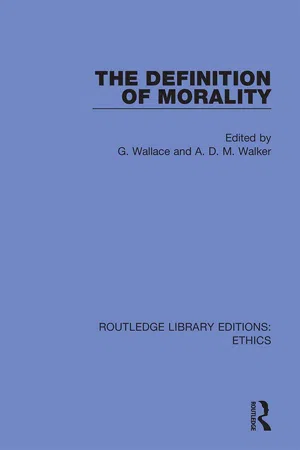
The Definition of Morality
About this book
Originally published in 1970, the papers in this volume discuss the essential and defining characteristics of morality and moral issues and examine how moral views differ from political views, moral beliefs from religious beliefs, and moral judgements from aesthetic judgements. Some of the chapters discuss problems of method and shed light on the complex conditions which any successful definition of morality must satisfy. Taken collectively, these papers reflect he wide variety of approaches adopted by contemporary philosophers.
Information
1
On defining ‘moral’
C. H. WHITELEY
A good many recent philosophical papers have been concerned with discussing which principles, attitudes, problems, propositions can be properly counted as ‘moral’, which characteristics are ‘essential’ to what is moral as against what is not. These are questions of definition. But the philosophical problem is not that of giving a ‘correct’ definition, in the sense of one which accords with ordinary usage. For in ordinary usage the words ‘moral’ and ‘morality’ have no precise and consistent use. While there are many principles, attitudes, problems which everybody would agree in calling ‘moral’, and many others which everybody would agree in not calling ‘moral’, there.are large numbers of doubtful cases, and no generally accepted criteria for drawing the line. Thus a reasonably exact definition must depart from usage to some extent. Such a definition should not be judged as correct or incorrect; it should be judged as suitable or unsuitable. But we cannot judge of its suitability unless we have some idea what purpose the definition is intended to serve, and in what contexts it is to be used. Different definitions may well be convenient in different contexts or for different purposes. I shall assume that any acceptable way of defining ‘moral’ and ‘morality’ must isolate something which plays a distinctive part in human life, and must enable us to distinguish matters of morality (right and wrong’) from matters of taste or preference, and matters of convenience or expediency, since it is with these matters that morality is usually contrasted. I shall suggest two ways in which this can be done, and two ways in which it cannot be done.
Reprinted from Analysis, 1959-60, pp. 141–4, by permission of the author and Analysis.
The first possible way is that suggested by the etymology of ‘moral’, ‘ethical’ and similar words. The morality of a community consists of those ways of behaviour which each member of the community is taught, bidden and encouraged to adopt by the other members.
Moral behaviour is behaviour in accordance with these recommended patterns, moral grounds are grounds derived from applying the accepted rules, moral issues are issues involving the required standards. In this concept of morality there is included the idea of a sanction: no rule is part of a community’s morality if people can openly break that rule without incurring the hostility and disapproval of their neighbours – there may, but need not, be other penalties as well. There is also included the idea of general rules or standard patterns of conduct, incumbent upon all of given classes of persons in given classes of circumstances; for only general rules or standards can be taught, enjoined and systematically enforced. There is not included in this concept any reference to motive; morality consists in habitual voluntary conformity with the conventions, from whatever motive or motives this conformity arises.
This is a sociological or political concept. Morality so defined has a definite role in the life of societies, and one may study its functions, its development, its relationship with religion, economics, government, etc. The concept suffers from some inevitable vagueness. Disapproval is a matter of degree; there is no clear line of demarcation between cutting a man because he is a bounder, and avoiding him because he is an eccentric. Besides, there are always certain kinds of conduct which some members of a given community wish to insist on, while others are indifferent. For these reasons, the distinction between what is morally obligatory and what is morally optional – a matter of taste or convenience – in a society cannot be quite sharp. But in most societies the doubtful cases are relatively few.
My second possible way of defining ‘moral’ is from the point of view of the agent himself. My morality consists, not in what other people insist that I should do, but in what I insist that I should do. It is the content of my conscience. The peculiarity of conscience, or moral obligation, as against other motives for action, is, as Kant observed, that its imperatives are categorical. My morality comprises those actions which I think I ought to do regardless of inclination and regardless of personal advantage. A man who just does whatever he feels inclined to do has no morals, even if what he does is always right and good. The same is true of a man who always does what he thinks will be for his own greatest happiness. Morality in this sense does not necessarily involve the idea of external penalties: I can hold myself obliged to do sometliing though I shall be none the worse off, even in my neighbours’ estimation, if I do not do it. Nor does it necessarily involve the idea of general rules or principles. It is both logically and psychologically possible for me to think that I am morally obliged to do something without thinking that anybody else in a similar situation is or would be obliged to do it. The instances par excellence of categorical imperatives, the ‘calls’ or ‘concerns’ which must be obeyed before all else (‘The word of the Lord came unto me, saying …’) are individual obligations without general import.
This concept of morality is psychological. It defines a certain factor in the consciousness and conduct of individuals. It is a suitable concept for those who are concerned with moral endeavour, aspiration and struggle, with the nature, development and influence of the conscience. It offers a sharper distinction between moral and non-moral than the first concept. For the difference between what I feel obliged to do willy-nilly, and what I am prepared to abandon if I lose my taste for it or find it unprofitable, while not perfectly clear-cut, can be pretty nearly so; and the more self-consciously conscientious I become, the sharper the distinction.
The two concepts of the moral coincide over a wide range: that is, the things that people think they (categorically) ought to do are very largely the things that are enjoined on them by their neighbours. But the coincidence between conscience and convention is logically contingent. It is possible for a community to have rules which, though generally obeyed, are obeyed solely from self-interest or habit, so that no member ofit has any ‘inner’ morality. And it is possible for a community of people to have well-developed consciences which do not support any established conventions. No human community fits either of these possibilities. But in all human communities there is a divergence between conscience and convention; and it is usually wider than it looks on the surface. What people in their hearts are devoted to may be something quite other than the conventionally ‘moral’. Here the study of language may easily mislead us. For the way people talk is dominated by the conventions, and can mask the way they think, feel and behave. In the extreme case, the man who denounces ‘morality’ or ‘conscience’ may have quite strong convictions about the way he ought to behave.
‘Morality’ can thus be defined in two different ways, from a sociological and from a psychological point of view. Contemporary philosophers, whose approach is apt to be neither sociological nor psychological but linguistic, sometimes attempt to draw a distinction between moral and non-moral in terms of uses of language or kinds of reasoning or argument. I do not believe that any such distinction can be drawn.
There are no words or expressions, no uses of words or expressions, no types of proposition, which are distinctively moral or ethical. There are indeed words and expressions whose characteristic use is to evaluate or to recommend, and it is important that this use of language, which is prominent in talk about morals, should be distinguished from other uses, such as the descriptive or the straight imperative. But words like ‘good’, ‘right’, ‘ought’, which are used to evaluate and to recommend in the discussion of moral issues, are also used, without change of meaning, in the discussion of other matters. Conduct can be good, as meat can be good. The fact that I can approve of conduct on moral grounds (though not only on moral grounds) no more makes ‘good’ an ethical word than the fact that I can approve of meat on dietetic or gastronomic grounds makes it a dietetic or gastronomic word. If I say to you that you ought to sell your brewery shares, I can give as my reason either that profits from brewing are declining, or that it is immoral to profit from the debaucheries of your fellows, or both reasons at once. There are many other words (words like ‘honest’, ‘sly’, ‘rash’, ‘heroic’, ‘strait-laced’, ‘discreet’, ‘boorish’, ‘unselfish’, etc.) which play an essential part in the expression of moral appraisals, though linguistic philosophers have paid them very little attention. But they can equally well be used in the expression of non-moral appraisals, or of neutral descriptions. Thus if we define Ethics as the study of the language of morals we give it no effective definition; for morals has neither vocabulary nor idioms of its own. And the examination of the meanings of words which are common to moral and non-moral discourse can hardly be expected to shed much light on the peculiar characteristics of morality.
Similarly, there are no specifically moral kinds of argument. Arguments aimed at convincing a person that he is morally obliged to do or not to do something may be of a variety of logical types: deduction from agreed premises (‘But that would be dishonest !’); analogy (‘Isn’t this just like what X did, which we all thought was so shocking?’); appeals to sentiment (‘Think how unhappy it would make her!’); sheer brow-beating (‘I don’t know how you have the nerve to suggest it!’). Sometimes we argue from a general principle, sometimes we attend only to the case in hand. Sometimes we assume a pro-attitude; sometimes we set to work to evoke it. There is no type of reasoning or persuasion in place in moral contexts which is not equally in place in admittedly non-moral contexts. Thus the ‘moral’ is not a subdivision either of language or of logic.
2
What morality is not
ALASDAIR MACINTYRE
The central task to which contemporary moral philosophers have addressed themselves is that oflisting the distinctive characteristics of moral utterances. In this paper I am concerned to propound an entirely negative thesis about these characteristics. It is widely held that it is of the essence of moral valuations that they are universalizable and prescriptive. This is the contention which I wish to deny. I shall proceed by first examining the thesis that moral judgements are necessarily and essentially universalizable and then the thesis that their distinctive function is a prescriptive one. But as the argument proceeds I shall be unable to separate the discussion of the latter thesis from that of the former.
I
Are moral judgements essentially and necessarily universalizable? The contention that they are is expressed in its most illuminating form in Mr R. M. Hare’s paper on ‘Universalizability’ (Proceedings of the Aristotelian Society, 1954–5, pp. 295–312). Mr Hare borrows his terminology from Mr E. Gellner’s paper on ‘Logic and Ethics’ (P.A.S., 1954–5, pp. 157–78) where Mr Gellner distinguishes what he calls U-type and E-type valuations. A U-type valuation is an application of ‘a rule wholly devoid of any personal reference, a rule containing merely predicates (descriptions) and logical terms’ (p. 163). An E-type valuation is one containing some uneliminable personal reference. Hare’s thesis is that moral judgements are U-type valuations. To give a reason for an action is not necessarily to commit oneself to such a valuation ‘for I see no grounds in common language for confining the word “reason” to reasons involving U-type rules’ (p. 298). But Hare goes on to say that his thesis ‘is analytic in virtue of the meaning of the word “moral” ’.
Reprinted from Philosophy, 1957, pp. 325–35, by permission of the author and Philosophy.
What this amounts to is made very plain in an imaginary conversation which Mr Hare constructs between a ‘Kantian’ and an ‘Existentialist’. This runs as follows:
E.: ‘You oughtn’t to do that.
K.: ‘So you think that one oughtn’t to do that kind of thing?’
E.: ‘I think nothing of the kind; I say only that you oughtn’t to do that.’
K.: ‘Don’t you even imply that a person like me in circumstances of this kind oughtn’t to do that kind of thing when the other people involved are the sort of people that they are?’
E.: ‘No: I say only that you oughtn’t to do that.’
K: ‘Are you making a moral judgement?’
E.: ‘Yes.’
K.: ‘In that case I fail to understand your use of the word “moral”.’
Mr Hare’s comment on this is: ‘Most of us would be as baffled as the “Kantian”; and indeed we should be hard put to it to think of any use of the word “ought”, moral or non-moral, in which the “Existentialist’s” remarks would be comprehensible. Had the “Existentialist” said “Don’t do that”, instead of “You oughtn’t to do that”, the objections of the “Kantian” could not have been made; this illustrates one of the main differences between “ought” and ordinary imperatives’ (pp. 304–5).
The crux then of Hare’s position is the contention that whenever anyone says ‘I, you or he ought to do so-and-so,’ they are thereby committing themselves to the maxim ‘One ought to do so-and-so.’ This commitment is embodied in the meaning of the word ‘ought’ in so far as ‘ought’ is used morally – and indeed, Hare seems to say, in non-moral uses of ‘ought’ also. But is this contention in fact correct? Consider the following example which is borrowed from Sartre (L’Existentialisme est un Humanisme, pp. 39–42). One of Sartre’s pupils was confronted during the war with the alternatives of leaving France to join de Gaulle or staying to look after his mother. His brother had been killed in the German offensive in 1940 and his father was a collaborator. These circumstances had left him with a strong feeling that he was responsible as a patriot and they had left his mother in a state of almost complete dependence upon him. What should he do? Stay with his mother or escape to England? Sartre uses this problem in order to argue that there are no ‘objective’ criteria by which such a choice may be made. Part of the force of his argument is this. Someone faced with such a decision might choose either to stay or to go without attempting to legislate for anyone else in a similar position. He might decide what to do without being willing to allow.that anyone else who chose differently was blameworthy. He might legitimately announce his choice by saying, ‘I have decided that I ought to stay with my mother.’ If he did so, his use of ‘ought’ would not express any appeal to a universalizable principle. It would not be a U-type valuation, but it would be a moral valuation.
Two points need to be made about this example. The first .concerns the function of ‘I ought to do so-and-so’ when it is used to announce a decision in a case like that of Sartre’s pupil. Its use is plainly to commit oneself, to allow that if I do not do what I say I ought to do, then I am blameworthy. It is a performatory use of ‘I ought’ in that its use makes one responsible for performing a particular action where before saying ‘I ought’ one could not have been held responsible for performing that action rather than some alternative one. To note this is to bring out the oddity in Hare’s treatment of the ‘Existentialist’s’ contribution to his dialogue. For in this non-universalizable sense of ‘ought’ one could never say ‘You oughtn’t’ but only ‘I oughtn’t.’ To say ‘You oughtn’t’ and suppose that you had used ‘ought’ in this sense would be as odd as to say ‘You promise’ and suppose that thereby one had committed someone else to a promise.
Secondly, it might be argued that the very possibility of a problem such as that of Sartre’s pupil presupposes the acceptance of certain universalizable maxims as moral principles. If Sartre’s -pupil had not accepted the maxims ‘One ought to assist one’s parents when they are in need’ and ‘One ought to assist one’s country when it is in need’ there would have been no problem. What is important is that the clash between two principles need not be resolved by reformulating one of the principles or formulating a third one. Certainly this clash could be so resolved. Sartre’s pupil might have acted on the maxim ‘Duties to one’s parents always have precedence over duties to one’s country’. Had he done so he would have legislated not only for his own but for all relevantly similar situations. But in order to make his own decision he does not need to so legislate. Now it seems to be a consequence of Hare’s position that if the decision between principles is itself to be a moral decision it must itself rest upon the adoption of a universalizable maxim. This, in the light of Sartre’s example, could only be defended by an a priori restriction on the use of the word ‘moral’. Such a restriction, however, would not be merely a restriction upon our use of a word. For to adopt Hare’s use of ‘moral’ would be to permit only one way of settling conflicts of principle (that of formulating a new principle or reformulating an old one) to be counted as genuinely a moral solution to a moral problem, while another way – that of the non-universalizable decision à la Sartre – would be ruled out from the sphere of morality. To do this is plainly to do more than to offer a descriptive analysis of the meaning of ‘moral’. It is to draw a line around one area of moral utterance and behaviour and restrict the term to that area.
What one can conclude from this is twofold. First, not all, but only some, moral valuations are universalizable. What leads Hare to insist that all are is his exclusive concentration on moral rules. For rules, whether moral or non-moral, are normally universal in scope anyway, just because they are rules. As Mr Isaiah Berlin has written in another context, ‘In so far as rules are general instructions to act or refrain from acting in certain ways, in specified circumstances, enjoined upon persons of a specified kind, they enjoin uniform behaviour in identical cases’ (‘Equality’, in P.A.S., 1955–6, p. 305). If this is so, then there is nothing specific to moral valuation in universalizability and in so far as moral valuations are not expressions of rules they are not universalizable. Secondly, the exceptions are not simply cases analogous to that of Sartre’s pupil. A whole range of cases can be envisaged where moral valuations are not universalizable. At the one extreme would be those instances where in adopting a moral position someone consciously refrains from legislating for others, although they might have done so; where a man says, for example, ‘I ought to absta...
Table of contents
- Cover
- Half Title
- Title Page
- Copyright Page
- Original Title Page
- Original Copyright Page
- Contents
- Acknowledgements
- Introduction
- 1. On defining ‘moral’
- 2. What morality is not
- 3. MacIntyre on defining morality
- 4. Critical notice of R. M. Hare’s Freedom and Reason
- 5. Two concepts of morality
- 6. Morality and importance
- 7. Social morality and individual ideal
- 8. Definition of a moral judgement
- 9. The concept of morality
- 10. Moral arguments
- 11. The moral point of view
- 12. Modern moral philosophy
- 13. Morality and advantage
- Bibliography
- Contributors
- Name Index
Trusted by 375,005 students
Access to over 1.5 million titles for a fair monthly price.
Study more efficiently using our study tools.
Frequently asked questions
Yes, you can cancel anytime from the Subscription tab in your account settings on the Perlego website. Your subscription will stay active until the end of your current billing period. Learn how to cancel your subscription
No, books cannot be downloaded as external files, such as PDFs, for use outside of Perlego. However, you can download books within the Perlego app for offline reading on mobile or tablet. Learn how to download books offline
Perlego offers two plans: Essential and Complete
- Essential is ideal for learners and professionals who enjoy exploring a wide range of subjects. Access the Essential Library with 800,000+ trusted titles and best-sellers across business, personal growth, and the humanities. Includes unlimited reading time and Standard Read Aloud voice.
- Complete: Perfect for advanced learners and researchers needing full, unrestricted access. Unlock 1.5M+ books across hundreds of subjects, including academic and specialized titles. The Complete Plan also includes advanced features like Premium Read Aloud and Research Assistant.
We are an online textbook subscription service, where you can get access to an entire online library for less than the price of a single book per month. With over 1.5 million books across 990+ topics, we’ve got you covered! Learn about our mission
Look out for the read-aloud symbol on your next book to see if you can listen to it. The read-aloud tool reads text aloud for you, highlighting the text as it is being read. You can pause it, speed it up and slow it down. Learn more about Read Aloud
Yes! You can use the Perlego app on both iOS and Android devices to read anytime, anywhere — even offline. Perfect for commutes or when you’re on the go.
Please note we cannot support devices running on iOS 13 and Android 7 or earlier. Learn more about using the app
Please note we cannot support devices running on iOS 13 and Android 7 or earlier. Learn more about using the app
Yes, you can access The Definition of Morality by G. Wallace,A. D. M. Walker in PDF and/or ePUB format, as well as other popular books in Philosophy & Ethics & Moral Philosophy. We have over 1.5 million books available in our catalogue for you to explore.