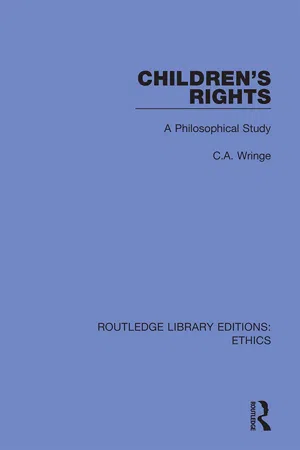
Originally published in 1981, this book provides a detailed account of the emergence of the children's rights movement, and analyses the concept of a right. It considers the justifications which may be sought when rights are claimed. Particular attention is given to the problem which arises when different rights are seen to be in conflict with each other or with other kinds of moral consideration. These arguments are then examined with regard to such special features of children as their incomplete but developing rationality and their material dependence on adults.
- 190 pages
- English
- ePUB (mobile friendly)
- Available on iOS & Android
eBook - ePub
About this book
Information
| The claim that children have rights | Part I |
| 1 | The children’s rights movements |
PUPIL MILITANCY AND ADULT POLEMICS (1)
Following the events of May 1968 at various European and British universities the spread of militancy into secondary schools was widely anticipated. In France Lycéens were already involved in the student unrest of 1968 and by 1969 pupils’ joint management committees (Schülermitverwaltungen) were established in Gymnasien in certain German Lander, only to be stigmatised by many of the pupils whom they were meant to placate as ‘eine Farce’.
It is perhaps small wonder that as student militancy became old hat, the exploits and utterances of members of the Schools’ Action Union should rapidly be seized upon as ‘news’. When on the last day of Christmas Term 1969 this organisation mounted a strike and marched on County Hall, five pupils of an East London comprehensive school were suspended. Significantly, the issue which divided the governors and others who discussed the case was not the validity of the pupils’ demands contained in a letter handed in at County Hall, but whether those suspended were properly to be described as ‘truants’ and ‘recalcitrants’, who might easily be dealt with inside the traditional framework of school discipline, or whether they were ‘strikers’, to be treated according to different canons.(2) It is perhaps an indication of the tense atmosphere surrounding pupil militancy that the five pupils in question were eventually expelled and the then Minister of State for Education asked the Inner London Education Authority for a full report.(3) The SAU were again in the news in February 1970 when it was revealed that the headmaster of one of their members had written about his political activities to a university which had subsequently rejected his application for entrance.(4) In July of that year the speech day at a well-known London public school was interrupted by SAU activities,(5) and in November a boy was suspended at a school in Suffolk after ‘openly defying school rules’ by publishing an article in ‘Vanguard’, the organ of the SAU.(6) In the same month some of the specific demands of the SAU were widely reported following the organisation’s conference in Manchester.(7) In December a ‘good natured strike’ over the dismissal of a teacher at Holland Park Comprehensive School also threw up demands for increased pupil representation.(8) Apart from eight boys being transferred from one secondary modern school to another for ‘trying to start a union’, (9) 1971 appears to have been rather quiet from the point of view of actual pupil militancy, though as will be seen, the children’s rights movement continued to proceed on other fronts. The two most significant events in this field in 1972 were the so-called ‘Schools’ Demo’ on the 17 May (10) and the inauguration of the National Union of School.Students a few days later.(11)
Though estimates of numbers vary to some extent, it appears that 2,500 pupils absented themselves from school to attend the SAU ‘Schools’ Demo’. After the pupils had rallied in Trafalgar Square an attempt was made to ‘storm’ County Hall. Fourteen juveniles and, perhaps rather surprisingly, ten adults were arrested and the ‘demo’ was widely reported as being badly organised and lacking in leadership.(12)
Although the ‘demo’ achieved no obvious practical results, it does at least appear to have provoked some thought regarding the powers and responsibilities of heads. Shortly before the demonstration, the Chief Officer of the Inner London Education Authority is reported to have written to head teachers to the effect that it was neither wise nor proper for them to give pupils permission to be absent from school in order to attend the demonstration. Absence from school to attend the demonstration was described unambiguously as truancy and heads were advised (though not all of them agreed) that the responsibility for seeing that pupils attended school lay with parents.(13)
The inaugural conference of the National Union of School Students also took place in May 1972 following a motion at the previous conference of the National Union of Students, which already claimed to have some 12,000 members in secondary schools. Area conferences of school students were organised in London and ten provincial centres and a steering committee was elected. In her inaugural speech, the first President of the NUSS declared that the main aim in the union’s twenty-five-point policy statement was the achievement of a greater degree of democracy in schools and ultimately a say at national level in decision-making. She was, however, at pains to distinguish the ‘moderate’ and ‘non-political’ programme of the NUSS from that of the SAU. School strikes were not regarded as part of the NUSS programme. It was hoped to gain the co-operation of adult bodies such as the National Union of Teachers, or at least of its younger members. Another member of the NUSS executive is reported to have said that joint campaigning with the National Council for Civil Liberties was unlikely, even though the two organisations had certain aims in common.(14)
The spread of militancy among school pupils was followed by the development of a supporting underground literature. ‘The Little Red School Book’ appeared in the spring of 1971, translated and adapted for use by English pupils.(15) The first edition of the magazine ‘Children’s Rights’(16) appeared in November of that year and continued to appear more or less monthly until the following September. The seven editions of the magazine featured such topics as alternative education, exam resistance, children in care, and children’s rights in the matter of arrest (the controversial ‘Children’s Bust Book’). Contributors included such well-known names as John Holt, Leila Berg and Chris Searle. The editorial board was listed as Paul Adams, Leila Berg, Nan Berger, Michael Duane, John Holt, A. S. Neill, Robert Ollendorff and Viv Berger, though after the controversy over the ‘Children’s Bust Book’ it was revealed that this board was not intended to edit or even see copy, membership being something of an ‘empty title’ intended to ‘pull in the customers’. After the appearance of the ‘Children’s Bust Book’ the editor (Julian Hall) was ‘sacked’ and the seventh and final edition appeared under the name of ‘Kids’. The organisation then decided to continue its work in the form of a ‘Children’s Rights Workshop’ which later published occasional pamphlets and held discussion meetings.(17) ‘Children’s Rights’ was by far the most substantial magazine of its kind. Others, often locally based, included ‘Mother Grumble’ (North East), ‘Brain Damage’ (Oxford), ‘Carfax Comic’ (Oxford), ‘Pigeon’ (Slough), ‘Hackney Miscarriage’ (East London).(18)
To see the push for children’s rights merely as a downward seepage of university unrest would be mistaken for a number of causes appear to have contributed to the intensity with which this topic was debated during the period 1969 to 1972, when the controversy was at its height. To begin with, much of the impetus came not from pupils and their organisations, but from adults and, in particular, from adult writers. The idea of the school as a democracy, or at least as a kind of constitutional monarchy, has an honourable history in the tradition of progressive education at least as old as Homer Lane’s Little Commonwealth and the teaching and writings of A. S. Neill. In January 1971, however, the theme received special prominence in a work in which three progressive educationalists, two Reichian psychologists and a prominent member of the National Council for Civil Liberties discussed various aspects of the struggle for ‘children’s rights and their contemporary denial’.(19) The year 1971 also saw the beginnings of the ‘deschooling’ debate in Britain and although the preoccupations of Illich and his followers are in important respects different from those of the children’s rights movement, the emphasis of the deschoolers on the supposedly stultifying and custodial nature of schooling and the premise of less institutionalised alternatives became an important element in children’s rights literature.
Professional writers on education were not the only adults to involve themselves in the issue of children’s rights. Though major personalities in the two main political parties refrained from taking up an identifiable position, one Labour MP is reported as advocating that not only teachers, but also pupils should have a larger say in the determination of the school curriculum.(20) At the other extreme, a Monday Club pamphlet published in August 1970 under the title ‘Who’s getting at our Kids?’ alleges the existence of an actual conspiracy to ‘suborn the hearts and minds of a section of the British youth’. The subversive nature of the movement lay, so the pamphlet claimed, in the portrayal of authority as ‘an instrument of bourgeois capitalism’ and the movement for democracy in schools is condemned as ‘a logical preparation for worker control and industrial soviets’.(21)
On what some may consider a more serious level, the National Council for Civil Liberties in January 1971 began publication of a series of Discussion Papers under the general title of ‘Children Have Rights’. The first of these relates specifically to children in school and points to aspect of the pupils’ legal position vis-à-vis school authorities which were considered unsatisfactory.(22) In April of the following year the NCCL in conjunction with the London Co-operative Society’s Education Department organised a London ‘Conference on Children’s Rights’ which was attended by such figures as Brigid Brophy, Joan Lestor, Francis Deutsch, Peter Newell and Anna Shearer, each with an axe to grind. The SAU and YAK (Youth Action Kommittee) were represented. So also was the NUT, whose representative was sharply critical of some of the NCCL’s recommendations.(23) Shortly after the ‘Conference on Children’s Rights’ the annual general meeting of the NCCL passed ‘more or less unanimously’ an executive resolution calling for a vigorous campaign on three particular children’s rights in schools, namely, the abolition of corporal punishment, the right of children to determine their personal appearance in school and the need for effective channels for participation by pupils in the running of schools.(24) Later in the year an NCCL group in south-east London urged that the power of heads should be curbed and suggested, prophetically, that the shifting of head teachers’ powers and responsibilities to a more representative body might be facilitated by introducing changes into the Model Articles of Government and Management of Schools.(25)
Like the NCCL, the Advisory Centre for Education also chose to promote discussion of certain educational issues in terms of pupils’ rights by publishing in the April 1971 issue of ‘Where?’ its so called Draft Charter of Children’s Rights, posters and free off-prints of which were offered to interested readers.(26)
Official reaction to the children’s rights movement from teachers’ professional organisations does not appear to have been forthcoming until spring 1972. When it came, it could, for the most part, only be described as truculent. One representative of the NUT expressed his union’s opposition to any weakening of the teachers’ position ‘in loco parentis’ or the legal obligation on children to attend school up to the age of sixteen. Another felt that in taking up the case of children who were ‘upset by being told to do things they don’t want to’, such as wearing uniform, the NCCL was concerning itself with trifles compared with ‘the infringements of liberty that result from poverty, over-crowding, ill-equipped schools and selective higher education’.(27) Commenting on the proposed formation of the NUSS, the Assistant General Secretary of the union said that his organisation did not ‘see the necessity for a national organisation of pupils’ and doubted whether ‘interference’ by such an ‘outside body’ would be helpful in settling the ‘serious educational question’ of the development of pupil participation. In a somewhat similar vein, the Assistant General Secretary of the National Association of Schoolmasters expressed the view that agitation for children’s rights was based on the false premise that ‘children are from an early age capable of determining what is good for them’. The same official also defended the retention of corporal punishment (for the good pupil(!) though not for the habitual delinquent) and pointed out that the legal right of the head to determine what children wore in school had already been established by ‘case law in the courts’.(28)
Of all the bodies representing teachers only the NUT left-wing splinter group Rank and File appears to have expressed itself in favour of the pupils’ rights movement. This group voted ‘full support for students struggling by direct action to democratise the schools’ and criticised the union for condemning school strikes, particularly in view of the NUT’s own successful strike in 1970.(29)
Though most educational authorities were naturally extremely reticent on the whole topic of children’s rights, mention must be made of an article by Sir Alex Clegg in his authority’s schools’ bulletin, supposedly based on a ‘Bill of Rights’ for school children from an American high school. The article mentions ‘as a gruesome warning to head teachers’ such provisions as the right of free speech, the right to publish magazines and newspapers without censorship and the right of pupils to see their own school records. The article was later said by its author to have been ‘a joke’.(30)
One final factor colouring the discussion of relations between the young and adults was the passage of the 1969 Children and Young Persons Act following the 1968 White Paper ‘Children in Trouble’. Neither of these, of course, related to the normal run of school pupils. The rights of young delinquents and the rights of school pupils do, however, raise the common issue of a young person’s position with regard to civil rights. Discussion of both provides stuff for the charge that ‘society’ allows supposed rights of...
Table of contents
- Cover
- Half Title
- Title Page
- Copyright Page
- Original Title Page
- Original Copyright Page
- Dedication
- Contents
- General editor’s note
- Preface
- Introduction
- Part I The Claim that Children have Rights
- Part II What is a Right?
- Part III The Justification of Different Kinds of Rights Claims
- Part IV The Rights of Children
- Notes
- Bibliography
- Index
Trusted by 375,005 students
Access to over 1.5 million titles for a fair monthly price.
Study more efficiently using our study tools.
Frequently asked questions
Yes, you can cancel anytime from the Subscription tab in your account settings on the Perlego website. Your subscription will stay active until the end of your current billing period. Learn how to cancel your subscription
No, books cannot be downloaded as external files, such as PDFs, for use outside of Perlego. However, you can download books within the Perlego app for offline reading on mobile or tablet. Learn how to download books offline
Perlego offers two plans: Essential and Complete
- Essential is ideal for learners and professionals who enjoy exploring a wide range of subjects. Access the Essential Library with 800,000+ trusted titles and best-sellers across business, personal growth, and the humanities. Includes unlimited reading time and Standard Read Aloud voice.
- Complete: Perfect for advanced learners and researchers needing full, unrestricted access. Unlock 1.5M+ books across hundreds of subjects, including academic and specialized titles. The Complete Plan also includes advanced features like Premium Read Aloud and Research Assistant.
We are an online textbook subscription service, where you can get access to an entire online library for less than the price of a single book per month. With over 1.5 million books across 990+ topics, we’ve got you covered! Learn about our mission
Look out for the read-aloud symbol on your next book to see if you can listen to it. The read-aloud tool reads text aloud for you, highlighting the text as it is being read. You can pause it, speed it up and slow it down. Learn more about Read Aloud
Yes! You can use the Perlego app on both iOS and Android devices to read anytime, anywhere — even offline. Perfect for commutes or when you’re on the go.
Please note we cannot support devices running on iOS 13 and Android 7 or earlier. Learn more about using the app
Please note we cannot support devices running on iOS 13 and Android 7 or earlier. Learn more about using the app
Yes, you can access Children's Rights by C. A. Wringe in PDF and/or ePUB format, as well as other popular books in Philosophy & Ethics & Moral Philosophy. We have over 1.5 million books available in our catalogue for you to explore.