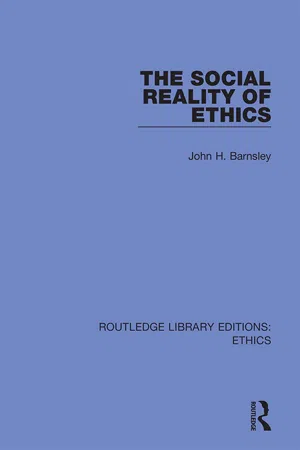
Originally published in 1972, this book clarifies 'ethical' concepts such as 'values', 'norms' and 'precepts'. It begins with a discussion of the conceptual problems faced by any inquiry into moral codes. The author looks in particular at the numerous ways of specifying the 'moral' component in human affairs and at the need for a definition appropriate to the requirements of social research. He then examines these questions from amore empirical viewpoint, and emphasis is put on the interplay between concepts and methods in social research. The important issues of ethical relativism and its relation to sociological inquiry is also raised. In this way, some of the possible ethical implications of sociology itself, both as an empirical discipline and as an organizing perspective, are critically examined.
- 462 pages
- English
- ePUB (mobile friendly)
- Available on iOS & Android
eBook - ePub
The Social Reality of Ethics
About this book
Information
part one
Ethics and sociology
1 The sociology of ethics
Ethics and sociology
All men, in all societies, evaluate. In all societies evaluations exist which, to a greater or lesser extent, are shared, and this is an important part of their culture. Sharedness presupposes communicability and the notion of culture implies that these evaluations have a certain consistency over time. Culture is a summary word for social meanings; it is the key for interpreting those codes of behaviour which form social structure.
So moral standards are important in understanding any society. Yet explicit theory in this field is rare—for example, if one compares it with the work done on aspects of social structure, such as organizations or kinship systems. That this aspect of sociology has received little attention relative to its importance is due, we believe, to at least four reasons.
Firstly, the subject straddles several disciplines. Of these, moral philosophy, jurisprudence, and theology are perhaps traditionally the most important ones though a variety of emerging disciplines—like linguistics, prescriptive logics, and decision theory—must now be added to these. Thus sociologists have tended to leave the analytical problems which the subject raises to the practitioners of these fields and content themselves with descriptions of moral codes as between different societies.
Secondly, it seems that such a practice may also follow from our current tendency to disguise moral decisions as technical decisions. Overawed by science, we perhaps see its canons as superseding questions of value and moral choice, however logically naive this may be. One finds this evident in many issues that are raised for public debate. For example, architectural designs, for housing developments, office blocks, city centres, and so on, are not merely the resultants of a series of discrete technical decisions. They involve also conceptions of how people ought to live and hence, ultimately, moral choices.1 The contemporary functionalist view of buildings as designed for pre-existing purposes reflects neatly the utilitarianism of the modern world. The danger is not so much that alternative conceptions are rejected, as that they are not recognized to exist.
This tendency is we believe true both of the general public and of intellectuals. In his 1967 Reith Lectures, Dr Edmund Leach characterized the outlook of intellectuals on moral questions as follows:2
Beware of moral principles. A zeal to do right leads to the segregation of saints from sinners, and the sinners can then be shut away out of sight and subjected to violence. Other creatures and other people besides ourselves have a right to exist, and we must somehow or other try to see where they fit in. … So long as we allow our perception to be guided by morality we shall see evil where there is none, or shining virtue even when evil is staring us in the face, but what we find impossible to see are the facts as they really are.
This seems a fair picture. There are of course exceptions. And it is also true that such attitudes do exist within a moral framework, in this case that of a liberal-humanism. But the point we wish to establish is merely that being consciously moralistic is viewed as undesirable.
The result, of course, is not that value-judgments disappear, but rather that they become covert. In a similar way, we should remember that modern techniques of decision-making—such as operational research or ‘cost-effectiveness’ thinking—always operate within certain value parameters, whether these be implicit or explicit. They cannot themselves serve as the source of these parameters.
Without labouring this point, we may note that if such an attitude is, at least in the West, linked to the influence of scientific technology, we would expect it to be less true for those people who are little influenced by this development. What little data there are seem to support this. Thus within industrial society, the degree to which attitudes are held in a moralistic way consistently correlates negatively with centrality of social position.3 Research also demonstrates that our expectation is fulfilled for non-industrial societies and, interestingly enough, for the type of sociology produced in such countries.4 The cult of objective detachment is not a universal one, even for established traditions of social science.
However, it is understandable that a discipline which aspires to scientific status should have reasons to avoid studies of morality as such, since, on the face of it, it is precisely here that its objectivity would appear to be most in peril. But for a community which consensually accepts a certain set of moral beliefs, which are both clear and unquestioned, these beliefs themselves acquire a kind of taken-for-granted objectivity. And this leads to our third point. The current position of our own culture is not only one of a diversity of moral opinions, alongside a broad area of uncertainty. The problem runs deeper than that. It is rather that we lack a common moral vocabulary for discussing, and potentially reconciling, these diverse opinions. As Professor MacIntyre has observed:5
In our society the acids of individualism have for four centuries eaten into our moral structures, for both good and ill. But not only this: we live with the inheritance of not only one, but of a number of well-integrated moralities. Aristotelianism, primitive Christian simplicity, the puritan ethic, the aristocratic ethic of consumption, and the traditions of democracy and socialism have all left their mark on our moral vocabulary. … Between the adherents of rival moralities and between the adherents of one morality and the adherents of none there exists no court of appeal, no impersonal neutral standard. … [As a result] we cannot expect to find in our society a single set of moral concepts, a shared interpretation of the vocabulary. Conceptual conflict is endemic in our situation, because of the depth of our moral conflicts.
This confusion is likely to be reflected in sociological accounts, and hardly favours the clear-cut categorizations which could provide a basis for theory, and a motive for research. It is not unlikely that this situation would also be projected on to other cultures, so that the moral becomes synonymous with indeterminacy and vagueness, an area to be avoided. But if the current situation appears to militate against effective sociology, it also offers a challenge to it, and a reason for its potential value.
A fourth reason why the sociology of morality has received little attention is undoubtedly to be found in the intrinsic difficulties of the field. Clear thinking on the subject is difficult and rare. So it tends to be left to the discipline traditionally concerned with conceptual clarification, philosophy. The most immediate problem is one of language: what do predicates of the type ‘good’ and ‘bad’, ‘right’ and ‘wrong’ mean? This is a central question of moral philosophy. But it is also relevant to ask what type of predicates these are. The language of morals is normally not only a language of evaluations and preferences but also one of prescriptions of various kinds. Traditional logic gives us little help here because it has traditionally concerned itself with descriptive propositions and its methods are not directly translatable into this new field. Modern philosophy has begun to give attention to the kind of problems involved here, but, for instance, the development of prescriptive logics of various types is still in its earliest stages.6
It is secondly, however, a question of the social contexts in which this sort of language is used. One principal need is for a socially-based classification of the various types of imperatives. The implications of this kind of study would extend to various fields, including law and general sociology. But as yet sociology gives us few cues, because its concerns have in the past been elsewhere.
The history of moral philosophy has been characterized as a history of succeeding orthodoxies and the logical status of moral terms and moral propositions is still as disputed as it ever was, so we should not expect consensus in sociology. But it is in fact the case that sociologists have worked out their own approaches to social morality in remarkable independence from the efforts of philosophers. Some of the shortcomings of this will become apparent in this study.
However, the sociological perspective is a comparative one. And when moral terms come from other societies and cultures there is the additional problem of translation. This is partly a simple linguistic problem which follows from the fact that moral terms seem to be especially subtle in their meanings and, for instance, allow few accurate synonyms even in their own language; but it is also a result of the systemic nature of moral attitudes, which must thus be understood with reference to the whole of which they are a part.7
In his book K. M. Sen gives some examples (Hinduism, p. 14, 1970).
To explain the principles of Hinduism to people unfamiliar with its frame of reference is a difficult task. For one thing, some of the terms used do not have exact synonyms in the European languages. Almost every writer on Hinduism is forced to point out that dharma and religion are not the same thing; a mandira is not a Hindu church; jati has been translated as caste, but it is an unhappy rendering. A word so important to Hindu philosophy as sadhana has no equivalent in English. This is comparable with the difficulty in finding exact synonyms for such words and ideas as ‘cross’ and ‘charity’ in non-Christian cultures and languages.
However, despite the problems, descriptions of the moral codes of various societies are available, and authors are increasingly aware of the need to view these in systemic terms. Since the nineteenth century the amount of such reasonably reliable material has gradually accumulated. In this century particularly, such evidence in anthropology and sociology has had a distinct influence on moral thinking, both of professional philosophers and of the general public. This has been so far in excess of the numerical and fiscal strength of these disciplines that one might argue that this is the influence they have had on popular thinking.
What has been the nature of this influence? Fundamentally, it has led to an awareness of cultural relativism. Rephrasing Pascal, we may say that it has led to the recognition that what is good on one side of the Pyrenees is bad on the other. That is, people have become more and more aware that the content of moral codes varies widely both as between various societies and historically within any society, and, to some extent, as between the different social groups of any particular society. The ethical implications of this are to be considered later.
The spread of the awareness of cultural relativism has been buttressed by another idea derived from sociology; this is the notion, which lies at the root of the sociology of knowledge, that ideas—including moral ideas—are socially determined. It has also been supported by the scientific canons of questioning everything and of only accepting those propositions which have objective validity. Empirically, this cultural relativism has encouraged an ethical relativism: that is, a sort of moral thinking which denies the universalizability of one’s own values.
Ethical relativism is a challenging subject in itself. But the fact that the diffusion of the social sciences has, along with certain other factors, served to encourage its acceptance makes it doubly important. Yet it has received scant attention from the present generation of sociologists, or, for that matter, from the philosophers. It is for this reason that the final part of this book is devoted to the question of relativism in ethics. For the present let us return to the very basic questions of definition raised by a study like this.
Values and beliefs
‘What are values?’ ‘What are rules?’ ‘What does it mean to say that they exist?’ We will be concerned throughout the study with the answers that sociologists have given to questions of this type, whether by explicit definition or by implication, and we shall relate them to some major traditions of analysis in philosophy. But for the moment we should like to make two points.
Firstly, although answers to these general questions would for most people seem elusive, it is also true that most people could cite examples of morality, of values and rules, were they asked to do so. Few people would reject that in general the preservation of human life is a value, or that it is morally wrong to commit murder; similarly most people know some legal rules, if only those which affect them most directly, just as they know the rules of some sport. One could go further and say that most people recognize that our rules and values have some kind of coherence about them, that they form some sort of system, at least in the sense that either contradictions or gross inconsistencies are discouraged. Yet precise definitions remain elusive.
It is evident that the distinction between clear standard cases, such as those given, and challengeable border-line cases must be made for almost every general term that we use to classify facts of human life and of the world in which we live. Sometimes the difference is one of degree: as in the distinction, familiar to census-compilers, between an unskilled and semi-skilled worker. At other times the deviation arises when the standard case is a complex of normally concomitant but none the less distinct elements, some one or more of which may be lacking in the cases open to challenge. Is a hovercraft a vessel? Should suicide be (as it usually is) classed as deviancy when no direct sanctions can be brought to bear on the offender? Can we talk of international law in the absence of a centrally organized system of sanctions ? And so on. Such cases encourage us to reflect upon, and make more explicit, our conception of the composition of the standard case. But this problem of specifying general terms is by no means peculiar to moral terms.
The second point is that the evaluative aspect of social life is usually introduced by contrast with what it is not. Thus most sociology textbooks of recent years have contrasted ‘values’ with ‘beliefs’ about the world. The sociological distinction follows from the familiar philosophical one. Hume demonstrated in his A Treatise of Human Nature as long ago as 1740, that no ‘is’ proposition can provide a logically conclusive ground for an ‘ought’ proposition. You cannot prove value-judgments by deriving them from what are claimed to be statements of fact. Thus the forerunners of sociology, the cla...
Table of contents
- Cover
- Half Title
- Title Page
- Copyright Page
- New Preface for the 2020 Reissue
- Original Title Page
- Original Copyright Page
- Contents
- Tables
- Acknowledgments
- Introduction
- Part One Ethics and sociology
- Part Two Review of research
- Part Three Ethical relativism
- Notes and references
- Name index
- Subject index
Trusted by 375,005 students
Access to over 1.5 million titles for a fair monthly price.
Study more efficiently using our study tools.
Frequently asked questions
Yes, you can cancel anytime from the Subscription tab in your account settings on the Perlego website. Your subscription will stay active until the end of your current billing period. Learn how to cancel your subscription
No, books cannot be downloaded as external files, such as PDFs, for use outside of Perlego. However, you can download books within the Perlego app for offline reading on mobile or tablet. Learn how to download books offline
Perlego offers two plans: Essential and Complete
- Essential is ideal for learners and professionals who enjoy exploring a wide range of subjects. Access the Essential Library with 800,000+ trusted titles and best-sellers across business, personal growth, and the humanities. Includes unlimited reading time and Standard Read Aloud voice.
- Complete: Perfect for advanced learners and researchers needing full, unrestricted access. Unlock 1.5M+ books across hundreds of subjects, including academic and specialized titles. The Complete Plan also includes advanced features like Premium Read Aloud and Research Assistant.
We are an online textbook subscription service, where you can get access to an entire online library for less than the price of a single book per month. With over 1.5 million books across 990+ topics, we’ve got you covered! Learn about our mission
Look out for the read-aloud symbol on your next book to see if you can listen to it. The read-aloud tool reads text aloud for you, highlighting the text as it is being read. You can pause it, speed it up and slow it down. Learn more about Read Aloud
Yes! You can use the Perlego app on both iOS and Android devices to read anytime, anywhere — even offline. Perfect for commutes or when you’re on the go.
Please note we cannot support devices running on iOS 13 and Android 7 or earlier. Learn more about using the app
Please note we cannot support devices running on iOS 13 and Android 7 or earlier. Learn more about using the app
Yes, you can access The Social Reality of Ethics by John H. Barnsley in PDF and/or ePUB format, as well as other popular books in Philosophy & Ethics & Moral Philosophy. We have over 1.5 million books available in our catalogue for you to explore.