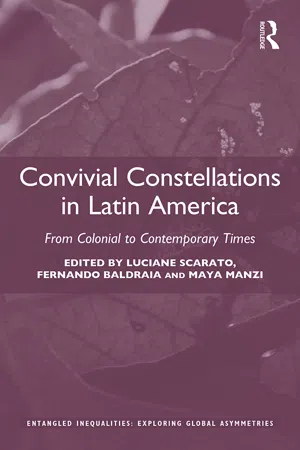
Drawing on diverse theoretical perspectives on conviviality, this book considers the ways in which Latin America, a continent marked by deep inequalities, has managed to afford, create, sustain, and contest forms of living together with difference across time and space. Interdisciplinary in approach and presenting studies from various nations across the continent – from the medieval period to the present day – it considers the ways in which Latin America might contribute to our understanding of the relationship between inequality, difference, diversity, and sociability. As such, it will appeal to scholars of history, sociology, geography, anthropology, development studies, postcolonial and social theory with interests in Latin American studies, and in the contingencies and contradictions of living together in profoundly unequal societies.
eBook - ePub
Convivial Constellations in Latin America
From Colonial to Contemporary Times
- 182 pages
- English
- ePUB (mobile friendly)
- Available on iOS & Android
eBook - ePub
Convivial Constellations in Latin America
From Colonial to Contemporary Times
About this book
Information
Part One
Convivial bonds
1 The neglected nexus between conviviality and inequality
Until the lions invent their own stories, the hunters will always be the heroes of the hunting narratives.
(African proverb cited Couto 2012, p. 9)
Introduction
Since Ivan Illich (1973) incorporated the term conviviality to the humanities vocabulary, a wide variety of heterogeneous contributions have applied the categories and tools developed by Illich to various fields of knowledge or have expanded and reformed his concepts to adapt them to the study of contemporary problems. This chapter has two objectives. The first is to systematize this vast discussion, seeking to grasp, in its various currents and forms, useful ideas that could support a research program dedicated to studying the nexus of the reciprocal constitution between conviviality and inequality. The second objective stems from the first. In dialog with the reviewed literature, the chapter seeks to specify the nexus between inequality and conviviality and to offer some methodological suggestions on how to study this nexus. These two objectives determine the structure of this text. While the first and longer section reviews the debate about conviviality, the second discusses the nexus between conviviality and inequality. The third and final section focuses on methodological aspects.
Conviviality: state of the art
Based on three etymologically related concepts, konvivenz, convivialisme, and conviviality, a varied group of analytical and normative programs has recently emerged. Despite their affinities and overlapping, these programs have developed independently, motivated by theoretical and political impulses that are not always congruent and compatible with each other. Nevertheless, their etymological kinship reveals common concerns. This involves, in all the cases, the analysis of and search for ways to live together in society. In some approaches, “living together” is understood not only as ordinary life among human beings, but also between humans and non-humans, such as plants and animals, spirits, and artefacts.
Convivialisme
Discussions on convivialisme can be traced back to the French journal MAUSS (Mouvement anti-utilitariste dans les sciences sociales) and sociologist Alain Caillé at the University Paris-Nanterre. With the publication of the Convivialist Manifesto in 2013 (Les Convivialistes 2013) and its translation into various languages, the discussions about convivialisme began spreading far beyond France. From a theoretical perspective, convivialisme relates to the work of French anthropologist and sociologist Marcel Mauss (1872–1950), specifically on his argument that the gift and not utilitarian reason is the primordial and foundational element of social interactions. Another important tenet of convivialisme is the critique of economic growth developed by thinkers such as economist Serge Latouche and philosopher Patrick Viveret (2014). According to this critique, the living standard attained by the richest countries in the 1970s should serve as a worldwide and universal standard of material wealth. This implies a global redistribution of wealth and the development of sustainable production technologies dedicated to a new form of relating to nature and with other living beings (Les Convivialistes 2013, p. 32). Politically speaking, convivialisme is a doctrine that, according to Caillé (2011, p. 8), “simultaneously synthesizes and goes beyond the four grand ideologies of modernity: liberalism, socialism, anarchism and communism.”
According to the diagnosis of the convivialists (Les Convivialistes 2013, p. 26), capitalism, especially in its current configuration of financial capitalism, destroys the greatest human asset, which is “the richness of its social relations.” By disrupting conviviality among human beings, capitalism also undermines their relationship with nature. Accordingly, capitalism produces social inequalities between people, countries, and regions, which, ethically unacceptable, prevent an equilibrium between working and living, thus destroying solidarity and the ecological basis of existence. Based on this diagnosis, the convivialists defend a course change that would lead towards the creation of a convivial society, constructed under democratic conditions and through respect for social, cultural, and existential plurality (Caillé and Chanial 2014). Although the Convivialists themselves can be seen as a transnational social movement, convivialisme as a concept is used to articulate a diverse range of other social movements, including critical movements of economic growth and deacceleration (décroissance, degrowth, slow food, etc.), alongside ecological movements (Adloff 2018).
Konvivenz
The neologism Konvivenz was coined in the realm of the Lebenswissen (Life Knowledge) research program, led, in the past two decades, by the literary scholar Ottmar Ette from the German university of Potsdam. Today, the program has adepts in various universities in Germany, Latin America, and the Caribbean, at research centers with which Ette and his group collaborate. According to the Life Knowledge program, the concept of Konvivenz has a primordial function: it makes intelligible the very idea of life with its irreversible, indivisible, and unforeseeable character. To live together in society thus represents the context of experience in which knowledge about living is generated and exchanged. Literature, and particularly literature “without a fixed abode,” is the vehicle that transports the “knowledge about living together.” At the same time, however, literature is more than a vehicle. In contact with its contemporary and future readers, literature itself produces knowledge about and for living together (Ette 2010, 2012, p. 70 ff.).
The concept of culture related to the Life Knowledge Program rejects the idea of cultures as closed containers that coexist, multiculturally, alongside each other. It also does not involve an intercultural relationship, in which stable cultural units communicate with each other. Instead, the establishment of polylogical structures of thinking, understanding, and translation originate a transcultural mixture, largely characterized by the mutual transformation of cultures that interpenetrate and merge with each other (Ette 2012, p. 89).
The semantic of cultural mixing that uses metaphors such as cultural archipelagos and kaleidoscopes connects the Life Knowledge program with the environments, theoretical lines, and concepts developed by intellectuals from the former French and Spanish colonies in the Caribbean. This is particularly clear in the discussion undertaken by Gesine Müller (2018) on concepts such as creolité and caribeanidad.
Conviviality
The term conviviality is currently associated with various analytical and theoretical programs. Some are closer, others farther from the definition coined when the term was introduced into the humanities vocabulary in Tools for Conviviality (Illich 1973). At that time, theologist and philosopher Ivan Illich was leading in Cuernavaca, Mexico, the Centro Intercultural de Documentación (CIDOC), a space where intellectuals from Latin American and various parts of the world gathered. At least two important sources inspire his book, both theoretically and politically. The first is generically called the 1960s third-worldist movement, which incorporated elements from African decolonial movements and highly diverse voices in support of the oppressed that spread throughout Latin America at the time – from local reconstructions of Marxism to the liberation theology of Gustavo Gutiérrez and Hélder Câmara and the pedagogy of the oppressed developed by Paulo Freire. Illich not only read them but was a regular interlocutor close to all these intellectuals (Hartch 2015). Illich’s second inspiration comes from the radical humanism of thinkers such as Erich Fromm, who was also a friend and interlocutor, with whom Illich shared the interpretation that capitalist rationality and various forms of totalitarianism systematically scorn human talent and virtues. Given these inspirations, it is not surprising that Illich’s book from 1973 contains a normative appeal to self-limitation (of consumption and material welfare) despite the increasing possibilities raised by technical and industrial development. For Illich, only by renouncing instrumental and unidimensional rationality, which is intrinsic to industrial capitalism, can human beings reach convivial life, which is synonymous with emancipation:
I choose the term ‘conviviality’ to designate the opposite of industrial productivity. I intend it to mean autonomous and creative intercourse among persons, and the intercourse of persons with their environment; and this in contrast with the conditioned response of persons to the demands made upon them by others, and by a man-made environment.
(Illich 1973, p. 11)
It is not an exaggeration to say that after being forgotten for decades, Illich’s work has recently experienced a true revival, given the recurrence and enthusiasm with which his tools for conviviality have been reinvented and rediscovered in various fields. Illich was the inspiration behind the first articulations of convivialisme in 2010 (Adloff 2018, p. 11), although, since its rise, the movement has aggregated various references in a way that Illich’s influence is no longer clearly visible in contemporary discussions on convivialisme. The posthuman turn, however, has most decisively revived and expanded Illich’s work, as detailed next.
Posthuman conviviality
In the field of posthuman studies,1 Illich became a repeated reference because of his insistence on the interdependence among living beings. To exemplify this trend, various works from two distinct disciplines can be mentioned. The first example comes from urban geography: Hinchliffe and Whatmore (2006) expand and refine the thesis of Tools of Conviviality, building on a variety of inspirations that range from the Deluzian theory of minoritarian politics and feminist philosophy to the actor-network theory of Bruno Latour and Isabelle Stengers. From these influences arise the concept of living cities that, contrary to the planning and constructing modern ascetic and sterile cities, are living spaces of interaction between humans and non-humans (Hinchliffe and Whatmore 2006). For urban planning, this understanding implies treating cities as multispecies entanglements (Houston et al. 2018), that is, as spaces shared by human and non-humans, which are not in relationships based on competition or cooperation, but conduct interdependent lives.
The second example is the study of the archeologist Given (2017) about conviviality in soil. Stemming from the fact that a gram of fertile soil can contain 200 million bacteria, Given argues that the soil constitutes a paradigmatic case to reveal the interdependencies between human beings that populate, nurture, and release detritus onto soil, and the non-human beings that contribute(d) to the daily transformation of sterile ground into fertile and living soil. According to this interpretation, instead of occupants, users, predators and, less frequently, those who recuperate the soil, human beings belong to a network of “players” who, living in symbiosis, make of the soil what it is. Given affirms that the emphasis on symbiosis should not imply reducing conviviality to relations of cooperation, given that tension and conflict are a constitutive and necessary part of the convivial relations between humans and non-humans, including among non-humans, on which the maintenance of the life cycle of the soil depends.2
Through the incorporation of the idea of conviviality to the paradigm of posthuman, important discussions have risen about the role and form of both knowledge and technique that stem from the thesis of irremediable interdependence between humans and non-humans. Authors involved in these debates argue that the modern division of disciplines between the natural sciences, and the humanities and social sciences; the distinction between lay knowledge and specialized knowledge; and the separation between scientific and sensorial apprehension of the world constitute serious impediment to understanding the networks of interdependences. In living cities, gardeners, amateur ornithologists and entomologists, and homeless people contribute as much to understanding the interactions in point as professional environmentalists and scientists do (Hinchliffe and Whatmore 2006, p. 131). Concerning soils, Given (2017, p. 133) brings to attention the limits of theoretical-analytical thinking and the need of complementary sensorial experience such as touching and feeling the soil: “people’s material engagement with the conviviality of soil has to target what is perceptible as they engage in their various soil tasks: texture, colour, smell, stones, larger pieces of vegetable matter […].”
Current debates on the consequences of the posthuman turn for critical technology studies build on Illich’s concerns. Accordingly, arguments developed in this field warn that technological innovation cannot be limited to reducing the impact of technology on nature, and operate under the assumption that human beings and the artefacts they create are part of a universe exterior to nature. It is mandatory to accept the inseparability between humans and non-humans to create technologies capable of interacting with nature: “the ideal of convivial technologies is clearly that of being useful in an ecological cycle” (Vetter 2017, p. 1783).
Fragile convivialities
In addition to the efforts to update and give continuity to Illich’s reflections, the term conviviality has also been widely used in contemporary debate, in other contexts, and with other meanings, without necessarily referring to his pioneering work. This is the case with British sociologist Paul Gilroy (2004, 2006) who turns to the concept of conviviality to respond to various challenges that have a common origin: the reification of identity. This involves, in the first place, a criticism of the mobilization of the vocabulary that celebrates individual or collective identities for the purpose of aggregating market value to products and services by branding them ...
Table of contents
- Cover
- Half Title
- Series Page
- Title Page
- Copyright Page
- Table of Contents
- List of figures
- List of contributors
- Introduction
- PART ONE: Convivial bonds
- PART TWO: Conviviality between norm and praxis
- PART THREE: Contested conviviality
- Index
Trusted by 375,005 students
Access to over 1.5 million titles for a fair monthly price.
Study more efficiently using our study tools.
Frequently asked questions
Yes, you can cancel anytime from the Subscription tab in your account settings on the Perlego website. Your subscription will stay active until the end of your current billing period. Learn how to cancel your subscription
No, books cannot be downloaded as external files, such as PDFs, for use outside of Perlego. However, you can download books within the Perlego app for offline reading on mobile or tablet. Learn how to download books offline
Perlego offers two plans: Essential and Complete
- Essential is ideal for learners and professionals who enjoy exploring a wide range of subjects. Access the Essential Library with 800,000+ trusted titles and best-sellers across business, personal growth, and the humanities. Includes unlimited reading time and Standard Read Aloud voice.
- Complete: Perfect for advanced learners and researchers needing full, unrestricted access. Unlock 1.5M+ books across hundreds of subjects, including academic and specialized titles. The Complete Plan also includes advanced features like Premium Read Aloud and Research Assistant.
We are an online textbook subscription service, where you can get access to an entire online library for less than the price of a single book per month. With over 1.5 million books across 990+ topics, we’ve got you covered! Learn about our mission
Look out for the read-aloud symbol on your next book to see if you can listen to it. The read-aloud tool reads text aloud for you, highlighting the text as it is being read. You can pause it, speed it up and slow it down. Learn more about Read Aloud
Yes! You can use the Perlego app on both iOS and Android devices to read anytime, anywhere — even offline. Perfect for commutes or when you’re on the go.
Please note we cannot support devices running on iOS 13 and Android 7 or earlier. Learn more about using the app
Please note we cannot support devices running on iOS 13 and Android 7 or earlier. Learn more about using the app
Yes, you can access Convivial Constellations in Latin America by Luciane Scarato,Fernando Baldraia,Maya Manzi in PDF and/or ePUB format, as well as other popular books in Social Sciences & Sociology. We have over 1.5 million books available in our catalogue for you to explore.