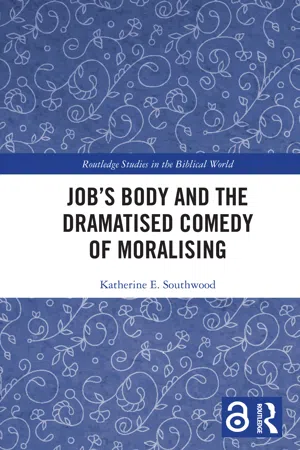
Job's Body and the Dramatised Comedy of Moralising
eBook - ePub

Job's Body and the Dramatised Comedy of Moralising

Job's Body and the Dramatized Comedy of "Advice"

  1. 190 pages
  2. English
  3. ePUB (mobile friendly)
  4. Available on iOS & Android
eBook - ePub

Job's Body and the Dramatised Comedy of Moralising

Job's Body and the Dramatized Comedy of "Advice"

About this book

This book focuses on the expressions used to describe Job's body in pain and on the reactions of his friends to explore the moral and social world reflected in the language and the values that their speeches betray.

A key contribution of this monograph is to highlight how the perspective of illness as retribution is powerfully refuted in Job's speeches and, in particular, to show how this is achieved through comedy. Comedy in Job is a powerful weapon used to expose and ridicule the idea of retribution. Rejecting the approach of retrospective diagnosis, this monograph carefully analyses the expression of pain in Job focusing specifically on somatic language used in the deity attack metaphors, in the deity surveillance metaphors and in the language connected to the body and social status. These metaphors are analysed in a comparative way using research from medical anthropology and sociology which focuses on illness narratives and expressions of pain.

Job's Body and the Dramatised Comedy of Moralising will be of interest to anyone working on the Book of Job, as well as those with an interest in suffering and pain in the Hebrew Bible more broadly.

Trusted byĀ 375,005 students

Access to over 1.5 million titles for a fair monthly price.

Study more efficiently using our study tools.

Information

Publisher
Routledge
Year
2020
Print ISBN
9780367462574
eBook ISBN
9781000163414

1 Introduction and methods

DOI: 10.4324/9781003029489-1

Introduction

Eskenazi comments ā€˜nowhere else in the Bible is the face of the other in utterly uncontainable pain so carefully and relentlessly attended to than in the book of Job’ (Eskenazi 2003:68). More dramatically phrased, Duhm suggested that Job ā€˜wrote with his own blood’ (Duhm 1897:ix). A key feature of Job is the persistent focus on the protagonist’s body in pain and how this changes the social dynamic between Job and his friends. As will be demonstrated, the book reveals little to nothing about disease. Nevertheless, this monograph argues that there is a clear case to be made for Job’s contribution to our understanding of how pain and illness were imagined and contextualised socially at the time of writing and for early audiences. In the book of Job, illness and pain are presented as moral events that provoke profound introspection but also, more importantly, as culturally salient events which cause the community to question its meaning and significance as well as their own values. This is achieved in the book of Job through tragedy but also, importantly, through comedy. The entire scenario is rather surreal, the one-dimensional characters Eliphaz, Bildad, and Zophar (and Elihu) are overflowing with moralising advice, and the main protagonist is a pompous, self-aggrandising windbag. We should note here that by ā€˜moralising’ language and advice, what is meant is judgemental communication – speech emphasising personal responsibility and incriminating assumptions embedded within advice. Moralising is specifically embedded within language and interaction. This is because, as Newsom observes, ā€˜every way of talking implies a moral and a social world’ so that ā€˜all sorts of values are built into talk, not only in what is explicitly affirmed or criticized but also in the structure and texture of the talk and what it requires of one who hears and responds to it’ (Newsom 1993:119).
One interesting critical niche concerning the body in Job can be found through using modern research focusing on illness and pain experiences and behaviours from medical anthropology and sociology comparatively with the dialogues in Job.1 This body of research enables us to assess critically the social dynamics between Job and his friends in a comparative way. There is a case to be made that the Hebrew Bible is far from irrelevant for the study of the social aspects of illness and pain. The book of Job, which can be dated to approximately the late exilic period, at the very earliest, or more likely, later in the post-exilic period,2 asks some of the most pertinent questions about community and provides a rich and fertile resource for examining the social ramifications of suffering. A key contribution of this monograph is to highlight the nuances of how the perspective of illness as retribution is powerfully refuted in Job’s speeches and, in particular, to show how this is achieved through satirical comedy. Comedy in Job is a weapon used to expose and ridicule the idea that suffering is punishment for some wrongdoing. A particular site upon which this exposure plays out is on Job’s body. The book, despite its many genres, and therefore its regular description as a ā€˜polyphonic’, ā€˜multivalent’, and less regular designation as a ā€˜contrapuntal’ text, is treated here as a coherent whole (Jones 2010; Newsom 2002). Indeed, the book of Job is imagined in this monograph as a drama to be performed with an audience, perhaps with some similarities to Aristophanes and the Athenian theatre. Therefore, perhaps like Aristophanes, ā€˜comic elements’ are used ā€˜to support serious points concerning his audience’s world and ideals’ (Lazarus 2014:47), Job is, we therefore argue, a dramatised comedy of ā€˜advice’.
1Although throughout this monograph we refer regularly to the research as coming from medical anthropology, there are also numerous references to research beyond this specific field. Therefore, it is acknowledged that although a lot of the comparative research is drawn from medical anthropology, we have not ruled out other relevant research simply for the benefit of remaining strictly within the limits of this discipline.
2A date in the exilic period would be, more specifically, to the very late sixth and the first half of the fifth century BCE, at the very earliest. This is partly on account of the resonance between parts of Job and Deutero-Isaiah, Lamentations, Psalms, Proverbs, and Jeremiah (although given their dating is also a matter of debate, the reasoning here is admittedly somewhat circular). The mention of ā€˜The Adversary’ is also a possible clue to quite a late dating, given the adversary appears only elsewhere in Zechariah and Chronicles. The matter is made more complex by the rather wide range of nonbiblical primary material that exhibits similarities with Job (refer to note 11).
In much of the Hebrew Bible we find a persistent stance on illness which aligns well with theories and arguments concerning retribution.3 A suitable example of this is the presence of illness in curses which come with not observing the covenant in Deuteronomy 28:4
3For a helpful summary of this and especially in terms of the nuances of the idea of retribution, which is not to be dismissed as ā€˜simplistic’, refer to Kaminsky’s article (Kaminsky 2015). Refer also to Dell 2000:32; Adamiak 1982. The treatment of the idea of retribution in this monograph is limited to a focus on the body.
4This is often viewed as stereotypical curse language which accompanies the breaking of a treaty, as is found in comparative material such as the Vassal Treaties of Esarhaddon, the Syrian and Assyrian Treaties, Hittite Treaties, and the Code of Hammurabi, as well as the Sefire Inscriptions and the Tel Fakhariyah inscription (refer to Quick 2017; pace Crouch 2014). The grouping of curses into the different categories which Hillers suggests is helpful, and these would be considered divine curses (Hillers 1964; refer also to the discussion of curses in Kitz 2014).
The Lord will make the pestilence5 cling to you until it has consumed you … The Lord will afflict you with consumption, fever, inflammation, with fiery heat6 and drought, and with blight and mildew … The Lord will afflict you with the boils of Egypt,7 with ulcers, scurvy, and itch,8 of which you cannot be healed. The Lord will afflict you with madness, blindness, and confusion of mind.9
(Deuteronomy 28:21–22, 27–28)
5The term translated here as ā€œpestilenceā€ (דֶבֶר) is possibly ā€˜an infectious disease of epidemic proportions’ which the LXX ā€˜translates with θάνατον (death)’ (Lundbom 2013:770; cf. Jer. 21:6; Hos. 13:14). However, given the perils of retrospective diagnosis, which we will later discuss, Lundbom is correct to exercise caution through vagueness.
6ā€˜Consumption’ (שחפת), ā€˜fever’ (קדחת), ā€˜fiery heat’ (×“×œ×§×Ŗ + חרחר). It is not clear what these terms refer to. The term קדחת is a hapax legomenon which the LXX translates with πυρετῷ (ā€˜fever’). Various theories about what these conditions might mean exist (Lundbom 2013:770; Nelson 2002:331; Mayes 1979:354; Driver 1902:208).
7It is not clear what ā€˜boils’ (שחין) of Egypt means. The same term is used in the prologue of Job (Job 2:7–8). The term is sometimes linked to the unknown condition צרעת on account of the link between them in Leviticus (Lev. 13:20). Refer to note 35 for a discussion of צרעת.
8עפל is usually translated ā€˜tumour’ or ā€˜haemorrhoid’ (NRSV ā€˜ulcer’). The qere has ×˜×—×Ø×™× also meaning ā€˜haemorrhoids’ (but a perpetual qere, euphemistically replacing potentially offensive terms), as BHQ notes. The LXX reads ā€˜an Egyptian boil in the seats’ (ἐν ἕλκει Αἰγυπτίῳ ἐν ταῖς ἕΓραις) which combines the first two afflictions. The term translated by NRSV as ā€˜scurvy’ (גרב) seems to affect both humans and animals in Lev. 21:20 and 22:22 and is understood by the LXX as ā€˜a severe itch’ (ĻˆĻŽĻį¾³ ἀγρίᾳ). Similarly, the hapax legomenon חֶרֶה seems to mean ā€˜itch’. Again, it is best to be vague here, given the perils of retrospective diagnosis, which will be discussed later.
9The conditions ā€˜madness, blindness, and confusion of mind’ could be understood in an atomistic way as separate problems or could be understood as a three-fold description of the same problem seemingly related to some kind of physical, mental, or emotional disorientation.
Here the implication is that if you fail to uphold your side of the covenant that is tantamount to bringing the listed conditions upon yourself. These ailments can simply be avoided through human agency: to live in an upright manner in accordance with the covenant will, after all, mean that the god YHWH will ā€˜turn away from you every illness; all the dread diseases of Egypt … he will not inflict on you’ (Deut. 7:15). Such reasoning also appears in other sources which compare with Job (Magdalene 2007). To use an Akkadian example, in the Dialogue Between a Man and His God the young man is ā€˜sickened with his burden’ and admits ā€˜I have blasphemed you’ after which the god orders restoration of health,10 stating:
10The focus of this monograph is on illness rather than healing. However, it is appropriate to point out that in much of the Hebrew Bible and comparative literature, as in this example, healing is often the responsibility of the deity (Pilch 2000:62).
Your disease is under control, let your heart not be despondent! The years and days you were filled with misery are over. How could you have lasted the whole of this grievous illness? You have seen distress … is (now) held back. You have borne its massive load to the end.
(Hallo and Younger 1997:485)11
11Refer also to Lambert’s translation: Lambert 1987:187–202. Numerous parallels to the book of Job exist. For example, in Egyptian material The Admonitions of Ipuwer cites the conventional belief ā€˜He [God] is the herdsman of all; there is no evil in his heart … only lament the wickedness that the deity allowed to stand’. Because of the social upheaval, the author denies the existence of a providential deity guiding human affairs. He asks: ā€˜Where is he today? Is he asleep?’ Similarly, the Dispute Between a Man and His Ba describes a miserable person who tries to persuade his soul to join him in a pact to commit suicide. The man longs for death which is ā€˜like a sick man’s recovery’. Likewise, the Eloquent Peasant welcomes death ā€˜a thirsty man’s approach to water, an infant’s mouth reaching for milk, thus is a longed-for death seen coming thus does his death arrive at last’. Like the book of Job, these texts have prose frameworks enclosing poetic complaints. In Mesopotamian material we have I Will Praise the Lord of Wisdom wherein the sufferer believes in compassion: ā€˜I will praise the Lord of wisdom … whose heart is merciful … whose gentle hand sustains the dying’. Also relevant is the Babylonian Theodicy which resembles Job in that a sufferer engages in a dispute with a learned friend. Finally, The Dialogue Between a Master and His Slave has similarities with Job...

Table of contents

  1. Cover
  2. Half Title
  3. Series
  4. Title
  5. Copyright
  6. Dedication
  7. Contents
  8. Preface
  9. 1 Introduction and methods
  10. 2 Methinks the Job, he doth protest too much
  11. 3 The tyranny of tradition
  12. 4 Pride comes before a fool: Job’s loss of social status
  13. 5 Is the answer for Job blowin’ in the wind?
  14. Name index
  15. Subject index
  16. Job’s body: index of scriptural references

Frequently asked questions

Yes, you can cancel anytime from the Subscription tab in your account settings on the Perlego website. Your subscription will stay active until the end of your current billing period. Learn how to cancel your subscription
No, books cannot be downloaded as external files, such as PDFs, for use outside of Perlego. However, you can download books within the Perlego app for offline reading on mobile or tablet. Learn how to download books offline
Perlego offers two plans: Essential and Complete
  • Essential is ideal for learners and professionals who enjoy exploring a wide range of subjects. Access the Essential Library with 800,000+ trusted titles and best-sellers across business, personal growth, and the humanities. Includes unlimited reading time and Standard Read Aloud voice.
  • Complete: Perfect for advanced learners and researchers needing full, unrestricted access. Unlock 1.5M+ books across hundreds of subjects, including academic and specialized titles. The Complete Plan also includes advanced features like Premium Read Aloud and Research Assistant.
Both plans are available with monthly, semester, or annual billing cycles.
We are an online textbook subscription service, where you can get access to an entire online library for less than the price of a single book per month. With over 1.5 million books across 990+ topics, we’ve got you covered! Learn about our mission
Look out for the read-aloud symbol on your next book to see if you can listen to it. The read-aloud tool reads text aloud for you, highlighting the text as it is being read. You can pause it, speed it up and slow it down. Learn more about Read Aloud
Yes! You can use the Perlego app on both iOS and Android devices to read anytime, anywhere — even offline. Perfect for commutes or when you’re on the go.
Please note we cannot support devices running on iOS 13 and Android 7 or earlier. Learn more about using the app
Yes, you can access Job's Body and the Dramatised Comedy of Moralising by Katherine E. Southwood in PDF and/or ePUB format, as well as other popular books in Education & Teaching Arts & Humanities. We have over 1.5 million books available in our catalogue for you to explore.