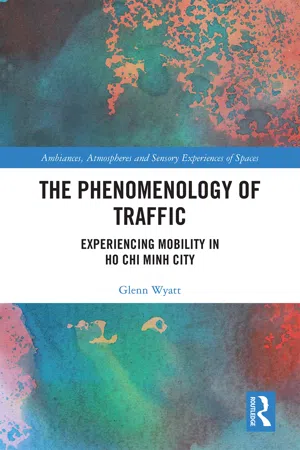
The book delves into the affective, embodied, and sensory dimensions of traffic and urban mobility. It brings together key phenomenological and post-phenomenological readings to challenge taken for granted assumptions of urban traffic.
Through the experiences of traffic users in Ho Chi Minh City, Vietnam, the book provides fascinating pathways into structures and processes that make up phenomenal traffic worlds. It explores the nature of the traffic experience, modalities of existence within it, and the wide spectrum of awarenesses involved in making sense from non-sense. The book offers rich theoretical insights on how we feel our way through our affect-laden worlds. Through empirical examples from the urban traffic in Ho Chi Minh City, the book explores this fluid, constantly changing complex collective of ongoing negotiations we call 'traffic,' often emotional, involving and producing all kinds of entities. It develops a range of philosophical concepts in order to better understand the complex relationships between humans and non-humans in everyday settings.
Offering innovative insights into the structures, authorities, materialities and forms of power that shape our experiences of traffic, this book will be of interest to students, scholars and practitioners interested in philosophy, cultural geography, mobilities, transport studies, cultural studies, and urban studies.
Recently, I met with a Vietnamese friend after work, in a quiet bar, conveniently located to both our apartments. Like most other traffic users in Ho Chi Minh City (HCMC), to get from home to work and vice versa, she rides her motorcycle through traffic conditions, the likes of which citizens in many other cities could not even imagine. This daily practice that one might refer to as the ‘mundane commute,’ in HCMC, comes with no small amount of danger and accumulated ill effects on health. Riding a motorcycle in HCMC might be a mundane activity, but that doesn’t mean that it is not a dangerous (and, perhaps, slightly crazy) thing to do, given the risks. For most, driving a car, or taking a taxi or Grab car is not economically viable, and given the lack of public transportation services in the city, my friend, like most others (like myself), has little choice but to enter this typhoon of sociotechnical manic activity, every day, and generally without complaint.
Over the many years we have known each other, my friend has, on occasion, shared with me some nostalgic memories of her childhood, of growing up in HCMC, where just to pass the time, she often leisurely rode her bicycle great distances around the city. Those nostalgic days of riding for leisure now seem firmly in the past. In HCMC, participation in the traffic forms a substantial and challenging dimension to one’s existence, and every moment my friend spends in the traffic, she contributes, unknowingly, to its current form, as it, equally unknowingly, contributes to the person I know as Châu. In the traffic in HCMC, we all “find ourselves in a buzzing world, amid a democracy of fellow creatures” (Whitehead, 1978, p. 50), in a world full of actualities that exist in the same sense as we do (Hosinski, 1993), vying for the right to move forward, but in a democracy where physical size matters.
From inside the bar, I watch as she parks her scooter on the footpath and removes some of her traffic apparel: helmet, gloves, ‘hoodie’ jacket, and facemask. She wears less additional ‘traffic’ clothing than many other female motorcyclists in the city, who have earned the name ‘ninjas,’ wrapped as they often are, from head-to-toe in traffic accessories that are worn over their regular clothes; stealthful and anonymous, yet in less clandestine ways, somehow always managing to get in my way. As Châu enters the air-conditioned bar, with its warm yellow-lit ambience and quiet music, the traffic noise from outside briefly enters with her through the open door, temporarily changing the mood inside, a reminder of the vast difference between the two worlds. I turn to greet her, and, when closer, I am struck by her expression. I see signs of accumulated stress and exhaustion, so much so, in fact, that her face is almost frozen into a mask, as though she has just experienced a haunting. I know this person to be extraordinarily patient and forgiving, but I sense an imminent implosion or explosion, and so scurry to find her a glass of wine.
Figure 1.1 Negotiating for mobility rights in a common space. Copyright 2016 by G. Wyatt.
She sits down next to me, still looking somewhat harassed as her eyes stare out, unfocused, and unseeing. As she stares blankly, her body is still, but I imagine her mind is anything but immobile, perhaps still buzzing with ghost motorcycles, the constant beeping of horns, the smell of exhaust fumes, the roar of engines, and the kamikaze buses that career through the HCMC streets, forging their own paths like ice-breaker ships or snow ploughs. She removes her jacket slowly and consciously, as though intentionally excommuning, as though it were a sacred rite that might shed the layers of dust, heat, and noise from which she has just been extricated. Yet, the quiet ambience of the bar still remains beyond her; she is yet to find it, yet to dwell in it. As her eyes and brain begin to focus again on the here and now, she picks up a menu from the table, but before considering its contents, turns to me, and with some resignation, but still that defiant resilience that comes with being Vietnamese, she says, “if Vietnam ever has another war, I know we will win again.” In a culture that prizes courage and confidence and does not shrink from a fight, vying for mobility rights can be a serious affair.
Edensor (2010) notes that “place is characterized by the mobilities that course through it” (p. 5), and the aesthetic character of HCMC would, no doubt, be a very different kind of place without its particular version of a traffic system.
For people new to HCMC (as well as some who are not so new), this is traffic that challenges our conceptions of what ‘traffic’ is or even should be, and it can be a common topic of conversation amongst Vietnamese locals and expatriates alike. Visitors to the city are often seen standing by the roadside taking videos of the traffic, as though they were witnessing the migration herds of wild animals, or simply looking perplexed, caught like an insect in an amber bubble of indecision and confusion, simply unable to figure out just how to cross the street. I suspect that this fascination resides in the fact that while the traffic contains the usual universal paraphernalia of traffic: traffic lights, stop signs, cars, etc., it operates according to a logic different to traffic in other cities. In other words, whilst it still looks like a duck, it doesn’t really seem to walk like one, and oftentimes, I hear visitors make comment that they are surprised not to have seen an accident or that “it seems to work,” a sentence uttered in complete amazement.
Mobility in the HCMC traffic system can be less like commuting, and more like surviving, striving, being prepared to leave everything on the fighting room floor if that is what it takes. This sounds negative, but, in many ways, the experience of being in HCMC traffic is a high-octane adventure, where one gets the chance to continually sharpen one’s skills, techniques, and wits, never quite knowing what might happen next. Bissell (2018), in the introduction to his recent book on commuting practices, points out that the word commute comes from the term commutation, whereby multiple single railway passenger tickets were commuted into a single payment railway pass. To commute is to be subsumed into Fordist efficiencies and mundane modes of moving the masses: seamless, uniform, and homogenized. The term ‘commute’ conjures images of a bus ride home from the office through unexceptional suburbs or being shunted through the concrete caverns of a subway system, isolated in a crowd of nameless faces with eyes transfixed to smartphone screens, like rabbits in headlights, frozen under fluorescent glare. In contrast to this, the unique structures of mobilization in HCMC were not born of the efficiencies of Fordist paradigms, but, instead, grew out of a complex, multi-layered mix of histories, beliefs, rural practices, technologies, and colonial influences.
Figure 1.2 Traffic-themed graffiti in District 2, HCMC. Copyright 2019 by G. Wyatt.
The style of mobility in HCMC seems much less like commuting and much more like being caught up in a blizzard of constantly changing heterogeneous materiality, a dynamic, buzzing, zipping high-stakes chess game, and one Vietnamese scholar (Phạm, 2012) has made comment that the traffic in Vietnam is growing so fast that it is completely reconfiguring the traditional structure of society. My friend, on arriving at the bar, feels, I suspect, as though she has just been through some kind of war zone, not quite unscathed, in an environment where ethics are evolving parallel with emerging traffic practices. Most people who have lived some years in the city will say that the traffic has changed enormously in recent years and now seems more dangerous, perhaps because it is more heterogeneous, with many more cars, buses, and trucks, the speeds are faster, and the margins for error are becoming narrower. As cars increasingly dominate the physical space, often taking over the motorcycle lanes, an atmosphere brews in the traffic like a pressure cooker, an affective presence that has a profound influence on the emergence of new practices.
Sherburne, a scholar of the philosopher Alfred North Whitehead, quoting the French poet François Villon, asks, Où sont les neiges d’antan? “Where are the snows of yesteryear and how are they related to the present?” (cited in Sherburne, 1967, p. 253). Sherburne points out that Whitehead’s answer to this would lead directly to God and that the past is preserved in the eternal realm, objectively immortal in his consequent nature. For Whitehead, it is God who sets up the initial conditions at the base of things, at the base of events, providing the seeds that inspire aims, cues, and relevance, resulting, over time – indeed, creating time – in outcomes of order that gel, if you like, with the unity of the universe. To view the HCMC traffic through Whitehead’s ontology is to see it as constituted by events, varying in structural complexity, where God is seen as the divine orderer (Whitehead, 1978). Not to say that the kinds of order that result from these processes are pre-ordained or without autonomous creativity – creativity is central to Whitehead’s scheme – but rather that the initial conditions set up by God limit or condition these creative processes (Whitehead, 1978) and therefore mediate the kinds of forms that emerge. Whitehead’s scheme relies on the preservation, in the eternal realm, of all that has ever been in actuality – such as in Vietnam’s past – which then, through God, finds its way back into the primordial processes that create the actual universe. However, whilst the traffic in HCMC might be seen as constituted by events, it is not the events themselves that endure over time – when an event is gone, it is gone (Whitehead, 1920) – but it is enduring forms that go on to inspire novel future outcomes. For Whitehead, God is viewed as the only possible means by which the past may be given in the present, because he endures eternally and exists outside of time, and therefore, God is the ontological ground for the “somewhere” of eternality (Sherburne, 1967, p. 252).
Whitehead’s process philosophy provides illuminating ways to view the complex processes and relationships through which eternal possibilities become concretely actualized. However, the existence of the entity ‘God’ in this scheme remains problematic for some scholars (Sherburne, 1967), existing almost as a kind of deus ex machina, a necessity existing beyond the temporal realm, and therefore able to create time itself. To consider Whitehead’s metaphysical scheme sans God is to raise a number of productive questions, such as by what processes and dynamics do enduring ‘things’ reach in from the past and affect contemporary events, causally speaking, what is the nature of such enduring forms, how are they passed on, and where they reside whilst waiting to play their part?
Since Whitehead’s time, the science of complexity – the notion of which is still open to debate (Corning, 1998; Érdi, 2008) – has evolved frameworks, definitions, and characteristics of systems that are dynamic and constituted through nonlinear relations, such as urban traffic systems. One of the most important characteristics of complex systems is a profound sensitivity to their histories, which fundamentally influences how they evolve over time. The endurances that resonate through the complex system that is the traffic in HCMC, for example, may have their seeds in historical events, but like Whitehead’s God, they inspire outcomes in the contemporary world in ways that are impossible to predict or even to causally connect. Vietnam’s ‘snows’ of yesteryear are characterized by the kinds of chaos that evolve in conditions of war, and this is a past that also includes years of extreme poverty, famine, and the complexities of colonialism. The question arises as to how this unique history might live on in the complex nonlinear dynamics that contribute to contemporary practices in Vietnam, for example, in its urban traffic. This is not to say that Vietnamese people consciously dwell in this history of war, but neither do they forget. There are many reminders of this history that are formally instituted in daily life, such as in commemorations of past events or in the names of streets, but HCMC is a young city, with much of its population born after the war (in fact, the population of Vietnam itself has the median age of 30 (CIA World Factbook, 2017), and, ...
Table of contents
Cover
Half Title
Series Page
Title Page
Copyright Page
Table of Contents
List of figures
Acknowledgements
Preface
1 The experience of traffic in Ho Chi Minh City
2 Towards a metaphysics of experiential complexity
3 History, capitalism, and the ethics of kinetics
4 The bifurcation of nature: matters of fact and matters of concern
5 Complexity and computer modelling of traffic
6 The character of character
7 What is a car?
8 The subject in traffic
9 Lures for driving and infrastructures of the ephemeral
10 The emergence of order
Epilogue
Index
Trusted by 375,005 students
Access to over 1.5 million titles for a fair monthly price.
Study more efficiently using our study tools.
Frequently asked questions
Yes, you can cancel anytime from the Subscription tab in your account settings on the Perlego website. Your subscription will stay active until the end of your current billing period. Learn how to cancel your subscription
No, books cannot be downloaded as external files, such as PDFs, for use outside of Perlego. However, you can download books within the Perlego app for offline reading on mobile or tablet. Learn how to download books offline
Perlego offers two plans: Essential and Complete
Essential is ideal for learners and professionals who enjoy exploring a wide range of subjects. Access the Essential Library with 800,000+ trusted titles and best-sellers across business, personal growth, and the humanities. Includes unlimited reading time and Standard Read Aloud voice.
Complete: Perfect for advanced learners and researchers needing full, unrestricted access. Unlock 1.5M+ books across hundreds of subjects, including academic and specialized titles. The Complete Plan also includes advanced features like Premium Read Aloud and Research Assistant.
Both plans are available with monthly, semester, or annual billing cycles.
We are an online textbook subscription service, where you can get access to an entire online library for less than the price of a single book per month. With over 1.5 million books across 990+ topics, we’ve got you covered! Learn about our mission
Look out for the read-aloud symbol on your next book to see if you can listen to it. The read-aloud tool reads text aloud for you, highlighting the text as it is being read. You can pause it, speed it up and slow it down. Learn more about Read Aloud
Yes! You can use the Perlego app on both iOS and Android devices to read anytime, anywhere — even offline. Perfect for commutes or when you’re on the go. Please note we cannot support devices running on iOS 13 and Android 7 or earlier. Learn more about using the app
Yes, you can access The Phenomenology of Traffic by Glenn Wyatt in PDF and/or ePUB format, as well as other popular books in Physical Sciences & Geography. We have over 1.5 million books available in our catalogue for you to explore.