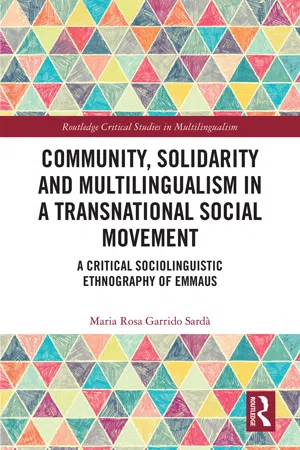
Community, solidarity and multilingualism in a transnational social movement presents a critical sociolinguistic ethnography of the Emmaus movement that analyses linguistic and discursive practices in two local communities in order to provide insight into solidarity discourses and transnational communication more broadly. Integrating perspectives from a range of disciplines, the monograph seeks to understand the ways in which social movements are maintained across disparate communities grounded in shared cultural referents and communicative practices but not necessarily a shared language. The book focuses on Emmaus, the solidarity movement that emerged in post-war France which brings formerly marginalised people together with others looking for an alternative lifestyle into live-in communities dedicated to recycling work and social projects.
The book first offers a historical overview of the Emmaus movement more generally, moving into an account of its development and spread across national and linguistic borders. The volume draws on data from two Emmaus communities in Barcelona and London to analyse the everyday communicative and discursive practices that appropriate and resignify the shared transnational movement ideas in different socio-political, economic, historical and linguistic contexts.
Community, solidarity and multilingualism in a transnational social movement considers the social implications of local practices on the situated (re)production and evolution of transnational social movements more generally and will be of particular interest to students and researchers in sociolinguistics, linguistic anthropology, discourse studies, cultural studies, and sociology.
1 Language, Discourse and Transnationalism in a Social Movement
1.1 Emmaus as a Holistic Social Movement
My first contact with Emmaus dates back to 2008 at a communal lunch in a refectory-style dining room in Barcelona1 bustling with chatter in different languages among over 30 people of different social backgrounds, geographical origins and age groups. I could not help but wonder: what brings all these diverse people together at this table?The answerlay in the painting of Abbé Pierre (Henri Grouès, 1912–2007) presiding over us. This image symbolises the origins of the solidarity movement that this French working priest founded in a similar community of ragpickerson the outskirts of post-war Paris. Immediately beneath the Abbé’s portrait, there was an aerial picture of the massive Barcelona demonstrations against the Iraq war in 2003. I imagined that the local ragpickers of Emmaus had participated in these massive mobilisations as had many other Leftist civil society organisations in Catalonia.
Fast forward to June 2009. I was sitting in a similar dining room in the first ever Emmaus community in Neuilly-Plaisance, in the Parisian banlieue. Everything looked familiar there, not only because of Abbé Pierre pictures and quotes but also because of the spatial layout, social diversity and communal routines such as the collective lunch that I was invited to. In this case, the main (but not only) language of interaction during lunch was French. My subsequent visits to four British Emmaus communities as part of this study in 2012 and 2013 revealed further symbolic and organisational commonalities in similar groups elsewhere. Linguistically, English was the main language used in these communities. These ethnographic visits to Emmaus communities in France, the UK and Catalonia showed that the figure of Abbé Pierre seemed to give meaning, structure and legitimacy to the Emmaus project, as part of a transnational imaginary shared by many similar local groups around the world.
Recalling my very first encounter with the Emmaus movement in Barcelona, the question of what united people at that table, and at many similar ones all over the world, boiled down to what was going on right there, right then: everyday communication; that is, people interacting with and showing concern for others in ways that (re)create feelings of connectedness. In every single Emmaus community that I have visited, I have invariably been invited for lunch, to share food and conversation with the local members. As a matter of fact, a magazine article on Emmaus Barcelona was entitled “Qui vulgui conèixer Emmaús que vingui a dinar”[Whoever wants to get to know Emmaus, come and have lunch] (2006) and was illustrated with a picture of the community members at the table. This is how visitors and newcomers first hear the stories about Abbé Pierre and the origins of the movement from old-timers (see Chapter 3). This made me wonder about the organisation of individual communities named “Emmaus” and their connections with other groups with the same name and origins, as well as other related social movements and the nation-state apparatus.
While recognising the many commonalities among these communities, my ethnography also foregrounds the differences among local communities in different nation-state contexts. Contrary to my expectations, based on what I had learned from my experiences in Emmaus Barcelona, I did not come across politicised images such as the anti-war demonstration shown in Figure 1.1 in any of the British groups that I visited. To my surprise, I saw pictures of Queen Elizabeth II and Union Jack flags decorating shop windows during the Diamond Jubilee in 2012 (see Figure 6.1) and of the Royal Patron of Emmaus UK, the Duchess of Cornwall, in newsletters. One would never see pictures of royalty or national flags in the Barcelona community, vested in alter-globalist discourses against hereditary privilege. Slowly, I came to realise that a social movement is as much about creating transnational sameness as it is about producing social difference locally. Soon enough, I became conscious that one of the key discursive tropes in this movement, that of “solidarity with others”, was interpreted and appropriated differently by each local Emmaus group. How do Emmaus communities construct sameness and difference at the same time? What differentiates the local communities? To which discourses and social arenas is “solidarity” connected in local contexts? How do the Emmaus members from different communities talk to each other? These are the some of the questions that I seek to answer in this monograph.
Figure 1.1 Dining room in Emmaus Barcelona, 2012. Pictures taken by Maria Rosa Garrido Sardà, with permission of the community.
Over the years, I have become fascinated by the holistic nature of the Emmaus movement. Emmaus resembles very few other community- based initiatives, such as Taizé, L’Arche or Comunità di Sant’Egidio.2 Unlike these three examples, and in spite of its early Catholic inspiration, Emmaus is a non-denominational movement where believers and non-believers lead a collective, simple lifestyle to help “those less fortunate” according to the Universal Manifesto of the Emmaus movement (see Appendix 1). Following Bergier (1992), I conceptualise Emmaus as a holistic movement that merges unconditional shelter (accueil in French, acollida in Catalan), cooperative work and social service. The basic pillar of unconditional shelter materialises in local “communities” of “companions” (i.e. residents). An Emmaus community is a social environment in which people from different social backgrounds live and work together for the solidarity mission. According to the Universal Manifesto, any person is welcome regardless of religion, nationality or language, in conformity with the Declaration of Human Rights (UN General Assembly, 1948). The Emmaus philosophy is contrary to traditional charity and challenges the helper/helped dichotomy, as the companions provide support and affection for those who are even worse off.
Companions who live in an Emmaus community collectively engage in voluntary recycling work (Figure 1.2), prioritised by the Universal Manifesto of the Emmaus movement (see Appendix 1) as a “primary means” for the Emmaus mission. This economic activity makes communities self-sustainable, covering the companions’ basic needs. The surplus from ragpicking work also allows Emmaus groups to offer local social services to third parties and/or to cooperate with other Emmaus groups and external co-development projects. To maintain their dignity and self-esteem, each person contributes to the recycling process according to their qualifications, skills and preferences. Alberto, a longstanding companion in Barcelona, claimed that “la vida familiar está unida al mundo laboral” [family life and work are united] in the social and labour reinsertion process (interview, 27 March 2012). Unlike the situation in for-profit private companies, companions are asked to work according to their ability. Alberto views Emmaus Barcelona as a “community of life and work”, linking the Emmaus surrogate “family” to their social entreprise.
Figure 1.2 Second-hand shop, Emmaus Barcelona. Photo by Ivan Barrios Andelo, reproduced with permission.
Concerning social service in Emmaus, the obligation to “serve first those who suffer most” is not just charity aimed at minimising extreme poverty and homelessness; it is also social protest, reacting to the structural causes of inequality (see Article 6 in the Universal Manifesto, Appendix 1). Abbé Pierre opposed bourgeois charity, which he had witnessed as a child, because it maintains the status quo. In late modernity, recycling labour recreates social belonging in the Fordist period in an altered context in which the nation-state offloads care services to voluntary associations (Muehlebach, 2011). Abbé Pierre disagreed with the Leftist tendency to bypass immediate suffering in order to hasten the revolution. His vision was that the privileged and the underprivileged should join forces for social transformation through Emmaus. The Rule of Emmaus captures this double mission: “In the face of any human suffering, as far as you can, work not only to provide relief without delay but to destroy its causes. Work not only to destroy its causes, but to provide relief without delay” (English version taken from Brodiez-Dolino, 2013, unnumbered page).
Today, Emmaus has more than 350 local groups in 37 nation-states (as of 2015, source: Emmaus International, 2019, https://emmaus-international.org/images/site/menu-secondaire/publications/carte-monde/CARTE_MONDE_EMMAUS_EN_2015_bd.pdf), which makes it linguistically and discursively heterogeneous. My critical sociolinguistic ethnography (Heller, 2011) of Emmaus examines a transnational movement and shared imaginary formed by local communities in different nation-state contexts. This book has two main strands. First, it investigates the situated construction of Emmaus as an imagined community through daily discursive and communicative practices. Second, it takes an ethnographic approach to the discursive appropriations of shared linguistic and discursive resources in different socio-political, economic, historical and sociolinguistic contexts. This monograph is mainly based on intensive ethnographic fieldwork conducted in two Emmaus communities, located in the Barcelona metropolitan area and in Greater London, complemented with visits to the first Emmaus community in Neuilly-Plaisance, the annual Salon Emmaüs in Paris, the Centre Abbé Pierre Emmaüs in Esteville and other European Emmaus communities, as well as the celebration of the 50th Anniversary of the adoption of the Universal Manifesto of the Emmaus movement (May 2019). Besides, the Emmaus movement and the two research sites in my study have been historicised thanks to the Emmaus International Archives located in Roubaix (France).
Emmaus Barcelona is a grassroots community founded in 1980 by young people who were introduced to the movement and its founder at work camps in the 1970s (see Chapter 2). In 2012, it had 14 companions, over 20 volunteers and 3 employees (cook, driver and part-time shop assistant). Decisions were made in community assemblies of companions, four of whom were responsables in a system of primus inter pares. The community led an alternative lifestyle, supported by two second-hand shops and collaboration agreements with the local administration. The financial surplus obtained was employed in co-development projects in Central and South America, in a three-month residential project in the local community (2003–2011) and in a smaller-scale external housing project for unhoused migrants. This group was deeply embedded in the tradition of Social Catholicism, with links to Latin America, andpost-’68 ideals now fused into alter-globalist agendas (see Chapter 4).
This community is located in a city on the outskirts of Barcelona in Catalonia (Spanish state), which was predominantly bilingual in two official languages, Spanish as the nation-state language and Catalan as the main historical language. The latter was more present in the city centre where this community was situated. During fieldwork, I documented the emergent bilingual norm in Catalan and Spanish, a form of reciprocal/passive bilingualism, which gradually overrides the traditional value of Catalan as an intra-language that legitimises the use of Spanish to address those categorised as outsiders, originally castellans (Woolard, 1989) – people from other parts of the Spanish state – as well as transnational migrants today (Pujolar, 2007a). Some migrant languages in the city, notably Tamazight, Wolof, Mandinka and Fula, were present thanks to the residential projects but relegated to backstage spaces together with French and English as lingua francas.
Emmaus London, on the other hand, is a more recent community, founded in 2007 after a ten-year fundraising campaign under the auspices of Emmaus UK. In March 2012, it had 27 companions who were formerly homeless people; during my fieldwork there, I documented 14 external volunteers. This community had a top-down structure, with nine members of staff (general manager, community leader and deputy community leader, training officer, business manager, retail manager, driver, book keeper and volunteer coordinator) mainly responsible for running the community. In addition, there were three “companion assistants”, elected by other companions, who took responsibility for the community overnight. In 2012, their business consisted of two small boutiques and a superstore for second-hand goods. As a young community, Emmaus London was self-sufficient but it did not produce a surplus to support other solidarity projects. This group was dedicated to the labour market reinsertion of homeless people in London, in cooperation with other local organisations (see Chapter 4).
This more recent community is located in a London Borough characterised by ethnic diversity, with a sizeable population of Afro-Caribbean origins, where English remains the dominant language in the linguistic landscape. Emmaus London was English dominant and vested in English banal nationalism. As a consequence, it ideologically erased the multilingual repertoires of some companions. Although it was one of the British communities with a higher percentage of Black and Minority Ethnic (BME) companions, it was composed of a majority of White British English speakers during fieldwork. This was a result of state regulations not to accept those without leave to remain in the UK and the requirement for Housing Benefit for most companions, in line with the practices of other homeless charities. Fluent English was an unwritten requirement to apply for a companion spot and to become accepted by the other companions.
Having introduced Emmaus as a holistic movement, I will now discuss the relevance of social movements today and re-formulate the ethnographic issues presented above into three guiding research questions for this monograph. These questions concern the social, cultural and linguistic significance of community building and maintenance, at a local level and in the wider movement, exploring socioeconomic transformations in late modernity.
1.2 Investigating Sociolinguistic Articulation across Borders
Social movements have attracted renewed academic interest, with increasing numbers of research projects being undertaken and courses taught, since the Occupy movements and Arab spring revolutions in 2011. In view of the global political and economic transformations that have taken place, this monograph explores the ways in which language and discourse have reconfigured a post-war social movement in the early 21st century. This critical sociolinguistic ethnography explores socioeconomic issues in transnational formations located in post-welfare nation-states at a sociohistorical juncture of neolib...
Table of contents
Cover
Half Title
Series Page
Title Page
Copyright Page
Dedication
Table of Contents
List of Figures
Acknowledgements
1 Language, Discourse and Transnationalism in a Social Movement
2 Historicising the Transnational Expansion of a Social Movement through Key Events and Texts
3 Transnational Articulation and Socialisation through the Emmaus Founding Story
4 Discursive Localisations of Solidarity in Two Socio-Political Contexts
5 Language Ideologies for Negotiating Positioning in the Emmaus Social Movement
6 Linguistic Nationalism and Multilingualism in Local Emmaus Communities
7 Language, Transnational Solidarity and Utopia in an Imagined Community
Appendix 1: Universal Manifesto of the Emmaus movement (1969)
Appendix 2: Abbé Pierre’s Radio Appeal on 1 February 1954 (Short Version)
Appendix 3: Orientations – Proposals – Questions Adopted at the Sixth Emmaus International General Assembly in Verona (1988)
Appendix 4: Transcription Conventions
Index
Trusted by 375,005 students
Access to over 1.5 million titles for a fair monthly price.
Study more efficiently using our study tools.
Frequently asked questions
Yes, you can cancel anytime from the Subscription tab in your account settings on the Perlego website. Your subscription will stay active until the end of your current billing period. Learn how to cancel your subscription
No, books cannot be downloaded as external files, such as PDFs, for use outside of Perlego. However, you can download books within the Perlego app for offline reading on mobile or tablet. Learn how to download books offline
Perlego offers two plans: Essential and Complete
Essential is ideal for learners and professionals who enjoy exploring a wide range of subjects. Access the Essential Library with 800,000+ trusted titles and best-sellers across business, personal growth, and the humanities. Includes unlimited reading time and Standard Read Aloud voice.
Complete: Perfect for advanced learners and researchers needing full, unrestricted access. Unlock 1.5M+ books across hundreds of subjects, including academic and specialized titles. The Complete Plan also includes advanced features like Premium Read Aloud and Research Assistant.
Both plans are available with monthly, semester, or annual billing cycles.
We are an online textbook subscription service, where you can get access to an entire online library for less than the price of a single book per month. With over 1.5 million books across 990+ topics, we’ve got you covered! Learn about our mission
Look out for the read-aloud symbol on your next book to see if you can listen to it. The read-aloud tool reads text aloud for you, highlighting the text as it is being read. You can pause it, speed it up and slow it down. Learn more about Read Aloud
Yes! You can use the Perlego app on both iOS and Android devices to read anytime, anywhere — even offline. Perfect for commutes or when you’re on the go. Please note we cannot support devices running on iOS 13 and Android 7 or earlier. Learn more about using the app
Yes, you can access Community, Solidarity and Multilingualism in a Transnational Social Movement by Maria Rosa Garrido Sardà in PDF and/or ePUB format, as well as other popular books in Languages & Linguistics & Linguistics. We have over 1.5 million books available in our catalogue for you to explore.