eBook - ePub
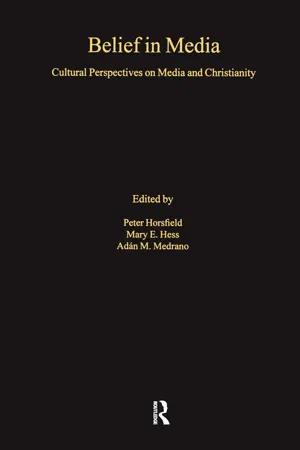
Belief in Media
Cultural Perspectives on Media and Christianity
- 268 pages
- English
- ePUB (mobile friendly)
- Available on iOS & Android
eBook - ePub
About this book
Most works on media developments and Christianity approach the subject from the perspective of the implications of new media technologies for traditional Christian practices or how churches can use new media to further their goals. The common framework of analysis is a 'given reality' of traditional institutional Christianity and how it interacts with, affects and is affected by media. Media are treated as a separate cultural reality. This book presents, in an accessible form, the new directions that approach the interaction of media and religion from a cultural perspective, and illustrates these new directions by a number of international and intercultural case studies and explorations. Looking at how global media are constructing cultural forms, structures and processes, the authors show how these have become the life out of which individual and social meaning is created and practised. Examining how individuals create religious meaning by interacting with media of various kinds, crossing boundaries of traditional religious cultures and contemporary media cultures, this book reveals how Christian institutions are also defined in the process of living culturally within their broader media context.
Information
PART I
THE CULTURAL PERSPECTIVE
Introduction
It is reasonable to say that until recently the relationship between media and religion has not been a large area of research concern. In the modernist sacred-secular dichotomy, media have not been seen as very significant by those whose primary interest has been in the world of the sacred and religious, and issues of religion have not been considered important for those who have been involved in research in the largely secular field of media studies.
What studies there have been of media and religion have tended to be defined by and oriented around the actions and interests of religious institutions or individuals. As Horsfield points out in this section (Chapter 2), these studies operated out of a largely unquestioned modernist framework that conceptualized religion and culture as separate entities, with studies focusing on aspects of their interaction rather than their interdependence. Using largely instrumentalist or narrowly focused theological methodologies, traditional studies of media and religion have concentrated on such things as analysis and critique of (secular) media contents from religious perspectives, media activities of particular religious institutions, and the effectiveness of media uses for achieving particular religious outcomes in areas such as evangelism, propaganda, church growth or education.
That situation has been changing over the past several decades as a result of a number of convergences in theory and research. One has been the growing influence in the latter part of the twentieth century of the European cultural studies approach to media research in the United States. The cultural approach to the study of media has challenged and gradually been assimilated into what has been a much more instrumentalist approach to media research in the US. This approach to culture as belonging to all people rather than just a social élite has broken down some of the singularity of modernist definitions and demarcations and opened the way to study the characteristics of all groups from a perspective of greater complexity of individuals, power relationships, diversity of cultural positions, and various stances of acceptance, resistance, negotiation and subversion of the dominant order. Applying a cultural perspective within the much more ‘religious’ popular culture of the United States has begun to open up new considerations of media and religion from a cultural perspective.
A number of characteristics of the cultural perspective have thrown new light and created new collaborations in the study of media and religion. Those new perspectives and collaborations are reflected in these chapters.
One is the cultural focus on the construction of meaning as central to understanding and researching media and communication. In a production-centered or effects approach to media study, it is assumed that meaning is created by the person or institution producing the message. The study of media then largely involves researching the extent and effectiveness with which that meaning is generated and transferred to those receiving it, and the effects that are brought about as a result. In a cultural perspective meaning is seen as a joint enterprise: a negotiated outcome that comes about through an interaction of the person generating the text, the text itself, the person engaging with the text, and the contextual circumstances in which these occur.
This culturalist concern with meaning has lead to a breakdown in the modernist attempt to separate ‘fact’ and ‘opinion’, the objective and subjective, and created new convergences between the field of media studies and that of religious studies. From an institutional point of view, it could well be argued, as Steve Bruce does, that religion is of declining importance and interest today. Steve Bruce, for example, suggests:
As I shall show below, the religious cultures of different societies have developed in very different ways. However, as a starting-point, we may note that, with the partial exception of the USA ... the pattern of decline in the social significance and popularity of religion sketched above is common to most industrial societies and there is widespread agreement that such evolution is driven by common social forces and hence that a general explanation of secularization is possible (Bruce, 1996).
It’s unknown whether Bruce would argue the same thing since the events of 11 September 2001 and the impact in western countries of Islamic political fundamentalism. The perspective of this book is not necessarily to challenge Bruce’s argument in relation to the decline of religious institutional practices, but rather to explore the fact that the character of religion and religious practice in western countries has significantly changed. One of those major changes has been a shift in religious exploration and practice away from traditional religious institutions into the institutions of the commercial media marketplace.
A second major theoretical shift that has influenced the study of media and religion has been away from the concept of the truths of religion being unconditioned revelations or cognitions towards the realization that understandings and concepts of truth, even religious truths, are constructed and in the process of construction they reflect a power struggle between competing positions and interests. When the element of vested power is introduced into the analysis of religion, it challenges existing religious hegemonies (the claim by some religious groups or institutions that they alone are concerned for the preservation of the integrity of the religion) and opens up new dimensions of questioning, conceptualization and research about how particular religious phenomena have been constructed, how they are perpetuated, and the changes that occur as power relationships change. One of the concerns of this book is to explore in what ways the social structures and practices of religion are changing as a result of the different power relationships created by the development of new electronic, visual and digital media.
The chapters in this section explore the theoretical dimensions of the cultural approach to media and religion in different ways. Lynn Schofield Clark (Chapter 1) from her perspective as a media scholar explores some of the theoretical issues in removing the traditional research boundaries between secular media and religious practice. Peter Horsfield (Chapter 2) follows a historical biographical approach to trace the theoretical shift that occurred during the later part of the twentieth century and issues within it. Roberto Gozuieta (Chapter 3) from a theological perspective examines the implications of taking media and symbolization seriously in theological analysis, with a case study on the practical differences in religious practice that emerge from different symbolic practices. Juan Carlos Henríquez, a film-maker, media producer and academic researcher (Chapter 4), explores questions of epistemology, one of the initial four core issues of the Commission, using science fiction narratives as an example.
References
- Bruce, S. (1996), Religion in the Modern World: From Cathedrals to Cults, Oxford: Oxford University Press.
Chapter 1
Reconceptualizing Religion and Media in a Post-National, Postmodern World: A Critical Historical Introduction
Lynn Schofield Clark
Zimbabwean author Yvonne Vera’s (1993) book Nehanda tells the story of a missionary priest attempting to convert Kaguvi, a leader of the Chimurenga, to Christianity (Landow, 2002). The exchange between the priest and the Shona spiritual leader occurs at the end of the novel, as nineteenth-century colonization has wrought devastation and loss to the Zimbabweans. Kaguvi, rooted in an oral culture, first expresses puzzlement at the priest’s insistence on the importance of the Bible. Yours is a ‘strange’ god who is ‘inside your book’, he tells the priest. In contrast to this book-bound god, Kaguvi says: ‘My god lives up above. He is a pool of water in the sky. My god is a rain-giver. I approach my god through my ancestors and my mudzimu ... My mudzimu is always with me, and I pay tribute to my protective spirit.’ The priest then tells Kaguvi that his Christian god is also ‘in the sky’ but adds that his is ‘the true God. He is the way to eternal happiness.’ Kaguvi is further confused by this claim, as he has never considered the possibility that happiness could be eternal. ‘If a man harvests his crops, that is happiness. If a man marries and has children, that is happiness. If a man talks to his neighbors and they respect him, that too is happiness’ (p. 105). Misconceptions define the encounter between the priest and Kaguvi, highlighting the inextricable relationship between cultural context and religious understanding. Yet Kaguvi is confused rather than offended by the missionary’s words, for despite the priest’s arrogance, he appears to Kaguvi to be sincere in his desire to help him, and Kaguvi finds it hard to believe that the priest is lying or that he is foolish (Grundy, 1999). Ultimately in Vera’s story, Kaguvi is not so much converted to Christianity as he is dissociated from his traditional ancestral spirituality, a loss that comes to symbolize, as Vera’s conversion story itself does, the tragic losses that occurred through Zimbabwe’s encounter with colonization.
The first decades of the second millennium seem destined to be defined by such important reconsiderations of the encounters between cultures and religions around the world as fictionalized in Vera’s story. Nation-states and the relationships between them have been reorganized throughout the twentieth century, with the end of colonial control, the reordering of a global capital market, and the subsequent transformation of the global/local relationship. Meanwhile, the ‘next Christianity’ is emerging in Africa, Asia, and Latin America, with sweeping implications for worldwide practices of faith and the looming possibility of a schism between the liberal North and the conservative South (Jenkins, 2002).
Today we see evidence of what Castells (1989) has termed the ‘dual city’, embodied on the one hand by the cosmopolitanism of information producers, and by the localism of laborers on the other (see also Appadurai, 1996). Nations and the political and economic élite that rule in them have not disappeared but remain powerful entities, of course. As David Harvey (1990) has pointed out, capital accumulation remains the primary organizing principle that influences how nation-states interact with one another, and how people within various locations are situated in relation to labor and capital. While much of the celebratory literature on globalization has hailed the developments of a transnational identity and the benefits accrued to those of privilege (as VISA, McDonald’s, Microsoft and other western products are now truly ‘everywhere you want to be’), poverty has been restructured and exacerbated by a globally networked society as well, and along very familiar lines (Beasley-Murray, 2002). Our world may now be post-colonial, but, as Williams and Chrisman (1996) have reminded us, it is not post-imperial.
Religion often becomes a point of connection and distinction in this context, providing comfort and familiarity among immigrant communities, but at the same time exacerbating tensions. Identification with religion is often viewed by the majority as a disruptive threat to the nation-state. Colonialist approaches to mission work like those of the missionary priest in Vera’s story have been largely delegitimated in this new context, but this is not to say that such drives to conversion no longer exist; they simply play out on different stages. While twentieth-century technologies such as radio broadcasts and satellite television serve as less personally disruptive and more efficient evangelization tools as used by celebrity televangelists from the West, the formerly colonized countries in Africa, the Pacific and Latin America now have their own home-grown versions of such luminaries, as Kwabena Asamoah-Gyadu demonstrates in Chapter 5 of this volume. These areas have witnessed the rise of Pentecostalism, Christian fundamentalisms and Islamicist movements in the past few decades, as relocated and restructured communities are motivated to embrace traditions of their homeland more fervently. In addition to the highly visible and costly uses of television and film, leaders of such movements have employed low-cost audiocassettes and radio broadcasts, reproduced photographs and press coverage to mobilize constituents for both religious and political ends, thereby creating new interactions between politics, religion and identity.
This is the context, then, in which we must begin to reflect on the intersection of media and religion in the world today. In this chapter, I review the history of the study of media and religion, offering a critical review of the field’s development and attempting to highlight how this book represents a step in new directions that reflect the learnings from the new global context of religion and media. I then consider the status of religion and media in the contemporary context, offering a challenge to ...
Table of contents
- Cover
- Half Title
- Dediaction Page
- Title Page
- Copyright Page
- Table of Contents
- List of Figures
- Contributors
- Media, Culture and Religion: An Introduction
- Part I The Cultural Perspective
- Part II Mediated Christianity
- Part III Media Culture and Christian Institutions
- Part IV An Overview
- Bibliography
- Index
Trusted by 375,005 students
Access to over 1.5 million titles for a fair monthly price.
Study more efficiently using our study tools.
Frequently asked questions
Yes, you can cancel anytime from the Subscription tab in your account settings on the Perlego website. Your subscription will stay active until the end of your current billing period. Learn how to cancel your subscription
No, books cannot be downloaded as external files, such as PDFs, for use outside of Perlego. However, you can download books within the Perlego app for offline reading on mobile or tablet. Learn how to download books offline
Perlego offers two plans: Essential and Complete
- Essential is ideal for learners and professionals who enjoy exploring a wide range of subjects. Access the Essential Library with 800,000+ trusted titles and best-sellers across business, personal growth, and the humanities. Includes unlimited reading time and Standard Read Aloud voice.
- Complete: Perfect for advanced learners and researchers needing full, unrestricted access. Unlock 1.5M+ books across hundreds of subjects, including academic and specialized titles. The Complete Plan also includes advanced features like Premium Read Aloud and Research Assistant.
We are an online textbook subscription service, where you can get access to an entire online library for less than the price of a single book per month. With over 1.5 million books across 990+ topics, we’ve got you covered! Learn about our mission
Look out for the read-aloud symbol on your next book to see if you can listen to it. The read-aloud tool reads text aloud for you, highlighting the text as it is being read. You can pause it, speed it up and slow it down. Learn more about Read Aloud
Yes! You can use the Perlego app on both iOS and Android devices to read anytime, anywhere — even offline. Perfect for commutes or when you’re on the go.
Please note we cannot support devices running on iOS 13 and Android 7 or earlier. Learn more about using the app
Please note we cannot support devices running on iOS 13 and Android 7 or earlier. Learn more about using the app
Yes, you can access Belief in Media by Mary E. Hess, Peter Horsfield in PDF and/or ePUB format, as well as other popular books in Theologie & Religion & Asiatische Religionen. We have over 1.5 million books available in our catalogue for you to explore.