- 440 pages
- English
- ePUB (mobile friendly)
- Available on iOS & Android
eBook - ePub
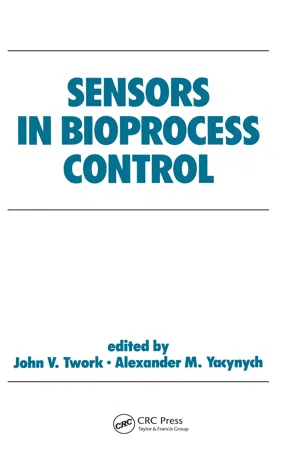
Sensors in Bioprocess Control
About this book
This volume presents the reader with an overview of current chemical sensor technology and outlines a framework relating industrial bioprocess monitoring to modern process control technology. It deals with conventional multivariable control technology, focusing on bioprocess applications.
Information
1
The Needs for Sensors in Bacterial and Yeast Fermentations
BRUCE F. BISHOP Monsanto Corporation, St. Louis, Missouri
STEPHEN J. LORBERT Monsanto Agricultural Company, St. Louis, Missouri
I. Introduction
Recent advances in the field of biotechnology have greatly increased the need for new on-line sensor technology development. Recombinant DNA technology has resulted in the development of complex systems for the expression of heterologous proteins in bacteria, yeast, and mammalian cell culture. Frequently, the cell inserts the protein (protein products) into insoluble “refractile bodies,” or the protein might be so unstable intracellularly that it is degraded by the cell as quickly as it is produced. Ideally, the fermentation is first carried to a high cell density and only then induced by either chemical or physical means to begin production of the foreign protein. In this manner, deleterious effects of the plasmid on the cell during growth can be minimized, and any toxic effects of the foreign protein on the cell will also be minimized.
Typically, these fermentations are composed of two distinct phases: a growth phase and an induction phase. Because of their dynamic nature, the fermentations (with growth rates and rapid doubling times approaching 30 min), new sensor technology must be developed to assist in monitoring and control. The ability to couple sensors to computers will allow sophisticated closed-loop control strategies to be developed which can utilize real-time data to automate and improve the process. The driving force toward higher levels of control will hopefully result in many process improvements, including higher final cell densities, an increase in the amount of product produced per unit of biomass, and sustaining consistent levels of increased productivity. Other benefits of improved control capability might include optimizing use of raw materials and improving product quality, which could dramatically decrease downstream purification costs.
A. Sensors for Cell Density Determination
The ability to monitor biomass concentration in a reactor is an important consideration in process development. In many recombinant systems the process improvement objective is to maintain a consistent level of product expression per unit of biomass and to maintain that level of expression at high cell density, thus increasing product yield. A second objective is to increase the level of product expression per unit of biomass, again maintaining this level of expression at high cell density. In fed-batch fermentations, the critical nutrientes) is(are) fed into the fermenter at, or near, the utilization rate of the organism. In this manner much higher final cell densities can be achieved than in conventional batch processes. The development of sensors to measure biomass concentrations in the fermenter would prove invaluable in the development of stringently controlled nutrient feed strategies. These sensors will be discussed in more detail in Section II. In fermentations of recombinant organisms, many process event markings can be a function of biomass concentration. For example, as the biomass reaches a critical point for induction, it could signal addition of inducer to initiate expression of the desired protein. The possibility of morphological changes in the cells upon induction must be considered in the development of process event markings. In one study with Escherichia coli, investigators found that induction of a foreign gene (i.e., an analogue of human alpha interferon) caused a breakdown in the correlation between culture turbidity and dry cell weight [1]. The breakdown appeared to be caused by the dramatic increase in cell size as it produced high levels of the recombinant protein. Prior to induction of alpha interferon there was a very good correlation between culture turbidity and dry cell weight. If these phenomena prove to be reproducible from batch to batch, computer control algorithms could be designed to use biomass data for process control during the induction phase of the fermentation. Further, as the fermentation becomes characterized and reproducible, deviations from established growth profiles may also serve as indicators of contamination.
Due to the absence of any method to determine biomass concentration on-line, many off-line procedures are used to measure wet cell weight, dry cell weight, viable cell count, and optical density [2–4]. These methods can yield different results, depending on the method used and on operator technique. Samples must be removed from the fermentor for assay off-line. Because of the time required to generate assay data off-line and because of the dynamic nature of these fermentations, matching control actions corresponding to critical time points in the fermentation will be very difficult, if not impossible to achieve. Instruments have been designed to automate sampling and measurement of culture turbidity. These systems involve either continuous or semicontinuous removal of fermentor broth to a dilution chamber where the culture is diluted to within the linear range of the spectrophotometer (usually 0.1–0.6 optical density units measured at 550 nm). The diluted sample is then automatically injected into the spectrophotometer for measurement. Major problems are encountered with fouling of the instrument tubing and orifices, bubble interference with the measurement, and the sterility of sampling, which can result in culture contamination.
A variety of novel technologies are being investigated for use in biomass monitoring. Laser technology and acoustic characteristics of biomass are being used to develop noninvasive sensors which would circumvent the major sensor disadvantages of sterilization/contamination and on-line calibration. A review by Clark et al. [5] discusses these and other physical and biochemical principles on which new sensors might be based. The authors highlight techniques utilizing dielectric potential of microorganism membranes, infrared spectra of cultures, antibody-specific immunosensors and polarization of chiral structures such as DNA within the cell.
Probably one of the most promising areas of biomass sensor development is in the area of spectrofluorometry of cellular cofactors, such as reduced nicotinamide adenine dinucleotide (NADH). NADH is oxidized to NAD+ during oxidative phosphorylation for the production of energy-rich ATP to drive other metabolic pathways [6]. When irradiated with light at 340 nm, NADH fluoresces at 460 nm while oxidized NAD+ does not fluoresce. Duysens and Amesz [7] showed that culture fluorescence could be changed by altering the metabolic state of baker’s yeast. Fluorescence profiles have been shown to be indicative of metabolic activity in yeasts and bacteria in a variety of fermentation systems [8–10]. The relationship between culture fluorescence and biomass concentration has been shown to have very good correlation [11], particularly in logarithmically growing cultures at relatively low cell density. Fluorescence technology has resulted in the development of commercially available fluorometers for biomass monitoring and are presently being evaluated in high cell density fermentations in industrial processes.
B. Sensors for Fermentation Medium Analysis
On-line compositional analysis of fermentation broth will allow the fermentation technologist to obtain critical information needed for process optimization. Sensors designed to monitor substrate concentrations could be used to calculate substrate utilization rates. Matched feeding of substrate to the organism’s utilization rate would maximize growth and product formation. The need for stringent control of residual glucose concentrations in the broth have been shown to be critical for high product yields in recombinant strains of E. coli [12] and Saccharomyces cerevisiae [13,14]. In addition, the production of deleterious metabolic by-products such as organic acids in bacteria and ethanol in yeast could be minimized with sensor-based control.
Electrochemical Sensors
The lack of on-line sensors to detect sugars and other metabolites has led to the development of novel electrochemical sensors for use in fermentation. These sensors contain immobilized enzymes on an electrode to perform the analysis. Immobilized microorganisms are also being considered for use in the development of electrochemical sensors for monitoring fermentation broths [15–17]. In a review by Twork and Yacynych [18], the authors list several advantages of electrochemical sensors:(a) selectivity is high, even in turbid solutions; (b) the sensors can function over wide ranges of concentrations of the chemical; (c) they can be used to monitor a wide range of medium components, including organic acids and ethanol; and (d) electrochemical sensors are relatively cheap and easy to operate. Electrochemical sensors have several disadvantages that prevent their use in situ. They are not steam sterilizable and must be incorporated into automated off-line analysis methods, resulting in long lag times for assay. Contamination risks and plumbing fouling are also potential problems in these systems. Enzyme analysis of certain components requires assay conditions outside of physiological limits, e.g., ammonium ion control with an ammonia electrode at pH 11.0–11.5 [19]. These analyses must be performed outside the fermenter. On-line calibration of probes and stability of the enzymes or microbes present additional problems. A number of investigators have developed automated analysis systems utilizing enzyme sensors [20–22]. Oguztoreli et al. [23] have developed a mathematical model for optimizing substrate concentrations in fermentation broths with a separated sensor. Attempts are being made to develop novel technologies to minimize the problems associated with off-line automation. These approaches have been discussed [18], and include the use of selective, sterilizable membranes for providing assay material to the analyzer, chemically sterilized sensors, and, possibly, developing more stable enzymes.
High-Performance Liquid Chromatography (HPLC)
HPLC is a well-known, routine technique for the separation, identification, and quantitation of chemical and biochemical compounds. A method has been developed to interface an HPLC with a fermenter for continuous on-line monitoring of fermentation broths [24]. A cross-flow membrane device is used to provide cell-free broth to the HPLC for analysis. Depending on the chromatography column configuration used, this “sensor” can be used to monitor levels of sugars, alcohols, organic acids, or extracellular protein concentrations. By monitoring protein concentrations in the broth, an on-line HPLC could be used for event markings such as process end-point determinations. An on-line HPLC system is commercially available for industrial applications at costs approximately equal to conventional HPLC systems. The added advantage of this system is that it can...
Table of contents
- Cover
- Half Title
- Series Page
- Title Page
- Copyright Page
- Series Introduction
- Preface
- Table of Contents
- Contributor
- Half Title
- 1 The Needs for Sensors in Bacterial and Yeast Fermentations
- 2 Sampling
- 3 On-line Monitoring of Bioprocesses Using HPLC
- 4 High-Performance liquid Chromatography
- 5 Applications of NADH-Dependent Fluorescence Sensors for Monitoring and Controlling Bioprocesses
- 6 Fiber-Optic Sensors in Bioprocess Control
- 7 Applications of Electrochemical Sensors
- 8 Electrochemical Biosensors for Bioprocess Control
- 9 Thermistor Probes
- 10 Flow Injection Analysis in Bioprocess Control
- 11 The Use of On-line Sensors in Bioprocess Control
- 12 Multicomponent Analysis and Chemometrics for Bioprocess Control
- Index
Trusted by 375,005 students
Access to over 1.5 million titles for a fair monthly price.
Study more efficiently using our study tools.
Frequently asked questions
Yes, you can cancel anytime from the Subscription tab in your account settings on the Perlego website. Your subscription will stay active until the end of your current billing period. Learn how to cancel your subscription
No, books cannot be downloaded as external files, such as PDFs, for use outside of Perlego. However, you can download books within the Perlego app for offline reading on mobile or tablet. Learn how to download books offline
Perlego offers two plans: Essential and Complete
- Essential is ideal for learners and professionals who enjoy exploring a wide range of subjects. Access the Essential Library with 800,000+ trusted titles and best-sellers across business, personal growth, and the humanities. Includes unlimited reading time and Standard Read Aloud voice.
- Complete: Perfect for advanced learners and researchers needing full, unrestricted access. Unlock 1.5M+ books across hundreds of subjects, including academic and specialized titles. The Complete Plan also includes advanced features like Premium Read Aloud and Research Assistant.
We are an online textbook subscription service, where you can get access to an entire online library for less than the price of a single book per month. With over 1.5 million books across 990+ topics, we’ve got you covered! Learn about our mission
Look out for the read-aloud symbol on your next book to see if you can listen to it. The read-aloud tool reads text aloud for you, highlighting the text as it is being read. You can pause it, speed it up and slow it down. Learn more about Read Aloud
Yes! You can use the Perlego app on both iOS and Android devices to read anytime, anywhere — even offline. Perfect for commutes or when you’re on the go.
Please note we cannot support devices running on iOS 13 and Android 7 or earlier. Learn more about using the app
Please note we cannot support devices running on iOS 13 and Android 7 or earlier. Learn more about using the app
Yes, you can access Sensors in Bioprocess Control by John Twork in PDF and/or ePUB format, as well as other popular books in Tecnologia e ingegneria & Biotecnologia. We have over 1.5 million books available in our catalogue for you to explore.